


Minuit
-
Posts
5139 -
Joined
-
Last visited
-
Days Won
13
Content Type
Profiles
Forums
Gallery
Everything posted by Minuit
-
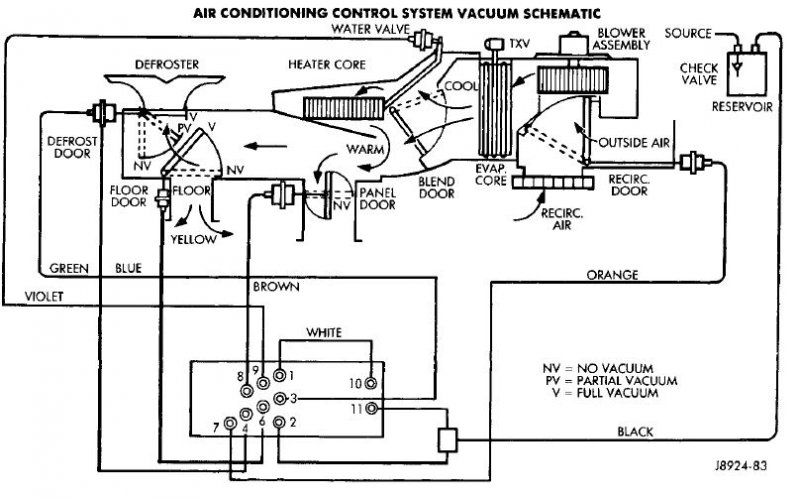
Pete asked about it, so here's a little something. This will be part of an appendix of the final AC writeup. I put this together because I had the time to, and because I personally wanted some answers. This is the writing style I plan to use for the entire thing. If there's any questions, comments, concerns, cries of outrage, or calls to action you have after reading this, let me hear them. My free time is about to take a nose dive, because I'm starting a new job and it's been hectic. I hope to have a table of contents fairly soon. I may release the writeup in chunks, or I might put the whole thing out one day all of a sudden. Not sure. The Heater Control Valve For as long as there have been Jeep forums, one of the most common pieces of wisdom you'll see thrown around is "get rid of the heater control valve and throw it in the trash". It's a 30 year old piece of plastic with coolant flowing through it, so it presents a definite possibility for leaks. I threw mine away several years ago on this advice. However, Jeep wouldn't have installed it for the first 12 years of the XJ's run if they didn't have a reason for it. That reason is very much connected with the subject of this writeup, so let's take a look at it. Why worry about any of this? Let's look at a diagram of the MJ's HVAC system. (source: 1990 Jeep factory service manual) The A/C evaporator is the first thing the air passes through after leaving the blower motor. This is to provide dried air (via the A/C evaporator) no matter the blend door position - very useful when defrosting the windows, and if the driver would prefer to have dry heat in the cab. Unfortunately, that means that everything that happens to the air after it leaves the evaporator is out of the A/C's hands. Even if you want the coldest possible air, the cold air still has to pass through the rest of the HVAC box and out to the vents, in relatively close proximity to the heater core. If coolant is flowing through the heater core, the heater core will be very hot, and it will warm up everything around it. As it flows through the hot ducting, the air will warm up a little. The heater control valve was Jeep's solution to this problem. When the driver commands the coldest air possible, the valve closes and prevents hot coolant from flowing into the heater core, which prevents the heater core from warming up the surrounding duct work. Since even cold air has to pass right next to the heater core, this can and does make a difference to A/C performance. Even if you don't have A/C, not having any hot coolant flowing through the interior will help keep cabin temperatures down. The valve is closed in the "OFF" and "VENT" positions. In all other positions, the valve is closed any time the temperature selector is in the "full cold" position. So, let's put some numbers to this. To simulate a working heater control valve, I bypassed my heater core and went for a ride. To summarize my results, all else being equal the air at the vents with the core bypassed is between 3 and 7 degrees cooler when the truck is at operating temperature. These measurements were taken on two back to back days at a temperature of around 83 degrees. In the world of A/C performance, seven degrees is a big difference. It can separate a "decent" system from a "good" system. In my case, this allowed for air in the high 30s at speed on an 83 degree day. I live in the humid South, and I want all of the A/C performance I can possibly have, so a seven degree improvement is worth the effort. After this test, I've changed my stance on keeping the valve. If you are interested in maximizing your A/C performance, I suggest that you keep the heater control valve, and replace it if it is leaking. The valve is still available in the aftermarket and you may be able to find Mopar valves in inventory. The 1991 and later part number for 2.5L and 4.0L engines is 56005900. The 87-90 part number is 52003226 for 4.0L engines, 56002522 for 2.5L engines, and J3222290 for the 2.1L diesel engine. For an open cooling system, use the later part.
-
That will be an appendix to the final A/C write-up. There's a thread about it somewhere in the pub.
-

Is a renix to obd1 swap worth it?
Minuit replied to onebigmj's topic in MJ Tech: Modification and Repairs
No. I don't really think a Renix to OBD 2 swap is worth it. -
Saw my first Gladiator on the road a couple of weeks ago. I was driving my MJ at the time and the guy driving the Gladiator waved at me. That was neat. I don't really care about the Gladiator itself though. They look even longer in real life than they do in the pictures.
-
R12a Evacuation/Recharge
Minuit replied to caseyrstewart's topic in MJ Tech: Modification and Repairs
Should be easy peasy to get the compressor out. It's right on top. Remove the belt, remove the two lines (evacuate the system first), and the electrical connector. On my truck there is 4 bolts holding it on. I think it's the same on yours. And you're correct, this is my preferred way to get a glimpse at the system's health on an expansion valve system. You'll get a look at the oil level, oil cleanliness, and compressor health. The compressor normally holds the most oil out of all of the components. It's distributed throughout the system (it circulates through the system with the refrigerant) and when there's no refrigerant left to carry it around it settles in a component. Out of a total system capacity of 8 oz of oil, I'd expect the compressor to have between a third and a half of it. As long as you drain more than a couple of ounces out of the compressor, I'd say not to worry. The FSM says to add an ounce more than you drained out, and I'd consider that a good rule of thumb. You've read correctly. In an ideal world, you'd replace the drier every single time you open the system. You know that you've got at least one leak to fix, so it would be a waste of a drier to replace it when you know the system will leak itself empty in short order again. The mineral oil is the only oil used in an R-12 system, and yes there is only one kind of oil in a given system. The compressor doesn't have an "oil tank" - it relies on the refrigerant to carry the oil through it. That's the only reason we have oil in the system - to lubricate the compressor as the refrigerant moves through it. That's the only type of oil in your system. Once the system is charged and in use, it all mixes together. As far as I can tell, the selling point of Red Tek 12a is that it mixes with any refrigerant oil, making it usable in even a virgin R12 system. It's important to know, for anyone else who's reading this: the oil used depends on the refrigerant. Mineral oil mixes with R-12, which is why it's used in R-12 systems. When we moved over to R-134a, that caused a problem because R-134a does NOT carry mineral oil through a system. It has to use a different type of oil - usually, PAG oil but sometimes POE oil. There are a few different viscosities, which one is determined by the compressor. -
R12a Evacuation/Recharge
Minuit replied to caseyrstewart's topic in MJ Tech: Modification and Repairs
That dye kit will work. It'll have everything you need, including an injector. I have no idea if you can use it like a regular oil injector, but it would get the job done for just injecting dye - wouldn't be my first choice if you plan to work on A/C with any regularity though. I use one of these for adding oil and dye. A little pricy, but it's a lot more flexible. You can fill it up with whatever you want and inject it into either an empty or charged system. To go with that, I bought a cheap kit at O'reilly with a UV light and some UV blocking glasses. They work fine. https://www.amazon.com/FJC-2732-Hand-Turn-Injector/dp/B001T9AREK/ref=sr_1_6?keywords=fjc+oil+injector&qid=1560104546&s=gateway&sr=8-6#customerReviews Also - there's a pretty good chance that you're low on oil, especially since you went from cold to warm air in a couple of days. If I were working on this system, before I did anything else I would remove the compressor and drain/refill it of oil, as a sanity check more than anything else. If there's no oil in the compressor at all (I've seen it once or twice), that's bad and you wouldn't have known if you didn't check. The condenser would've had about 1oz of oil in it, and the leak probably caused some oil loss as well. I don't know if the 5-cylinder Sanden compressors have the same problem, but the 7 cylinder compressors on the 91 and later trucks love to leak oil out of the front seal. After you fix the leaks (and as the very last step before you put the system into permanent service), you will want to replace the receiver-drier. When you do that, you'll want to add an additional ounce of oil. Also, any time you disconnect an o-ring, replace it. Get an assortment of HNBR o-rings. I also like to go on RockAuto and order a couple of o-ring assortments for the vehicle in question, just to have some spares (and in case there's funny sizes of o-rings) https://www.amazon.com/Performance-Tool-W5201-Ring-Assortment/dp/B0002KO1XK/ref=sr_1_3?keywords=hnbr+o+ring&qid=1560106667&s=automotive&sr=1-3 When you drain the compressor out, if there is more than a couple of ounces of oil in it, the FSM recommends adding one ounce more than you drained out. If there's a LOT of oil in it (like 6oz or more), the system has way too much oil in it and that's a problem too. It'll also get some of that stop leak out. I'd recommend yanking the compressor off and doing this before you charge again, just to make sure the system HAD oil in it, and to make sure that the compressor has the best possible chance of living a long life. If the compressor is easy to remove (as it is on an MJ), I do this any time I'm working on a system that's new to me. Replacing the existing oil with new oil isn't a bad idea anyway. A little too much oil won't hurt, but it will hurt the cooling efficiency a little. Too little oil is REALLY BAD and will turn your compressor into glitter in no time. Unfortunately, there's no dipstick for checking your A/C oil. Removing the compressor and draining/refilling it is the next best thing. Since you're using 12a and it sounds like you want to keep using it, you'll add mineral oil to the system any time you add oil. That's what it would've originally come with, and IMO one of the few reasons to use it is that it will mix with the mineral oil. Here's a lifetime supply for 20 bucks. https://www.amazon.com/ACDelco-15-117-Conditioning-System-Mineral/dp/B00171UV82/ref=sr_1_1?keywords=ac+mineral+oil&qid=1560105899&s=automotive&sr=1-1 $13 a can isn't as bad as I thought it would be, but you still won't want to blow through a full charge of it every week. Once you've done the above, vacuum it down again and charge with 2 cans of 12a and 1/4oz or so of dye and see if you can pick out where the leak is. More likely than not it'll be an o-ring on one of the connections. -
R12a Evacuation/Recharge
Minuit replied to caseyrstewart's topic in MJ Tech: Modification and Repairs
A/C work is not easy, and you should be commended for being willing to stop and learn now that you're starting to see how deep of a rabbit hole you've fallen into. The UV dye will mix with the oil and circulate through the system. I've never heard of it causing problems in systems. In fact, a lot of factory charges (GM comes to mind) include dye. Once your system is proven to be solid, you don't need it anymore. Adding too much oil(or dye) will reduce the cooling capacity, and WAY too much oil can slug the compressor. It won't take much dye to show a leak. It's very, very concentrated. Just make sure you use dye for use in A/C systems, because it has to mix with the refrigerant and oil. On a recent job on a friend's Chevrolet half-ton pickup, I used 1/4oz of dye in a system that holds 35 oz of R-134a and I believe 7 oz of oil. I told him to use the A/C as much as possible and come back when it stops working. It showed the leaks just fine, and the system is working great 3 weeks after fixing the leaks. As for compressed air, I wouldn't. Compressed air will have some degree of moisture in it, and moisture is really bad for the system (that's the point of the receiver/drier, and why you should replace it immediately before the system is closed). Dry nitrogen is what I hear about being used most. If you don't have that, dye with the refrigerant is the most obvious way to pinpoint a leak. As much as I hate charging a system I know leaks, it's the best way if you don't have access to a cylinder of dry gas. Yes, you'll need more refrigerant to get it working again. You're not going to get rid of the stop leak except by flushing every single component, so we're going to have to live with that I guess. If your air is warm again after only a couple of days, it's a big leak that will be very, very obvious using dye and a UV light. I'm having a hard time finding price info on this 12a stuff. Is it expensive? This kind of thing is why I honestly prefer 134a - I'll just tell a customer to stop by Walmart on the way here and pick up however much they need for $5 a can. -
Welp, guess I'm going to paint my door handle screws now.
-
Here's a link to a study done by the DOT in 2006 that gives an estimate that 12.1% of 25 year old light-duty trucks are still on the road. https://crashstats.nhtsa.dot.gov/Api/Public/ViewPublication/809952 They give the exponential regression formula on page 6. I plugged in 28 years (for 1991) and got a survival rate of 9.6%. 9.6% of however many MJs they made in '91 is... not very many. Us Comanche fanatics are part of a slowly but surely shrinking group.
-
Lifter Tapping?Piston slapping? Any advice?
Minuit replied to MT Jeep's topic in MJ Tech: Modification and Repairs
I hear an exhaust leak too, but the tapping sounds too sharp and metallic for it to be an exhaust leak, to my ears anyway. If it was an exhaust leak, you'd know because it would be much louder under throttle, especially in high gear and high engine load. An exhaust leak might sound like a "click" but it will have a definite tone of air escaping to go along with it. -
R12a Evacuation/Recharge
Minuit replied to caseyrstewart's topic in MJ Tech: Modification and Repairs
250 PSI... at what temperature? With what refrigerant? If I saw 250 PSI on a 134a system when it's 90 degrees outside, that's a perfectly good pressure. If it was 65, different story entirely. If it was 110, that's a probable undercharged system. I did the math for the OP and found that he's approximately at system capacity considering the refrigerant he is adding. Continuing to add more refrigerant will quickly overcharge his system. I looked at the OP's post history and found that he's located about an hour from me. Neat. My fitbit tells me it's 75 today. 250 PSI is very high for 75F ambient on R-134a, and if he were on R-134a that number would indicate a significantly overcharged system or poor condenser performance. Please don't tell people to overcharge their system. -
R12a Evacuation/Recharge
Minuit replied to caseyrstewart's topic in MJ Tech: Modification and Repairs
Alright, @caseyrstewart, let's go in order of what you said. Dropping 3 inHg in an hour is a considerable leak somewhere between the manifold gauges and the atmosphere. A "solid" system should be able to hold 30 over night if the gauges are also leak-free. If it's in your system, it's a considerable leak, and it'll probably vacate the charge within a few weeks at that rate. I doubt the stop leak product will fix it, and if it does, I very much doubt it will be a permanent fix. If I were working on this system, I would want to get the stop leak out as fast as I could and start over. The correct way to find out where the leak is is by using UV dye. The dye mixes with the oil and will accumulate around the leak. For a large leak, it's visible with the naked eye, but smaller leaks will require a UV light and UV-blocking glasses to see for sure. You indicated a 20 PSI low side pressure. Let me just get this out of the way - charging by pressure in an automotive system is bull$#!&. Charging by low-side pressure only is even stinkier bull$#!&. The instructions that Red Tek provide are on the level of those "A/C PRO INSTANT FIX MEGA ULTRA ICE" cans of garbage from Autozone, and I'm sorry that those crappy, borderline dangerous instructions were what you had to go by and you thought you were doing a good thing by following them. In automotive systems, we charge by weight. These specs are usually fairly easy to find on the internet. If we're using a different refrigerant than the original, the charge weight will be the original multiplied by a conversion factor that depends on the refrigerant. I don't have an '87 FSM handy, but the number I found for your system was 36oz of R-12 and 8oz of mineral oil. Red Tek's conversion factor is 0.33 oz of their stuff to one oz of R-12. That means you need one pound of 12a (and my mistake, it's just "Red Tek 12a", it's not R-12a) in the system, so by pure luck you're probably at about the right charge weight including the other things you added, maybe slightly overcharged. You'll lose some in the gauges, so you're probably at approximately the right charge. Now, an expansion valve system like our MJs have should be very good about keeping the compressor running. My '91 will keep the compressor on almost all of the time at high fan speed. Does it stay running, or does it cycle the compressor? Some cycling is fine, but it should be able to keep the compressor running especially at high fan speed. To glean any real information on how the system is running we need the high side pressure too. In the future, tell us both of these pressures. In fact, that's where your cooling comes from - the pressure drop at the expansion valve. With the compressor on, what are you seeing on the high side gauge? We'll also need to know the ambient temperature, and it's best if you give us this reading with the engine as cool as possible. This number DEPENDS on the temperature, so we really need to know that -
Hey, if someone's willing to provide me with the funds and space to store all of these MJs that would appear, I'd be glad to!
-
Sometimes it's little things that you'd never think would be that hard to find too. I've been looking for a center console insert with a power mirror switch for almost a year now. Haven't been looking too hard, but I haven't seen a single 96 or older XJ in the yards with power mirrors in a very long time. MJs are getting to the age now where having the kind of plans I have is starting to be expensive.
-
R12a Evacuation/Recharge
Minuit replied to caseyrstewart's topic in MJ Tech: Modification and Repairs
We're going to need a lot more info here. A/C is not something you can just dive into, it's a precise field and we need all of the details you can give us. Have you ever worked on automotive A/C before? What year and engine is the vehicle? Has the system been previously converted to R-134a or is it a virgin R-12 system? Did the system hold ~30 inHg vacuum for at least one hour? Did you remember to open up the service valves? How do you know the compressor works? Did you verify that there isn't a bunch of metal shavings in the system? What brand are these manifold gauges? Are you familiar with how to use them? Is this 20 PSI on the high side, low side, or both? Is the compressor engaging? I am assuming here that it is not engaging. Did you open the service valves? Those have to be manually opened after the gauges are connected. The can should get cold and stay cold while you're attempting to charge. If it isn't getting cold and staying that way, the system is not taking refrigerant. Before you do anything else, you need to stop shoving stuff blindly into the system. You charge by weight, not pressure. Get a scale. A food scale is fine. Add oil with an oil injector, or if you hate yourself, by pouring oil into the service hose a little at a time. Measure that out too. I hate those stupid oil charge cans. Replacing the condenser and drier will require more oil than is in one of those anyway. What type of oil and what viscosity was in the oil charge cans? Also, I wish you wouldn't have stop leaked your system. It's tainted for life now. Hopefully you just forgot to open the service valves and none of it actually made it into the system. If you have a leak, you have to find it and fix it properly. I don't know what this R-12a stuff is, but I imagine it's probably some blend of hydrocarbons that hopefully mixes with mineral oil. There will be a charge weight conversion factor for it. With R-134a, the charge weight is roughly 80% of the R-12 charge weight. I don't know what it is for R-12a, but you have to weigh it out. It should say on their materials somewhere what that conversion factor is. If not, it's even sketchier than I thought. I think there's something else going on here. If you can't keep the system above 20 psi you have a GROSS leak that would be shooting refrigerant all over the place and it would probably be pretty loud. With all of the stuff you put in there you should have more than 20 psi, again assuming that this is a static reading and that the compressor does not engage. If the compressor is engaging and you see a low side pressure of 20 psi with the compressor running, that's an entirely different situation. Once again, with A/C you really need to tell us everything you can tell us. Better yet, take a video of what's going on on the gauges and with the truck. -
You'll want to remove the surface rust and cover it up with something to keep it from getting worse (and not just primer either, it attracts moisture) while you're waiting to have it painted.
-
Although I wonder what it'll be like to find sensors for an MJ in 30 years, I wonder a lot more about the technology on the interior, and what it'll be like trying to find a working touch screen for a modern car in 30 years. I wonder what kind of life expectancy your average "infotainment system" in a new car has. If it's anything like a smartphone or laptop, once it hits about 8 years old it's absolutely ancient. Don't even get me started on the car radios that have spinning hard drives inside of them, although I hope there isn't anyone in 2019 still putting a spinning hard drive inside of a car radio. As a side note, car electronics of today will NOT age well. The infotainment systems in 10 year old cars are so slow and unresponsive by today's standards that they're practically unusable. Meanwhile I'm surrounded by 30 year old radios that still do the same job just as well as they did on day one. One of these days I'll probably end up having to buy a car with a screen in it, but I won't be happy about it.
-
The ZJ discs are as easy as it gets on the Dana 35 with C-clip. The only modification to the axle needed there is longer rear studs. On a D44, my understanding is there is no "direct bolt on" swap like with the D35. They all require some modification to the backing plate and/or preload spacers for the bearings.
-
Ah yes, I forgot to mention. For the heater core bypass test, I did all of my measurements on NORM (so that it's cooling the 80-ish degree outside air rather than the ??? degree air inside the truck) on the second fan speed. On both days, it was between 80 and 85 degrees outside. Max makes the air slightly colder (and cools faster because it's recirculating) but makes nowhere near as much difference as bypassing the heater core made. I wanted to keep things simple and consistent for this test. Max A/C at the highest fan speed makes the truck into a meat locker and keeps the compressor running almost all the time. I love it!
-
Plug and play. If you have idiot lights for temperature and oil pressure, you'll need to switch out the temperature and oil pressure sending units to ones that are for gauges.
-
Bypassed my heater core, to test whether or not the heater control valve had an effect on A/C performance. Turns out, that yes it does, and yes, there were reasons for Jeep to include it that become apparent once you want some really cold air in your MJ. I always knew there was some change, but I had no numbers to back it up. Here's the first draft of one of the pieces I'm working on for the coming-soon A/C writeup. The Heater Control Valve For as long as there have been Jeep forums, one of the most common pieces of wisdom you'll see thrown around is "get rid of the heater control valve and throw it in the trash". It's a 30 year old piece of plastic with coolant flowing through it, so it presents a definite possibility for leaks. I threw mine away several years ago on this advice. However, Jeep wouldn't have installed it for the first 12 years of the XJ's run if they didn't have a reason for it. That reason is very much connected with the subject of this writeup, so let's take a look at it. Why worry about any of this? Let's look at a diagram of the MJ's HVAC system. (source: 1990 Jeep factory service manual) The A/C evaporator is the first thing the air passes through after leaving the blower motor. This is to provide dried air (via the A/C evaporator) no matter the blend door position - very useful when defrosting the windows, and if the driver would prefer to have dry heat in the cab. Unfortunately, that means that everything that happens to the air after it leaves the evaporator is out of the A/C's hands. Even if you want the coldest possible air, the cold air still has to pass through the rest of the HVAC box and out to the vents, in relatively close proximity to the heater core. If coolant is flowing through the heater core, the heater core will be very hot, and it will warm up everything around it. As it flows through the hot ducting, the air will warm up a little. The heater control valve was Jeep's solution to this problem. When the driver commands the coldest air possible, the valve closes and prevents hot coolant from flowing into the heater core, which prevents the heater core from warming up the surrounding duct work. Since even cold air has to pass right next to the heater core, this can and does make a difference to A/C performance. Even if you don't have A/C, not having any hot coolant flowing through the interior will help keep cabin temperatures down. In Renix-era models, the valve is closed in the "OFF" and "VENT" positions. In all other positions, the valve is closed any time the temperature selector is in the "full cold" position. In HO models, the valve is closed only when the temperature selector is in the "full cold" position. At all other times, the valve is open and coolant flows freely through the heater core. So, let's put some numbers to this. To simulate a working heater control valve, I bypassed my heater core and went for a ride. To summarize my results, all else being equal the air at the vents with the core bypassed is between 3 and 7 degrees cooler when the truck is at operating temperature. These measurements were taken on two back to back days at a temperature of around 83 degrees. In the world of A/C performance, seven degrees is a big difference. It can separate a "decent" system from a "good" system. In my case, this allowed for air in the high 30s at speed on an 83 degree day. I live in the humid South, and I want all of the A/C performance I can possibly have, so a seven degree improvement is worth the effort. After this test, I've changed my stance on keeping the valve. If you are interested in maximizing your A/C performance, I suggest that you keep the heater control valve, and replace it if it is leaking. The valve is still available in the aftermarket and you may be able to find Mopar valves in inventory. The 1991 and later part number for 2.5L and 4.0L engines is 56005900. The 87-90 part number is 52003226 for 4.0L engines, 56002522 for 2.5L engines, and J3222290 for the 2.1L diesel engine. For an open cooling system, use the later part.
-
Anyone on here able to make more of these ?
Minuit replied to Strokermjcomanche's topic in MJ Tech: Modification and Repairs
Yep, I'd totally be in for some of these if someone ends up making them. -
Driveway Ornament To Daily Driver: 7 Years!
Minuit replied to Minuit's topic in Member Projects: Your Comanches
Now, I don't really have enough time or material to come up with a full update, which will happen later. However, I do have time to share some snippets. 7.033 Month A/C Update A/C is still doing the thing. Pressures still look good and the air still feels cold. Not much else to say... yet. I'll be putting together a writeup on HVAC theory and service procedures at some point in the indeterminate future. I might have to deal with a leaky valve core in the future, because the last time I put gauges on, one of the service valves took some fiddling to seal. Perfect chance to demonstrate a tool that I think is just the coolest thing in the world. Circuit Boards! My circuit boards are finally here, and they look much better than expected. I was expecting cheap crap like you'd find inside your average knockoff eBay electronics, so when I opened the package up these absolutely blew my mind. This run was mainly to test shipping times and quality. I've since made some improvements to the circuit design and layout, so I'll need to make another run of boards. I am still learning the dark magic of printed circuit board design, after all. Remind me to pony up for real shipping next time, because these took almost a month and a half to get here. Of course, now that they're here I have no time and no parts to put them together, so maybe it's for the best... Next time on Driveway Ornament to Daily Driver, I'll... Bypass a perfectly good heater core... Install some pre-owned brake parts... ... and take out the trash. -
If this is meant to be an art piece, I am not entirely sure what kind of message they want to send or what kind of emotions they're trying to evoke in me.
-
I found a Jeep/Eagle accessory catalog circa 1991 on eBay for sale once. It was a big thing I think with a lot of pages with part numbers. Been kicking myself ever since about not buying it. One of these days I'll finish my dealership brochure collection.