


gogmorgo
-
Posts
5984 -
Joined
-
Last visited
-
Days Won
4
Content Type
Profiles
Forums
Gallery
Everything posted by gogmorgo
-

Online Library for Manuals and Catalogs
gogmorgo replied to Manche757's topic in Forum Issues, Ideas, Testing
Check the DIY index. There are some manuals to be had in there. -
Make that 200%. That's how percentages work, right? Sorry I can't actually offer you any forum advice, though. I will say that whatever it is Pete's got going on seems Pretty Friggen Awesome.
-
Yeah... I mean with so many places offering free shipping I can sorta understand it, but still. Half the parts I order online I end up paying almost as much again in shipping, then there's always a chance of getting stung again for duty at the border. And most carriers seem to have figured that one out and automatically charge a brokerage fee now, even though there's only about a 0.5% chance of CBSA actually opening your box and you getting charged duty.
-
clutch No clutch and black fluid in reservoir
gogmorgo replied to Foffett's topic in MJ Tech: Modification and Repairs
Old brake fluid like what you might find in a clutch that hasn't had the fluid changed out for many years can be quite dark. It's incredibly unlikely oil from a rear main leak is making it into the slave cylinder. If if there's nothing wrong with the Peugeot trans itself, just the clutch, if you just want to get it driving ASAP I don't see anything wrong with just changing out the leaking slave cylinder. But it wouldn't be bad to have the external slave ax15 ready to swap in the next time the trans needs to come out if that's the way you want to go. But yes, the engine and trans need to be separated to get the slave cylinder out, so either the engine or trans needs to come out, the transmission is going to be less work. Not every engine oil leak that looks like a rear main seal leak is actually coming from the rear main, in fact most don't. Common leaks are the oil filter adapter, distributor gasket, and valve cover gasket. Because the engine sits tilted back, almost every leak ends up running down the oil pan mounting surface and back, making it look like a rear main leak. -
Truck bucks like a horse at 2500rpms for some reason
gogmorgo replied to Deleted's topic in MJ Tech: Modification and Repairs
The heat of the cat causes the rust, that and the water that is a combustion product. Even if the cat isn't rusted out though, 33 years down the road it's probably not doing much for you anymore anyway. -
HO spark plugs in a Renix
gogmorgo replied to DirtyComanche's topic in MJ Tech: Modification and Repairs
There was a head redesign between HO and Renix. While I can't state with certainty, I imagine the shift in plugs would be related to how they sit in the combustion chamber. If the HO plugs stick out that much further due to the longer electrode, they'd see higher temperatures, hence the need for a hotter plug. I've never had a Renix head off so don't really know what they've got going on. As I'm sure Dirty knows (but I'll point out for others) the heat range of a spark plug doesn't produce a "hotter" spark or affect combustion temperatures, it's just the heat tolerance of the plug itself. -
The sulfur content is a much more long term corrosion issue than that. The factory recommended gl5 gear oil won't immediately trash your synchros like that. Many people have gotten away with running it for the long term. Jeep's solution was just to recommend running synthetic 10w30 engine oil in the ax15, which works fine (I have it in my ZJ) but if there's a small amount of damage done already a modern oil intended for manual transmissions will probably do a better job. What you're looking for is that it's safe for yellow metals and that it has a weight somewhere around 75w90. You may have to do some digging to uncover this info, but it's pretty much a guarantee with any name-brand manual trans oil. As far as running engine oil in it, many people will have concerns that it's too thin, but that's not the case. The weights were deliberately standardized on different scales to help avoid confusion between gear oils and engine oils. 75w90 and 10w30 are close enough in viscosity not to worry about. Synthetic is important due to lubricity – my understanding is manual trans oils rely on the deposition of additives onto the synchros for smooth operation, but engine oils don't have those so you're relying on the the oil itself, and coventional oils don't have less molecular consistency which leads to higher friction. I'd go for a decent manual trans oil before running engine oil myself, but when I filled my trans after I picked up the ZJ my local parts store didn't have any available. The engine oil was better than the gear oil that I drained out (you can tell by smell) but not perfectly buttery smooth like I'd like it to be. I've never used Redline MTL-90 but it's got excellent reviews on here. I've used Royal Puprle Synchromax in other brass-synchro transmissions and it did quite well, it's what I'd use next time if I planned my change in advance because I can pick it up the next town over, although I'm trying to track down the MTL-90 to use. Most oil manufacturers have their own manual trans oil, they're probably all pretty good.
-
What "modern trans fluid" did you use? Most of the modern manual trans oils (Royal purple Synchromax, Redline MTL-90, etc) are pretty good and make for some pretty decent shifting. Might be worth it just to drain and refill with known good oil to see if it makes a difference.
-
Or at least put up a sign or something. I knew I was close to the border, I was just about ten miles further south than I was expecting. It's pretty easy to miss a mile marker without realizing it when the road looks like this: Although I didn't miss the road itself, I just hadn't been paying attention to how far down I'd gone and didn't think I'd made it there yet.
-
If no one else closer has one I could probably pull one of mine and send it down. Once the snow starts flying again the build progress will essentially stop on it and it'll just be sitting.
-
When you were talking to them, did they give any indication of timeline on maybe producing an HO version? Totally awesome someone out there is willing to do this.
-
Yesterday I was tooling around on the forest service roads in south-eastern BC, when I saw this cool looking valley with some roads on the other side that I couldn't really see a clear way to get to from my side. It didn't seem like the roads were on the map I'd saved on my phone either, so I was figuring they were fairly new. Then I came to a bit of a parking area, with a couple well-travelled wheel tracks running towards the edge of the valley. They went a couple hundred feet into a cutline, then they became much less well-travelled. I thought that was a little odd. Also thought it odd that I hadn't seen any signs or anything indicating buried gas or other sort of pipeline, transmission line, etc. Then a couple things clicked and I pulled out my phone to check gps. Sure enough, that cut line is the 49th parallel. I missed a fork on the map as I was following my route, and ended up much further south than I intended. The roads that weren't on my map weren't there because roads in Montana don't show up on BC maps. As curious as I am about what might have happened if I kept following those tracks, I'm pretty happy I stopped where and when I did.
-
Endless tail light search
gogmorgo replied to SIERRA051's topic in MJ Tech: Modification and Repairs
Just hit the quote button. Then type in the text box underneath it.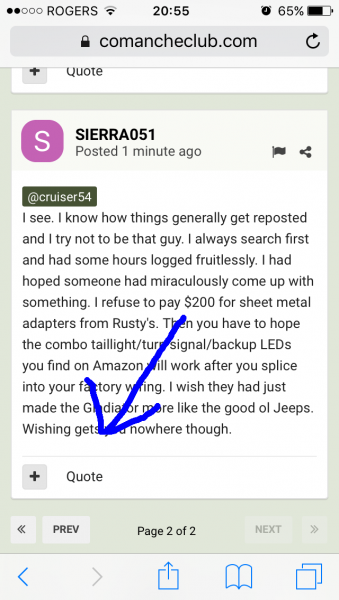
-
Jeep Wrangler tires on a Comanche
gogmorgo replied to Inventorben's topic in MJ Tech: Modification and Repairs
Take a look through the MJ project threads on here, might give you some ideas. -
You're referring to the little metal sleeves for the later style valve cover bolts?
-
1989 Comanche Rear Lift
gogmorgo replied to 1989commanche's topic in MJ Tech: Modification and Repairs
Before getting too carried away with managing sag, it's worth taking some quick measurements just to see where you're at. Scroll down to Eagle's post for factory specs. I don't think it's completely wise to go SOA with sagged springs (as Dirty suggests) if you actually do much with your truck. Probably this is obvious to most but the pedant in me feels the need to point it out. If a leaf spring is sagged, that means it's been compromised. Fatigue from flexing over time means the metal no longer has the same strength as before, which is why it's frequently reported that a re-arched spring has sagged back down to where it was in a short timeframe, it simply can't handle the load any more. Again an extreme example, but the MJ I refer to above only needs about half the rated payload to have the frame sitting on the axle. My MJ with less worn springs had no such issues with as close to the full rated payload as I've ever got. -
1989 Comanche Rear Lift
gogmorgo replied to 1989commanche's topic in MJ Tech: Modification and Repairs
What shape are your current springs? If they're like 50% of MJs out there, they probably are sagged pretty bad. As an extreme example my 2wd MJ with ~110,000 miles sits about two inches higher in the back than my 4x4 with ~330,000 miles, even though the 4x4 springs put it an inch higher from factory. That's three inches lost to sag. -
There was a recall over the heads. Not all were fixed but most were. I doubt anyone who'd bored an engine out would've neglected to look at the head.
-
By the time all was said and done, my second MJ buying trip had me at around 950 miles total. Just saying. My thoughts on which to choose also align with trying to find a longbed. I'm surprised you're struggling, as it seems most people prefer the shortbeds. I disagree with most people, but that's neither here nor there. As far as your suggested options, I don't necessarily like seeing someone hacking apart a clean truck if they don't need to, but also understand not wanting to deal with junk. And considering you're looking at chopping out a decent portion of the rear cab, if your options are between one where the cab may already be compromised vs one that's not, that could be a significant factor.
-
Most trunks have an emergency latch you can pull from inside, assuming you can get into it via a passthrough or even pulling the rear seat. But you can also use a 12v tool battery like Pete suggests. The Dewalt ones are good because you can push a spade terminal into the contacts, I imagine similar setups can be rigged for other batteries as well. Then you use aligator clips or whatever to clamp to the battery cables. It's not going to start the engine but it'll usually be enough to power windows, door locks, trunk latches, etc.
-
Looking through the parts manuals at XJjeeps.com for 87-90 I see a sending unit assembly for the 16gal tank in a long bed, and then another for both the 18gal and 23.5gal in "both" the short and long bed. One version of each for 2.5 and 4.0, I'm guessing because of the pump. Interestingly for the carbed engines it lists separate versions for all three tank sizes, although I don't know you could actually get an 18 gallon tank in anything with a carbed engine. But then I look in the 91-93 manual for the HO sending units, and now there's only two options. No difference in tank or engine choice, only gas vs diesel... all three of the diesel HO MJs built for the European market I guess. (When I say "three", I'm extrapolating from incomplete data on that production number, don't quote it).
-
Whether sarcastic or not, it's not necessarily a bad idea to have some sort of FAQ thread or subforum or something to handle that sort of thing, and other topics that come up over and over again like "how much tire" or "what oil do I use". Just as an example, here's a page that was intended to fulfill that role for another enthusiast group I've been involved with: http://www.ladaniva.co.uk/baxter/resources/newbies.htm. I imagine the "most important tip" thread would contain a lot of that info, and there's some in the DIY index as well, but it's a lot to sort through. Just one more of those things that comes up often enough and nothing ever happens.
-
Why diesel? Just thinking it doesn't compress so well. It doesn't lubricate too nicely either. I'd use a penetrating oil like PB blaster when trying to free it up. You can get assembly lubes that are intended for engines that might sit for a while before they run that'll work better for coating cylinder walls while in storage. Engine oil works okay in the short term.
-
Gave the truetrac a solid workout today, drove up to the wreckage of a DC-3 that went down in January of '46 up in the Crowsnest Pass, just east of the continental divide. Between the Truetrac and the Grabber ATXs, I've got traction to climb hills that are too steep for my stomach to handle, so I guess I can't complain about that. You can only point the nose so high before it feels like the front's about to come off the ground. I also managed to grab a factory tow hook set at a wrecking yard recently. Still haven't installed them yet, but that'll come.
-
242 and 231 should be directly interchangeable. Same length, same shift linkage, etc. Only difference is the bezel and gate for the shift lever. And I guess the wiring for the 4x4 lights. I like the 242 for on-road use. Any setting where you might want the added traction under "normal" driving conditions without the inherent understeer you see in 4hi. Snowy or gravel roads, even for better stability towing, or just to spread some of the load off of the rear axle going up hills. As far as using it off-road, if you're going through more serious stuff you'd already be in 4hi. Full-time does offer significantly more traction than 2wd, but having that centre diff locked is another noticeable step up when you're pushing through seriously deep snow or crawling up a loose hill. The only times I'd use full-time are if I was driving at significant speed, or was more concerned about tearing up the surface I'm driving on thanks to 2wd spinning or 4hi forcing wheels to unload and spin while cornering, than actually getting stuck.