


gogmorgo
-
Posts
5984 -
Joined
-
Last visited
-
Days Won
4
Content Type
Profiles
Forums
Gallery
Everything posted by gogmorgo
-
 The logic I was told is that the water getting pulled through the leak is thicker than air so it momentarily is blocking the leak. There’s undoubtedly some effect on combustion running water through the engine, but mostly you’re noticing the change in airflow into the engine. It’s going to set the idle air control to basically closed with all the extra leaking air flowing in, and when that extra air stops it has to respond by opening the idle control back up to compensate. The intake and exhaust manifolds use a combined gasket. The head gasket is its own thing so no need to worry about it right now. If the manifold bolts have been loose any leaking exhaust will burn holes through the gasket, potentially also on the intake side, so while you might get lucky just snugging up the bolts it’s likely it’ll mean a manifold gasket is in your truck’s future. But the good news is it’s not difficult to change the manifold gasket. All you really need to do is unbolt the manifolds from the head (intake may also be bolted to power steering pump) and push the manifolds over out of the way, get the old gasket out of there, and scrape any remaining gasket off sealing surfaces on the manifolds and head, then put it all back together. Unplugging the injector harness might give you some extra room to work.
 -
Wheel hop? Tire rubbing sound slow left turn
gogmorgo replied to Co-MAAAN-cheee's topic in MJ Tech: Modification and Repairs
Are you at or near full steering lock when it happens, and does it go away when you dial the steering back a little? It’s pretty common for a tire to catch the lip of the lower control arm, especially with larger than stock size tires, but even stock sizes can make it happen with aggressive enough tread. If that is what’s happening, going to tubular lower control arms like the WJ arms might be enough to stop the rubbing, or at least give them something with less bite to rub against compared to the stock arm. My ZJ on 31’s was bad for that, it would turn heads while parallel parking before I swapped the lower control arms. I’ve also had tires catch my inner fenders a little and make not great noises, but the tread blocks catching on the lower control arms can be drastic enough you’ll feel it in the steering wheel. -
Air pressure gurgling through something isn’t a particular good tell of whether or not a heater core is free and clear, or if a valve is operating correctly. Definitely not enough to commit to changing a heater core. You can bypass the heater valve easily with some hose adapters. That’ll tell you whether or not it or the vacuum to it is the problem over the heater core. If your weather isn’t cooperating in a way that would let you run a garden hose through the heater to flush it out, you can usually get away with doing it at a wand wash, but be real ginger careful with 2000psi if you can’t get the tip off the pressure washer wand.
-
You can also just use water while the engine is running to find a small vacuum leak. The rpm will dip while the water is being pulled in (temporarily stopping the leak) and going through the engine, sometimes it makes noises. No harm in doing it either, it’s no worse than driving in the rain. Smoke testing works by pushing pressurized smoke into the system and seeing where it leaks from. Potentially you could do similar with soapy water, but I’ve never attempted it.
-
best aftermarket oem style fuel tank?
gogmorgo replied to Pete M's topic in MJ Tech: Modification and Repairs
Spectra’s a Canadian company. They’ve shifted a lot of production to China but the bigger bulkier things like fuel tanks that cost a lot to ship are still made in Canada. -
Blend door movement is visible without taking anything apart. It’s under the dash above the passenger’s left foot. If you peak your head under the dash and slide the temperature lever back and forth you should see the cable moving a little bent rod, the other end of the rod is the blend door. I don’t recommend removing the cable from the rod unless you need to. The valve changed at some point so I don’t know for sure if this is the rule, but I had a ‘92 XJ with almost no heat and patching a vacuum leak in the line down to the reservoir in the bumper brought the heat back. Which was nice cause I was road tripping it at -40 when I found and fixed the vacuum leak. But at any rate that would tell me the valve opens when it gets vacuum. The vent selector kinda worked prior to correcting the vacuum leak, but mostly only at idle.
-
Continuation of starting woes
gogmorgo replied to NC Tom's topic in MJ Tech: Modification and Repairs
Bad NSS is a no-crank situation so it’s not that. Intermittent issues are difficult. And there isn’t much that letting the vehicle roll will do that cranking the engine over won’t also do, other than giving it time to clear out a flood, let a hot component cool down, or let a weakening battery recover a little. If it acts up again, try cracking the throttle a little while cranking, then roll in and out of WOT for clear flood mode. It would also be good to check for spark at the distributor, pull the wire off the middle button and check against ground, just don’t hang onto it yourself. You can also shoot a little starting fluid down the intake to see what happens. Just to confirm you’ve got spark all the way to the plugs. I’ve had three issues on my ‘91 lead to similar results, occasional stalling and no-starts where I’d come back a few minutes later and it would start. The first was the bellhousing bolts were loose, which meant the flywheel and CPS weren’t properly aligned. The second was a worn out distributor that wasn’t moving spark through it. The third was a broken flex plate, likely the result of the loose bellhousing bolts, but leading to similar misalignment problems. -
I suppose something could be scrambled in the abs computer. If the sensors aren’t quite in alignment due to age or weathering, a hard manoeuvre of some kind might be just enough of push out of alignment to start registering issues. Bearings often end up getting replaced in sets, based on the logic that if one is gone then the rest aren’t far behind. I don’t fully believe in that logic, but if it holds it would stand to reason that failing bearings are happening around the same time. And unless there’s a seal or lubrication failure, you can get away with rolling on loose bearings a long time before something catastrophic happens. The same everything happens equally to everything logic also applies to corrosion, dirt accumulation, anything else that could suddenly get to a tipping point. But we’re all just speculating here. I’ve experience cases where a lost signal makes the vehicle incorrectly think the wheel has stopped while braking, actuating the abs and releasing the brake on that corner, but you’d notice the pull and pedal pulsing.
-
“Signal malfunction” instead of a circuit code would tell me the sensors aren’t sending useful data, rather than a wiring problem. Meaning they’re not reading the tone wheels properly. That would be a bearing issue, sensor misalignment, tone wheel corrosion sort of concern. The sensors passed the circuit integrity checks but aren’t sending good signals.
-
Wheel bearings going out at more than one corner, tone wheels rusting and/or packed full of stuff... wiring issues maybe. Kinda depends on what the code is. If it's a circuit code then that would indicate a wiring issue, possibly a bad sensor. If it's an erratic signal it's more likely to be a mechanical issue.
-
Which end of the harness was wrong? Do you still have your original speed sensor in there or the one off the YJ? There’s a few different part numbers for the speed sensors for ‘91-‘93 and another one again for ‘94-‘96. I want to say I went through this on my ‘91 when I swapped to an NP242 out of a ‘93. I had to reuse my MJ’s speed sensor because the ‘93’s wouldn’t work with the MJ. It might have been a ‘94 though, it was a long time ago. At any rate I remember wanting to use the XJ’s speedometer gear for a better tooth count than my MJ had, but then I couldn’t use it. There was also something about the 4x4 switches that I think is tied into that interim harness, although my memory’s a little fuzzier there, it could be part of the trans harness, not Tcase. The CAD models use a switch on the CAD, but the later models use an electronic switch at the transfer case in place of the big vacuum mess. When I did it I think it took some effort sorting through to figure out what I needed to do, and I can’t quite remember what all I did ten years later, but everything plugged together in the end. But then I was going from XJ to MJ, not involving any YJ parts.
-
No, I was wrong So turns out it is a four wire, this is a terrible picture but I think you’ve got the right one. The under hood light connector is a two-wire.
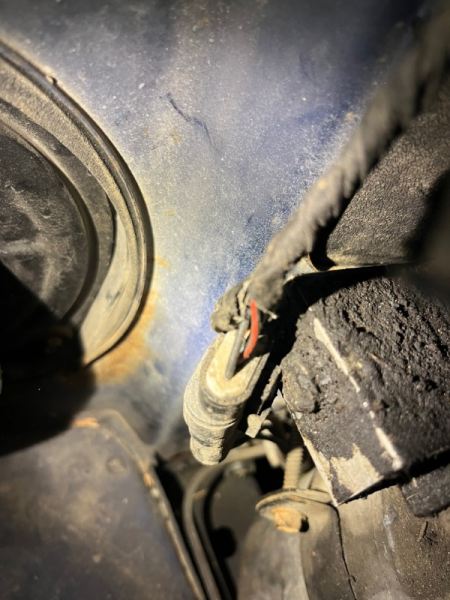
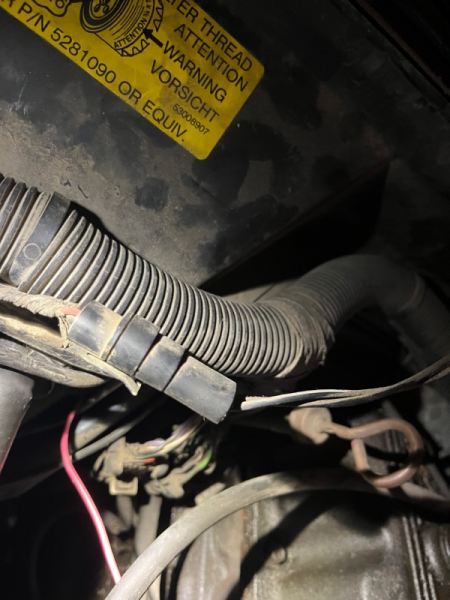
-
It’s that area and that general shape of connector, yes, although I think the four-wire connector is for the transfer case position switch. I thought it was only a two wire connector, but I could be wrong. I think the speed sensor changed from a 2-wire to a 3-wire sensor sometime between ‘92 and ‘95 but I don’t know how that would affect the connector. I’ll have to double check mine when I get home.
-
2.5L trouble removing oil filter
gogmorgo replied to Dan Schachner's topic in MJ Tech: Modification and Repairs
It’s a pain, yeah. Every time I do it I think about looking into a remote mount to make it easier. I think sometimes I’ve unplugged the distributor harness to get myself some more room to manoeuvre in my ‘91 2.5, but I do the same as what everyone else is doing, rotate it so it faces up and lift it up through a hole it doesn’t want to come through nicely. The new filter goes back in the same way, usually with some fresh scratches in the paint. -
Key left on; Now having electrical problems
gogmorgo replied to CheepComanche's topic in MJ Tech: Modification and Repairs
What did you do to jump start it? If booster cables were hooked up backwards it can do interesting things, blow the diodes out of the alternator, pop fuses… I only know this because I’ve had it happen to me so no judgement if that happened. My first thought was battery terminals. Having a battery go completely dead does sometimes cause corrosion on the terminals. The brown wire at the ignition switch is also a strong possibility. If the blower motor was going, as voltage goes down and a motor slows down, current through a motor goes up, and it will find any weak spot in the circuit. -
Front Suspension Replacement
gogmorgo replied to RiversideMJ's topic in MJ Tech: Modification and Repairs
Minor pull to the right sometimes is just slowly falling off the crown in the road. But it could be something. Make sure your tire pressures are correct, none of the brakes are seized, and that the axle seals aren’t leaking into the brakes. “Rebuild the front suspension” is a strange thing to tell someone. There’s five things there that would affect alignment, the four control arms and the track bar. Ball joints maybe but you can check those for play yourself. Same with the steering components. Nothing in the above photos looks particularly bent, so unless you have the wrong parts installed there should be an obvious problem somewhere. Visual inspection on control arm bushings, check for play in the steering linkage. You can measure the length of components too if you want. -
Lost voltage measured where? If you’re measuring just at the pump connector it wood be useful to know if it was on the power or ground side. The fuel pump only cycles for a few seconds after key on without the engine running. A better way to confirm power transmission would be jumping pins 30 and 87 at the fuel pump relay. Then you’d know if there’s a wiring concern or the truck isn’t asking the pump to turn on. You might as well check from proper power at the relay as well.
-
This was a long rambly post. But to sum it up, his recommendations are 1: basic maintenance. Ignition parts in particular, and also good synthetic fluids not just in the engine but also diffs, trans, tcase. And the air filter. Also the recommendation of good battery cables and electrical system, preventing voltage drops and unnecessary loads on the alternator. 2: keep the engine running in its sweet temperature spot. He recommends a 205° thermostat for environments that let passive cooling work, but stock 195 for when it’s hot because the 205 will make fans come on more often. Passive cooling methods like larger radiator, oil and transmission coolers, and hood vents in hot climates. Exhaust wrap to reduce engine bay temps if necessary. 3: aerodynamics. Don’t put anything on the outside of the vehicle, brush guards, winches, roof racks, no spare tires or cargo carriers on the roof. He recommends skid plates for underbelly smoothing. He also states the importance of not lifting and especially not levelling a vehicle, leaving a rake. Also larger tires are a concern, wider is a slightly bigger concern than taller but both hurt. Aero is obviously more of a concern on the highway, but around town keeping the extra weight of accessories off is an advantage too. He also talks about economodder principles here, like blocking off parts the grill, on adding a corrogated plastic belly pan, but adding the caveat that if loss of passive cooling airclow airflow makes active engine cooling work harder it doesn’t benefit you. Which is a good segue into 4: Don’t load the engine more than necessary. Passive cooling preventing engine fans from coming on. He recommends against additional cooling fans, or anything that will increase mechanical or electrical load. He unplugged the a/c compressor to stop it coming on in defrost, and said it didn’t work anyhow so left it unplugged in summer. 5: engine mods. He recommends a high performance ignition system which allows opening up the spark plug gaps a bunch, but also said this lead to running 89 octane over 87. He recommends a 2.25” cat-back exhaust and mandrel bent downpipe on a stock exhaust manifold, or 2.5” but if you have a higher flowing manifold/header to match it. He also went with 4-hole injectors. 6: driver mods: slow down. He claims an 8% increase in mpg doing 60mph instead of 65. It’s one of the more substantial single items on his list and costs $0 to implement. I didn’t look down the rest of the thread to see anything else claimed, but all of the above is in agreement with basic automotive principles. It passes the sniff check. Something else I’d add is front axle rotating mass is something we take for granted. The factory CAD isn’t ideal, but it does help some with MPG. Locking hubs would be better. I don’t religiously keep track of my own MPG anymore, but I was doing so for a while, around when I swapped from a CAD to a one-piece axle, and while the data is scattered enough I can’t pinpoint an exact when in the data, I do know that all my best MPG numbers were recorded prior to my CAD delete. I went from 17-18mpg averages mostly highway with the occasional 20 to 17-18 with the occasional 18.5. I’ve done other stuff too, like a brush guard and chunky tires, so it’s not just the CAD bringing me down today, but the CAD was the only mod of substance for some time and I haven’t touched 20 since doing it.
-
Front Suspension Replacement
gogmorgo replied to RiversideMJ's topic in MJ Tech: Modification and Repairs
I don’t think so. People swap axles around and don’t need to change steering components. People also put the ZJ V8 tie rods on everything without issues. What could be possible though is there’s a mix of early and late components. Just looking through the specs on Rockauto, the later tie rod ends are about an inch longer apiece than the early ones, and then the “adjusting sleeve” long part of the tie rod is about 2” shorter than the early ones. So the length difference in the tie rod ends is cancelled out by the length difference in the tie rod for overall the same length, but only if you match like with like. This looks like stock components to me. The drag link looks on the newer side but I’m not used to looking at parts that haven’t seen road salt so for all I know it could still be original. The adjustment in the drag link doesn’t look like it’s maxed out yet but it’s getting close to all the way in, but this only keeps your steering wheel on centre. It would still be good to double check there’s no play in the ball joints at the ends of it. The end at the wheel is important to the toe measurement if it’s got play, the end at the pitman arm isn’t important to the alignment, other than a little slop in your steering (you still don’t want play in it). The tie rod connecting over to the driver’s side wheel does look like it’s got quite a bit of the tie rod end thread revealed, meaning it could be getting close to max too. But I’m more concerned looking at the torn boots on the tie rod ends. If there’s play there they need replaced. The adjustment here is your toe-in/out adjustment, so it’s important to the alignment process, there shouldn’t be play in it. I would measure the adjustment sleeve here to double check it’s the correct length for the tie rods you’re ordering. Some of them on RockAuto have the specs. Sometimes it’s difficult to measure precisely but the difference is roughly 2” here so it would be easy enough to distinguish between the two sizes. Like I said before for the steering linkage it might be better just to get the original to match the year of your truck for the sake of simplicity, and only replace what you need to. But if you just want to rip it all out and start over I would do the V8 ZJ setup. I often will completely replace a tie rod instead of only doing one end, but see above about road salt… sometimes you can’t just replace one part. Other things important to the alignment are the actual ball joints in the axle C. If there’s play in the lower ball joint that’s bad, a little (like 20 thou, Moog says up to .060”) in the upper ball joint is normal because it’s a telescoping joint, but replace it if you have to do the lower. Some people will tell you to do both sides if you have to do one side but I don’t think that’s necessary. Wheel bearings will also screw up an alignment if they’re bad. Control arm bushings can throw off an alignment too if they’re hammered out. You’ll mostly be looking at the rubber bushings to see if they’re perished. The stock control arms are also a little on the flimsy side, and have a lip that likes to catch tire lugs, so if you are replacing them a good upgrade for stock length arms is the WJ lower control arms. They’re sturdier and don’t have the lip, on top of being scooped a bit for extra tire clearance. That all said, I’ve never brought a vehicle in for an alignment just for the sake of doing an alignment. Is there a shake or a wander you’re trying to solve? Or a tire wear concern maybe? -
Front Suspension Replacement
gogmorgo replied to RiversideMJ's topic in MJ Tech: Modification and Repairs
2wd and 4x4 steering are the same. Suspension is the same other than 2wd springs are an inch lower. Everything should be compatible with an XJ from ‘84 to ‘01 as well. Replacing everything including ball joints and sway bar links for toe adjustment being maxed out seems, frankly, incorrect. Like there’s got to be something else going on here. Is your truck completely stock up front? Did they give you an alignment printout? What specific issue were you trying to solve? Is there anything other than the tie rod adjustment being maxed out? If you want to replace it all for the sake of replacing it all, sure, I guess. None of it is particularly difficult as long as you can get it apart. But if you take stock parts off and replace them with stock parts that are identical dimensions, you’re not going to gain any adjustment range. And I wouldn’t want to spend money to pull good parts off to replace them with something that may not be as good quality when you’re not actually correcting an issue. And the everything-you-need kits are usually cheap junk. Editing to add that there are length differences between some components between ‘90 and ‘91 so you don’t want to mix and match before and after, but as long as you get everything for the same model year it should fit. This might actually be part of the issue if someone did mix and match. It’s probably better to order parts for the correct year of your truck so you don’t need to remember not to order the wrong parts later, which you’ll probably have to do if you plan on keeping the truck long term. -
3.08 gears cj and mj the same?
gogmorgo replied to Everz's topic in MJ Tech: Modification and Repairs
Car-part.com might find you a used 3.07 axle semi locally for cheaper than new gears. The 3.07 D35 is probably the least desirable MJ axle, I’m sure there’s someone close-ish to you with one that you’d be doing them a favour for making it go away. -
Flashpoint is the point a liquid emits enough vapour it can be ignited by a spark. It’s not an autoignition temperature. Isopropyl alcohol’s autoignition temperature is high enough you’ll have issues with your ultrasonic bath before it gets hot enough to ignite from heat alone, hot enough to start compromising the strength of steel. You’ll want to avoid boiling it of course, but its boiling point isn’t all that much lower than water’s boiling point. I’m not saying don’t be careful because it is still a flammable liquid, but if you’re not burning yourself on the things you’re putting in there with the alcohol, or rubbing a balloon in your hair while you’re taking the parts out, or throwing lit matches at it, you’re not really in much danger from a little hot alcohol. The flash point of gasoline is low enough you can start your car at -50, and it’s apparently not blowing up ultrasonic cleaners either.
-
dimmer Dash Lights Work, but Dimmer Doesn't...
gogmorgo replied to NickyV's topic in MJ Tech: Modification and Repairs
Voltmeter is a better tool than an ohm meter for checking this. Put the load on it then measure voltage across the switch. If there’s any drop across it you know there’s resistance. You shouldn’t see voltage drop through a switch. An ohm meter will lie to you. Imagine a big multi strand wire, cut through until there’s only half of a strand left holding the thing together. Your ohm meter is only putting out a tiny current, not enough to load the wire at all. That half strand will show you zero ohms, but it absolutely will not carry the full current that whole wire is expected to be seeing. That bottle neck is resistance, and it will show up as voltage drop, and that half strand is going to get hot. The headlight switch works the same way. The arc every time you turn it on burns the contacts slightly, until there’s just a tiny little bit left making enough contact to carry the current. That tiny little bit making contact is your voltage drop, it’s what gets hot, and that heat is what sets the thing on fire. -
Unfortunately yeah, that’ll be roughly ballpark. Basically everything that makes a truck decent off road detracts from fuel economy. Gentle driving can bring the number up some, but you’ll only see so much out of it. Keeping up on maintenance will definitely help. Fuelly.com is a good resource for seeing what other people are getting, based on real-world numbers. It won’t be a perfect comparison because you won’t know the specifics of their driving, but it’s a good approximation. If you really want to bring the numbers up you can look into hypermiling techniques. The biggest improvements I’ve found are just from sticking to the speed limit and avoiding routes where you’ll be spending a lot of time stopped, moving slowly, or accelerating and decelerating a bunch. But there’s only so much you can do.
-
Yeah, the Holleys in 3000k are so far the only ones that temp me. Although I think I’d prefer something closer to 4000k and could probably do with some heated lenses. But everything else just looks a bit too space-agey for an old brick of a truck, and I still don’t have any trouble seeing with my sealed beams on relays, either.