


gogmorgo
-
Posts
5984 -
Joined
-
Last visited
-
Days Won
4
Content Type
Profiles
Forums
Gallery
Everything posted by gogmorgo
-
EGRs plugging things up is pretty typical to all diesels, especially if they’re just poking around town in heavy traffic, running cold on short trips with lots of low rpm and idle time. I think they call those little bulbs in the housings “city lights”. If I understand it correctly they’re for cruising around a well-lit city where you don’t need extra light to see, but need to be seen by traffic without blinding anyone. A “nighttime running light” if you will. The ECE low beam kicks a fair bit of light up and right for reading road signs which can be unpleasant for anyone in eyeshot. I don’t know if the housings with the city lights would have been factory or not, but they’re definitely common. ECE sealed beams were definitely a thing but there’s a very strong preference for H4 housings. The DRL on North American spec Jeeps from the era is accomplished with a step down module that sends 5V to the high beams, its a little square box on the driver’s side inner fender up by the firewall. It uses the same sealed beams as the non-DRL setup. They like to fail and stick the high beams on. It works alright with OE wattage halogens but doesn’t always play nice with higher powered aftermarket lights, especially LEDs that don’t expect the 5V. I don’t know if the European Jeeps used the same system, or even had daytime running lights at all. I know European cars did have them but I don’t know if it was mandated or just a premium feature. The Canadian-spec Ladas I have had the DRLs added at the port with a couple relays that turn on some function of the headlights. There’s no documentation about them that I’ve found anywhere and I’ve never bothered decifering how they’re supposed to work. But this is still very early post-Soviet stuff and even today the Russian market isn’t exactly a typical example of European regulation equipment. But the ‘93 Samara I have has OE molded H4 housings with city lights. The ‘96 Niva has standard 7” round lights. It may have had sealed beams in it when I first got it, but I put some cheap aftermarket H4 housings with blue neon halos shortly after buying it that also had the city lights, also in blue. I had to pull the DRL relays to keep the headlights off so you could see them while driving around town. It looked cool but I don’t know how I didn’t get ever stopped for them. But one of the lenses cracked and I replaced them with some OE H4 assemblies. I don’t remember if they have city lights or not, but they’re for sure much better at being headlights than the cheap ones were.
-
If the lug nuts aren’t tight on the left side of the vehicle, the wheel wobbling around will spin them off. On the right side of the vehicle loose lug nuts spin themselves sorta snug but still loose enough the studs will bend enough to fatigue and eventually snap, or wear the nuts through the wheel. It would pay to double check the torque on the rest of the lug nuts before driving after the wheel that came off gets corrected. Usually if one wheel was loose the rest will be too. Wheels and lug nuts that have been on the same vehicle for a long time tend to wear into each other, and might not play nice when paired with a different wheel or lug nut, and require quite a few frequent retorquings before they’ll stay tight for you. This is especially true if you used lug nuts that had been used with steel wheels on an aluminum wheel. The steel wheel wears a stronger pattern into the steel nut, where a steel nut will wear itself into a much softer aluminum wheel. Aluminum wheels don’t usually like the shape that a steel wheel wears into a lug nut.
-
It’s a valid question. Automatics have all sorts of clutches in them, and most transmissions are automatic. As someone who orders a lot of parts, the system is what it is. You get the prompts and you have to pick an option to move on, whether or not it seems relevant. Sometimes they’re weird prompts, but it’s worth it to the company to eliminate a bunch of incorrect parts so there’s a higher chance of selling you the right ones on the first attempt, and often the question is going to be easier to answer for most people to answer, like most people aren’t going to know their trim level but they will know whether or not they have power seats. Not every system lets you choose a “don’t know” when it doesn’t matter, but sometimes it does matter in a way you wouldn’t expect, so it’s worth answering the questions correctly. The questions may seem dumb, but either know what you need and come in armed with a part number or don’t complain about having to play the parts counter game. Most parts chains have an online catalogue and inventory so you can look up what you need on your own if you don’t want to play. Most of them now even let you order and pay online before you leave home and will have it ready so you just walk in and pick it up when you get there, so you don’t have to talk to the kids at the counter at all. And know that it works both ways. As soon as you walk out the parts counter staff are going to laugh at you and call you a dumbass for not just answering the questions, same as if you modified your vehicle but answer all the questions like the part is in the vehicle you put it in then get to the end and then say “but it came out of this” and make them start all over again.

-
Always been curious about the 2.5 diesel. How it compares to a 4.0 or 2.5 gasser. Every so often I window shop the 2.5td/ax15 ZJ. Seems to be a few of them cheap in Italy, but I’m a long way from when I’d be able to import anything. Seems everyone in Europe thinks they’re junk but that’s the overall opinion of Jeeps in general there so… yeah. Out of curiosity does the XJ have headlight height adjustment on the dash? I’m pretty sure it was a euro requirement. Both my Ladas have it, at least, and I’ve seen it on the ZJ but I haven’t found any info about it on the XJ.
-
Usually whatever app you open the photo with will have an “edit” button and give you basic resize, crop, and rotation functions at minimum. I regularly have to rotate photos on my iPhone to upload. Mostly just to here but it happens often enough, where my phone tells me it’s upright and then once uploaded they’re upside down. The fix is usually just a case of rotating it through 360° and saving it again, although if the editor is smart enough to know that makes it the same as it was before and doesn’t change it, you might need to outsmart it by doing it in two steps. Rotate it partway and close the editor and save the file, then open it back up and finish rotating it upright.
-
I had everything reasonably well organized into labelled boxes at one point. But I’ve moved the hoard a half dozen times now and every single time more stuff gets purged and shifted between boxes for better packing, so the labels aren’t strictly accurate. The second to last time I figured I was going to be bouncing between rentals for a bit so I bought an 18’ enclosed trailer and stashed everything in there, but at the cost of not being able to get at it easily because the only reasonable place to park it at my current house has it backed right up against a garage so I can’t get the ramp open without moving it. And the man door has a big stack of axles to climb over if I want to get at stuff that way. Eventually the goal is to move everything into said garage but I need to clean out all the previous occupant’s junk first… A few years ago I started keeping stuff in clear totes, which helps a fair bit. Hat tip to Adam Savage there. They are kinda labelled and organized, but not super specifically. Being able to see into the totes without pulling out the whole stack and opening them all is pretty handy for quick finding of stuff. Whenever I get around to organizing it into more permanent storage I plan to label everything with source and approximate price and then maybe 30 years from now I can set up a table at a swap meet or something when I need to start purging again.
-

New AX15, very chirpy but not the TOB
gogmorgo replied to brucecooner's topic in MJ Tech: Modification and Repairs
If the crack's bright and shiney inside then it's recent, if not it's probably been there for some time. The edge isn't flattened or rolled over doesn't look like it's been smacked with anything too hard, so it's possible that there was some rust or debris from the snap ring groove that got caught in between the bore and cap and pushed it apart. If it's just in the snap ring groove a little kiss from a welder might be all it needs to stop it from propagating. But if the nub that goes into the centring ball is worn down so it's loose then it might be time for a new shaft. But it happens. Metal parts that have been pressed together for decades don't always like coming apart like they should. A little bit of scoring in the bore is normal. I usually like to try to clean it up with something, stiff wire brush or some emery cloth, just to get rid of any loose rust but not really to remove material. It's not a bearing or seal surface so it doesn't need to be perfect so long as it's not loose enough the cap moves around inside the bore. Also that centring ball, I forgot to say something above. In addition to the spring it's also supposed to have needle bearings inside it, same as a ujoint cap. -
New AX15, very chirpy but not the TOB
gogmorgo replied to brucecooner's topic in MJ Tech: Modification and Repairs
Mm. Yeah. The 90° fitting is handy. I used to have a grease gun where I'd just added a 90° brass elbow between the hose and standard tip. It made it much easier to push and hold the tip in place on an obstinate nipple, or just made up for worn out tips that won't hold themselves nicely on the nipple. Grease guns universally use 1/8"npt fittings so it's not difficult to track down an elbow. You can really lean on that elbow instead of trying to push down on a greasy hose. I've never really cared much for adapters that lock onto a nipple, beyond the standard ones with their little bit of grip. It adds bulk, makes it tougher to get into some spots, and makes it cost more to replace when you inevitably wear it out prematurely from hitting a bunch of rusty old nipples. When you're using them professionally, you go through them. It also adds an extra step unlocking it to move to the next nipple, which is fine if you're only doing a handful of grease fittings, but when you've got like 70 of them on a tandem plow truck with a sander body on it and you might do two trucks in an afternoon, that's a lot of extra steps. -
New AX15, very chirpy but not the TOB
gogmorgo replied to brucecooner's topic in MJ Tech: Modification and Repairs
I don’t know what actual torque spec is on them. I’m sure you could look it up if you wanted to know. I usually just tighten them back down good with whatever tool I used to remove them. You don’t want them to back out but remember they are small fasteners so you don’t want to overdo it. There is a variety of other adapters out there. I’ve used one that’s like a long thin tube that just barely fits over the nipple that’s good for tight spots. I’ve seen needle style grease gun fittings too, like a needle for inflating basketballs, although I think I’ve mostly seen them used for pushing around a boot for a ball joint, which I think is of questionable value, because you’re not really putting the grease onto the bearing surfaces. There’s another common enough fitting in ujoints, typically to go in the cap (not the cross) for low clearance areas, where you might risk snapping it off. It’s a bit of a shallow cone. There are specific grease gun adapters to fit those, basically the same shape but opposite. But that brings up a couple good points. It’s good to make sure you orient the grease fittings in a way you can get at them. I had a one-ton on the hoist yesterday where I couldn’t grease the rearmost driveshaft ujoint because it was installed with the nipple pointed straight at the pinion yoke. If it had been flipped around and pointed facing the shaft it wouldn’t have been an issue. One other less critical point, it’s nice to line up all the nipples along a shaft so they’re all pointing the same direction. It doesn’t improve function at all, but it makes it quicker to find them when you’re greasing them, instead of being pointed in random directions. -

-
They were also building the 4.0 there and every other AMC inline six, and some after the fact redesigning was necessary to make it fit in the XJ/MJ engine bay. So it’s not totally out to lunch that a truck could have ended up there for that process. But it’s still just speculation in either case.
-
So what kind of lights are you running?
gogmorgo replied to Spinnakerblue89's topic in MJ Tech: Modification and Repairs
There’s different kinds of “xenon” bulbs. HID lights use xenon gas, and have been referred to as “xenon” lights. They use an electric arc and plasma stream to create light instead of a standard incandescent filament. They produce a ton of light and heat. Then there’s the incandescent “xenon” lights that are just a standard incandescent filament halogen bulb but filled with xenon gas instead of a “lesser” noble gas like argon. It does a few things for colour output. The different density of the gas around the filament makes for different light transmission properties. I’m pretty sure that’s all the Wagner xenon sealed beam lights previously mentioned are. Presumably a sealed beam bulb’s housing would be able to take any heat the bulb itself produces. -
I’m skeptical. There’s lots of erroneous title documents out there that cite model year as the production date or year of purchase. There’s lots of MJs built in 1985 that would have been purchased that year. Its also a common belief that you can’t legally remove and replace a vin tag back onto the vehicle it came off of, and I’ve seen people strongly insist you need to go get an assigned vin to make your vehicle legal after a dash swap, which considering this truck looks to have other Waggy interior parts swapped in seems likely. Its also not unheard of to end up with an assigned vin when going through a lost title process. There’s other reasons as well the state could assign a new VIN to a vehicle. MJs weren’t assembled in Kenosha. AMC was building things that weren’t Jeeps there, but I don’t know what of their design work actually happened at the assembly plants. It seems odd that something assembled elsewhere would end up there. It’s also unusual for preproduction models to end up anywhere other than corporate storage or a recycling facility. Obviously I can’t say with certainty it’s not a preproduction vehicle. It looks like a nice clean truck that’s been well cared for. But you’d think that would mean there’d be a little more evidence than an assigned vin tag if that’s actually what it is. And you’d think the assigned vin would be done in the state where the vehicle was produced, or where the company HQ was located. Or the company would just slap their own vin on it like they do every other vehicle they produce.
-
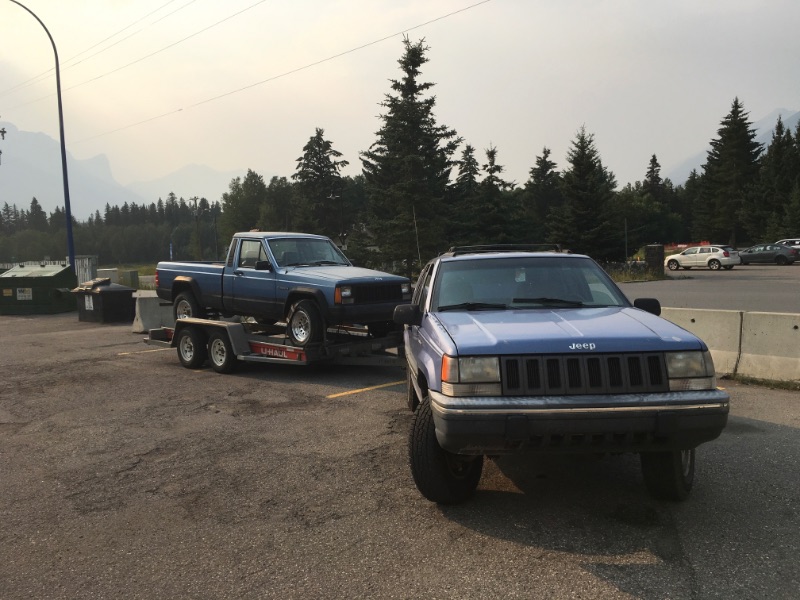
Leaf springs are too sagged in the longbed for me to chance it but I have done it with the ZJ. Pulled it 450km in total, over two 2000m passes 80km apart with a valley dropping to 1300m between them. Its a lot of weight for a 4.0 to drag up a double-digit grade but she did it. But knowing now what I know about U-Haul’s maintenance program and how unlikely you are to get a trailer that actually has functioning brakes, I definitely wouldn’t recommend doing it again. I have a real truck for doing that now. An MJ isn’t much of a load to haul and you for sure don’t need a 1-ton to do it, but for how cheap it was to get a vehicle that’s actually rated to tow that sort of load it’s definitely not worth the risk.

-
AW4 transmission slow takeoff
gogmorgo replied to Ken Seymour's topic in MJ Tech: Modification and Repairs
Nothing a wire brush, degreaser, and a rag can’t fix. No need to drop a trans just to clean it. You’ll want the kickdown cable installed for sure but the thing not going into first gear on its own in overdrive is consistent with the trans computer being disconnected, fuse pulled, etc. The transmission defaults into a manual mode when that happens. It’s strongly possible that was done deliberately to make up for the broken lockdown cable. -
Buying General Springs Leaves to lift my 2wd MJ
gogmorgo replied to jakesmog's topic in MJ Tech: Modification and Repairs
Do you have a local(ish) suspension shop? You can get your original springs rearched for more height. Or get some added if you don’t get as much out of the General Springs as you’d want. They can also source new springs for you if yours aren’t worth rebuilding, which might save you money over shipping in a set. That’s what I did. Admittedly I’m in Canada so shipping them up here is exponentially more than within the US, but sourcing new springs from the local shop was cheaper than buying online, and then paying again to have more height arched into them and a leaf added was still cheaper than getting lift springs shipped up here. -
Might want to look into starter orientation. I think the biggest reason people prefer the Camarobird engine is there’s issues putting the front-wheel-drive engines in a rear-drive orientation. But I haven’t done the swap and don’t know what all is or isn’t a concern. I can imagine it’s getting harder to track down the older camarobird V6’s now though. Not exactly a desirable powertrain outside of some niche markets.
-
For what it’s worth, it’s been 23 days since that ‘24 F150 took a ride to the dealer. It’s still sitting there. Apparently the wires for the a/c compressor came into contact with the exhaust and shorted out, which is what bricked the thing, and they’re still tracing out and replacing all the stuff that fried. We got a call yesterday saying they’re waiting on more parts. Fortunately it’s under warranty still I guess. On most MJs (I can’t speak to the 2.8) the a/c compressor wiring isn’t anywhere near the exhaust, but on the off chance it did short out some other way, it would pop the fuse for the compressor clutch and you’d lose your a/c but you’d still be running and driving. Worst case Ontario your compressor clutch pulley grenades, but you can tie a shoelace around the water pump, alt, and crank pulleys and keep driving. It shouldn’t brick the vehicle. I’m not saying don’t go out and buy a new vehicle, there’s plenty of good arguments for doing so, but expecting it to be any more reliable than something older you’ve been maintaining properly is completely unrealistic.
-
New AX15, very chirpy but not the TOB
gogmorgo replied to brucecooner's topic in MJ Tech: Modification and Repairs
Yeah the front shaft is not the nicest thing to remove. You unbolt the driveshaft from the flange on the transfer case, which wouldn’t be such a big deal except for there’s very tight clearance for getting onto the bolt heads, and they tend to have not moved for a long time which means they don’t want to. I think it’s a 5/16” hex head, if memory serves. The box end of a wrench is the easiest thing to get on there but if you don’t have a very good fit on it they’ll want to turn into circles. I’m nervous even using a high-end 12-point wrench. 6-point wrenches are getting difficult to find, but it’s the one of the few places I’d want to use one. And it’s not a great spot to get heat onto to help loosen them. -
New AX15, very chirpy but not the TOB
gogmorgo replied to brucecooner's topic in MJ Tech: Modification and Repairs
The factory rear driveshaft doesn’t have this. It has a slip yoke in the transfer case tailhousing. Its likely you’ve got a slip yoke eliminator setup. It’s less critical with the MJ’s longer driveshaft but on a shorter wheelbase Jeep with enough lift you might have enough travel in the slip section as the axle moves up and down to pull a slip yoke too far out of the transfer case. Similar to the front driveshaft. It’s also sometimes done to help with driveshaft angles. Usually you’d see it with a full CV like the front shaft, but not always. There’s a few different outfits that produced them, there’s also a couple common DIY methods, and plenty of driveline shops custom building things. It’s tough to say what you’ve got without knowing. But in general there’s not much inside the sliding section. There’s usually a seal on the female end, but other than that you’re really just looking at greased splines sliding in greased splines. Not necessarily the worst idea to pull it apart and clean any debris out of there that might have worked its way in, but if it’s been kept well greased and the seal’s in okay shape it’s not usually a huge concern. If for whatever reason you do decide to pull it apart, mark the alignment so it goes back together the same way. You don’t want the driveshaft U-joints going out of phase or you’ll get some hellacious vibrations. Although if it does come apart on you and it’s not marked, it’s easy enough to line the ujoints back up. Just drop the shaft on a flat surface and make sure the u-joint caps are both sitting flat. -
Interesting. This is "bleed everything, open a front bleeder and bleed the rear, close the front bleeder and bleed everything again". I guess the initial bleed is for practise.
-
So what kind of lights are you running?
gogmorgo replied to Spinnakerblue89's topic in MJ Tech: Modification and Repairs
To make matters worse on the proper aiming front there's been a bit of a trend where manufacturers haven't made correct aiming very easy. There's a lot of vehicles where you just get a diagonal sweep and you have to compromise the left/right aim to get the up/down you want. Or vice versa. Hopefully we see an end to that trend now that IIHS is including headlight performance in it's safety scores. There's a lot on this topic I can rant on... I should probably get off my soapbox and quit derailing this thread. -
It's interesting. The process doesn't indicate that you should rebleed the rear circuit after closing the front bleeder. Theoretically I suppose you shouldn't need to, considering the regular rear line isn't block off in the distribution valve and fluid should flow down both rear circuits at the same time and push air out of both. But I'd have to revisit the half-cut images of the load-sensing valve to determine if fluid pressure coming back past it could close the ports and block it... I wouldn't think so but I've been wrong before. It definitely doesn't hurt anything to bleed the rear a second time. In practise having two paths from a single source to a single destination doesn't usually result in exact halving of the flow down each path, or even that one path will see any flow at all, so bleeding with the front bleeder open will get most of the air out and then closing and bleeding again will get it all out of the primary path. I can also see it being possible that if you have a fully bled primary circuit when you open up the bypass you'd end up with equal pressure on both ends of the bypass and simply not move anything through the bypass at all... hopefully the inner workings of the load-sensing valve would be enough restriction to reduce pressure at the outlet so stuff does move, and that restriction might be enough to get very little flow through the primary circuit when the bypass is open. That was kinda rambly stream of consciousness but I think I just made a good enough argument for going one step extra on the FSM procedure and bleeding the rear brakes again after closing the front bleeder... It's five extra minutes and brake fluid is cheaper than sketchy brakes. Matter of perspective. It gets pushed towards the forward brake circuits. I think it is in fact shifted rearwards in the vehicle (I'd have to go open my hood to confirm orientation and it's dark out) but specific location in the vehicle isn't strictly critical knowledge to the bleeding process.
-
So what kind of lights are you running?
gogmorgo replied to Spinnakerblue89's topic in MJ Tech: Modification and Repairs
Yeah. I will say that drop-in LED replacements from reputable manufacturers have improved a lot in the last few years, and even five or ten years ago the early sealed beam replacements from reputable manufacturers were good. The trouble is headlights are a precision optical instrument and all the dirt cheap knockoffs floating around online have build quality all over the map, and unfortunately having a bright white hotspot on the road immediately ahead of them can fool people into thinking they have improved vision, or worse, they get an incredibly bright unfocused flood that completely blinds every other road user and only illuminates the important things by accident. -
No, don’t know specifically what you mean by “extension”, but everything from the brackets to the end caps is different.