


gogmorgo
-
Posts
5984 -
Joined
-
Last visited
-
Days Won
4
Content Type
Profiles
Forums
Gallery
Everything posted by gogmorgo
-
I'm thinking about picking up a sled for this winter, and am wondering if anyone has hauled one in their MJ. Anyone bought or built a deck? What about a ramp? My main concern is how far it would hang off the end of my shortbed. The obvious answer is just trailer it behind the ZJ but then I've got to stash a trailer somewhere and I don't have space to do that at my place short of leaving it hooked up to a vehicle on the street...
-
You want to be careful with the brake cleaner, don't want to wash the grease out of the bearings.
-
That speed range is pretty typical tire balance, although I think you'd pretty well need a tire to start separating to make it anything I would describe as violent. Were the ujoints and trans mount done before or after you noticed the vibration?
-

Scavenger hunt! this month: guess the package!
gogmorgo replied to krustyballer16's topic in The Pub
I'm guessing handbrake lever. -
Instrument cluster ground
gogmorgo replied to Vineyard86manch's topic in MJ Tech: Modification and Repairs
Cruiser54.com, one of his tips addresses the dash ground. I'd give the headlight switch a look if that doesn't help. I can't really see it causing anything more on the dash than just turning on dash lights if it goes bad, but it's also a known weak point that likes to melt harnesses. -
The current through the circuit is determined by the sum of the resistances. If you increase resistance without increasing voltage, it reduces the total current. As a rule resistance will generate heat (or some other form of work), however the conductor carrying the current will also dissipate the heat almost as effectively as it conductors electricity. In most cases by the time there's enough resistance to build enough heat quickly enough to damage components, the voltage drop will be already be obvious because the circuit has quit functioning as intended. I've seen plenty of corroded connectors in my line of work (wrenching on highway plow/sanders) and a decent number of burnt or melted ones as well, but I can't recall ever seeing one that was both corroded and melted. Most of the melted connectors I've seen have been for switches with movable contacts and high currents, like fan speed switches, that rely on spring tension to maintain their connection, which lessens as the switch ages, and the heat has clearly been generated within the switch rather than the connector. No signs of corrosion. I've seen a couple cases of melted connector pins randomly within a connector on an otherwise functioning circuit, but the heat is very localized, with the only evidence limited to the inside of the connector, just the area around the poor connection. The heat is conducted away pretty effectively by the wire. Again there's no obvious corrosion inside the connector, just melted plastic and burnt dielectric grease. The few other cases I've seen of overheated connectors to the point of significant damage have been down to exceeding intended current, either through a short-circuit or if something was added to a circuit, like extra lights. I've only encountered two cases of actual electrical fire. One was my MJ's headlight switch, again an aging movable contact switch under heavy load, a well-documented problem. The other was the main positive cable to a relay box controlling most of the functions of a vacuum truck, that rubbed the frame and shorted. Just because I find it interesting to point out, that last one did have circuit protection in the form of a type-2 (self resetting) circuit breaker which tested good, so it seems it didn't provide adequate cool-down time before resetting, and just pulse-width-modulated the accidental heating element until it caught fire. The cable wasn't switched so there's no telling how long it took to ignite; the truck had been parked for a few hours before someone noticed smoke and flames, although the operator said he didn't notice anything not working while it was running. I changed it out for a manual-reset breaker after replacing the burnt harness and relay box.
-
Yeah, but that exemption was gone in the early '80's. Officially I think we were a year or two behind the US fed in adopting the requirements, but since most of the vehicles sold this side of the 49th were built for the US market anyhow, so we ended up with effectively the same adoption years.
-
100% chance a cat was original equipment. All passenger vehicles after '76 I believe, and light trucks after '80, give or take a year or two, but not 7 years.
-
Scar-Fab frame stiffeners!
gogmorgo replied to krustyballer16's topic in MJ Tech: Modification and Repairs
That's actually not bad at all, I was expecting more than that. I've been thinking a little more about weight recently after realizing my square tube rockers weigh about 75 lbs per side. 70 lbs here and there adds up in a hurry, and a guy starts wondering how solid his truck really needs to be. I've really been enjoying how light and nimble my 2wd 2.5 is in contrast to heavier trucks, or even my ZJ, but the bed's full of snow after this weekend's storm and the performance difference is very noticeable. -
Scar-Fab frame stiffeners!
gogmorgo replied to krustyballer16's topic in MJ Tech: Modification and Repairs
Probably one of those dumb questions, but do you have a guesstimate at weights? I don't really see myself needing stiffeners for my planned use, but the chassis I'm building has over 300,000 miles on it so I'm open to the possibility of it not being at 100% original rigidity, but I also don't want to eat into payload ratings too much if I don't need to. -
I'd keep checking for vacuum leaks. The manifold gasket isn't uncommon, the bolts seem to like working themselves loose which can lead to a failed gasket, but check all the lines as well, you're dealing with 33 year old plastic components. A leaking head gasket is usually a cause, not a symptom. Typically they present with some very noticeable symptoms, cross contaminated fluids, pressure and bubbles in the cooling system, etc. You could do a compression test if you're really concerned, but I'll point out that I once had a 2.5 with a bad head gasket and hole in a piston, 20psi compression on that cylinder, and it ran and idled fine, just blew out all the contents of the cooling system both onto the ground and into the oil in pretty short order and only started running rough when it had dumped enough coolant to overheat.
-
Open loop is essentially a "warm up" mode. It mostly just runs a bit rich, like the choke on a carb'ed engine. I would think 175°F would be enough to kick it into closed loop, but I'm just guessing on that.
-
Sensor & Blower Fan Recommendation
gogmorgo replied to Manche757's topic in MJ Tech: Modification and Repairs
I'd be looking at the fan switch on that, could easily be a poor contact in it. That said I've seen failed fan speed resistor packs in other applications where the resistive coil untwisted itself and shorted against other coils, leading to some pretty strange behaviours. It's worth the five minutes it takes to pull it out and have a look at it. -
50 years ago planes were a thing mostly just the wealthy could afford. Have you seen the planes the wealthy fly on today? They're not serving half-cans of coke, I'll tell you that much. This statue is a pun.

-
No, it is true. Ohm's law. Current is voltage devided by resistance. I=V/R. Voltage in the circuit doesn't change, but increased resistance will reduce the current. This is why corroded contacts don't generate much in the way of heat, despite high resistance, they just block current operation. Loose connections are different. Impedance isn't the issue in a loose connection, it's the current arcing across the gap that generates the heat. Like a welder. If you touch both electrodes they'll probably make some heat due to the current passing through, but to weld properly you need to hold them apart slightly to create an arc, which generates the necessary heat. Like I said, point of pedancy. We both agree that the loose terminal is not a good thing.
-
Factory Fog Light Switch
gogmorgo replied to Drahcir495's topic in MJ Tech: Modification and Repairs
There should be factory wiring and a connector behind the dash somewhere, no? -
Comanche with 1997 4.0 bogging issues
gogmorgo replied to Eric sicca's topic in MJ Tech: Modification and Repairs
Check fuel pressure if you suspect anything. Make sure whatever hose you use in the tank is rated for submersion. The cheaper line will break down if you get gas on the outside of it. -
Point of pedancy, high resistance connections don't usually generate heat because they obstruct the current. What will however create heat in this instance is current arcing across a loose connection.
-
Seems like a totally normal way to wire a switch to me. I mean in theory you could use a two-pole switch and switch both the hot and neutral circuits, but that's redundant. Think of it like an automotive DC circuit. Hot would be your batt+, neutral is your batt-. You can have a switch on either side to complete the circuit. You just can't exactly call them positive and negative in an a/c circuit because the voltage alternates back and forth. The ground for household wiring is a safety device. Because the power will return to the power plant through the soil under our feet in the event of a short, the ground provides a direct path to the soil so it's less inclined to jump through a person on its way down. I've also had the misfortune of messing with questionable vintage wiring. Seems every electrician had their own way of doing things, if it was even a trained electrician. It used to be acceptable to use the plumbing for your ground. All well and good until you've got a ground fault and suddenly can't touch your faucets with wet hands...
-
And it hasn't quit yet. We're expecting about a foot by the time all's said and done. Seems like something that would be difficult to leave behind?
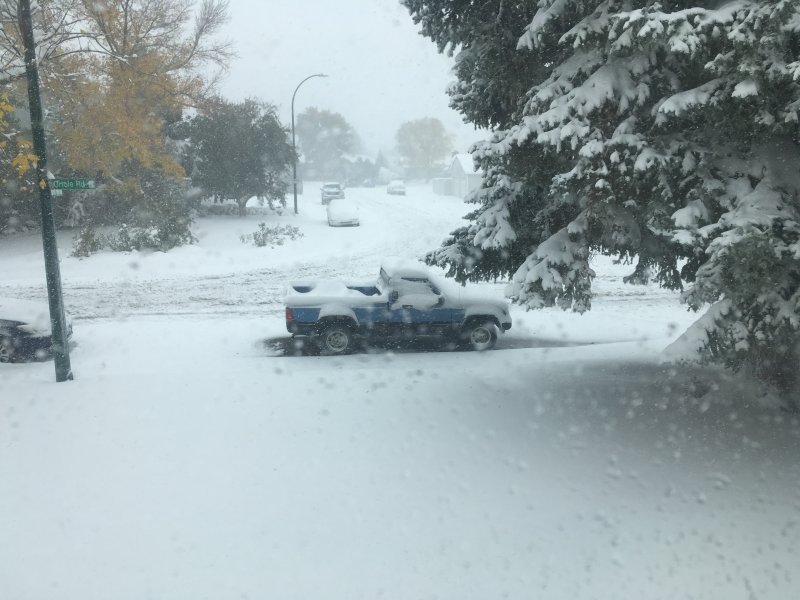
-
That time of year again, folks.
-
Foglights without the harness
gogmorgo replied to Dammerung's topic in MJ Tech: Modification and Repairs
I don't think they're stock either. They look like a Made-in-China set I picked up at Crappy Tire for cheap. Probably could the same ones in a different box at Walmart, or name-your-chain parts store. -
Shouldn't be an issue running a CV on only the one side, especially since you're looking for the driver's side. The ujoint doesn't know what's going on with the shaft on the other side. That said I would do (and have done) both myself, but you should know that if you put a single-piece shaft into the CAD housing, it won't seal properly on that side. There is a seal you can get that will do the job. There should be a DIY thread on here about prepping the CAD axle housing for a one-piece shaft.
-
Foglights without the harness
gogmorgo replied to Dammerung's topic in MJ Tech: Modification and Repairs
For reference, whatever fog lights you mount must meet SAE J583, in addition to only functioning with low beams, to be legal. Driving lights must meet J581, and only function with high beams. Number of lights and where you mount them on the vehicle also affect legality, but you can't just stick any old light below your headlights and call it a fog light just because it's below the fog lights. That may be obvious to most people, but it's a myth that gets brought up from time to time on social media and it's rarely refuted. But back to the subject at hand. The connector for the factory fog light switch always exists under the dash, or at least I've never seen someone say they couldn't find it. It takes power from the low beam side of the headlight dimmer switch, and feeds it through to one of the wires in the ten-pin headlight harness connector up under the air box. This wiring will exist from the factory. If you don't have a factory fog light harness you can tap into that wire at the headlight harness connector, like I did. I suppose you could add a pin and wire to the connector, but I just snipped and spliced on the truck side. I ran it through a relay to trigger my LED flood lights. The relay gets power from a fused line going to the battery. I also snipped the wire from the dimmer and connected it to a constant hot on the fuse panel, so I could control the lights independently from the low beams. I have soft covers ($7 a piece at Princess Auto) so it's legal to drive around with the lights mounted (but not turned on), even though they're not SAE fogs or driving lights. Some jurisdictions are more concerned about compliance, but most can issue a ticket for uncovered off-road lights, even if they're not in use. I'll get off the soapbox now. -
I don't happen to have a 4.0 handy because I'm about 400 miles away from home for the next month, but my 2.5L will fire up and idle with spark plug wires unplugged on cylinders 3 and 4. It wouldn't start on only a single cylinder, but that's not totally surprising. It was firing and it did have some inertia, it took it a few seconds to spin down and stop after I let go of the key, makes me think it would likely run with a heavier flywheel... but that's getting a little beyond the scope of the experiment. I see no reason a 4.0 wouldn't run on three cylinders. Three cylinder engines exist, and they do meaningful work. They typically have a 120° crank angle, same as a straight six. Generally they use a balance shaft because they don't have balanced reciprocating mass, but the three compressor pistons would help with that. Crankshaft longevity might be a concern because the harmonics of the compressor and not firing half the engine would be different from what the crank was developed for, so a healthy harmonic balancer would be critical. I'm curious why someone might categorically state it wouldn't work without producing any evidence to support their statement, or even any theory to support the hypothesis. Another "easy" solution would be to find a belt-driven compressor and drive it off the crank pulley, leave the engine as-is, but that also defeats the purpose of this thought experiment. And one more argument against using the exhaust valve is you'd only want it to pop open when there's more cylinder pressure than compressor tank pressure, which would mean a brief period at TDC. I don't think you'd be able to have a cam lobe profile that would open and close it quickly enough with such a short duration and still be strong enough to tolerate smashing into the lifter, even with a roller lifter.