

gogmorgo
-
Posts
5984 -
Joined
-
Last visited
-
Days Won
4
Content Type
Profiles
Forums
Gallery
Everything posted by gogmorgo
-
3.55 d30's are for sure easier to find. Almost every auto XJ has one.
-
Yeah, the only people I know who race are either doing it in LeMons, or else started out karting when they were kids.
-
By all means check everything people are mentioning. It is an older vehicle, and things that will affect your power output without obvious mechanical symptoms are frequently caused by components that deteriorate more with age than with use, like plastic vacuum lines, corroding wires, etc. If you haven't done Cruiser's tips that's somewhere good to start too. www.cruiser54.com But regarding AMC/Chrysler's choice of 3.07's, times were not the same when the 4.0 came out. The national speed limit was 55. HP levels were barely starting to recover after emissions controls, and fuel economy crises were still within public memory. No one expected a Jeep to be a powerhouse, especially not with a six-cylinder. Despite this fact the 4.0 MJ was a pretty serious contender, mostly because the engine control system was far more advanced than most others at the time. And as Hornbrod pointed out many things that we view as weak were perfectly acceptable to the general populace of typical pedestrian drivers. Dana 35's and Peugeot BA/10's have lived long and happy lives in many MJ's and XJ's, but beefier options were available to people who wanted more out of their Jeep. And you can't really compare it to more modern vehicles that are expected to cruise at speeds closer to 75mph than 55. Starting in the '90's as the national speed limit was being raised, everything was getting deeper gears, despite increasing power levels. In part this was due to larger tires, but people were wanting more performance out of their trucks, treating them more like regular cars, and it was just what was expected. As an example, the V6 KJ came standard with 3.73's, and tires that weren't really a significant jump from a 235/75r15. It wasn't until 2005 as fuel prices were climbing and fuel economy became more of a concern again that they put 3.55's back into the manual KJ's. But that's still 3.55's, not 3.07's, and the 3.7L in the KJ is a pretty good hp bump from the first 4.0's. Still then no one would've expected a six-cylinder SUV to be a huge performer, but 3.07's would not have been acceptable to most of the population, despite any modest mpg gains. 3.07 is a very tall axle ratio.
-
 I noticed that spot too in the photos, I think the flash makes it far more obvious than it is otherwise. Although I noticed the wear spot in the middle of the clutch pedal first and was thinking it showed a lot about how the Jeep was driven. The spot on the clutch is much more worn than the corner of the brake pedal, which is pretty common for somewhere like southern mb/sk where the roads are straight and flat and you can see most obstacles on the road a mile or two in advance. Also I suspect it would be more common for a vehicle driven by an older gentleman like I bought it from than a younger person like myself who is always rushing around. No problem. I'm also sorta on the lookout for another, changed my mind I think about parting out this XJ to manual swap my MJ like I originally intended to do.
 -
Pretty much my experience. Towing through Saskatchewan the roads are flat enough I could occasionally get 5th but it really didn't take much of an incline at all (to the point I didn't necessarily notice the incline) before it would loose speed, I think the longest I got out of it was 1/4 mile if that. Eventually I gave up. I'm guessing it's the extra drag from the trailer that overcomes the feeble torque you're putting down through 3.07's, not so much the weight of the trailer. But even unloaded it doesn't really accelerate much in 5th, 3.07's are less than ideal.
-
There was a thread a few years ago about someone else discovering the availability of these sending units. One for Renix, one for HO, the difference being the polarity of the sender, as pointed out. I'm guessing it's this one that you found: If you keep reading until the end you'll discover that it's just an XJ sender unit. Someone somewhere must have assumed the senders interchanged because the pumps did... Unfortunately not the case. A few members did however make them work, at least somewhat. The Delphi pumps aren't known for their quality. Could simply be you got a defective one.
-
If you're having issues maintaining highway speed in 5th gear on flat ground without either of a trailer or a significant headwind, something's up. I would expect low fuel pressure to cause other symptoms like stalling out or backfiring, or overhearing from running lean, but it's easy to check. What point do you shift at? In my XJ I won't shift into 5th until I'm up to speed. It's an overdrive gear, so I don't expect to do much accelerating with it, especially not with a trailer, and definitely not with the 3.07's. Without a load behind it it'll still hold speed on steep hills and even accelerate somewhat in 4th.
-
1992 XJ. tough to get pictures of the clutch/brake pedal mounts because there's so much going on. Also not being able to see where I'm pointing my camera. Hopefully you can figure out orientation of the shots from the location of the fuse panel and steering column. Gas pedal was easier though. If you want more pics from different angles I can try to get them.
-
My money's also on the 3.07's. Recently had the experience of pulling a trailer with my stock 4.0/five-speed/3.07 XJ. It's decently quick unloaded, even full of junk, but once hooked up to an empty UHaul 5x8 which they claim only weighs 900 lbs, it was a total dog. Barely even touched 5th on the flat, any sort of hill or a headwind and I was down to 3rd. My MJ, 4.0/aw4, 3.55's (same engine, just automatic and lower gears), doesn't seem to notice trailer weight quite as much. My '01 auto 4.3L Jimmy barely even noticed the UHaul when it pulled it over the continental divide to return it... Same hp with a spit more torque further up the rev range, but also 500lbs heavier than the MJ and 800lbs heavier than the XJ, 30x9.5's vs the 235/75/15's on both Jeeps, but most importantly 3.73 gears. Shouldn't be too tough to find a 3.55-geared MJ d35 if you want something bolt-in, although if you're up to setting up perches on a different axle (or fine with paying someone else to) that would be the way to go to get something with a little more beef... Later XJ 8.25 should be easy to find in a 3.55 and be a pretty good match, or a KJ will be a bit more work to cut brackets off but will likely come with 3.73's and disc brakes, but there are plenty of other common swaps as well... Beauty of a 2wd is you don't need to worry about matching the front ratio, unless you plan on swapping in 4x4. Just don't waste money and effort regearing a Dana 35. And like others have said, it really doesn't hurt to make sure your MJ's in decent running condition too.
-
I've noticed a similar effect with LED's. Although I don't much care for "fullness". Part of it I think is that the light is more polarized from an LED than from an incandescent bulb, so there's a lot less scatter when the light hits things, and shadows become much sharper. The other part I think is just that when you have a really bright light, the shadows just seem that much darker, as your eyes will adjust for the brightness and you'll struggle with the contrast, not being able to pick up anything in the shadow. I think I might struggle a bit more than the average person with dealing with that sort of contrast. I've been fortunate enough to have mostly lived in places that rank a 2 or a 1 on the Bortle scale, and when it's dark out, its DARK. It almost seems like in terms of illumination it's more helpful to have a bigger, more even spread of light than an actual brighter light that's still fairly focussed in a typical headlight pattern. Past a certain level it just seems like you're blinding yourself. Especially with very white LED's, colours get washed out, the "brighter" shadows moving around through the trees as your lights move make it harder to pick out things that might be about to step out in front of you, and it just seems to get worse as light gets added.
-
Just a tip with jengaing the alternator out... As much as it's tempting to do, pull the cables off first. They don't get all that much easier to get at half-pulled, but once you pull the alternator off far enough to get to them easily you'll have spent a fair bit of time maneuvering it to a position much more difficult to get it out of. At least that's what I did...
-
Those vacuum lines aren't just for emissions. They also do things like HVAC controls, cruise control, 4x4 engagement... Lots of stuff. I would trace vacuum lines very carefully before getting rid of them. As for a vacuum diagram, Google is your friend. https://www.google.ca/search?q=Jeep+xj+2.8+vacuum+diagram
-
I also had fit issues with the Delphi, and the hose clamps didn't hold it as well as they could've... After about a week I started "running out" with half a tank of gas. Obviously it either popped out of the pickup or otherwise started sucking air as the level dropped. I used the Bosch 69302 on recommendation of some members here, although I had a shop do it while they were replacing my gas tank (ran over a deer and insurance paid otherwise I would've done it myself) so can't really comment on fit, although since doing it I've seen some some people say that the adapters need some modifications to go into the holder.
-
And one other thing, regarding other people flashing you, making sure they're aimed properly will go a long way towards improving the headlights as well.
-
Is it actually still for sale? Craigslist ad was posted in November. As to the 4x4 fetching a higher price... A 2wd is a weekend and a $300 XJ away from a 4x4.
-
I'll point out that for my '92 XJ the resistance was 1.5Ω, not 1.1 as in your chart. 1.1Ω is stamped on one of the terminals but I measured 1.5Ω.
-
Did your truck ever have a/c or was it not optioned? If it did have and it was just disconnect during the swap there's a chance you still have the HVAC stuff installed, so all you would need is a setup for your engine. See what people with your engine as factory are doing for r134a conversions, then pick and choose components between those and your engine.
-
You can laser cut aluminum? A shop I worked with said they couldn't because it was too reflective. I guess it might depend on the alloy. Also, you should figure out how to draw up the source files and program the machine yourself. In most cases it really isn't that difficult, especially if you can just pull a cad-type file (or I've actually used a PDF with a smaller laser cutter) off a flash drive.
-
One other thing that hasn't been mentioned yet, make sure your lenses are clean. My MJ saw a lot of gravel highways and was constantly dusty, and between the brush guard and then wire rock guards on the lenses themselves, the lights are not easy to keep clean... But it makes a huge difference. Since the washer fluid bottle doesn't hold a whole gallon I would splash the remainder onto the lights every time I filled it. Or you know wash the truck regularly... But for me the truck would look the same a day after I washed it as it did the day before so it didn't happen as often as it should have. As to the silverstars I don't really find them much brighter, but it is a whiter light. I run my lights whenever I drive so they get used a ton... five years and 45000 miles later they haven't burnt out.
-
So in a classic herpityderp moment I got home after an exhaustingly repetitive day at work today, grabbed a beer, picked up my bottle opener off the counter beside it, and went "huh". It's the opener I keep on my Jeep keyring. I've literally had my keys in my hand three to six times a week for the last month and a bit, and been wondering the whole time what I did with them. Lol. So, vehicle 2 from above revisited. 1. 14.67 2. 3.82 3. 1.5 4. Pretty much as close to a brand new Bosch 69302 as you'll find. I also confirmed that my hotwiring technique does in fact hold the ballast resistor out of the circuit, as I could start and run it that way with the resistor wires disconnected, or pull them off while running without killing it. In contrast when started with the key it would die after a couple seconds if started disconnected, or instantly if I pulled a wire off while it was running with the keys. So now I'm wondering why it does that... Based on previous readings of the wiring diagrams I assumed all I was doing was alternatively turning the key, (and everything works when I start it like that! Except the steering and shifter interlocks) but I guess not. Obviously whatever tells the ecu to switch circuits isn't getting triggered. Huh.
-
Best bang for buck is to upgrade with a relay harness. Not only will it increase the output of your factory bulbs, it will eliminate the risk of your headlight switch setting your truck on fire. After having done this I have never felt the need for better than the factory lights.
-
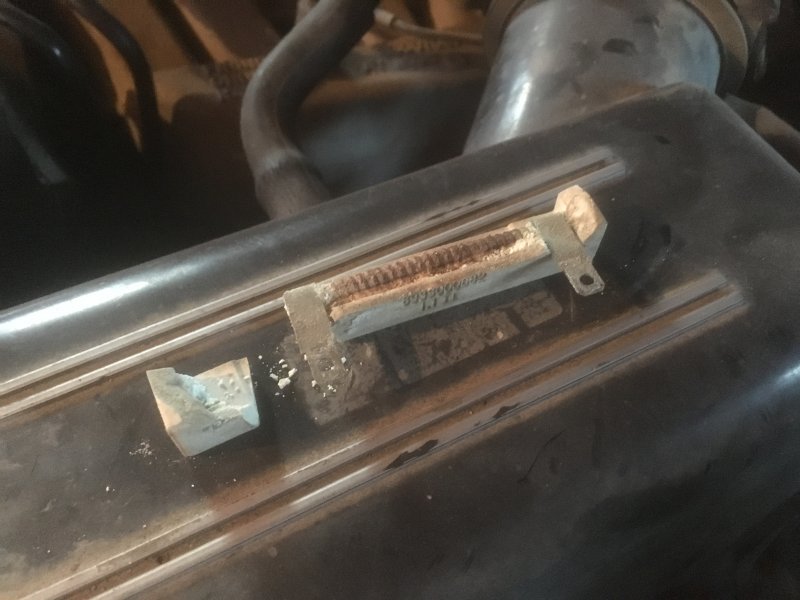
Two vehicles. vehicle 1 1992 XJ, 2dr Sport , 4.0/5-speed/231 1. 14.62 2. 3.64 3. 1.5 4. IDK suspect original @336,000km... Almost everything else is original. Frankly amazed the resistor still works. The reason I had bypassed it was because the terminals felt loose (and I didn't like how quiet the pump was, lol), but ceramic actually split in half when I plugged it back in. Had to scrub a ton of corrosion off the contacts before I could get a consistent reading. Incidentally in doing so I discovered one says 1.1 ohm on it. If anyone is curious what they look like inside: After running the resistor winding was warmer than ambient (~40°F) but not really warm to the touch, maybe just under body temperature. Vehicle 2, 1991 MJ, 4.0/aw4/242, 535,000km. 1. 14.76V 2. 0.221V 3. 1.5 4. Brand spanking new Bosch 69302, unsure of exact mileage on it but it was installed in November and it's mostly been parked... Maybe 100km, if that. I'll add a caviat to this that I've misplaced the keys for the MJ in a recent move (mostly I'm too lazy to look for them, my guess is they're in a jacket pocket somewhere), and I started it with a jumper wire from the constant 12V at the starter relay to the ignition fuse to turn it "on" and then another jumper across the terminals of the starter relay socket to crank it over. When I find the keys I'll start it "normally" to see if there's much change. My concern is the ecu circuit that bypasses the resistor won't have been disengaged by my, er, unorthodox starting method, especially given how my voltage drop across the resistor is an order of magnitude less than others. I had to scrub some corrosion but it stabilized at that, so I couldn't really do much more than that.
-
Yeah I don't use tapatalk. It's odd though that I'm still get notified about it.
-
1986 Comanche Xls Resto
gogmorgo replied to 19comanche86's topic in MJ Hardcore Tech: Epic Journeys to Greatness
Good job on picking up the project after so long! I really hope mine doesn't end up sitting that long before I get to it... -
92 Comanche pipe-dream come true.
gogmorgo replied to foxboy633's topic in Member Projects: Your Comanches
Hornbrod's is a long bed, clearance might be different on the short beds.