


Minuit
-
Posts
5139 -
Joined
-
Last visited
-
Days Won
13
Content Type
Profiles
Forums
Gallery
Everything posted by Minuit
-
Let us know what you think of the speed bleeders Don. I don't always have an extra foot around to bleed brakes and I'd like to know if they're worth it vs. say a Mityvac.
-
81-85 according to the grille.
-
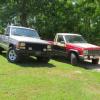 You're right Bo, it seems like the Eliminator wheels with the fake rivets around the face were gone for 1992. I can't find any picture of a 92 Eliminator with them. Those in the pic (and on every stock 92 Eliminator I can find) are just XJ 10-hole Gambler wheels. On that note, the 1991 Jeep brochure has pics of an XJ Sport and an MJ Eliminator with "Eliminator" wheels, and I've seen an old Motorweek review of a 1991 XJ, also with the Eliminator wheels, so at least for that year they weren't exclusive to the Eliminator either. So to make it short, your truck does have the right wheels after all!
 -
In my opinion, that truck has already lost its purity. It has the wrong wheels, and I would bet my life that it's been repainted. My advice? Don't worry about it. Just limit your mods to things that can be reversed - don't drill holes in it, don't make cuts in it, and don't weld on it. That's the philosophy I follow. Sent from my LG-D850 using Tapatalk
-
Yeah, for a swap like that the 5.0 is a much better option. Plus the 4.6 is really wide, so you'd probably have trouble fitting it in the engine bay. Sent from my LG-D850 using Tapatalk
-
I sees a D35. And an AMC DNR radio. And that bumper looks like it's seen some action and was then repaired. Why are these Barrett-Jackson trucks always built like this? "restored" is such a cheap word these days. What they really mean is "molested to my taste, probably not properly, then painted, probably cheaply"
-
I love the 4.6, even though it's just an early 2 valve model. One of the smoothest car engines I've ever seen and I personally like the way they sound. I've driven a '93ish Cougar with the low output 5.0, and the 4.6 definitely wins out stock vs stock. Not a strong as the 5.0 on the low end, but the 4.6 likes to rev. The T-bird is a really heavy car with tall gears, but it really moves if you want it to. I don't know how swappable the 4.6 is, but it's definitely a pleasant engine to drive. Of course your goals might be different from mine, but I use that car for highway driving in a straight line and getting 27mpg, and it does that very well.
-
OP here. I swapped the '89's blue shocks to the '91, and while it did make the ride a little smoother, it wasn't much of a difference. The '89 kept its (relatively) soft ride. It's gotta be in the springs - the '89 seems like it has much softer springs at both the front and rear. If I push down on the front bumper of the '89 it dips a couple inches, the '91 dips about half of that. Ditto for jumping up and down in the bed and on the front bumper. I don't know if the springs on the 89 are just worn out, but there seems to be a real difference in the spring rates. Regardless of which shocks are on which truck, the '89 has some "bounce" to it on bumps. The '91 recovers instantly.
-
Driveway Ornament To Daily Driver: 7 Years!
Minuit replied to Minuit's topic in Member Projects: Your Comanches
It's a new page, and a new era for this Comanche. If you've read this build thread any other way than "click on link and skip to last page," you'll for sure have noticed that this truck has taken a turn for the luxurious over the course of the last 5 years. In fact, I think it would be somewhat fair to say that this truck is currently now one of the most heavily optioned 2WD trucks on this forum, even though it didn't start life that way. This is a major step in that direction, since now it has joined the short list of Comanches with... power windows and door locks! We are now entering the fifth year of this truck's build. Holy $#!&, it's really been that long. I am starting to grow tired of the lack of apparent progress. I want to put my best effort towards having this truck in a finished or near-finished state by year's end. I've tried to write this update 3 4 separate times now. At first, it was one of those boring nothing updates, then I decided to scrap it. The second time, the power went out as I was writing it. The third time, I forgot to save it before I left for work. Maybe I'll get it done now! :wall: Even after this update, I'll still be behind. And this is only one of my two trucks. And then I need to write an update on the big white land barge... :papers: Going Soft: January 2017 Power windows had always been on the table, but I wasn't going to do it until I had a set of the 2-door switch panels on hand. Every now and then I would look, and find nothing in my price range. Until this truck showed up: A loaded 1988 Eliminator. Bucket seats, full console, power windows, power locks, fog lights, and not a single part was taken. Judging by LKQ's website it had gotten there the day before. I was so giddy to get my hands on a fresh Eliminator that I didn't take any pics of it until I was done taking the parts I wanted: The floors were even in brilliant shape. If they didn't have the vehicles supported by the floorpans at this yard, I would have cut the floors out of it to use on my trucks. And believe me, I took everything I could carry back that wasn't welded down, including those prized switch panels. After 3 years of changing my mind back and forth, I had the switch panels. They didn't even charge me for them. If I was going to do this, I had about 2 weeks to be done, so I did some quick on-the-spot research, and discovered that adding power windows and locks was quite a bit easier than I had thought, but for the most seamless install I needed either a 1991 or 1992 XJ donor. Here's why: 1984-1990: Crap. In typical Renix era fashion, the wiring is subpar. The passenger side switch is used as the master switch, with all current for the accessories travelling through basically the entire cross-body harness no matter what function was being commanded. In addition, there are no relays used for locking and unlocking, resulting in weak door locks. Door harnesses not compatible with other years, and no replacement window regulators are available. Door lock actuators are compatible 84-96. 1991-1992: Relays are now used for locking and unlocking at all times, and they are conveniently located in the cross-body harness. Window regulators are updated, and run faster. Door locks work very positively, and all parts are commonly available or compatible with something that is. Power for accessories comes from fuse taps that plug into the fuse box. Minimal splicing is required, as the power accessories are mostly standalone from any other wiring and simply need power and ground. 1993-1996: If you're swapping this into an MJ, get ready to splice! The door lock and unlock relays are now located in a relay center... in the dash harness. After finding that out, I quickly decided not to bother with a 93-96 donor. Window regulators and door lock actuators are compatible 91-96. Conveniently, a junkyard down the road had this '92 Laredo: It donated the cross-body harness, door harnesses, and door lock actuators. Make sure to get the red fuse-tap and a few inches of the other wires from the 10-pin connector on the cross-body harness. I didn't bother with the window regulators because... Tip: When pulling window regulators at the junkyard, look for a 1994 or later donor! They are riveted in on earlier years, and are a massive pain to remove and re-install. Thankfully, there was a 1994 Country with power windows right next to it, so I grabbed my tool battery to test, and once they tested good I had the regulators out in a jiffy. Hopefully I don't need to say this, but you'll want to test any used power accessory parts you grab in the junkyard. Both the window motors and lock actuators work by reversing polarity, so by swapping power and ground with a simple 12V power source (like the Milwaukee drill battery in the pic) you can test them fully. I've made up some test leads with a variety of different ends for different purposes. The Milwaukee battery is very convenient because quick disconnect terminals slot into the top slots on the battery. Overall, I've found the XJ regulators and actuators to be pretty reliable. I've never had a window regulator not move in the junkyard. Some have made some pretty crunchy noises, but they usually at least work. In a single day, I had the following cast of characters: Door switch panels: 1988 Eliminator Cross-body Harness: 1992 Laredo Door Harnesses (w/power mirrors): the same 1992 Laredo Door Lock Actuators: 1992 Laredo Window Regulators: 1994 Country Now that I had all of the key ingredients, before I took a single screw out of my truck I wanted the entire setup operational to make the swap go as smoothly as possible. Sitting crosslegged on the floor with the FSM wiring diagram in one hand and a test light in the other, I became one with Jeep power accessory wiring: I only hit one snag, and it was due to mixing up parts years: with the system powered up as the FSM directed, the power locks would only work from the driver side. If the driver side switch panel was unplugged, the locks would operate from the passenger side. After about three hours of very intense headscratching, I decided to pull up a picture of the back of a 91+ switch panel: Versus my '88 switch panel: See the difference in the foil backing on the lower left? That switch on the bottom left corner is the door lock switch. Anything that foil backing touches is grounded. Turns out, that when you mix a pre-1991 switch panel with 1992 wiring, the driver side lock switch grounds out the passenger side lock switch. Removing the foil from the lower left switch fixed the issue. If you want to read a few more details on this, and my sudden realization 2 hours after posting a help thread, look here. Since my wiring was from a 4-door Cherokee, and the 4-door switches are laid out differently, I needed to switch two wires around to be able to control the passenger window from the driver side: On a 2-door switch panel, the right front window switch is where the left rear window switch would be on a 4-door. Swap the wires for the LR and RF window, and you're golden. The small plug on the driver side can then be discarded. After that, the swap devolves into a simple matter of replacing components, adding wiring, and providing power and ground. Not much of it is interesting for the purposes of a build thread, so let's pick up after adding the wiring: The cross-body harness is run under the carpet padding in front of the shifter. In an XJ, it would be attached with small clips sticking out of the floor, but my truck didn't have those so I used tape. The carpet and interior panels will hold the harness well enough. The jute padding is temporary; I have a much, much better solution coming soon. The very nice thing about the 1991-1992 cross-body harness is that the door lock relays live here, independent from anything else. A pre-punched divot marked the spot for these. Here, you can see my grounding point of choice behind the driver side kick panel. All of this wiring was not meant to co-exist with the MJ's foot operated parking brake, but I made it work. Routing all of this stuff while still being able to use the parking brake and still being able to put the kick panel trim on was not fun. Lots of zipties were used to keep everything from shifting. ~to be continued~ -
Nice, it looks really clean for an '82, especially in Canada.
-
I have a similar problem to you, but mine runs good at speed. I do notice a big increase in power right at 3000 rpm (4.0s aren't supposed to have VTEC!), no explanation for that one. Have you gotten a spark tester and looked at the spark? My spark is orange and kind of inconsistent, which I'm sure isn't helping. Coil and wires are in spec on mine also. This weekend probably I'll be swapping to the '96 throttle body with onboard MAP sensor. I'll let everyone know if I see improvements.
-
What Minuit knows about stock Jeep radios
Minuit replied to Minuit's topic in MJ Tech: DIY Projects and Write-Ups
Thank you very much. I'm kind of surprised by how popular this has been. Thought I was the only one who cared about the factory radios. I have 2 radios I haven't put in a vehicle yet (the 8956007214 that came in last weekend and the 8956001910 which I just got the factory service manual for) so I'll get off my @$$ and do that probably this coming weekend. I have everything I need to make an AMC to 13 pin Jeep/Eagle plug adapter, so I'll probably put the 1910 I just got in the '89 soon. On the bench it sounded great, but I need to study the wiring diagrams to see how I can neatly make it play from an aux in before it finds a permanent home in a vehicle of mine. Here's what I don't have yet. I don't have a working 56009004, an AMC DNR, any of the '84 shaft radios or any of the pre-92 AM/FM only radios. I don't really have much interest in the AM/FM only Chrysler radios since they don't have the TP371 and TP471 pins, so I doubt you'll see those unless I get one very cheaply. So if you don't count the AM/FM and ultra rare '84 radios, this writeup is almost complete. Edit from the future: I have a good technique for aux input on the AM-FMs now. -
Making The Thunderbird Great Again
Minuit replied to Minuit's topic in Member Projects: Other Cool Stuff
No worries. :yes: I wouldn't want to be interesting now, would I? :doh: A visual inspection condemned the strut rod bushings, but just for poop and laughter I decided to kick the tire backwards and forwards to see just how bad they were. No wonder this thing couldn't hold an alignment - the wheel would move back and forth in the wheel arch more than an inch! It was even worse than this: For those who don't know, the strut rod on a MN12 car is roughly analogous to the control arms on an MJ - it's responsible for keeping the wheel in place forward-to-backward, and caster alignment is also done at the strut rod. Me kicking the tire is absolutely nothing compared to the forces the suspension will see on the road, and I could make the wheel visibly move forward and backward. The strut rod bushings are under a lot of stress on this suspension design, and they're typically showing their age well before the 115,000 miles this car has on it. This problem is further compounded by the aftermarket offerings, most of which are made of overly hard thermoplastic and are usually shot inside of a year, and can fail abruptly and catastrophically. The only good options are Ford OEM parts, which are at this point quite hard to come by. Another problem - the strut rod bushings have a metal sleeve inside of them that isn't like any aftermarket part. The OEM parts are all but gone, but if you can't save yours reproductions are available for... about $100. Sadly, this car has a curse that's going to show up time and time again... it's a RWD Ford car that's not a Mustang. You can build an entire Mustang with aftermarket parts off the Internet, but that's far from the case with a 1996 Thunderbird. Thankfully, these cars have a small but dedicated following and the essentials are usually available, but be ready to open your wallet. When I first got started with this car I thought I'd have an easy time finding parts... :rotfl2: -
What Minuit knows about stock Jeep radios
Minuit replied to Minuit's topic in MJ Tech: DIY Projects and Write-Ups
Minuit wanted to make sure that everyone knew that Minuit knows all of this information. Minuit can change the title if it offends you :D -
Making The Thunderbird Great Again
Minuit replied to Minuit's topic in Member Projects: Other Cool Stuff
Believe it or not, I haven't forgotten about this car. I just haven't done much to it other than a couple of fluid changes, but that won't last. I've gotten over being so pissed off at the paint situation on the roof, and other than being deep in maintenance debt this really is a pretty nice car. It rides nice, even with the rough strut rod bushings it drives fairly nice, gets an honest 25 MPG on the highway, and it's smooth and quiet. I'm probably going to have a longish (50 miles or more each way) commute in the near future, and I hope CC members will forgive me for not wanting to do that in a Comanche that empties its tank in 270 miles. Here's a summary of where I'm at. Not a whole lot has changed since the last update - I've maybe put 500 miles, all city, on this car in the past 12 months. - The front suspension needs Jesus, which wasn't a surprise. The strut rod bushings aren't completely gone, but they're well on their way. The upper ball joints on both sides aren't looking so great either despite the invoice I talked about earlier saying they've been replaced. The struts are getting tired - quick struts are $130ish for Monroe or $70ish per for a brand I've never heard of, so I'll probably buy the Monroe cartridges ($55 each from Rockauto) and take them to a shop and have the springs swapped over. It has aftermarket tie rod ends and lower ball joints, so those have been replaced at some point. New strut rod bushings have been ordered. - The new blend door actuator is sitting on my desk at this very moment. The automatic climate control has been behaving recently, but it'll probably crap out again soon. - Touch-up paint has been ordered, paint code WR. The original paint job is a tri-coat so the touchup definitely won't look perfect but it'll look a lot better than a few square inches of no paint at all. - The brake pulsation has become more noticeable. The rotors aren't visibly warped but the surface is pretty ugly. I think they'll just need to be resurfaced. Pads have plenty of life left - the brake noise I talked about earlier probably has to do with the rotors being ugly and the slide surfaces needing to be lubricated. - Tires need to be put out of their misery. The tread level is fine but both fronts are noticeably out of round and the sidewalls are showing early signs of cracking - the rears are in much better shape. The size is 215/70/R15 - plenty of options in that size. I'm considering the General Altimax RT43. For the type of driving I'll be using this for I don't need anything fancy. - I recently bought a Snap-On MT2500 scanner with everything I need to talk to this car and the Jeeps. According to live data the engine is running well. The check engine light is on, I believe the code is P0443 - evap purge fault. Also, it does burn some oil in a way that strongly suggests valve seals. It's a big job on this overhead cam engine, but I'll deal with it eventually. - Interior is typical of a semi-neglected 21 year old car. I broke the gauge cluster face the other day - those things are plastic of the "crumbles when touched" variety. It's a shame, because I've never seen another MN12 car with woodgrain interior trim. I found a blue gauge bezel out of a 95 Cougar in the junkyard - I think I'll have a go at painting it. The woodgrain is in rough shape anyway, so I'll try to find the other two pieces of trim (around the radio/climate control, and the center console bezel) and paint them to match. Anything with headliner material on it is trashed. I'll probably be recovering the headliner and visors in the near future. - I installed a set of NOS headlights since the originals were completely trashed. - The right power window motor is making a crunching sound and the window does not move. I'll need to get a look, but the most likely problem is a couple of plastic bushings have fallen apart. Parts are available to fix this for fairly cheap. - I intended to change out the odometer gears last weekend but I can't find the damn things :fs1: - This weekend, I cleaned the multi-function switch since the turn signals would cut out every so often and the "flash to pass" feature wasn't working. Not too hard, and beats the crap out of buying a new switch. Before: After: I added a very thin coat of electrical contact grease and put the assembly back together - getting the stalk to line back up in the casing was a huge pain, but it fell into place eventually. Everything now works as intended. Doing this inside of a trash bag saved my @$$ when the hazard light switch went flying :laughin: So yeah, a year and a half later and that's where the 'Bird stands. I want to press this car into more regular service, so expect to see some actual content soon. This won't be a "build" - pretty much everything I do will be bringing it out of maintenance debt. I won't be doing much in the way of modifications (except maybe performing the J-mod procedure on the transmission as the 4R70W is extremely "slushy" in its stock form), so don't expect this to be as interesting as the my adventures with the trucks. -
What Minuit knows about stock Jeep radios
Minuit replied to Minuit's topic in MJ Tech: DIY Projects and Write-Ups
Hey look, here's the 1988-only 8956002467, the very first Chrysler tape deck! Distinguishable by it's fader knob, which sticks out a little more. Also, the chassis and internal design is quite different. (Is it time to admit I have a problem?) It works, but the tape deck transport constantly cycles (common problem) and the paint on some of the buttons is worn off. Both easy fixes. -
Renix 4.0 factory MAP sensor replacement part number?
Minuit replied to big66440's topic in MJ Tech: Modification and Repairs
Many years of MAP sensors are actually GM parts anyway - Delco will be fine. Just Everyone Else's Parts etc. I wouldn't believe for a second that those sensors are NOS, but they really aren't too failure prone so I'd feel fine running a used one. -
Norwegian 86' 2.5L 4x4 XLS (Picture heavy)
Minuit replied to Roar Nesbo's topic in Member Projects: Your Comanches
Was it one of the wheel studs? Do you have a pic? -
I agree - not worth swapping the doors unless you wanted to swap the doors anyway. I added power windows and locks using my original doors and 99% factory wiring and it really wasn't that difficult. Certainly easier than swapping a door. Just a pain to deal with the rivets on the factory manual regulators. And for what it's worth, I don't think the old regulators really are that slow. Mine came from a '94 XJ and I didn't do anything to them. No lubrication, no cleaning, nothing - and I don't think they're slow. The main problem is the cable that operates the window - if the door doesn't drain properly it can get rusty and stick.
-
My scanner has a test where you can set the engine idle with the IAC and it responds to the test, so I'd assume the IAC at least works. I'll have to check to make sure the o-ring isn't torn up.
-
My '91 is running a little rough. Has been for a while, probably should've sorted it out by now. The idle is rough and usually a little low. It idles at about 680-750 RPM when my MT2500 says it's aiming for 720. The vibration goes away instantly with any throttle. Above idle it runs smooth. Also (possibly related?) it feels like it has VTEC - after almost exactly 3000 RPM there's a noticeable increase in torque. I've checked a few things, but I'm running out of ideas. Here's what I know: - Plugs and wires have about 20k on them. They look normal and are gapped properly. Cap, distributor, and rotor were replaced about 5k miles ago, but the truck was running rough before then. - The spark is purple-orange and not very consistent, regardless of whether it's at the coil or at the plugs. - Coil was slightly out of spec at 1.8Ω primary 10.3kΩ secondary. Replacing the coil improved things slightly ( 1.2Ω primary 12.8kΩ secondary), still not great. The coil to distributor wire measures about 2kΩ. I can't find a straight answer as to what it should be. - The coil is getting 12V when cranking, and the ground is good. - Timing advance at idle is 12-14 degrees with occasional jumps to about 17. - Vacuum readings are consistent at about 18 inHg. The vacuum line going to the MAP was replaced recently and looks and feels fine. - TPS reads exactly 0.5V when the throttle is closed. - I've checked for vacuum leaks and found none. The manifold bolts are tight. - Injectors are the originals. - If I listen by the exhaust I can hear an occasional misfire, but not very often. I've done all of the things people usually say to check. The spark is my main suspect, but I'm not sure what's going on since the coil is in spec (admittedly not Mopar) and it's getting 12V. I'm kinda at a loss :dunno:
-
1/2-20
-
Dakota parts on Comanche?
Minuit replied to GeorgiaJeeper93's topic in MJ Tech: Modification and Repairs
I think this was the main reason. Why sell a stripper Comanche (or even an Eliminator) when you could spit out a fancy expensive Cherokee Limited on the same line and make way more money? That and no desirable extended cab (when the Dakota had that option) made the Comanche a losing proposition to the bean counters, regardless of which one was better (and I do firmly believe that the Comanche was a way, way better truck) -
Oh man, I forgot about this thread entirely. Can't believe it's almost been a year since I bought the Bumblebee from you. Any news?
-
Of course, a tensioner would be quite valuable even with a brand new timing chain these days because most aftermarket timing chains are looser than the old ones they replace...