

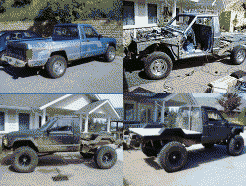
DirtyComanche
-
Posts
7945 -
Joined
-
Last visited
-
Days Won
11
Content Type
Profiles
Forums
Gallery
Everything posted by DirtyComanche
-
Because then we might actually know what's going on. Wouldn't want that, would we?
-
If it's on Facebook, there's a good chance it's wrong.
-
That's a front D44 spindle. Also used in the rear with certain bastardized full float/manual hub conversions (normally for flat towing), but those kits are quite rare.
-
Explorers are 38.5", or so I believe. Not gonna work.
-
I've got 32s and didn't cut anything. No idea what the issue is. There's these things called bumpstops, contrary to popular belief you have to adjust them in any situation where the suspension or tire size is modified.
-
No Start Condition
DirtyComanche replied to JustEmptyEveryPocket's topic in MJ Tech: Modification and Repairs
On average they do not live as long as internal pumps, although installation error likely plays a large part in this. The Ford pump that is commonly used actually works in conjunction with a first pump that is in the tank, which supplies the external pump with a healthy amount of head pressure. Going to a pump that was really meant to be installed externally and by itself may produce better results, but none of the aftermarket gasoline EFI ones seem to be very reliable. The diesel market is different because losing the pump is typically very costly, thus there has been good external pump (and lots of bad ones) available for a long time. -
No Start Condition
DirtyComanche replied to JustEmptyEveryPocket's topic in MJ Tech: Modification and Repairs
Yar. Wire the fuel pump in hot from the battery for testing. Also, you're likely to get sick of replacing external fuel pumps. -
Yeah, with two people it's not bad. Take the tailgate off first to make it a little lighter.
-
You could watch this incredibly boring video. It's relevant. Mostly. Otherwise I'd say just make sure the brakes are good, the fluids are full, and there isn't any of those "well, I've been meaning to get to that" things. And maybe throw a couple sandbags in the back for traction aids if needed.
-
Death wobble is trying to come back
DirtyComanche replied to Knucklehead97's topic in MJ Tech: Modification and Repairs
Is that TRE tight or not? If it isn't, fix that first. -
Just get an 8.8 or Liberty 8.25 (pretty certain they come 4.10).
-
I don't feel there is anything special about the HO trucks personally. Since the truck is so clean I would vastly prefer you don't butcher it. But it is your truck. And what it sounds like you want to do does not fall under what I call butchering.
-
Gm np241c question
DirtyComanche replied to Black Widow MJ's topic in MJ Tech: Modification and Repairs
NorthWest Fab has a yoke that I think will likely work. http://www.northwestfab.com/1310-NP205-Cast-CV-Yoke_p_2409.html You will need to measure your seal housing/seal to confirm, but I believe you'll need a different seal too, as the 1350 flange that's currently on there should take a seal with a larger ID. I think the one they list as going with it (for NP205 application) will likely work, but you would have to measure. Another option would be to get a Dodge 1350 CV driveshaft and change the yoke at the axle end or run a conversion joint. -
Yeah. Garbage. Cut it up.
-
If I get back to a laptop I could post pictures of what my XJ has. It's custom, there's nothing off the shelf that's really flat belly, and even mine isn't. Trying to stuff an acceptable exhaust through a flat belly is a challenge to start with, I'm even more hampered having a NP205 in there. However, it is possible to have a flat belly. If you run Wrangler clocking on your tcase with a slightly raised mount, there isn't any issues there. You will likely have to massage the floor a bit, but not a lot. The actual trans crossmember needs to be totally redone to work with this, and you'll need to go to 2" exhaust to maintain decent clearances. From there it's just a matter of fishing outstrips into the frame rails or welding them on from the outside.
-
I thought about it for doing an AWD street build. Worth it? I doubt it. And I wouldn't use that Mustang crap. If you're going to bother you might as well get something that actually has decent geometry. Assuming you can make it fit. It's not like the chassis was meant to run IFS and there would be some significant changes required.
-
I wouldn't try to clean it or throw mystery products in it. It's clean enough. So what if there's some sludge in the pan? It's not hurting anything, use quality oil and change it regularly, you won't have a problem.
-
In case it wasn't clear, I live in a climate that varies from +40 degrees C to -45 degrees C and I use only synthetic. I'm running Lucas right now because I get the best discount on it versus other oils with my account. I will run any major brand synthetic though. 10w30 all year. The "You can't switch oil types!!!!!!!11!!1!!!!one" thing is from oils of long ago, as in the 1980s. I believe you will find almost all decent modern oils have very similar effects on seals and carbon buildup at this point in time. Diesel oils are much higher in detergent agents though, and thus also have to run a lot more anti-foaming agents, but neither will adversely affect seals. Seals are not kept sealing by buildup on them. Engines you see that have massive sludge build up in them, and some "wise" person will say "Yup, that's what running Pennzoil will do to you" are actually the product of not changing the oil/filter often enough, it being contaminated by abnormal external factors (IE, running a K&N air filter will contaminate your oil considerably faster), contaminated by maintenance issues (very very small coolant leak into oil), the engine oil being subjected to prolonged temperatures outside of the range it was designed for (either by running it too cold, or too hot, for just too long), or using filters that are completely inadequate.
-
6.2 LS3/L99 and 6L80 in my LJ
DirtyComanche replied to Alexia's topic in Member Projects: Other Cool Stuff
That engine is a beast. Should be interesting to drive! -
The zinc isn't in elemental form. It's not plating it because it's melting, it's a chemical reaction.
-
Your opinion will be highly appreciated
DirtyComanche replied to MJ Hammer's topic in MJ Tech: Modification and Repairs
Are you going to wheel it? Then keep the 92. It's already broken in. -
Your opinion will be highly appreciated
DirtyComanche replied to MJ Hammer's topic in MJ Tech: Modification and Repairs
But that wouldn't annoy HOrnbrod, so I just don't see the point. -
Your opinion will be highly appreciated
DirtyComanche replied to MJ Hammer's topic in MJ Tech: Modification and Repairs
I'd swap the superior Renix injection system into the 92. Pick up a 89/90 4wd XJ for the donor and just stuff everything in. -
When hot enough it leaves a deposit on friction surfaces that acts as a sacrificial layer. Basically as the part wears it indiscriminately sticks zinc onto it to build it back up. IMHO, the issue of the lack of zinc in modern oils is massively overstated. Zinc was there because the oil sucked, the film strength wasn't high enough to prevent the cam from actually contacting the lifters, so something had to be done to prevent it from wearing the cam out. Modern gasoline oils, especially good synthetics, have upwards of several times the film strength of older oils, and you're not going to see anywhere near the number of contact events as with an older oil. Diesel oils, due to their extreme levels of detergents, will always have a much lower film strength than a comparable gasoline oil, thus they still need the zinc to not ruin cams as they're just not that good of an oil. Also, indiscriminately adding zinc to the oil, by using an additive like Camguard, can actually cause you far more problems than it will solve. Zinc actually becomes corrosive in high enough concentrations, and instead of coating the contact parts will attack the metal of them (it's actually essentially attacking it when it coats them to begin with, but it's not doing it that much so the whole thing is more or less in balance). I honestly believe the whole "There's no zinc in the oil and the world is ending" thing basically is the result of internet myth perpetuated by anyone that has any sort of a failure blaming it on the oil not having enough zinc. Yet there's plenty of beater XJs out there that have whatever the cheapest oil possible is put in them, by the worst oil change places in the world, on a "when I've got $30 to spare, don't need a pack of smokes or beer, and actually remember" maintenance schedule, and they're trucking along just fine with less failures than any comparable vehicle. Oh yeah, and throwing thick oil in it so you have "lots of pressure on the gauge" has nothing to do with how much pressure there is at the bearings, or if the oil will actually maintain it's film strength. GM figured it out a long time ago, it's more about flow than pressure. Low oil pressure is a symptom of wide clearances on parts or other wear issues, and adding thicker oil until it's back into spec doesn't do anything to fix the actual issue and is possibly even worse for the engine as the bearing surfaces need a lot of fresh oil on them to remain cool.
-
They rust there too.