

DirtyComanche
-
Posts
7945 -
Joined
-
Last visited
-
Days Won
11
Content Type
Profiles
Forums
Gallery
Everything posted by DirtyComanche
-
Ball Joints, U Joints, anything else?
DirtyComanche replied to nknapp16's topic in MJ Tech: Modification and Repairs
This. And the 51310X look like they're driveshaft ujoints. These are the 260X ujoints for early axles. Rockauto does not have them listed correctly. https://www.rockauto.com/en/moreinfo.php?pk=4937496&jsn=522 -
I believe you only got them with the full time tcases. I think by the time they went to the WJ they all got them... But could be wrong. I don't dabble in that stuff really.
-
Engine temperature gauge
DirtyComanche replied to tprman's topic in MJ Tech: Modification and Repairs
That won't tell you if you're overheating from a stuck tstat. Actually, it will only tell you if things have gone nuclear hot and the cooling system is completely saturated. -
Engine temperature gauge
DirtyComanche replied to tprman's topic in MJ Tech: Modification and Repairs
The factory put the sending unit there for a reason. It's the hottest part of the engine. -
They're mislisted. First one crosses to a P/N for a 91+ XJ, other one is definitely a Renix XJ.
-
HO exhaust manifold on a Renix
DirtyComanche replied to JMO413's topic in MJ Tech: Modification and Repairs
When deleting the EGR, it's easier to just use a pipe tap (I want to say 1/2" NPT) to thread the hole in the intake manifold, and then install a pipe plug in it, rather than making a blanking plate and getting a gasket. -
The ZJ ones are Cardone 663220 and 663221. Off Rockauto the pair of them is $107 CAD, or $81 USD. If you buy them it looks like a Timken unit bearing ships from the same warehouse, P/N 513107, $88 CAD or $67 USD each. The actual XJ/MJ CVs are Surtrack CH8220 and CH8221, about $50 CAD each or $38 USD. I have never purchased these but they should work, in theory at least, as they should be the ones used in rare applications with the NP229 or 228 or whatever fulltime Tcase. I did not purchase them because A) I have no idea if they actually fit and returning anything to Rockauto is horrible for me because it's cross border, and B) I do not know if they're as strong as the ZJ ones, which mattered to me. If you don't have the money to do the wheel bearings I would just pull the wheel bearing and axle shaft as a unit and put a new ujoint in it, and only on the side that's blown. The more stuff you try to take apart the more likely it's not going to go well. But that's me, everything I work on is rusty and having the stub shafts seized into the wheel bearings is common enough to be a real problem.
-
I'm not sure if the ZJ ones will fit directly into his axle because of the tone ring for the ABS. I don't remember when everything changed, but the earlier unit bearings have a different (extra) seal on them which fouls on the tone ring, which is a leftover from when they didn't use a sealed bearing assembly inside the unit bearing. He can either run the newer unit bearings, which may cause issues with how his rotors/calipers are spaced, or just pull the tone ring off. I pulled the tone rings off mine. Those CVs are almost certainly stronger than the early 260X ujoints. They might even be as strong or stronger than the 760X joints, but there is no reliable data on this.
-
Nuts are supposed to be 1 time use and new shafts almost always come with them. I say "supposed to" because people reuse them all the time with no ill effect.
-
aftermarket variable-assist power steering
DirtyComanche replied to omega_rugal's topic in MJ Tech: Modification and Repairs
Yes. Let me know if it works. When shimming the spring inside a very small difference in preload makes a significant pressure difference. I'd assume it will be similar if shimming it there. -
aftermarket variable-assist power steering
DirtyComanche replied to omega_rugal's topic in MJ Tech: Modification and Repairs
I don't know if it would work actually, you might have to turn the pressure down so much that it would be annoying at low speed, and I'm not sure if adding that much shim would keep the regulator functional or if it would just bypass all the time. A guy might need a new spring for that, which could be hard to source. The output fitting in the P/S pump has the pump pressure regulator behind it. You can take the fitting out the pump, it just takes a 13/16" socket or so, then fish out the regulator with a magnet, and then take the regulator apart by clamping it in a vice (use soft jaws, hose, etc to protect it) and undoing the cap off the end of it (1/2" wrench I think). There's a shim between the body and the cap of it sometimes, that's where you would add shim. Conversely, if you shim the inside of it (under the spring) you will increase the pressure. I had pictures of this somewhere. I've only ever turned them up, never down, so I don't know if it will change how things feel a lot. I don't really have data for stock(ish) applications. Normally I crank them up for people because they complain their oversized/badly scrubbing tires make the steering heavy/hard at low speed/in 4wd. -
aftermarket variable-assist power steering
DirtyComanche replied to omega_rugal's topic in MJ Tech: Modification and Repairs
You could also shim the regulator so the pump is only putting out 600-800 PSI. More than enough for maneuvering at low speed, but not a ton for the highway. Would only cost some time and a washer or two. -
Throttle won't open all the way
DirtyComanche replied to Deleted's topic in MJ Tech: Modification and Repairs
Got 'em all over BC too. Running on flat is absolutely different than in the mountains. People need to accept that their gear shifting arm is going to get some exercise. -
aftermarket variable-assist power steering
DirtyComanche replied to omega_rugal's topic in MJ Tech: Modification and Repairs
How about check your alignment and for worn parts. -
aftermarket variable-assist power steering
DirtyComanche replied to omega_rugal's topic in MJ Tech: Modification and Repairs
There needs to be a certain amount of backlash or the gears may lock up. But no, not much. -
Pump noise or pump life? I'm guessing the second was more important. All modern pumps are protected by a ballast resistor or PWM, they do not want to be exposed to full running voltage for long periods of time, and their max output is not necessary for the function of the engine. It allows you to disable the vehicle by pulling the wires off it and slipping them under the harness. 98% of thieves will assume the vehicle is broken and not even look, since it will start and immediately die. Of the rest, well, most don't know what they're looking for.
-
I leave them installed. I don't fully believe they were just there for noise. It is a very reliable part, and makes it easy to quickly disable the truck if need be.
-
aftermarket variable-assist power steering
DirtyComanche replied to omega_rugal's topic in MJ Tech: Modification and Repairs
I have a WJ pump and it absolutely doesn't have EVO. It fits the HO brackets if you swap pulleys or mill the bracket, so I guess it should fit a Renix bracket. I don't know what your problem is. With the WJ pump and hydro-assist I'd say my steering is a little touchy at highway speed, which isn't really a surprise given the flowrate of the pump and the amount of force the assist will put out, but my less modded MJ with a factory Renix pump and box is not at all. I think something else is making you perceive it as touchy, such as other worn out components or a lack of caster. Edit, if the V8 WJ has some sort of EVO, it would be after the T fitting to run the hydraulic cooling fan. I didn't take any of those components when I removed the pump. The XJ/MJ hose will fit the WJ pump if you swap the output fitting with the orifice in it, so likewise if you wanted to run the WJ lines to get the EVO you could probably just use the fitting out of the WJ pump. The only reason the WJ pump is ported and of a higher displacement is that it has to run the cooling fan continuously. I don't think it's an upgrade that anyone would want unless they had hydro-assist steering, or perhaps hydroboost brakes, otherwise it's a solution looking for a problem. -
Throttle won't open all the way
DirtyComanche replied to Deleted's topic in MJ Tech: Modification and Repairs
Revolution offers them, don't know who is cutting them or where. Dana didn't offer them for a reason. Regardless, that's only 10%~ lower. -
Floor pan question
DirtyComanche replied to All around mj's topic in MJ Tech: Modification and Repairs
As Jeep Driver says, don't go peeling it open just because you think it might be bad inside. It likely isn't. Take a hose and flush the inside of the rails out, then have a look in there with a small inspection mirror or a borescope. Chances are things are fine. If they aren't you can then assess what should be done. -
Yeah, if you want worm clamps go fully stainless and get them from a hardware store. Most other places have crappy plated ones that will rust out or strip in a hurry. If you want spring clamps autoparts stores should have them, find a counter guy that knows what he's doing. I generally run worm clamps but admit that spring clamps are better in ideal conditions (new hoses and undamaged fittings). Buy a pair of Knipex Cobra Pliers to make removal and install of them easy.
-
Instrament Cluster Problems
DirtyComanche replied to Phillip Gwin's topic in MJ Tech: Modification and Repairs
Probably the ground wire off the cluster chewed in two. -
Exhaust manifold bolts
DirtyComanche replied to 88whitemanche's topic in MJ Tech: Modification and Repairs
Probably. I should have mentioned I torque them to standard as per the pattern, not whatever they spec. I think they changed the torque on the 4.0 ones 3 or 4 times over the years. Also I'm a 4.0 guy and didn't realize this is a 2.5 thread. -
Laundry list of things!
DirtyComanche replied to Beau_41's topic in MJ Tech: Modification and Repairs
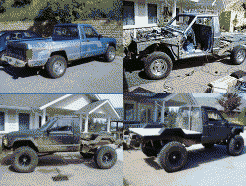
Yeah, that's mine. -
Laundry list of things!
DirtyComanche replied to Beau_41's topic in MJ Tech: Modification and Repairs
Yeah, if you use the wrong wheels. He also has about 18" too much lift. Ford HPD60, GM 14 bolt, and 37" Toyos. Reason I didn't narrow the axle... There's no point. If I did you lose turning radius, which in the grand scheme of compromises being a little wider isn't a terrible trade off to be able to hit the steering stops. With the flares on it's still wide... But really not. That said, no, I wouldn't use a D44 front from a Dodge. Or at least I don't think I would. I don't know a lot about them as they're a newer unit bearing axle, not that there's anything really wrong with modern unit bearings, but if I was to go that route I'd go Superduty and be done with it. That sort of swap is a whole different story though, and for 35s isn't at all a good fit. Honestly swapping any front axle that does not have at least most of the brackets in the right place is an involving process. At least now there's some decent bracket kits to do it, although I believe they all have drawbacks and compromises.