

AZJeff
-
Posts
1312 -
Joined
-
Last visited
-
Days Won
1
Content Type
Profiles
Forums
Gallery
Everything posted by AZJeff
-
Agreed. I ALWAYS use RTV on water pump, thermostat, and timing chain cover gaskets. The thin film helps seal any irregularities in the surfaces, and makes gasket removal MUCH easier if the job needs to done again for any reason.
-
That’s kinda hard to do with an in-line pushrod engine. You would basically have to revamp the design to OHC to make room for the exhaust ports/runners.
-
Front Suspension Replacement
AZJeff replied to RiversideMJ's topic in MJ Tech: Modification and Repairs
If you are replacing “front suspension parts”, the stuff you posted (with the exception of the track bar in the first picture) is all steering linkage stuff. You make no mention of installing new control arms and/or control arm bushings. if you are going to the trouble and expense of steering linkage, ball joints, and track bar, the control arms are a small cost adder at that point, and well worth the added scratch. The advice about avoiding “kits”, and using reputable brands such as Moog, purchased from competent on-line vendors like Rock-Auto, is also worth heeding. Nothing is more aggravating thank going through the effort of installing parts that turn out to be junk in short order. -
When I took engineering mechanics classes in college (a million years ago), we never discussed other variants of six cylinder engines beyond those used in ground transportation. The focus was on vibration and balance, as land transport devices will convey that vibration to operators/passengers. The straight six auto/truck engines have the added benefit of being balanced in both the primary shaking force, AND the secondary (harmonic) shaking force, thus making them very pleasant on passengers. I wonder why they use an alternative order for marine applications?
-
That’s interesting. I owned an E-type at one time, and don’t know if it applied to that model or not. Leave it to the English to go their own way with things automotive.🥴
-
I checked before I posted to be sure it was not a 2.5L. I guess I did not check carefully enough
-
The firing order on EVERY straight six in the entire WORLD is 1-5-3-6-2-4. unless the distributor is loose and turns, timing shouldn’t ever go out of wack
-
That’s a real possibility. I am going to try to remove the broken stub from the converter, and get a machinist I know to make a repair to this piece, since I don’t think it’s available as an item unto itself. And buying a new (reman) torque converter just to fix this piece is sort of extreme.
-
Yeah, as a retired mech engineer, I recognized that something is amiss to cause that failure. So that pilot piece is threaded into that hole in the converter?
-
Yup. That’s the part. I have already removed the flexplate from the old engine, and saw no cracks. I am going to see if I can pull the broken part from the torque converter to study the failure mode here.
-
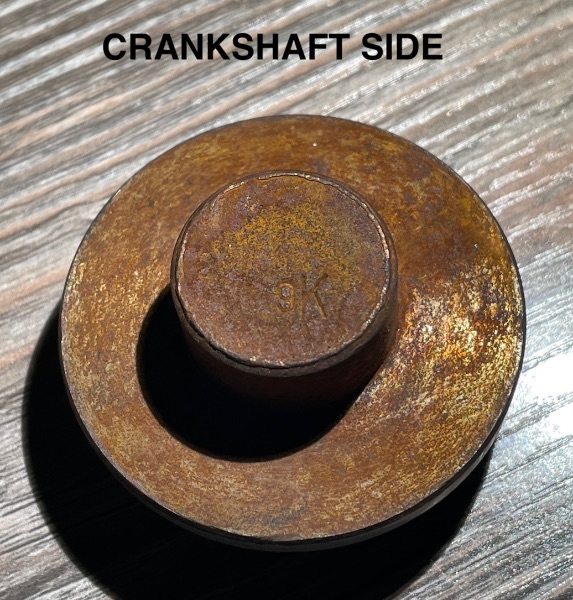
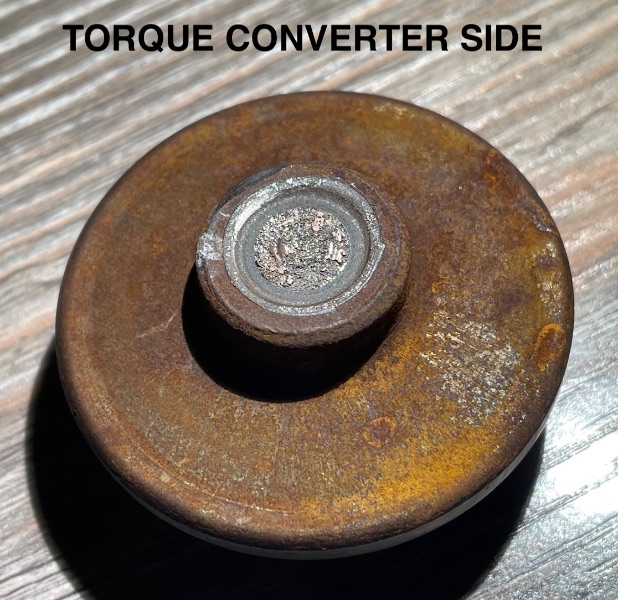
I pulled my old 4.0 engine in preparation of installing my newly rebuilt short block, and when I decoupled the engine from the torque converter on the AW-4, I found a strange piece located where the pilot bearing would be found on a stick shift engine. The piece is question has large flange that is inserted into the counterbore in the crankshaft in the same location where a pilot bearing would be found if the engine was connected to a manual transmission clutch. The other end of these piece has a small pilot stub that engages a hole in the front of the torque converter. This piece appears to be broken off flush in the front of the torque converter. I have not attempted to remove it yet, so I don't know if it's a press fit into the converter or not. The end that went to the crankshaft is loose enough that it fell out when the engine was lifted from the vehicle. WHAT IS THIS PART? I do not see it in the shop manuals I have for the XJ. I have seen it in YouTube videos of removing an AW-4, but nobody mentions if it's a loose fit or a tight fit into the torque converter, or if it's part of the torque converter assembly, or a separate piece. Wisdom and advice needed from those who have swapped engines or transmissions as separate items. I guess an even more pertinent question would be: is this part required? What happens if I leave it out? Will concentricity between the crankshaft and torque converter be reduced/lost?
-
88 4.0 rebuilt engine, blowing oil through cap
AZJeff replied to fiddlermj's topic in MJ Tech: Modification and Repairs
Those bearings are TERRIBLE for having been run for such a short time. That engine has serious issues that won’t be fixed by throwing a couple of quick parts at it. The wiping of the shells down to the copper layer implies SERIOUS wear, and all the bearings have significant dirt/foreign material scratching, which screws up oil pressure. oddly enough, the two main journals that are visible look like they might be able to be polished smooth. If you want this MJ to run reliably, I would start looking for a good used engine, or consider taking this one out and having a machine shop go through it from top to bottom. By doing that, the shop can fix all the stuff that is trashing those bearing shells and causing the weird oil geyser issues. -
88 4.0 rebuilt engine, blowing oil through cap
AZJeff replied to fiddlermj's topic in MJ Tech: Modification and Repairs
Wait a second. Your answer raises questions. 1. How do you measure the crank main journals in the car? You need to drop the crank to get the micrometer on the widest part of the journal, and that’s not easy in the car. 2. Thrust bearings don’t create shavings for no good reason. Did you check the thrust surfaces on the crank for scoring, etc.? Did you measure crank end play with the new thrust bearing installed? Was the thrust bearing damaged during installation? Did you remove the bearing to examine for damage to it and/or the thrust surfaces on the crank? 3. If you have “shavings” that entered the oil passages, they are all over the engine after it was run, and just cleaning the journals isn’t going to remove all that stuff that is floating around the oil system. Can you post a photo of these “shavings” (with something for scale) and describe exactly what locations in which you found these shavings. -
88 4.0 rebuilt engine, blowing oil through cap
AZJeff replied to fiddlermj's topic in MJ Tech: Modification and Repairs
Your issues are more than just a bearing that is a bit loose. (BTW, is that #3 rod, or #3 main bearing you are referencing?). If it’s a rod, it should be making a ton of racket when running if it’s as loose as you describe. Additionally, a loose bearing can cause journal surface damage that would need to be addressed before slapping an undersized set of bearing shells in a given journal, so some careful inspection of that journal is warranted. In addition, your description of streams of oil coming out of the pushrods/rockers would not be explained by this loose bearing. In fact, if anything, a loose crank bearing, be it a rod or a main, would cause more oil to leak out around that journal, and thus LESSEN the amount of oil getting to the lifters, and in turn, less oil being pumped up the pushrods. Further, have you done a DETAILED visual inspection of ALL the bearing shells and crank journals to try and find the source of the “metal shavings” you reported in your post on Sunday? BTW, what do the lobes on the camshaft look like? You need to roll the cam around and study them carefully with a flashlight for sights of pitting, scoring, etc. They may be a source of metal shavings. -
88 4.0 rebuilt engine, blowing oil through cap
AZJeff replied to fiddlermj's topic in MJ Tech: Modification and Repairs
Oil blowing out of the fill cap would be due to crankcase pressurization. Oil geysers from the pushrods would imply some serious blockage in the oil delivery system to the crankshaft, resulting in most of the oil going to the lifters, who, in turn, pump it up to the rocker gallery. Did you clean out all the cross-drilled holes in the crank that feed from the mains to the rods? Did you also make sure all the feed holes from the main oil galley that feeds the mains was clean? -
I would advocate for using a Reflex manifold gasket in lieu of the regular Fel-pro. The Remflex is more tolerant of sealing the juncture of the manifold and head.
-
Mildly Rough Clutch Pedal
AZJeff replied to White_Comanche's topic in MJ Tech: Modification and Repairs
Agreed. The rod itself only really has contact with the rubber dust boot, which provides almost no friction. The piston and its seals in the mast. cyl. bore, however, will drag massively if the bore or piston are corroded. -
If you install Brown Dog motor mounts, DO NOT use the ones with urethane in them, unless you only do trail riding. The amount of vibration that is transmitted by the urethane for street use will be QUITE noticeable. There is no need to try to source a rad without a trans cooler line embedded. The cooler line only travels up the one end tank, and thus not rob the rad of any fins and tubes. Just cap the two ends of the line on a 3 row rad, and you will be good to go.
-
Many engines locate the CPS at the front of the engine, and get the trigger pulse from a point on the front crankshaft pulley or harmonic balancer. I wonder why Jeep did not choose a similar solution, until I started studying the layout of the front of the engine. I concluded that on an MJ/XJ with the 4.0, due to the extremely limited space in that part of the engine bay, fitting the CPS in the front would be challenging, to day the least.
-
Is a MJ reliable enough for a daily driver
AZJeff replied to typicaljeepname's topic in MJ Tech: Modification and Repairs
Mine was a daily driver until I took the engine out to replace it. Once I heal from my open heart surgery, I will put the new (rebuilt) engine into it, and it will resume daily driver status. Then again, the list of stuff I have replaced over the years is so long that I more or less have an almost new 30 year old vehicle 😆 -
Death wobble is trying to come back
AZJeff replied to Knucklehead97's topic in MJ Tech: Modification and Repairs
This is VERY TRUE. Many people think the stabilizer will stop or “cure” DW. It does VERY little to mitigate DW on a vehicle that has any of the issues I listed as causes in my above post. -
Death wobble is trying to come back
AZJeff replied to Knucklehead97's topic in MJ Tech: Modification and Repairs
If you search the XJ andZJ forums on the subject of death wobble, the following facts regularly surface as primary culprits: Out of balance or out of round tires. loose or worn steering linkage components, including ball joints loose or worn control arms and/or track bar Note. that the steering stabilizer is so far down the list in mitigating death wobble as to be inconsequential. -
Virtually any of the hard plastic vacuum/vent lines on a 30 yr old MJ are going to be super brittle, and they will crack if you even look at them wrong.😁 if you want to fix this once and for all, I recommend replacing all the hard lines with appropriate sized rubber or silicone tubing.
-
20k is slightly optimistic. Last I heard, the number is closer to 16k. And that number includes vehicles that are registered in some state/province, but make not actually being driven.
-
Two questions: 1. Did you bleed the system COMPLETELY and in the proper order? 2. When you swapped boosters, was the booster new, or used? Likewise, was the MC new?