


AZJeff
-
Posts
1312 -
Joined
-
Last visited
-
Days Won
1
Content Type
Profiles
Forums
Gallery
Everything posted by AZJeff
-
One of the best ways to check for steering system looseness is to have a helper sit in the vehicle with the engine off and rock the unlocked steering wheel side to side until they feel the force to turn the wheel get high. This essentially takes all the lash out of the steering system. while the guy in the cab is doing that activity, you climb underneath and check each joint one at a time. The way you check the joint is both visual and by feel. the “by feel” part involves grasping the individual joint by hand, trying to encircle both halves of that steering linkage connection with your hand and fingers. You are attempting to feel for any relative play between the two parts of that particular steering linkage connection. this test only works on the steering linkage and on the track bar connections. The test for control arm looseness is only really feasible with a BRIGHT flashlight and visual inspection, looking for cracks in the rubber and/or permanent rubber deformation.
-
Steering stabilizers DO NOT remove vibrations. They merely reduce them. Pete M raises some good questions about/where the vibrations are felt. Based on the speed you stated, it sure sounds like a tire balance issue, but answering Pete’s questions will give some clues as to the source.
-
I already tried Wrangler knobs. They are significantly smaller in diameter. any other Mopar knobs of a similar era what would fit will be cracked just like mine are due to Arizona sun and heat. I guess I need knobs from some junkyard donor KJ from a region of the US that does not have the environment seen here in AZ.
-
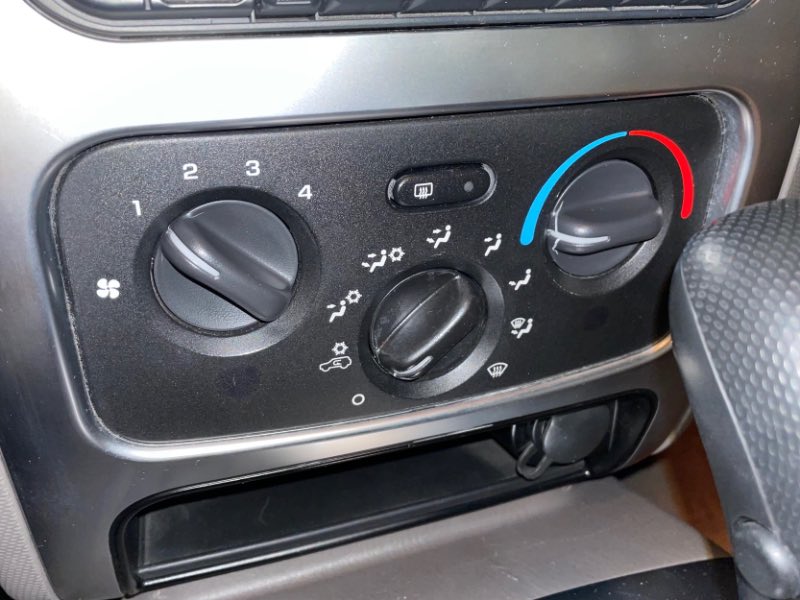
Here is what the heater control panel looks like. All three knobs are identical and interchangeable.
-
I know this is not an MJ question, but I need guidance from one of our experienced members here. My wife’s 2004 KJ has cracked heater control knobs. The heat and the sunlight are the culprits, and any junkyards here in AZ all have knobs in the same condition. Anything on eBay only lists complete heater control assemblies, which is overkill for wanting three new knobs. does anyone know of a source for either new or used good condition knobs for this old KJ?
-
Installing a Third Brake Light/Cargo Lamp Combo
AZJeff replied to LakeOzarkMJ's topic in MJ Tech: Modification and Repairs
My MJ has a third brake light/cargo light from late 1990’s Ford Ranger. It works quite well. The brake light is tapped into the circuit going back to the taillights through the floor of the cab. The cargo bed lights are tapped into the light switch connector. All joints are soldered and sealed with heat shrink tubing. be sure to use the appropriate gasket (rubber seal) between the lamp housing and the sheet metal of the body to prevent water intrusion. -
Identify my disc breaks
AZJeff replied to dreaminbohemian's topic in MJ Tech: Modification and Repairs
That looks like someone did a half-posterior job of adapting a set of KJ disc brakes to your MJ. I would start by taking the caliper and rotor off to see how much of the parking brake system is in place on the brake backing plate. You might need to clean or replace parts that are damaged or missing. the cable that goes to the actuation lever for the parking brake shoes on a KJ has a return spring that is much larger in diameter (And with lower force) than a regular parking brake cable on an XJ or MJ. It also has a clevis on the end that hooks over the actuation lever. KJ parking brakes are actuated from a lever on the center of the transmission tunnel, so they are of equal length. If you are still using the foot actuated parking brake common on the MJ, you might need to figure out how connect that pedal cable to KJ cables. -
Factory is 195*
-
Help with Bleeding Brakes, Please
AZJeff replied to guava_jelly's topic in MJ Tech: Modification and Repairs
-
Lots of guys claim the only thermostat worth buying for the 4.0 is Mopar OEM, but I have had NO problems using the "Motorad" brand from Rock Auto. Whatever brand you choose, make sure it has a "jiggle pin" hole in the flange of the thermostat to aid in "burping" the cooling system. If you cannot find one with a jiggle pin hole, and small (1/16") hole drilled near the perimeter of the thermostat flange can be made. Then make sure you orient the thermostat with this jiggle pin hole on the "12 o'clock" position when installing it in the head.
-
Your engine is running WAY to cold, even accounting for the near zero temperatures. replace the T’stat with a known good one set for 195*. Also, make sure your cooling system is holding pressure as designed.
-
The football type reservoir was used on all the later XJ’s. I cannot see how using on an older XJ or MJ would cause any issues in terms of storing residual vacuum.
-
Help with Bleeding Brakes, Please
AZJeff replied to guava_jelly's topic in MJ Tech: Modification and Repairs
Gravity bleeding the system is quite helpful in gettin about 80-90% of the air out of the lines. It can be messy, unless you have four hoses and containers to collect that coming out of the bleeders, but having all four bleeders open wide, while keeping the master cylinder full, will shorten the final “pressure bleeding” sequence quite a bit. -
Testing the vacuum system is pretty much start at the intake manifold by applying vacuum at the hose connection there. If it fails, move to the next juncture in the vacuum system, and apply vacuum there. Repeat on down the line until you get to a junction where you no longer have a vacuum failure. at that point, you now know where the vacuum leak is, and you then start inspecting the components at that juncture for cracks, dry rod of hoses, etc. having a vacuum diagram for your MJ will help you know where to look.
-
The easiest way to test the ball is to first REMOVE IT and inspect it visually for cracks or places where the two haves are bonded together and have separated. Then take the vacuum pump suggested above, and connect the hose from the pump to the nipple on the canister ball. Pump the handle a few times and watch the guage. If the guage on the pump drops back to zero in just a couple of seconds, the canister ball is leaking. there is a less expensive vacuum pump that Harbor Freight also sells that will do the job, if money is tight. https://www.harborfreight.com/brake-bleeder-and-vacuum-pump-kit-63391.html
-
The symptoms of “defrost only” air venting from the heater box is a sure sign of a vacuum leak. Have you actually tested the ball-shaped vacuum reservoir to see it hold vacuum? Have you inspected the heater control assembly for possible cracks or leaks? you say you replaced all the vacuum lines. Did that include the one to the reservoir?
-
Does Anyone Make this Heater Core T?
AZJeff replied to oleskool's topic in MJ Tech: Modification and Repairs
If it was my MJ, I would fabricate one from copper water pipe and the appropriate fittings, all soldered together. -
Dielectric Grease as Belt Treatment
AZJeff replied to AnotherOldJeepGuy's topic in MJ Tech: Modification and Repairs
Quoted for posterity. -
Dielectric Grease as Belt Treatment
AZJeff replied to AnotherOldJeepGuy's topic in MJ Tech: Modification and Repairs
MEK is gonna take paint off of anything it touches, and may be harmful to the phenolic resin PS pump pulley. Acetone would be the best choice. Soap and water and a toothbrush will also clean the grooves in serpentine belts of any silicone residues, and won’t hurt any plastics or paint. -
Dielectric Grease as Belt Treatment
AZJeff replied to AnotherOldJeepGuy's topic in MJ Tech: Modification and Repairs
That is WAY too loose for a 4.0 belt. That engine/belt routing requires an ungodly amount of tension to not slip, so such so that it does not deflect hardly at all with manual testing. placing silicone on a serpentine belt is a bad idea, for reasons mentioned previously. Now you have contaminated the belt AND the PULLEYS with that stuff. You need to get a new belt and, before installing it, get the silicone off the pulleys with generous amounts of brake cleaner an a toothbrush in the grooves of each pulley. (Silicone tends to migrate every wear, and it’s not easy to remove completely.) -
87 mj with 94 xj brakes and axles.
AZJeff replied to 87MJROB's topic in MJ Tech: Modification and Repairs
The definitive test for a bad booster is this: 1. Engine OFF. Pump brake pedal until it is rock hard. 2. While keeping brake pedal DEPRESSED FIRMLY, start the engine. 3. If the pedal “sinks” somewhat as engine vacuum is established, booster is working normally. -
Agreed. Given the small price difference compared to added output, the alternator with the biggest output that will fit is always the best choice. Side benefits such as faster battery recharging are also realized with this choice.
-
Harbor Freight (among others) sell infrared temperature sensing “guns”that have a built in laser pointer. Warm up your engine, and make sure the heater control valve is open to allow full coolant flow into the heater core. Using the temperature gun I described above, point the laser at each of the two nipples of the heater core. The difference between the inlet and outlet should be relatively small. If one side is much lower than the other, that’s a clue that your heater core is plugged. Whether flushing both directions will alleviate the low heat is totally dependent on what sort of crud is blocking the core🙁
-
“Not needed” does not mean “not beneficial”. Even if all it does is make the next gasket removal job easier, it’s worth the small effort to add a film of RTV before installation.
-
Fast idle after tire change WTF
AZJeff replied to Co-MAAAN-cheee's topic in MJ Tech: Modification and Repairs
If Oxgard is not available, dielectric grease (or plain old silicone grease) is quite effective in sealing out moisture and oxygen at the microscopic level where the electrical connection is actually made. I use this on ALL electrical connectors under the hood where the environment is less than benign.