
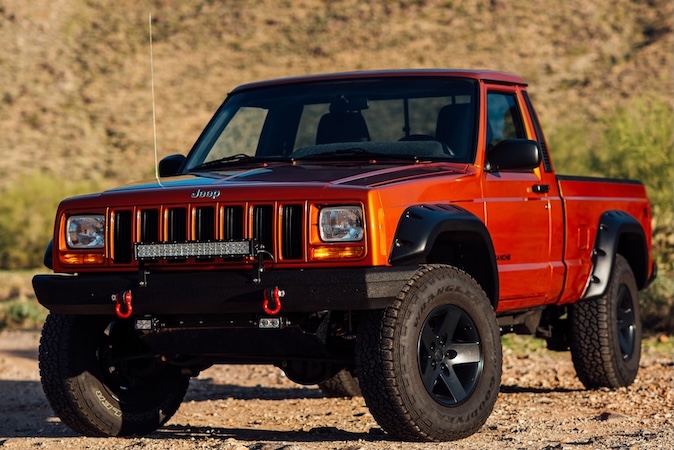

AZJeff
-
Posts
1312 -
Joined
-
Last visited
-
Days Won
1
Content Type
Profiles
Forums
Gallery
Everything posted by AZJeff
-
Yeah, that was the place. It was a great source for stuff.
-
There used to be a junkyard here in the PHX area that specialized in Jeeps. I went to them when i was looking for a sway bar for my MJ, since some previous owner had removed the one it came with . I was surprised that almost ALL of the ZJ, MJ, and XJ chassis in the yard were already missing their swaybars. Apparently, they are a hot item, at least out here in AZ.
-
I was gonna ask this too. The crankcase ventilation system can handle blow-by to a certain level, and then after that, it's too much, and the usual symptoms show up, like oil out the dipstick tube, leaky distributor, oil soaked air filter, etc. Tell us how healthy your rings are with a compression test.
-
If you can acquire a brand new ZJ bar, that would be the best choice. Since you have connections at a dealer on the west side, are you saying that a brand new OEM ZJ bar is still available? Just curious.
-
I would be quite surprised if a sway bar was able to be "narrowed" (as measured end to end) or "widened" due to poor recovery practices without the vehicle showing signs of damage where the sway bar is attached to the chassis. After all, this bar is made from forged spring steel. One thing I noticed is that the brackets that are welded to the axle housing, upon which the lower end of the sway bar link is attached, seem to be made from a forging, and not from a stamping. (My MJ has a late model XJ front axle, and those brackets are made from heavy gauge stampings instead of what OP's axle has.) I am wondering if those thicker brackets are part of the cause here. Is there some sort of difference in sway bar attachment points on the axle that happened over the years, or between 2wd and 4wd front axles?
-
Send a couple of pics so we can study the situation better and offer suggestions.
-
AC Compressor Pulley Misaligned?
AZJeff replied to MississippiComanche's topic in MJ Tech: Modification and Repairs
I have done conversions from R12 to R134a on several vehicles, and I have done write-ups on this forum before, so you can search for those. I a nutshell, converting to R134a will require the following: 1. new R134a compatible refrigerant oil (use the same amount as called for with the old R12 oil) 2. new o-rings on ALL connections that are compatible with new refrigerant oil 3. a new receiver/dryer (accumulator) 4 new shrader valves on the charging ports 5. evacuation of the system to remove all old R12 and confirm you are leak free 6. installation of a charge of R134a. The amount installed should be 80% of what the amount would have been for R12. If you have questions, fire away. -
Lexan or other thermoplastics won't be very scratch resistant, and some of them might even have UV light sensitivity, depending on what the exact thermoplastic of choice is used. For something like the race truck posted above, it's no big deal, because it's life expectancy isn't measured in years. For a regular street vehicle, though, getting a thermoplastic in sheet form that has scratch resistance and UV tolerance is going to be tough (and expensive).
-
Sway bar end link too close to coil spring
AZJeff replied to Duncan Moody's topic in MJ Tech: Modification and Repairs
Deleting a sway bar on a lifted vehicle is a VERY bad idea. Yeah, sway bars inhibit articulation over off-road obstacles, but they also LIMIT SWAY of the body in turns, and that's VERY important as the vehicle speed and ride height increase. If you want more articulation for off road, but some quick disconnect sway bar links from JKS or other suppliers. DO NOT ditch the sway bar. -
Grease, plus airborne desert dust = tan glop over every item so treated. Then I have to get under the KJ and wash the grease off before applying a new coat Rubber issues aside, you should see the bottom side of the wife's 2004 Liberty. It looks almost brand new, with no corroded bolts and all original chassis paint still fully intact. When I do have to work on it, it's like taking apart a car that is less than 6 months old from places like Minnesota.
-
I replaced the entire lower arms on the wife’s KJ with Moog from Rock Auto. However, my main motivation was dried/cracked arm bushings, and having a new BJ already in the new arm was a bonus. Rubber bushings live a hard life here in PHX, as road surface temps regularly get to over 140 degrees.
-
A "pin hole" to me is something of about 1/8" in diameter or less. Under that definition, I would drill them out to be round (assuming they are not) and them put a "pop" rivet into the hole. Then coat both sides of the rivet with automotive body seam sealer. If there a bunch of pinholes all located near each other, i would not recommend this approach, and I would install a proper patch in the sheet metal instead.
-
Here are two things to consider: 1. The distributor gasket's purpose isn't to seal against pressure, it's to prevent weaping of oil from out of the hole. If you are seeing oil leakage immediately upon startup, and the leak is steady, the o-ring/gasket isn't designed to handle such leakage, and crankcase pressure might be the culprit. 2. The distributor clamp's job is to prevent distributor rotation once the timing is set correctly. The amount of pressure needed to keep the distributor stationary isn't very high, if all parts are in good condition. If you grab the distributor, and try to turn it by hand with substantial force, and it does not move, the clamp is doing it's job.
-
As long as the flange on the distributor housing is in firm contact with the machined surface on the engine block, the o-ring should seal no problem. The forked clamp really plays no part in determining leak resistance other than making sure the distributor stays seated on the engine surface. If you are still getting leaks from your distributor, I have to wonder if your crankcase is getting pressurized due to the crankcase ventilation system being plugged up. Have you ever checked to make sure that the crankcase vent tube between the valve cover and the manifold is not restricted? One sure sign of crankcase vent problems is that oil vapors leak out around the grommets in the valve cover, and/or the air filter box is full of oily residue.
-
Assuming one cannot find a corner from a rusty bed, any SERIOUS body shop could fabricate a replacment corner using an "English Wheel" It wouldn't be cheap, but a new corner could be created and then welded into the existing bed. This method is often used in older vehicles where replacement parts are nearly impossible to find. However....given the relative ease at finding a trashed rusty bed from an MJ that still has good corners, the approach I suggest would be a last resort, unless you have lots of extra cash laying around.
-
Front aftermarket bumper opinions
AZJeff replied to Bugout 1's topic in MJ Tech: Modification and Repairs
I have a RockHard bumper on my MJ. I don't have the brush guard/bull bar for it, but it's a bolt on item that can be added as needed.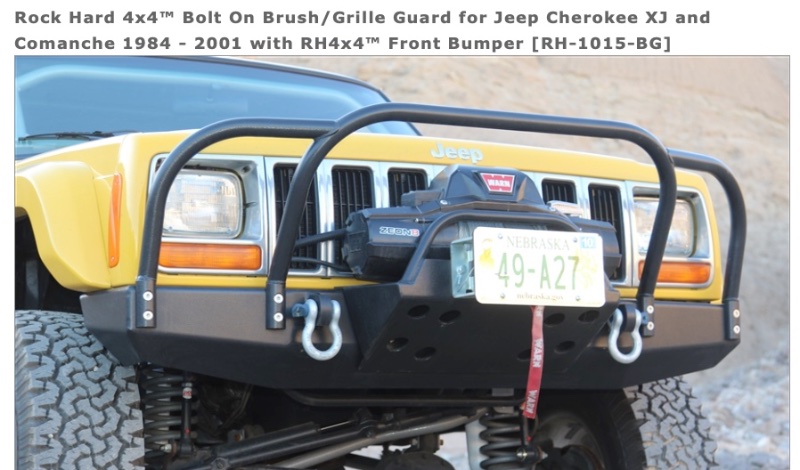
-
A small piece of plastic sheet stock, or thin aluminum can be painted and installed with small screws or "pop" rivets to block the hole. I did that on my dash where a previous owner had installed a big bracket for a two way radio microphone. Once painted to match the interior, it's barely noticeable.
-
1989 4.0 Comanche, Fuel Supply System-crash course needed
AZJeff replied to Dal3's topic in MJ Tech: Modification and Repairs
Wire nuts have NO place on automotive applications. For starters, they don't hold well in high vibration environments such as vehicles. Secondly, they are not sealed from the elements at all. Moisture will get into such joints and cause corrosion of the individual strands of the conducting wires and eventually create an open connection. The BEST connection of two wires is solder, with an outer coating of heat shrink tubing. Barring that, a crimp type connector with an outer covering of shrink tubing that contains adhesive is the next best choice. -
Here is my list of tips from that thread, repeated for posterity: I have owned multiple XJ's and now an MJ here in Phoenix, and all of them have run just fine in the heat. The secret to that is to make sure your cooling system is operating AS DESIGNED by Jeep. If ANYTHING has deteriorated below OEM spec, overheating is likely. Here are my thoughts: 1. I don't trust the temperature gauge on the dash to be particularly accurate. I alway confirm temperatures by using one of the infrared meters with a laser pointer on it (Harbor Freight for the win.), and I take my temps on the thermostat elbow. By doing that, you can sort of extrapolate how far off the gauge on the dash is from reality. 2. If your coolant is even the slightest bit cruddy, a flush is the minimum to do. When you refill, be sure you run the correct mix of antifreeze, because it not only lowers the freezing point, but it raises the boiling point of the coolant as well. 3. If your viscous fan clutch is more than 5 years old, replace it, regardless of if it "feels" OK. 4. If you don't have the electric fan in your MJ, install one (An improved one was used in the 97+ XJ, and is a worthy upgrade.). 5. If your radiator has any crud that does not come out from a good flush (an inspection mirror and flashlight is needed to see inside the end tanks to look for permanent deposits in the radiator), then consider converting to an open cooling system while you are replacing the radiator. It removes a bunch of weakness with the closed system pressure tank and cap. 6. If you are redoing the system to convert to open, ditch the heater control valve while you are at it. That plastic piece of junk is prone to breaking, especially with the heat we see out here. 7. If your hoses are even the slightest bit soft, you can expect them to get MUCH softer very soon with the higher under-hood temperatures. I just automatically replace mine as soon as I see or feel any squishiness at all. 8. While you are changing the hoses and/or the radiator, put on a new belt if the one you have isn't new within the past 5 years was well. The heat kills those things as well. I know guys who run the hood louvers, but I am not convinced it really helps the actual engine cooling that much. It might make the temperature of various components lower, but actual engine temps are not going to be improved that much.
-
If your original headliner backer board is solid, removing the old headliner fabric and installing new stuff from the vendor of your choice is pretty straightforward. There are lots of YouTube videos on how to do it for a Cherokee, and an MJ is just a smaller version of that. There are also “how to” sites on how to recover the sun visors as well. The job doesn’t require lots of special tools, just clean hands and patience.
-
Power Steering Lines Leaking
AZJeff replied to Warren99's topic in MJ Tech: Modification and Repairs
Order the ones for the 96 XJ, and they will fit fine on your MJ. -
'89 MJ 4.0L renix - Radiator fan question
AZJeff replied to TheGhostLight's topic in MJ Tech: Modification and Repairs
Given the age of the OP's vehicle, getting an OEM clutch and an OEM electric fan is about zero. That means aftermarket stuff. Buying from the local auto parts store is a crap shoot, and most of the time, the stuff comes from China, which always makes me leery. At least going to Rock Auto, you get to see what brands of stuff they offer, and choose accordingly. My MJ has a e-fan made by Continental, which although it is not OEM, it is a reputable brand out of Europe. The fact I could choose that brand (along with ones from China) on Rock-Auto makes them one of my favorite places to shop. -
Yeah, but the older fan, if working as intended, should not cause total overheating like the OP is reporting. The new fan should just give a bit more margin. I am sort of stumped here. The "plumping" of the coolant tank is to be expected, especially when it's older. I was expecting the OP to report some sort of pressure loss at the cap, since that is a COMMON issue with older closed system tanks. I keep going back to the fact that the vehicle only overheats when stationary. That is almost ALWAYS a sign of lack of airflow over the radiator. (I had an F150 that would do the same thing.) OP---I have a question. When your AC is running, and you come to a stop, does the interior cabin temperature start to climb noticeably? And then once you start moving again, it cools back down to what it was before you stopped?
-
So if you can escape traffic, and begin cruising at a steady 40+mph, do the temperatures return to the normal range? If it does that, it sure implies that not enough air is moving across the radiator when the vehicle is sitting still to dump the heat being put into the rad. Once vehicle speed raises the air flow rate, then the radiator can do it's job correctly. I am going to ask another question--do you have a OEM fan shroud around the mechanical fan?
-
It sounds like you are getting properly correlated temperature readings on the dash. I am wondering why they are so high, even for this area. From what you are saying, your high temperature problem is most evident in traffic, when airflow over the radiator is lessened, and the radiator cannot dump the heat generated by the engine. That can only happen if coolant flow in the radiator is reduced by some reason, or if air flow over the radiator is not adequate. 1. You have a new radiator. I assume it is at least the OEM 2 row type, correct? 2. Is your radiator filled with a 50/50 mix of antifreeze and clean water? 3. Have you confirmed the electric fan is working, and coming on when engine temperatures reach about 215*? 4. What is the condition of the thermostat in the engine? You say it is new, but have you actually checked its' function outside the vehicle? 5. You say you have a new clutch fan. Does it seem to be functioning as expected? (I wonder if it's defective.) 6. Does your MJ have factory AC? If so, is the condenser free of any obstructions of airflow? (dried mud, tons of dead bugs, etc.) I am looking at ways the radiator isn't getting the airflow it needs. 7. Are your upper and lower radiator hoses nice and firm (when cold)? A soft lower hose can collapse under water pump suction, and restrict coolant flow. One last question: when the engine temperature begins to take off for the moon, does the engine actually begin to boil over via the pressure tank, or has the tank and it's cap contained the pressure while it's exceeding normal limits?