


AZJeff
-
Posts
1311 -
Joined
-
Last visited
-
Days Won
1
AZJeff's Achievements
MJ Junkie (6/11)
-
Coolant Loss. Dip stick clean, and no leaks
AZJeff replied to RG67MA's topic in MJ Tech: Modification and Repairs
A sharp wood chisel is a EXCELLENT tool for removing old gasket material BUT…only use it on iron and steel surfaces. The chisel can easily gouge aluminum surfaces if you slip while scraping. An electric drill with a wire wheel is very useful for cleaning gasket surfaces as well, and can safely be used on aluminum if you don’t get to aggressive with it. -
The doors that direct flow inside the heater box are vacuum operated, as I suspect you know. The default setting for those doors (when no vacuum in present) is the "DEFROST" mode. The fact that you cannot select any mode but "defrost" suggests that you are not getting any vacuum to the heater control assembly, which is used to port the vacuum to the various vacuum servos to move the doors to the selected positions. The first thing I would do is to put a vacuum gauge on the vacuum line that goes through the firewall to see if vacuum is actually getting side the cab of the MJ. Do this with the engine running, and then also with the engine off. If you are getting no vacuum, then you have a big leak on the firewall side of the vacuum system that needs to be uncovered and repaired. (The vacuum line running under the battery box is a common source of leakage.) If you ARE getting vacuum to that line with the above test, then the issue is inside the passenger compartment, somewhere between the entry through the firewall and the heater control assembly. (Another way to check this is to put a manual hand-operated vacuum pump on the vacuum line entering the firewall, and pump to create a vacuum. Then move the heater "mode" slider to various positions, and see if the air goes out the appropriate vents in the dash.)
-
Head replacement: what else to do?
AZJeff replied to hgeranium's topic in MJ Tech: Modification and Repairs
Among the things often missed to consider during a head R&R is upgrading the intake manifold gasket from the OEM type that is hard to get to seal properly. I always use a “Remflex” brand of gasket. They cost a bit more, but are SO MUCH BETTER at staying sealed. Also consider switching the lower manifold bolts in the head to studs and nuts. It will make manifold installation much easier. -
another coil spring question
AZJeff replied to jamespwsullivan's topic in MJ Tech: Modification and Repairs
The proper place to measure coolant temp is at the thermostat housing elbow. Coolant temp will be within 1-2* of measured surface temp. -
Wanted wiring harness for 88 4.0 auto
AZJeff replied to aussiebob's topic in MJ Tech: Modification and Repairs
The easiest fix is to obtain a bunch of rolls of appropriate wire in guages that are at least as heavy as the OEM. Multiple colors will help, as will a wiring diagram for your model year. Do this one at a time: 1. Cut out the burnt/melted wire at each end of the damaged area. 2. Using a wire of gauge the same or maybe one size larger, splice in a replacement wire to replace the cut section. 3. DO NOT use butt splice crimp connectors. I have seen too many of those wind up creating high resistance connections that causes further wiring melting. 4. Either use solder-type butt splices that use low temperature solder (that can be activated by a heat gun) or do the old fashioned solder and heat shrink tubing to restore each connection. I know this sounds like a PITA, but early XJ/MJ wiring was sorta marginal, and fixing wires that were flakey with improved current carrying capacity (and reduced chances of heat damage) is a good thing. My fuel injector harness on my XJ HO engine developed this issue due to engine heat, and after I discovered how pervasive the damage was, I bit the bullet and fixed all the suspect wires. Underhood (or under dash) wiring fires are no joke. -
Wanted wiring harness for 88 4.0 auto
AZJeff replied to aussiebob's topic in MJ Tech: Modification and Repairs
What is driving the need for a replacement harness? Broken/chafed wires, or trashed connectors? -
Frame Rot :(, What Are My Options?
AZJeff replied to VorTekX's topic in MJ Tech: Modification and Repairs
That’s a solid plan. -
Locking together Exhaust and Inlet Manifolds
AZJeff replied to aussiebob's topic in MJ Tech: Modification and Repairs
I assume you are referring to the manifolds on the 4.0, because they are larger. I find installing the exhaust first LOOSELY and then fitting the intake works best. i also ditch the stupid OEM manifold bolts for all of the lower attachment points, and instead use studs and nuts. It makes alignment about a million times easier. The only ones I retain with the OEM bolts are the upper ones that attach the intake only in between cylinders 2 and 3 and between cylinders 4 and 5. -
Steering column is loose! I can move it left-to-right.
AZJeff replied to MJ 4.0's topic in MJ Tech: Modification and Repairs
Here is a really detailed explanation of how to rebuild your GM tilt mechanism to work like new again. Fixing a loose tilt column -
That is correct. I did this to my MJ about 8 years ago, and it makes a MUCH cleaner installation, and eliminates the potential for rusting where the bright metal trim would rub/vibrate on the painted edge of the glass opening.
-
The clips are ONLY used on the windshield trim when using the bright metal trim pieces. If you are using the one-piece rubber surround trim, no clips are needed. i would be concerned that your glass installer doesn’t know what he is doing if he thinks he needs metal clips to install a windshield with the rubber surround.
-
Any junkyard with a 4.0 from an XJ or MJ will fit the bill.
-
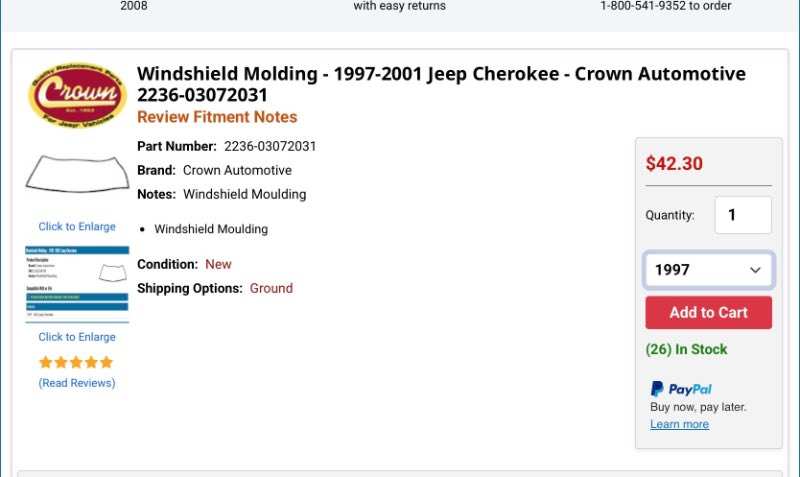
A quick search showed several suppliers who carry this one
-
It’s odd that your glass guy does not have a line on that rubber surround, given that the seal often becomes permanently bonded to the glass during installation and must be replaced when new glass is installed. A clarification here: that rubber piece is NOT a gasket or seal. Its presence (or lack thereof) will play NO PART in making the glass-to-body joint waterproof. That rubber piece is there strictly to fill the gap between the edge of the glass and the opening in the body shell.
-
Safelite is a bunch of idiots, obviously. The only real difference in the windshield between the 97+ XJ and the older MJ/XJ is that the later style has a rubber gasket that slips over the end of the glass and surrounds its perimeter, whereas the older style had separate metal trim pieces that covered the gap between the edge of the glass and the body. The actual method of attachment of the windshield to the opening in the body of the vehicle is identical in both variants and employs the usual urethane adhesive. In actual terms of installation, that the rubber gasket, even when present in an original installation, often is permanently bonded to the old glass with excess adhesive, and cannot be reused. That means having a replacement rubber gasket is always prudent if you are the glass installer.