

AZJeff
-
Posts
1312 -
Joined
-
Last visited
-
Days Won
1
Content Type
Profiles
Forums
Gallery
Everything posted by AZJeff
-
Brand New A/C will not charge
AZJeff replied to AeroNautical's topic in MJ Tech: Modification and Repairs
I would check to make sure you have good adapter fittings first of all, as others have suggested. About the only other way you could have high pressure is either a blockage or too much refrigerant oil. This may be important because evacuation does nothing to get rid of old refrigerant oil, and if you reused any old parts, who knows how much oil may be in those parts from the past. You said "brand new components", so I assume this means new condenser and accumulator. Those are important to a conversion, since the old R12 oil tends to settle in those two components. If you replaced those, then the R12 oil (no matter how much) isn't in the equation there. -
DOH.....I HATE when I jump the gun and don't check which FSM I consult for the pic. Yup, I posted the pic from the 2000 XJ manual. Your pic is correct. Sorry.
-
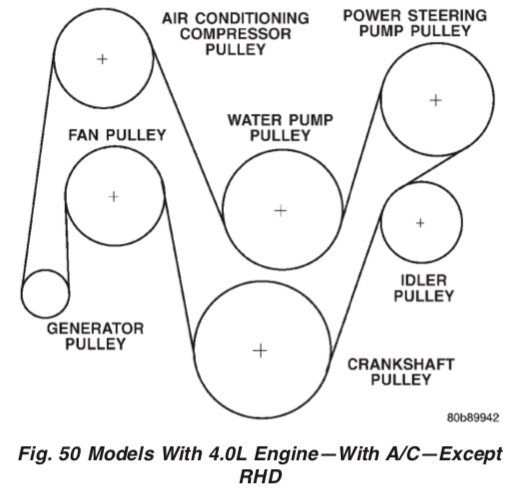
Here is the belt diagram for the 4.0 with AC.
-
Do you have the factory wiring diagrams for your MJ? If not, that is probably the FIRST thing you need to get, as it will help you determine what is add-on versus what is stock (and possibly "repaired"). I hate digging into vehicles where people who don't know how to do proper wiring have been messing around.
-
The lowest pulley is the crankshaft. The one directly above it is the water pump. There is a weep hole on the bottom of the water pump "snout" that supports the shaft sticking out of the front of the pump. The weep hole allows leaking water to leave the pump and avoid instantaneous distruction of the shaft bearings. SIgns of weepage at that hole means it is new water pump time.
-
Fuel Tank Alterrnatives--Very Technical
AZJeff replied to AZJeff's topic in MJ Tech: Modification and Repairs
That makes sense. It's odd that the later injectors are fed higher nominal pressure than are the older ones, but an aftermarket regulator should give me the pressure I need without resorting to the old vacuum controlled regulator rail. -
Fuel Tank Alterrnatives--Very Technical
AZJeff replied to AZJeff's topic in MJ Tech: Modification and Repairs
-
Fuel Tank Alterrnatives--Very Technical
AZJeff replied to AZJeff's topic in MJ Tech: Modification and Repairs
FSM says the spec. for the MJ pump is 31-39 psi. -
Fuel Tank Alterrnatives--Very Technical
AZJeff replied to AZJeff's topic in MJ Tech: Modification and Repairs
So the earlier pump should work with the later injectors no problem. That's good to know. Now does anyone know if the guage sender in a stock MJ tank will work with the late-style XJ gauge? I ask because the late model XJ guage does NOT get it's signal directly from sender. On the late XJ, the sender provides a variable voltage to the ECM, which in turn provides the guage with it's signal. The XJ sender is expected to send 0.6V at "FULL" and up to 8.6V at "EMPTY". What range of voltage comes out of the MJ sender over it's range of sweep? -
Sorry for the following novel, but I have to explain why I am asking the questions: The Previous Owner installed a 2001 XJ engine/trans (and instrument panel) into my MJ, and it of course it employs the late model OBD-II engine control system. This system requires a fuel pressure of about 49psi into the fuel rail, which an original MJ fuel pump will not deliver. To achieve this higher pressure, apparently the P.O. chose to use the late model combination fuel pump/pressure regulator/fuel sender from an XJ. SInce this assembly won't fit into a standard metal MJ tank, so he installed some unknown plastic Mopar tank from some OTHER vehicle, which is capable of taking the late XJ pump assy. This all sounds good, right? It runs great....just don't look under the vehicle at the fuel tank, because it's RUBBING on the DRIVESHAFT!! Worse yet, there is no way this tank can be moved over to make clearance to avoid this rubbing. The tank has GOT to go. So....I want to figure out how to use a more suitable fuel tank that will still allow some sort of fuel pump of higher pressure and the sender from the XJ type assembly. I am pretty sure that some others have done this, but I am looking for some advice of what is the best route to take here.
-
Thanks for the added info, guys
-
The column from a Cherokee of similar years will fit just fine, and most XJ's had floor shift, even as an automatic. When you scoop up the column, you can also get the console and the floor shift assembly at the same time. Cherokee buckets will also work, but you might need to do a bit of adapting to the floorpan. The only problem I see is that a seat that old might be in rough shape. Depending on your budget, a new seat intended for XJ's might be the best (most comfortable, best looking) choice.
-
Noise after replacing starter
AZJeff replied to Lftrn97's topic in MJ Tech: Modification and Repairs
Starters on 4.0 engines don't need shimming. When you had the new flex plate installed, I hope the installer inspected the attaching bolts for damage from the previous cracked flex plate, and he also used Loctite and a torque wrench when he installed the. You might take the dust cover off of the bell housing and do some visual inspection with a flashlight and a small mirror. -
When I used to frequent the XJ forums, the general consensus at the time was that the only real reliable fuel pump for the XJ was the Chrysler OEM one. All the others (Airtex, Bosch, Carter, etc.) had a nasty habit of dyeing an early death. That consensus was also 4+ years ago. What does anyone have to say about fuel pumps for MJ's? Are any non-OEM ones worth their salt?
-
87 dana 30 non CAD outer axle seal replacement
AZJeff replied to IronManche87's topic in MJ Tech: Modification and Repairs
This should do the trick for you: http://gojeep.willyshotrod.com/HowtoD30AxlesSeals.htm -
Comanche runs only with the key held on run.
AZJeff replied to Krisbodean85's topic in MJ Tech: Modification and Repairs
The 4.0 engine has a fuel pump ballast resistor that is mounted on the firewall just below the cowl. This resistor is designed to drop the voltage to the fuel pump, but ONLY does it when the key is in the "RUN" position. When the key is in the "START" position, power to the fuel pump is sent via a different path. It sounds like your fuel pump is only running when the key is in the "START" position, and that is a sign of a failed ballast resistor. -
Hydraulic parking brake for 97 to 01 with discs
AZJeff replied to JeepcoMJ's topic in MJ Tech: Modification and Repairs
They worked OK on my XJ, but I will admit they need to be adjusted VERY carefully. Even then, I would not trust them to be the only thing holding the vehicle on a serious incline. That's what "Park" is for, or putting it in gear with the engine off. To be honest, even the conventional parking brake on the Bendix-type drum brakes isn't the greatest, as it tends to work better against forward rotation than it does backward movement. -
I agree with Eagle. If you are on a limited budget, a lift of NO MORE than 2 inches is still both functional and practical. It won't break the bank, and it won't create some sort of mechanical monster that has bad handling and road manners. Welcome to the club. We are all glad to help!
-
I tend to agree.
-
Hydraulic parking brake for 97 to 01 with discs
AZJeff replied to JeepcoMJ's topic in MJ Tech: Modification and Repairs
It should work just fine. But..... For most applications, a mechanical parking brake should work fine. The idea of a mech. brake is that it is used for added 'locking' of the vehicle once it's not moving. That works well under two conditions: (1)the brake is not left applied partially and you drive off, dragging the brake and burning up the parking brake shoes. and (2) the parking brake does not freeze "on" in certain climates because of water in the parking brake turning into ice during an overnight parking situation. (This happened to me on a 1961 Ford when I was a kid, and it sucked.) If you have properly adjusted parking brake components that are adjusted, and the cables are lubricated and adjusted properly, the mech. parking brake does just fine. Deleting it is more a case of a personal experiment, rather than necessity of improving a deficiency. Just my $0.02... -
Duh...that makes so much sense I don't know why I did not think of that. THANKS!
-
The best radiator I have ever used in an XJ/MJ was one from Dirks' Off Road. It's not cheap, but it works VERY well. Here in AZ, a radiator gets tested to the max., and I will say that the ones Dirk's offers are top notch in both quality and their functional performance under EXTREME conditions. https://www.dpgoffroad.com/product/csf-hd-3-row-radiator-jeep-cherokee-91-01-open-system/
-
OK, I am a dumbass on some things. I assume you mean measure the overall extended length of the existing shock, correct? I can do that, but many of the standard "Jeep Parts Websites" don't sort shocks by overall length, and instead list them by vehicle application. I found some Fox brand shocks that match those that should be used for a 4" lift MJ, but I am getting a butt-cramp spending $135 a pop for those.
-
OK guys, I am still learing about some of the idiosyncracies of the MJ. Now it's the rear shocks. I know they are different than those on the XJ, so where do I search to find a decent set for the MJ rear axle with a 4" lift?
-
My Comanche lost it's spare tire and the winch that attaches it some time in the past. I am pretty sure that an OEM winch is rarer than hen's teeth. I want to store my spare under the vehicle, so I have the maximum bed space available for carrrying junk. What do you guys recommend for an alternative? Can winches from other vehicles be adapted relatively easily? I don't mind making a few brackets and whatnot.....