

AZJeff
-
Posts
1312 -
Joined
-
Last visited
-
Days Won
1
Content Type
Profiles
Forums
Gallery
Everything posted by AZJeff
-
Logic ground is generally going to be the same as chassis ground.
-
One other thing that can help make connectors more reliable (once they are clean and tight again) is to put a dielectric grease into the hole for the female contact before you plug the connector together again. This sounds counter-intuitive, but a normal connector will have sufficient force between the mating metal parts to force any grease away from the actual contact point. THe remaining grease that has been displaced from the actual connector contact point will surround the contact point and form a seal against moisture and OXYGEN that causes connector corrosion. Do a search on the term "fretting corrosion" for more details on how/why this works. We did this when I worked at Motorola for 32 years on all of our outdoor radio installations. PS---just about any grease will work, but be sure the grease you use is NON-CONDUCTIVE and does not have stuff like lithium or molybdenum in it. Silicone or polyethylene greases are the most common ones used for this sort of application.
-
For my main back panel below the window, I bought a piece of "masonite" hardboard at the lumber yard, and cut it to shape using the old warped/broken OEM board. Then I covered it with black headliner fabric. The "B" pillar moldings have small spots molded in on the area where the hardboard attaches. Instead of using the poorly-designed factory clips that are rivetted to the OEM hardboard, I installed some "j-nuts" onto the edge of the "B" pillar moldings and then used black uphholstery screws that thread into the j-nuts (3 on each side).
-
Your best bet is to get the FSM for a 1993XJ and look into the wiring diagrams that specifically relate to the console. It's not technically difficult, provided you actually know which wires provide which functions, but that only will come from the FSM wiring diagrams.
-
The bridge stiffens the rocker towers and reduces flex in the rocker arm assembly. It functions very much like the girdle that is belonw the main bearing caps in the bottom of the engine on the 4.0
-
Winch popping BUSS fuses and Starter relay
AZJeff replied to Me&my86MJ's topic in MJ Tech: Modification and Repairs
Some of the posters who are helping you with your original question are ALSO offering suggestions on how to IMPROVE the reliability and safety of your MJ's electrical system in general. The early XJ/MJ vehicles had truly HORRIBLE electrical systems with a poor design that resulted in LOTS of problems, and the problems got worse as the vehicle got older. In addition, our older MJ's have often been "repaired" by former owners in often equally poor methods. Yours looks like it falls into this group. What I am trying to say here is to take the advice these other posters have given, and save yourself some grief and frustration later on down the road. -
Outside rear view mirror glass
AZJeff replied to AZJeff's topic in MJ Tech: Modification and Repairs
Cool guys. I will check around here at the local glass shops -
Rock Auto shows rear view mirror glass for the door mirrors that comes in a plastic frame. This frame presumably connects to the power mirror gimbal, but the shop manual does not show how to separate the mirror glass from the gimbal. does anyone know how to separate the glass and its plastic mounting plate from the rest of the mirror?
-
I bought belts from these guys. They will work fine.h
-
Thanks for the link to the Dorman part no.
-
Dana 35 to ZJ rear disc problem
AZJeff replied to big66440's topic in MJ Tech: Modification and Repairs
Yes, I am. I put them on my XJ when I had it, and loved the improvement. My MJ rear drum brakes were totally shot, along with axle leaks, so I figured it was time to do the upgrade while fixing the axle leaks as well. -
You make a good point. Now to see how to mount a cooler in front of the condenser. I hate those zip-tie type mounts that poke through the adjacent radiator. I want it mounted like it was and OEM type device.
-
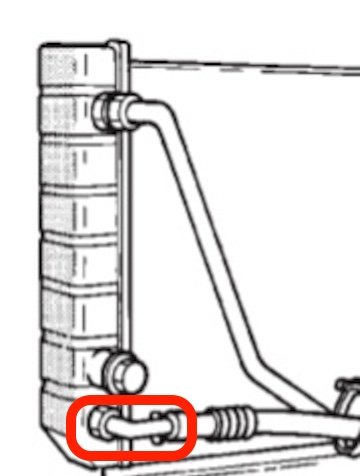
I have a leak in the trans cooling line where it leaves the lower port on the radiator. I have confirmed the leak is NOT in the quick-connect fitting on the hose, but is in the threaded flare fitting that screws into the tank end on the rad. I cannot find the part in the 2000XJ Mopar factory parts catalog I have, nor do any auto parts houses list a source for this item.k The part I need is highlighted in a red circle in the attached picture. Does anyone know where I can get a new one?
-
Dana 35 to ZJ rear disc problem
AZJeff replied to big66440's topic in MJ Tech: Modification and Repairs
If you are putting in a Dana 44, you will need the spacer ring to hold the seal in the correct position in the axle housing (just like on the D35). The trick is.....the axle tube ID where the seal goes is actually SMALLER on a D44 than it is on a D35. (Ask me how I know). That means the D35 rings are too large in diameter to fit a D44 housing. I had to have my D35 spacer rings turned down on a lathe on their OD to fit the D44 housing. YMMV..... -
I made a set from some very large self-adhesive heat shrink tubing from my local hardware store. They work quite well. i would expect the solution proposed by "HOrnbrod" would work quite nicely.
-
Hood Latch Issue (NOT the Normal Problem)
AZJeff replied to AZJeff's topic in MJ Tech: Modification and Repairs
There are no rubber hood stops in the corners of my hood, so that wasn't a factor. (I don't know about older MJ/XJ's, but the later ones don't have such stops.) I DID SOLVE the problem, and it was simple (and yet unexpected.) It turns out the new Dorman hood release cable had a HUGE amount of friction built into the cable out of the package. I just assumed it was normal, but after taking each piece of the system and testing it for release force contribution, the cable was the MAJOR factor. I removed the cable and lubricated it with a VERY lightweight aerosol gun oil, and it made a HUGE difference is the smoothness of the cable. After reinstallation with all my other clean and lubricated parts, the hood latch system now functions normally. -
Dana 35 to ZJ rear disc problem
AZJeff replied to big66440's topic in MJ Tech: Modification and Repairs
The first thing I would do is to pull BOTH axle shafts, and start measuring tube diameters, bearing recess depths, and the like. The idea is to look for any dimension between the two sides that is more than about 0.010 inches different. (If the axle housing is the culprit, it's likely the offending dimension will be MUCH greater in variation than this between the two sides. Another thing to consider is if the axle housing FLANGES are flat and perpendicular to the axle housing bore. That is needed to insure the axle retainer is applying a uniform force to retain the seal/bearing/axle shaft into the axle housing. -
Dana 35 to ZJ rear disc problem
AZJeff replied to big66440's topic in MJ Tech: Modification and Repairs
Dumb and horrible thought---something is wrong with the axle housing? -
Hood Latch Issue (NOT the Normal Problem)
AZJeff posted a topic in MJ Tech: Modification and Repairs
I have a hood latch issue that is got me VERY stumped. I have owned several XJ & now this MJ, so I know all about the normal issues that can affect this system, but this issue is really got me puzzled. Here are the symptoms: The force required to pull the handle to release the latches is HORRENDOUS. In addition, the latches will not reliably unlatch unless a helper is "bouncing" the corner of the hood at the same time. Here is what I have done so far: 1. New hood release cable (Dorrman brand) has been installed. The cable is routed per factory diagrams. 2. The bellcrank has been removed, cleaned, repainted. The bellcrank lever will now move under gravity alone when I turn the bellcrank body, so I KNOW the bellcrank is not sticking. 3. The push/pull rods from the bellcrank to the latches are clean and straight. All plastic guides are in position as from the factory. Return spring for push/pull rod is connected properly. 4. Each hood latch has been cleaned of all dirt and old oil/grease. They are clean, TOTALLY rust free, and all the rivets are tight, with no wobble. When tested out of the vehicle, they snap closed and pop open as expected with no weird behavior. 5. The latch strikers (on the radiator core support) are properly installed and shimmed to allow the hood to sit flush to the fenders and the grille surround. The striker springs are installed and have seemingly normal force. The strikers are clean of any rust or dirt. When I manually close the latches with the hood up, and then pull the release handle, the latches pop open as expected. Once the hood is closed, I need an act of God to get the latches to "pop" ANY SUGGESTIONS? I am at my wits end here. -
Dana 35 to ZJ rear disc problem
AZJeff replied to big66440's topic in MJ Tech: Modification and Repairs
NO. You do NOT want to use an epoxy compound to keep your axle shaft from migrating outwards. The fact that the seal is moving out means the bearing is ALSO moving out, since the seal holds the bearing in position (with the aid of the retaining plate pushing on the seal.) I have to wonder if you have the correct seal and/or if you have the correct retaining plate in your axle. The retaining plate should cover MOST of the seal, since it must press on the steel insert inside the seal that functions as an outer bearing/axle retainer. You might start by comparing the retaining plate dimensions (especially in the inside diameter) between the two sides of your vehicle. The condition you are describing where the seal "walks" outward is happening because the bearing is pushing outward on the seal (it will do this when loaded axially on turns). The fact that it actually moves enough to extrude past the retainer is a serious issue that could result in major axle damage. You need to get this issue figured out and corrected permanently. -
Dana 35 to ZJ rear disc problem
AZJeff replied to big66440's topic in MJ Tech: Modification and Repairs
The seal is a functional part of retaining the wheel bearing and axle shaft against outward axial loads. As such, it has a much more robust metal reinforcment inside it. When you say the seal "pushes itself through the retainer", I assume you are referring only to the rubber part, and not any of the metal reinforcement. Am I correct, or is the steel reinforcement inside the seal also getting distorted and pushed out through the retainer? -
OP---If you need one, I have a New Old Stock sender/pickup tube assembly I would sell to you have a very reasonable price. Just say the word.
-
The change of axle would have minimal, if any effect on the parking brake cables. The "metal piece" (better known as the 'equalizer') should be able to compensate for any minor variantions between a D35 and an 8.25. I have always been somewhat suspicious of J.C.Whitney. I am not saying they are a totally worthless vendor, but I trust other outfits like Rock Auto more fully.
-
The upper bolt that attaches on the top of the B pillar has a longer unthreaded shoulder on it than the two that attach at the floor. The retractor attaching bolt has no shoulder, of course.
-
Throw some JB Weld on it, and it will be good to go. Or so say the fans of JB Weld.....