


Eagle
-
Posts
15698 -
Joined
-
Last visited
-
Days Won
27
Content Type
Profiles
Forums
Gallery
Everything posted by Eagle
-
The factory electrical manual shows only one test for the idiot light. "Touch C307 terminal S to ground." [C307 is the terminal that plugs onto the temperature sender in the left rear corner of the engine.] If the idiot light illuminates, replace the switch (the temp sender). If the light doesn't illuminate but you know the bulb is okay, then you have a broken wire or an open connection between the sender and the bulb. (Could also be a damaged trace on the printed circuit board of the cluster itself.)
-
That means one of the cables has rusted and is seized up. Crawl underneath and find the equalizer (the yoke thingie where the single cable from the front splits into two cables, one for each rear wheel. There's a long, threaded rod off the end of the front cable. Soak it down with PB Blaster for a couple of days, then loosen it to take the tension off the cables. Once you do that, you'll be able to see which cable is frozen up, and buy a replacement.
-
Try the HELP! section at your local auto parts emporium. The socket that fits the XJ/MJ front parking lights (and possibly the rear, as well) happens to be a Ford socket.
-
What you call the "running lights" (that's "taillights" to most of us) should be the lower brightness of the two filaments in the dual-filamant bulb. The single filament bulb should not, under any circumstances, be used for tailights -- it's too bright. The MJ tailights use two dual-filament bulbs on each side (plus a single filament bulb for the backup lights). If you don't need or want to split off the turn signals from the brakes/hazards, then you don't need my diagram. Use the diagram from the '88 MJ electrical manual, and just skip the second wire to the second bulb. Or change the sockets to dual filament and have complete redundancy on both sides.
-
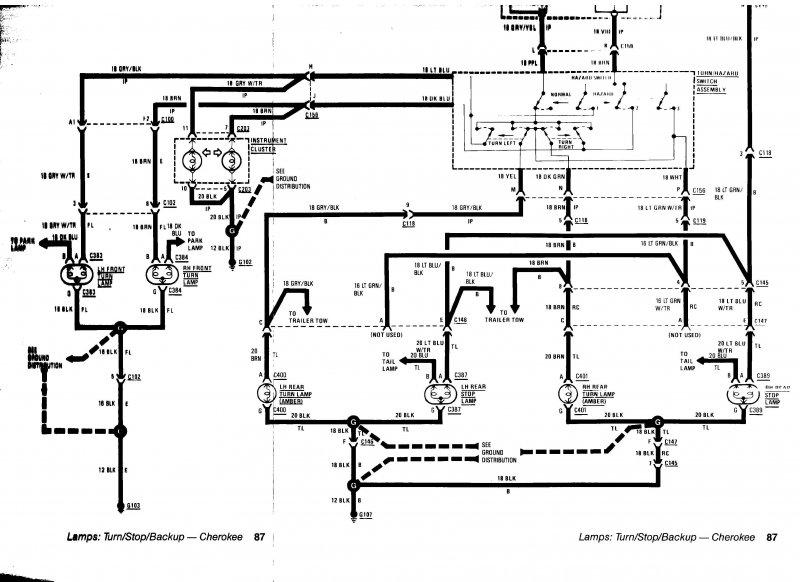
Tried another scan. This includes the area where the XJ is different from the MJ:
-
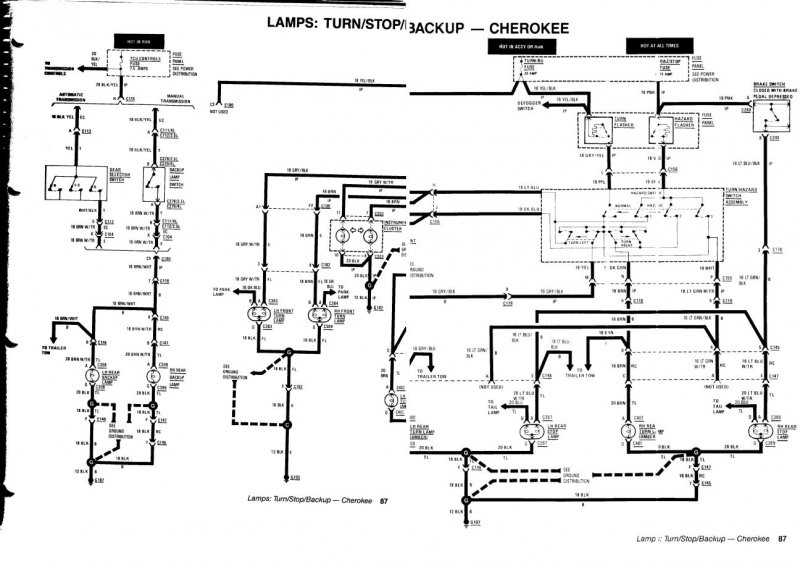
I tried scanning the XJ stop/taillight diagram and splicing the two scans together. It's clear enough, but I couldn't get the two scans to stitch together perfectly. The important part for making an MJ work like an XJ is on the right hand side of the diagram. Let's see how this looks:
-
I know it's a Ranger bed and tailight. I assumed it was set up for separate turns/hazards, and I so stated a couple or three times. But he stated that both the upper and lower lenses are red -- no amber. And I also explained how to make it work with separate turns/hazards -- modify the MJ wiring to make it like the XJ Cherokee wiring. That's why I posted the Cherokee wiring diagram.
-
The XJ also used the BA 10/5. Both the XJ and the MJ changed to the AX-15 in the 1989 model year. Remove the switch from the tranny and try pushing the plunger manually. See if the switch works.
-
Who said anything about leaving something unused? If that's what you got out of what we have posted, I think you're not reading the comments correctly. For clarification, how many bulbs does each of your taillights have -- three, or four? From your original post, I thought you had four -- two dual-filament bulbs behind a red section of lens, then a single filament bulb behind a white/clear section of lens, and then a single-filament bulb behind another red section. Whether you have one or two double-filament bulbs in the upper section, that or those was/were originally the tail ("running") lights and the brake lights. The one behind the white/clear lens is obviously the backup light. And the lone single-filament bulb at the bottom was originally the turn signal and hazard flasher bulb. If you're just typing into the existing Comanche wiring harness, that won't work so, as I posted above, you can use the bottom single-filament bulb as a second (or third) brake light.
-
The single filament bulb behind the red (or is it amber?) lens is the turn signal/hazard warning light. Or it should be -- that's the way it was wired in the Ranger. The problem is that the MJ factory wiring doesn't support that. However, as you can see from the wiring diagram, the MJ did use two bulbs on each side for brake/turn/hazard. If you don't want to modify the wiring to make it work as intended, just wire the single filament bulb to the high-intensity filament of the other bulb and you'll get redundant brake/turn/hazard lights. But, if you leave that as a single filament bulb, you won't have redundant running lights. By the way -- we'd like to see pics of the MJ with a Ranger bed on it.
-
IMHO it's more important to have redundancy for the brakes so, if you split the functions, use the upper set of two bulbs for the running light/brake function and the lower for turns and hazards. That's why the two uppers have two filaments and why the lower only has one filament. It's the right way to do it and, if you can figure out the wiring, I think it's worth the effort. Maybe someone on here who is scrapping a Cherokee could pull the rear lighting harness and send it to you. That might be a guide for how Jeep did it. Sorry the photos aren't better. My scanner only does 8-1/2 x 11. Maybe I'll try scanning to JPEG and using Paint to stitch the two halves of each page together. If I do that, I can also edit out the trailer light branch in the Cherokee diagram to make it easier to compare to the Comanche.
-
I can't scan full-size pages. See if you can make out the photos. http://s39.photobucket.com/user/AguilaBlanca/media/Jeep Tech/Wagoneer_Stop-Turn-Backup_zpszv8x0thb.jpg.html http://s39.photobucket.com/user/AguilaBlanca/media/Jeep Tech/Cherokee_Turn-Stop_Backuo_zpsohl7tlud.jpg.html http://s39.photobucket.com/user/AguilaBlanca/media/Jeep Tech/DSC00143_zpsatoofcnk.jpg.html
-
Got a suggestion for you, if you can make it work. Download the electrical manual I gave you the link to. The rear lighting is on page 71. I have the Cherokee/Wagoneer electrical manual here. The Cherokee had separate, amber turn signals. The XJ Wagoneer was set up like the MJ, and I just confirmed that the wiring is the same. So ... how to get it to work like a Cherokee is the question of the day. The Cherokees and Wagoneers mostly shared the same chassis wiring harness - the stop and taillights were changed by a different section of harness just in the back. It should be possible to find a connector in the Comanche that corresponds to that, and make a custom taillight harness for the MJ that will give you separate turns and hazards. I'll see if I can scan the pages involved and post them tomorrow.
-
They're around. I account for three. There's one in town about three miles from me -- it belongs to the father of a guy who used to post on NAXJA as REJeep (I think). There's a guy who works for the local office of the state D.O.T. who has one. The father of a girl who works at the local supermarket has (or had) one -- I haven't seen it recently. I've passed three more on to people in NAXJA who I hope fixed them up and kept them among the roster of viable vehicles. And I see others around in my daily travels. Not a lot, but some. Why did they die? Because Chrysler bought Jeep from AMC/Renault. Chrysler had the Dakota, and they didn't need or want a Jeep pickup stealing potential sales from the Dakota. Plus, the morons at AMC/Jeep never brought out an extended cab, and most buyers wanted either an extended cab or a 4-door crew cab. When I was vehicle shopping in 1988 I really wanted to buy a Comanche. But ... I needed protected interior space for carrying things, so I bought a Cherokee instead. I was committed to buying a Jeep. Other buyers who wanted a pickup and who wanted or needed more interior space simply had no choice -- they had to go to another brand. (And Chrysler hoped that would be Dodge, of course.)
-
To expand on Ohm's answer: The Comanche, unlike the Cherokee, does not have turn signals that are separate from the brake lights. That may be why you are confused. Each side has two taillight bulbs. They both do triple duty -- the low intensity filament is the taillights (or what you refer to as the "running lights"), the high intensity filament is the brake lights AND the turn signals. And the hazard flashers. In operation, the turn signals override the brake lights, so if the brakes are on and you initiate a right turn signal, the right "brake" lights will flash while the left brake lights remain steady. If you activate the hazard flashers, the brake lights override the hazard flashers. This always seemed like an incredibly dumb arrangement to me, especially since AMC did it right on the Cherokee. This may help: https://comancheclub.com/applications/core/interface/file/attachment.php?id=14915
-
Spray some Fabreze around, and drive with the windows open.
-
I took an adult ed tour of the Normandy beaches with my then-GF in 1994, at the time of the 50th anniversary. Seeing the beaches, seeing the terrain and the way the German defenses were set up, visiting Pointe du Hoc ... it's amazing that any of the Allied troops made it ashore. My father served in WW2, but not in Europe. He was sent to India and then into China.
-
If you park it on a flat, level surface and measure carefully, you're going to find that the front axle is now located roughly 3/4 of an inch over to the driver's side of the vehicle.
-
I thought the easiest conversion was the ZJ rear disks ...
-
This is why I laugh every time some of you guys put down the occasional iconoclast who mentions converting a Comanche to a carburetor and conventional distributor. Sure, it's low-tech, it might not deliver quite the same fuel economy (but it also might be better) ... but it's a lot easier to keep running, because the engine doesn't require input from four or six different sensors to know when to squirt gas into the cylinder and when to fire.
-
How much lift did you install? If you didn't install an adjustable track bar, your front axle is now off center to the chassis. An alignment technician will have lots of fun with that.
-
'88 fuel sender was calibrated 0 ohms = Empty, 88 ohms = Full. A broken wire would be infinite resistance, a grounded wire would be low or no resistance. Could be a bad ground at the tank sender. Check for ground continuity.
-
Did the original fuel gauge work?
-
http://www.olypen.com/craigh/skid.htm
-
Link doesn't work for me.