


Eagle
-
Posts
15698 -
Joined
-
Last visited
-
Days Won
27
Content Type
Profiles
Forums
Gallery
Everything posted by Eagle
-
91 swb 4.0 auto Brake Distribution Block
Eagle replied to Dave Littleton's topic in MJ Tech: Modification and Repairs
Excellent. Thanks for the update. -
91 swb 4.0 auto Brake Distribution Block
Eagle replied to Dave Littleton's topic in MJ Tech: Modification and Repairs
What about putting it in the freezer overnight? Or heating it in the oven to maybe 200 or 250 degrees and then trying the pliers. -
AX5 fifth gear and AX15 fifth gear
Eagle replied to eaglescout526's topic in MJ Tech: Modification and Repairs
They won't swap. The AX-15 is a larger, beefier transmission. As has been mentioned, the difference wouldn't be worth the effort anyway. If mnkyboy's ratios are correct, you'd go from 3,000 RPM to 2,788 RPM. But ... you shouldn't be turning 3,000 RPM at 65 MPH. If you're on 225/75-15 tires, at 65 MPH you should be turning 2,756 RPM with 4.10 gears. Even if you're on 205/75-15 tires the RPMs would only be 2,869. As for changing the axle gearing, 4.56 would be going the wrong way. That would increase your RPM. If anything, you should be looking at 3.73 gearing. That would put your RPM at 65 MPH (with 225/75-15 tires) at 2,507 RPM. But don't be intimidated by 3,000 RPM. You have to remember that the 2.5L Jeep engine is derived from the old AMC 199/232/258 cubic inch engine that was first introduced in a Rambler in 1964. I grew up in an AMC family. In those days, overdrive was an expensive option that nobody bought. The standard gearing on the 3-speed AMC cars (and later on the 4-speeds, since they were still 1:1 for top gear -- no overdrive) worked out to 24 MPH per 1,000 RPM. That meant 2,500 RPM was 60 MPH, and 3,000 RPM was 72 MPH. We cruised them at 70 MPH all the time, and the engines lasted forever. My brother's 1972 Gremlin with the 232 was well beyond 300,000 miles when he finally lost touch with it. -
91 swb 4.0 auto Brake Distribution Block
Eagle replied to Dave Littleton's topic in MJ Tech: Modification and Repairs
Look again. The slider activates the light by pushing up on the plunger in the bottom of that plastic insert (the switch) on top of the distribution block. The slider only activates the light -- it does not obstruct either the front or the rear circuit. Here's how it looks with the slider moved as it would be following a failure of the front brake circuit. When it moves back, it also opens the rear brake bypass circuit to provide full braking to the rear, bypassing the height-sensing valve. As you can see, the normal fluid path for the rear brakes is in through the front/upper port, and out through the nose port. There is nothing in the distribution block that can possibly obstruct the flow to the rear brakes. Soak it down with brake cleaner, then see if you can grab the plunger with a pair of needlenose pliers and twist it out. Even if you can't get the plunger out, though, you can use a fine drill bit to ream out the passages for the rear brakes. Turn the drill by hand, using pliers -- you just want to ream out any of the white powdery stuff, you don't want to be drilling the holes any deeper.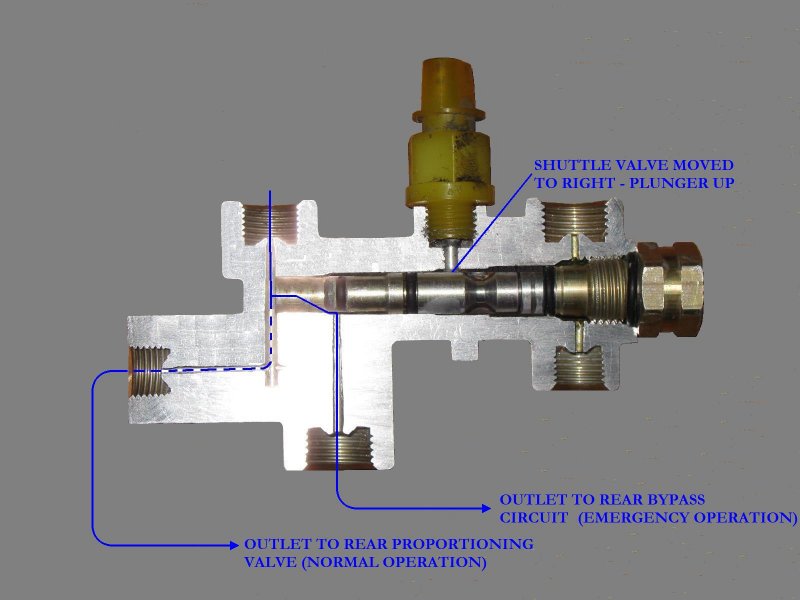
-
91 swb 4.0 auto Brake Distribution Block
Eagle replied to Dave Littleton's topic in MJ Tech: Modification and Repairs
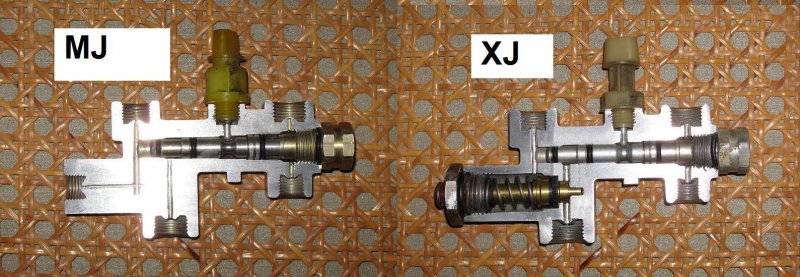
What valve inside do you think is interfering with flow to the rear axle? The MJ distribution block is ONLY a distribution block. It doesn't do any proportioning. If you're getting flow to the rear height-sensing valve -- it's open and functioning. If you're not getting rear braking, maybe the height-sensing valve isn't adjusted properly.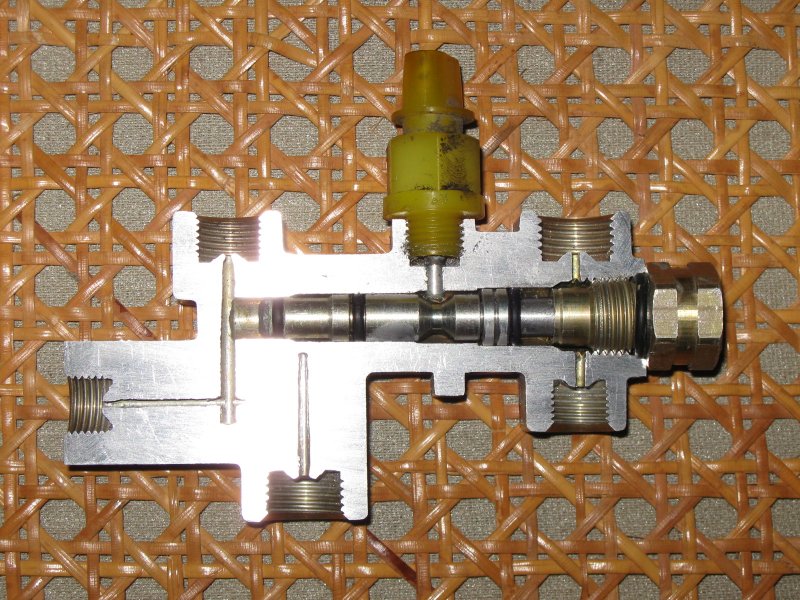
-
Not necessarily. Some of the diff housings on the CAD axles aren't machined to accept a seal on the right hand side of the housing.
-
The CAD front axle won't be an issue behind a 2.5L. My '88 XJ and '88 MJ (both with the original CAD front axles) have both been wheeled at Paragon, and the XJ has seen other trails around New England as well as fire roads and Forest Service trails in New Mexico. Just shift the CAD into the engaged position and lock it there.
-
Gas tank under serious pressure (solved)
Eagle replied to Deleted's topic in MJ Tech: Modification and Repairs
I know you think you didn't overfill it, but I think you overfilled it. Gasoline expands quite a bit as it heats up, and the MJ fuel system is sealed to prevent the escape of vapors into the atmosphere. The fact that gasoline exploded out of the filler when you removed the cap shows that you system isn't leaking. Do you stop filling the first time the nozzle shuts off, or to you "top off" after the auto-stop? When you filled up, was it at night? I see you're in Chandler, AZ. I used to have relatives in Chandler and the Phoenix area, and I've worked on projects in Tucson. I have some idea how hot it can get there mid-day, and what a difference there can be from nighttime temperatures to mid-day temperatures. -
Check the firing sequence. You changed the distributor. I did an engine swap once and crossed two spark plug wires. Dumb, but I did it, and it made the difference.
-
I need: A transfer case shift gate for an NP-242 (Select-Trac) shifter, to fit a Renix-era XJ (and MJ) The overhead light module for a 2000 XJ Sport withOUT the full-length overhead console
-
Spring Recommendations
Eagle replied to SandMountainJeep's topic in MJ Tech: Modification and Repairs
How much is it worth to you for me to not share this post with your lovely new wife? -
The rubber O-rings ONLY affect the shuttle valve (that slider across the top) that activates the brake warning light. They have nothing to do with controlling the brakes, and they cannot block the flow of brake fluid to the front wheels. The Cherokee unit IS a proportioning valve. You can use one, but you'll have to re-plumb the rear lines, and you'll be giving up the rear height sensing valve.
-
There is no valve. The front distribution block in the MJ is a distribution block, not a proportioning valve. Again -- there is no valve. How are your front flex hoses? If they are the originals, they may have deteriorated internally and a flap of rubber could be interfering with the fluid flow.
-
What's the outside diameter of your coils, and what's the wire diameter?
-
Axle/chassis centering is handled by the track bar -- that's what it's there for. The factory track bar is designed to center the axle under the chassis when the chassis is riding at stock ride height. As soon as you introduce lift, the axle is pulled off center toward the driver's side. The way to measure is to be sure both front tires are the same size and at the same pressure. Park on a known flat and level surface. Drop a plumb line from the fender flare on each side and measure from the plumb line to the tire or wheel. Adjusting for center after a lift is best done with an adjustable track bar.
-
I recently watched a Youtoob video about a guy who used sand casting to make a bronze cannon. There were actually a series of videos, because he had a lot of failures before he finally got one that was mostly okay. One of the alternatives he experimented with was a plaster mold. I wonder if you could make a plaster mold off the original and then cast fiberglas or carbon fiber into the plaster mold.
-
In the past, it has been proven conclusively that at highway speeds the lower hoses collapse if they don't have the spring in them.
-
Simple check -- find your CPS. The wires from the CPS go to a 3-pin connector. Do the wires from that connector then lead into a wiring loom with a bunch of other wires, or do they lead directly to a hole through the firewall?
-
Well, I have two drop-in bed liners here, and I've had two others. IMHO they are the same material and flex about as much as the factory flares.
-
The problem is that Jeep selected the gear ratios for performance in emissions and gas mileage tests prescribed by the government -- which were run on a chassis dynomometer, not on the road. So there was no wind resistance factored in. I've found that my 88 4.0L 5-speed gets equal or better fuel mileage in 4th gear as in 5th. In 5th, at 55 or 60 MPH, the RPMs are well below the engine's torque peak, and running at or close to the torque peak is the most efficient cruise setting for an engine. I think 3.55s or 3.73s are a much better gear choice for the 5-speed, and 3.73s should work well with the AW4 as well.
-
You need a radiator. In rain, on the highway, you should never need the aux fan.
-
But does the new one have the spring in it to prevent collapse?
-
I think fiberglas would be a serious mistake. It's far too fragile. I don't know what the original part was made of but I imagine its something like what the Old Town canoe company calls "Royalex." I think that's similar to (if not the same as) the material the drop-in bed liners are made of. It's much more damage resistant than fiberglas.
-
I suspect that means he was separated from his litter too early. One thing I noticed on a trip to Europe a couple of decades ago was that everyone let their dogs run free, and none of the dogs acted aggressive. They were all well socialized. That can be difficult with an adult dog that wasn't properly socialized before being sent off to live in a one-dog household.