
derf
-
Posts
1996 -
Joined
-
Last visited
Content Type
Profiles
Forums
Gallery
Everything posted by derf
-
Yeah, they started the Wagoneer in 1963 as a comfortable wagon that was more upscale than a traditional 4x4. They had independent suspension as an option, an automatic transmission (a first for a 4x4) and an optional single speed transfer case. The 70's saw one of the first AWD transfer cases in a traditional 4x4. These days, you almost can't get a part time 4WD case in any SUV. By the time the Grand Wagoneer was done in 1991 it was purely a luxury vehicle that happened to still have capable 4x4 creds. With all of the electronic do-dads and gizmos on the new one, it will do reasonably well off road by comparison while competing against Lincoln, Cadillac, and Land Rover. Sure, it will be targeted more at the high end on-road crowd but that's the demographic with the money to buy this thing, just like it was the demographic in the 80's.
-
That's about what I expected.
-
My XJ is my daily driver/mild trail rig. It has TrueTracs front and rear. It will almost never see a tire fully off the ground. For my rock crawling rig, the one that will see tires in the air on a quasi-regular basis, selectable lockers are the only answer for me. Automatic lockers and spools are preferred by others and they get the job done as well but they're not for me.
-
Yeah, I could see that as a unique tow pig for trips out to Moab. You wouldn't see a bunch of them out there, that's for sure...
-
Agreed. Shop around for a good used one.
-
Where I go, it's not as rare as you might think.
-
Yeah, my XJ with the TrashLoc from the factory was decent for the first couple of years. But by the time I trade it in it wasn't any better than an open differential. I had the same problem with an Auburn Gear ECTED (clutch type limited slip that has an electronic "locker" that doesn't actually lock the axles). They help a little when you have tires touching the ground with some weight. But start to lift a tire and the clutch type limited slip does nothing. In short order, you wear out the clutch packs and they don't limit slip at all. And I don't like the idea of having a diff full of grit from the clutch packs, or the idea that the differential is a wear item that needs to be serviced. I have TrueTracs front and rear in my XJ. They are great for on road manners and they do help on moderate trails with 4 tires on the loose ground better than any clutch type limited slip. Sure, they will let a tire spin when it's up off the ground just like any limited slip, but they are quite a bit better than the clutch type in all other respects.
-

-
I could have sworn it was different but you're right. So yeah, lump the ZJ in with the TJ.
-
I wouldn't take a ZJ (or WJ?) rear axle. It's a 5 on 5.5 bolt pattern so you have to deal with different rims front and rear. Well, unless you grab the front axle and swap it as well. If you're dead set on using a Dana 35, find a TJ (96-06 Wrangler). It at least has the same bolt pattern as the MJ. You'll have to build custom frame side mounts for the control arms to match the TJ donor. And weld up the coil spring bucket on the frame. But then you've done a lot of work to mount up a pretty weak axle. If you're not dead set on a Dana 35, there are so many better options out there to choose from. Fabrication effort is probably similar but you can have a better axle than a Dana 35 and that's never a bad thing.
-

-
FWIW, I have the Tom Woods SYE kit in my 242. If you don't mind spending the money for an easy button solution, I'd recommend them. The differential in the MJ Dana 44 is the same as any standard Dana 44. Just like the XJ, just like the Fords, GMs and Dodges. A standard Dana 44 TrueTrac works just fine in there.
-
I can say this because I are one... Engineers are the dumbest smart people you'll ever meet. Just because engineers designed it for sale doesn't mean that good decisions were made. Throw in the upper management and sales people (dumbest dumb people you'll ever meet) and add government regulations (don't get me started) and it's a wonder cars are as good as they are.
-
I get reluctance to modify, especially if you're never really going to use the truck in a way where the modifications are useful. I also get that a lot of people just like stock vehicles and they don't want to modify anything. And you really shouldn't feel the need to justify the decisions you make for your Jeep. But things like power steering coolers and all that other stuff isn't rocket surgery. Even upgrading the suspension and axles to handle monster tires is a well known quantity that no one should be afraid of. If you take some time and plan things out ahead of time, you can have a rig that's plenty reliable. Really built up rigs may not be your cup of tea but it's "easy" to build them up so they'll hold up to a lot of abuse and be plenty reliable. One other thing to remember. The engineers who originally designed the truck in the first place were many times plagued by cost constraints or office politics (i.e. Peugeot forcing the BA10/5 on AMC/Jeep). Stock vehicles in many cases are only reliable enough to mostly last until the warranty runs out. Chrysler transmissions are legendary for that trait. And that's just one example among so very many. Just because it's stock doesn't mean it's reliable.
-
Yep. All you need to do is make it not worth the effort. A determined thief can get through a lot. But the more annoying you make it the more likely the thief will move on.
-
Bigger axle means you can run bigger tires to compensate for the differential.
-
Also, when it comes to spacers, I prefer blue locktite on the lugs holding the spacer on. Taking the wheels off to check them introduces the chance that you will miss something putting them back on, not to mention needing to check them in 100 miles again.
-
I always torque my lug nuts with a torque wrench. And check them after 100 miles. Never had a problem with them coming loose. The only time I've had issues is when someone else worked on my vehicle. So any time any of them go to the shop I always reset the torque when I get home.
-
If you're looking mostly to have a truck that can work in the field and hold up, the most cost effective way to do it is to buy a different truck. Assuming you don't want to that, you'll need to build and fabricate upgrades based on parts from other vehicles. Upgraded axle housings are probably where you want to start. There are many options. Front Dana 44's can be sourced from 80's Jeep Grand Wagoneers and J-Trucks (70's has the differential on the wrong side). Also, with some exceptions, mid to late 70's Ford F150 and F250 trucks have the axles you want (80's they went to the TTB axles which are the reheaded step child of front axles). Rear Dana 44, Dana 60 and Ford 9" axles from the same donors will handle the weight. For even more strength, look to the big boys. F350's going back a long ways have front Dana 60 axles and Sterling 10.25/10.5 axles (with Dana 60 and 80 as options). Starting in 1999 the SuperDuty F250s went back to a solid axle (Dana 50 then Dana 60) with the same Sterling rear axles. There's enough support among the aftermarket to help swap any of these axles into an MJ. It's possible to bring the 3/4 or 1 ton steering from the donor axle to the MJ. You can also get kits to bolt 1 ton steering parts to factory axles. The MJ uses a steering gear box that was in everything from YJs to XJs to 1/2 and 3/4 ton Jeep trucks and Wagoneers so it's probably good as-is. Though there are a few upgrades to the mounting area that you want to look into. Big brake kits are available. Heavy duty axles come with bigger stronger brakes. The dual diaphragm brake booster from newer XJs is an easy upgrade. You can get hydroboost boosters from a number of companies if you start getting into bigger brakes. You can get stiffer springs (with overloads in the back if you want) to handle the heavier loads and hold up longer if you don't mind the stiffer ride. There are a few options for unibody frame stiffeners that will reinforce the subframe in the front all the way to the back frame section. The engine/transmission/transfer case is pretty well matched. The Peugeot 5 speed manual won't hold up to a lot of abuse but the AX-15 is a good upgrade. As long as you have gearing set up to match your tire size, you don't really need much in the way of upgraded drivetrain. An auxiliary transmission cooler for the AW4 automatic is always a good idea. If you do a V8 swap for more power, you'll want to bring along stronger transmission/transfer cases. Strength is just a matter of money and fabrication. How strong can you afford to make it?
-
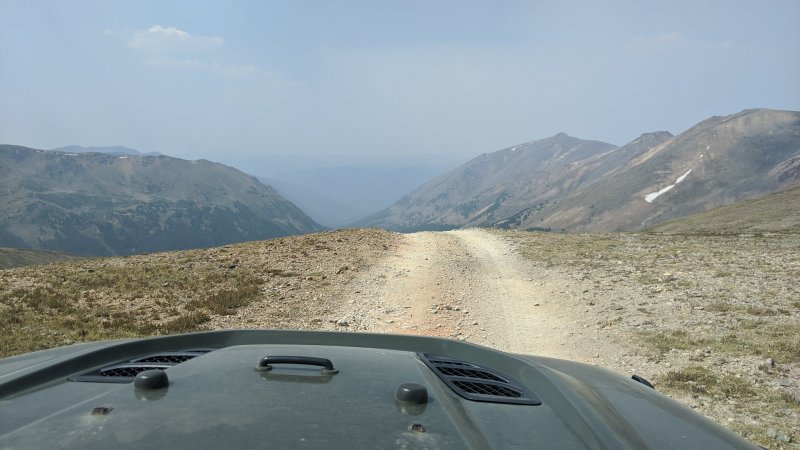
I was up on Red Cone trail SW of Denver this weekend. The fires are a ways away but there was plenty of smoke.
-
I learned to drive in a 1978 Olds with the 5.7 diesel. 0-60 was pretty close to the 1/4 mile time. (19.8 0-60 with a 22.6 1/4 mile). Looking back, having a slow car like that probably saved my life.
-
There isn't as much room by the transfer case for the exhaust on the driver side. You have to make sure the drive shaft and transfer case clear the exhaust pipe. It can be done. But it's easier just to use factory style exhaust.
-
-
 Forgive me, El Guapo. I know that I, Jefe, do not have your superior intellect and education. But could it be that once again, you are angry at something else, and are looking to take it out on me?
 -
We had a sky blue 78 Olds when I was growing up. It's first 4 years were spent in Florida baking in the sun. Shortly after we moved, dad bumped the mail box with the rear fender and put a good scratch into it. He bought factory code paint to fix it. He did a great job feathering out the paint. You couldn't see the scratch at all and the new paint blended into the old with a gradual fade. But the new paint was many shades darker than the original paint so that part of the fender stuck out pretty badly. I suspect that's what I'll end up with over the years. But I'm fine with that. After all, it's a trail rig not a show car.