

derf
-
Posts
1995 -
Joined
-
Last visited
Content Type
Profiles
Forums
Gallery
Everything posted by derf
-
F*** cancer. Rest in peace Eddie.
-
It fills a space in my garage and will suck money in for years. I might be able to drive it eventually.
-
Lesson #1 with Jeep projects. They are never done.
-
That's just it. I shelled out for the scope. Then they installed the radon system and may have broken it a few days later.
-

Converting 1987 MJ longbed from 2wd to 4wd
derf replied to Kesswic's topic in MJ Tech: Modification and Repairs
The easiest way to do it is to find an Cherokee or Comanche donor vehicle. The Cherokee and Comanche have the same drivetrain and swapping that is "easy". Find one with the same engine and transmission as the one you have now. There are some changes to the vehicles as you go from year to year. The big change from first gen "Renix" (Renault/Bendix) fuel injection to Mopar or "H.O." injection happened between 1990 and 1991. Best bet is another 87. But 87-90 is "easy". For those years, you only need the transmission and transfer case, along with other bits. If you get a 91 or newer, you can still do the swap but you will want to swap the whole engine, transmission, and transfer case along with all of the wiring. A lot of little things changed like the intake manifold and some other things so it's easier just to grab the whole engine but it will bolt right in. The transmissions are the same except at the very back. The 2WD and 4WD versions have unique tail shafts. It's a matter of just dropping the transmission and installing the replacement. A rebuild while it's out may be a good idea. Once the 4WD transmission is in, the transfer case bolts up. The front axle from the donor would bolt in with no modification but you absolutely must ensure that the gear ratios in the front and rear axle match or you break things in 4WD. The front driveshaft from the donor will bolt in (replace the u-joints while it's out) but you may need to modify the length of your rear driveshaft. If you have a Cherokee donor the rear driveshaft is too short. Any drivetrain shop can shorten your original driveshaft to fit. There are many opportunities to do some upgrades as you go. Some are more "important" to do than others. There are plenty of threads on here talking about them. Spend a bunch of time looking around here and be sure to ask plenty of questions. -
It's unlikely he'll get that much for it. A lot of people ask for a lot more than they can get for things. It will be interesting watching the price come down. It will all depend on how patient he is. He's just a handful of miles from me and I have thought about going to look at it.
-
-
Oh, and I have "limited use" of the facilities until the slow drain issue is resolved. So the first thing I'm going to do is put the rest of my chili in the freezer until this gets fixed. No one deserves to deal with that...
-
It's weird how the drain pipe snakes around under the basement. It goes around and comes in exactly the opposite direction you think it should. And right where they put in the radon system after the inspection...
-
So it's possible the people who put the radon system in hit the sewer pipe. They're going to bring a camera in to inspect ot tomorrow and verify.
-
Looks like it's been relisted. https://denver.craigslist.org/cto/d/aurora-rare-jeep-comanche-pioneer-150k/7207750516.html $10,900. Price dropped a hair.
-
Given 2020 as a whole, I guess this doesn't surprise me in the slightest. A few weeks ago I noticed a wet spot on the basement carpet away from anything that could have spilled. And the basement started smelling musty. Great. A water leak. Turns out it's a partial backup of the sewer. The water was coming up from the floor drain after a shower or running something like the dishwasher or clothes washer. The water drains away within a couple of hours so by the time I bothered to get down to the basement to look the water was gone except for where it soaked into the carpet padding. I checked after a shower last night and sure enough, there was just a little standing water right by the drain. Enough to get out under the wall into the carpet in the neighboring room. So yeah, I get to replace the ugly carpet sooner than I wanted. The plumber will be here in a couple of hours and figure out exactly what the blockage is. Hopefully it's not a tree root. I'll be pissed if it's that. But if they don't have to dig or only have to dig up the yard, that would be better than trying to fix a pipe under the basement slab. So since poop water got into the padding the plan is to pull the carpet and throw it in a WM Bagster Bag, then grab some of the adhesive backed carpet tiles from Home Depot that are basically remnants from industrial supply randomly thrown into a box so you get a scatter pattern of different carpet styles. Hey, it's under $1 per square foot and it's easy. If they have to dig inside the house, that will change. If this is the worst that happens to me this year, I'll be grateful. Still, it bugs me I have to deal with this right now.
-
I do like a challenge. But I also don't like friends who want me to show up and figure it out for them and then do it for them too. I would have just walked away from that pile of metal.
-
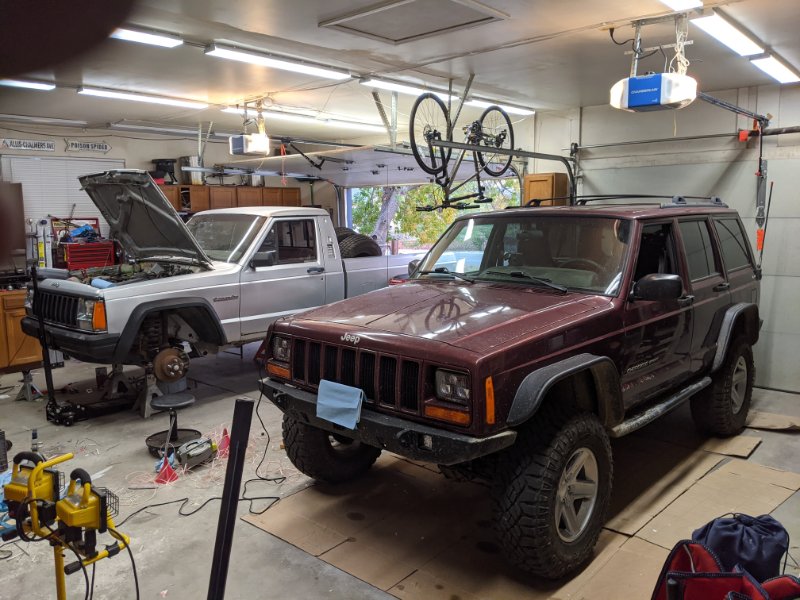
No real progress. I just wanted to take a picture. I'm going to get started with Cruiser's tips to get this Renix 4.0 back to life. I haven't tried to start it yet but I want to head off the obvious problems first.
-
I've seen people break JK 30s on stock tires. It's all in how you drive. The more careful you are, the bigger tire you can run safely. I had 35's with my JK 30 and it's still alive 8 years later. If I'm running big tires, I don't want to have to baby the axle to keep it from breaking.
-
1987 4 cyl MJ Rough running condition
derf replied to jeepogeek's topic in MJ Tech: Modification and Repairs
I have a Haynes manual that helps with 80-90% of what I need. Nothing really beats a factory service manual though. There are plenty of places to download and/or buy print manuals out there. -
Same as an XJ front axle. I ran one for a while and it was under an inch difference between the two.
-
Other way around. The 44 uses a lot of 30 level stuff. The Rubicon 44 is a Dana 44 center section with the rest being Dana 30 spec parts. The Dana 30 center section is smaller than a 44. The JK version of both is bigger than the XJ version. But very thin wall. The JK 30 is stronger than an XJ 30 but it's still not a full Dana 44 strength by a long shot. There are ways to reinforce the weaknesses, but I wouldn't run anything bigger than a 35" tire with one.
-
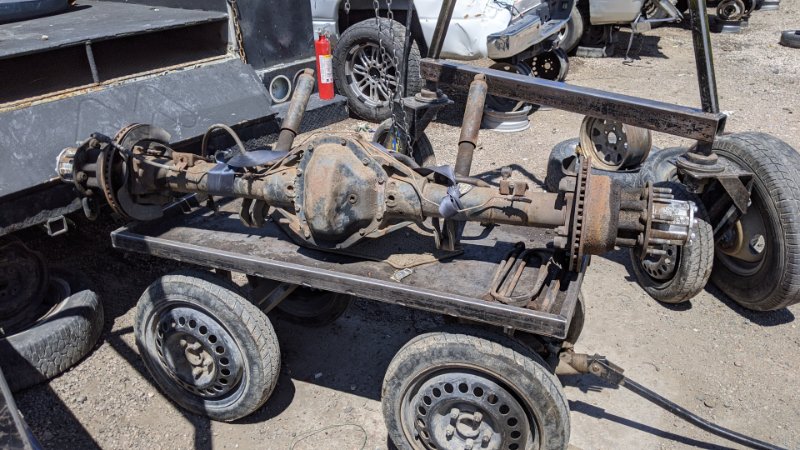
So the 80 is in a different location right now but preliminary measurements say a cab & chassis axle has springs perches right where the MJ springs land. So it will bolt up for a rear SOA with basically no modifications other than shock mounts. So I got that going for me, which is nice. I will probably play with the front axle position a little to maybe alter wheelbase and improve approach angle.
-
Does this axle make my rear end look big?
-
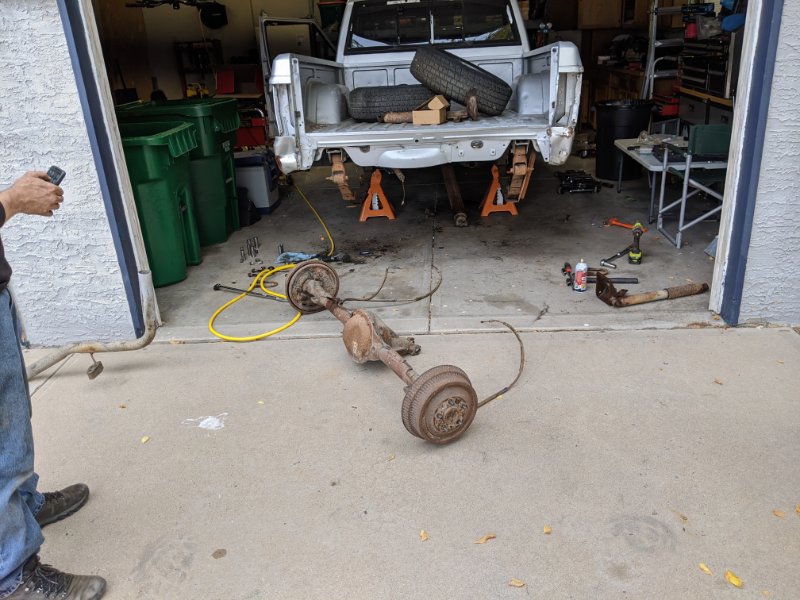
What started the wrenching was someone looking for a 3.07 geared MJ axle. I figured I would end up scrapping it because it's a Dana 35 with 3.07s and an open diff. But he wanted a quick bolt in axle for cheap. So I pulled it and sold it to him.
-
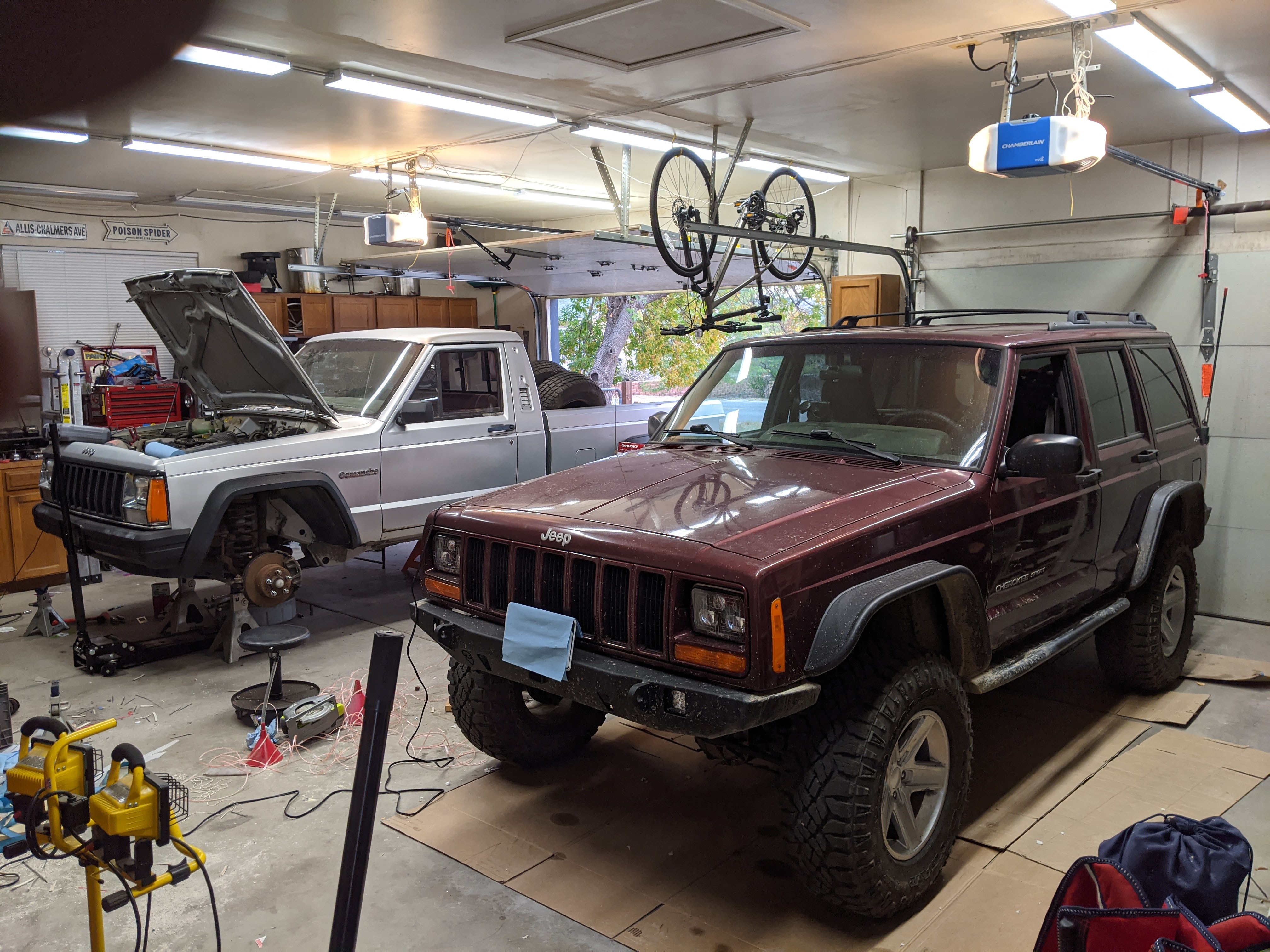
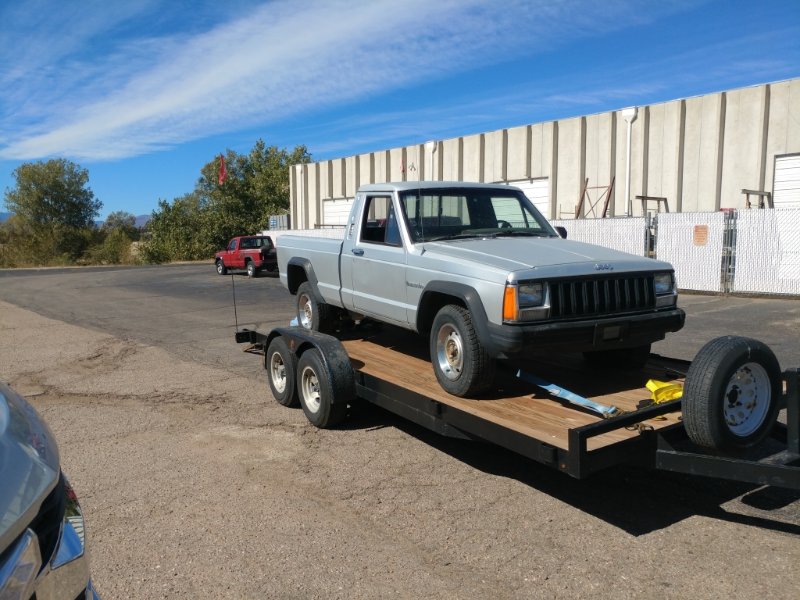
I've been sitting on this project for a while. I needed to have a house of my own before I got rolling and the parts accumulation is going to take a long time. But I started turning wrenches on it today so I'm going to start the build thread. This is the starting point: 1987 low option 4.0/5 speed 2wd that has been damaged in the rear a couple of times. The plan for it is simple. I'm going to make it into a trail beast that will do duty on some of the harder trails out there. Minimum 40" tires with lift and fender clearance to match. Right now, it has a Renix 4.0. It has been sitting for several years so I'm doing a bunch of preventative work before I fire it up for the first time in a long time. It has fresh oil and filter, coolant topped off, new air filter. The state of the gas tank was unknown so I dropped it to make sure it wasn't running on varnish. Turns out the fuel was still halfway decent so I'll be putting the fuel system back together with a new sender in about a week. I'm going to get the engine running first to see if its worth saving. Long term plans haven't fully set yet. I may keep the 4.0 that's in it (or a remanufactured one). I may upgrade to a 4.6 stroker. I may do an LS swap. I've entertained the idea of doing something like a 5.0 from an Explorer or F150 just to be different. We will see. Regardless, it will get an automatic transmission.. Either an AW4 for a 4.0/4.6, or a 4L80E for the LS, or the automatic that comes with the 5.0. For rock crawling, I've done stick shift enough. I'm going with a slush box this time. The transfer case is still open. It will probably end up being an Atlas 2 speed with 4.3 or 5.0 low range. I'm entertaining the idea of going with an ORD Monster Box with a Ford NP205. I have some of the parts for that already left over from a previously abandoned project. Again, the monster box/205 would be something different. It would give me 1:1/1.96/2.72/5.33 low ranges to pick from And it would be triple sticked, making for good conversation. I'm doing a fair bit of lift for the tires I want (which may be one of several, all 40"+). I will be doing a custom long arm in the front. I have frame brackets from StinkyFab Racing. They're ready to go in. I'll make my own links to go with the axle that's being swapped. I'm also going to do coil overs but I haven't picked out what I want yet. In the rear, I'm still not 100% settled on what I'm doing there. I like the idea of doing a triangulated 4 link. Better articulation, etc. etc. But I may stick with just a spring over conversion with maybe a little lift on top of it. That would keep costs down and let me finish sooner. I may end up doing SOA first and then go back and put in the 4 link later. The front axle is a 2002 Ford F350 Super 60. Sure, people like the 05+ for good reason. But I chose the 99-04. I got a decent deal on it and it's narrower. On an MJ, it will just look a little better. I have the Artec truss and high steer brackets all ready to go for the swap. I'm going to convert it to 35 spline outers, throw some 5.38's in and an ARB air locker, and do a high steer along with a hydraulic assist. The rear is a Dana 8 out of a 2000 Ford F350 chassis & cab truck. It's just under an inch wider than the front axle so it will look right sitting under there. It's going to get 5.38's and an ARB locker as well. It's a 35 spline and will probably stay that way. It also has the same 8 on 170mm bolt pattern as the front so one set of wheels works across the board. I'm still probably going to have to cut up some sheet metal to make room for the tires, even with the lift I'm doing. The front fenders will stay intact and be removed. I found some cut up XJ fenders that I'm going to bolt on and probably cut some more. The rear bed, which you can't see well in the pictures, is shot. It's been hit. Several times. It has thick bondo on it and it's been damaged since. It's not going to make it. But it will be perfect for a trail rig. I will be putting the rear plastic fenders for sale once they come off as they are still in good shape. And then the sheet metal will get cut. I'm planning an exo cage that will integrate fenders that (mostly) cover the tires once they're on. It will also stiffen up the chassis and provide some protection, as well as mounting points for things like gas cans and other accessories. I'm not an LED light bar kind of guy but I will be doing some lights of some kind as well. It's probably going to get another coat of paint, perhaps after being blasted. I think I've settled on Allis Chalmers Orange, as my grandfather was an Allis Chalmers dealer for decades. It's going to be a great truck, but I work for a living and all of the parts and tools I need will take time to acquire. Probably a couple of years. So that's why this is "Project Slow Cooker".
-
You can find a lot of helpful people (and others) at www.fsjnetwork.com and www.ifsja.org.
-
According to this: https://oljeep.com/gw/vin_81-86.html 1 = USA J = Jeep Corporation T = Truck N = 360 V8 J = Automatic, column shift, part time transfer case 25 = Short Bed J10 - 119" wheelbase N = 5979#/6200# GVWR 1 = Check Digit D = 1983 T = Toledo manufacturing plant 003916 = Serial number.
-
That would do it.