
derf
-
Posts
1995 -
Joined
-
Last visited
Content Type
Profiles
Forums
Gallery
Everything posted by derf
-
To me modern popular country music is just pop music with a country twang and southern accent. Then again, country music from the late 80's and early 90's was changing from more traditional country music as well.
-
I grew up in Iowa and spent a couple winters in Minnesota. I also visited the grandparents in North Dakota over Christmas break way too many times. The front range in Colorado has very mild winters by comparison. It's the best of all weather here. 4 real seasons so the weather does change. But it never gets really hot in the summer or super cold in the winter. The lack of humidity makes it perfect here.
-
Best bet is to find a copyright lawyer locally and start with them.
-

Isuzu 44 rear axle (Real experience)
derf replied to CMMagnussen's topic in MJ Tech: DIY Projects and Write-Ups
I do believe (someone else should confirm) that the JK Rubicon Dana 44 uses the same internals (gears, carriers, and bearings) as the Isuzu. It's important to note that the JK Wrangler Dana 44 from non-Rubicons is the same differential casting but they are machined for the older, smaller carrier bearings from the old generation Dana44 and also the same carrier but with larger bolts. The Rubicon uses 32 spline shafts, the non-Rubicon uses 30 spline shafts. But they both use the same gear sets. And just for fun, with the old carrier in the non-JK you use the 3.73 and down carrier for all ratios from 3.21 to 5.38. -
Best way is to clean off the round tag on the back of the case. It will be stamped with something like 231J. Behind the manual transmission in 1987, you'll most likely have the NP231. It's what would have come from the factory. There's an off chance that someone swapped out the factory case for something else but it's unlikely.
-
I can totally understand the motivation to make an air conditioned cab for a lawn tractor. I lived on the east coast of Florida for a few years when I was a kid. I remember how miserable it was in the summer. We would spend most of the day inside at friends' houses. Winter was a lot milder and easier to live with. Living in the upper midwest I got to still deal with quite a bit of humidity. Not as bad as FL though. But after living in Colorado for a while, I doubt I could ever go back to heat and high humidity to live again. It doesn't get really hot here at elevation and the humidity is pretty low. The dew point is 45 degrees today. If I ever become a "snow bird", I'd spend my winters in Arizona but I'd leave before it started to get too hot.
-
Sounds a lot like when I was trying to get parts for an old Grand Wagoneer. Half the time the part number in the book came back "part number not found". Now is the time to get a parts book so you at least have an idea what it is you're looking for. Some parts houses will cross reference old part numbers.
-
Yeah, it won't ride like a 70's Cadillac. But it won't ride like a 70's 1 ton pickup either. It's a solid axle but it's coil springs. So as long as you stay close to stock, it won't be that much different than a mostly stock XJ/MJ.
-
I always wanted to try the bumper dumper...
-
JK Rubicon axles are also Dana 30 outside the differential. They're marginally stronger than the TJ 30 but still not as strong. I've been eyeing putting a late 70s F150/250 Ford high pinion front 44 in a project. It's high pinion so gears are strong. Its old school so the tubes and knuckles are strong. Tons of locker options. Sure, it's 5 on 5.5" with an option to run 6 on 5.5" or 8 on 6.5" pretty easy. So matching rear axle would be needed. but I'd rather do that than any factory Rubicon axle. But the aftermarket axles are a good, if expensive, option as you can get them as strong or stronger than a "real" Dana 44 but built at the right width and with all of the brackets in the right place and the right bolt pattern.
-
Yep. The only difference between the 30 and front Rubicon 44 is the center section. The first gen TJ Rubicon 44 is low pinion driving the coast side of the gears. And the locker is "meh" at best. The money you save buying a non Rubicon can go towards an aftermarket Dana 44 using JK high pinion gears along with stronger tubes and inner C's.
-
Need help with gear ratios with Dana 44
derf replied to harding9641's topic in MJ Tech: Modification and Repairs
Various comanches and Cherokees came with different axle ratios. 2.5 four cylinder models tended to have 4.09/4.10/4.11 gears. Automatic 4.0 six cylinder models usually have 3.55/3.54. Manual 4.0 six cylinder models tend to have 3.08/3.07. You want the same ratio front and rear or "bad" things happen when you shift int 4WD. If you change tire size you should consider changing the axle ratio to match. -
I've never heard anyone call a 4 door an LK. There's always "JK" and "JKU" from what I see.
-
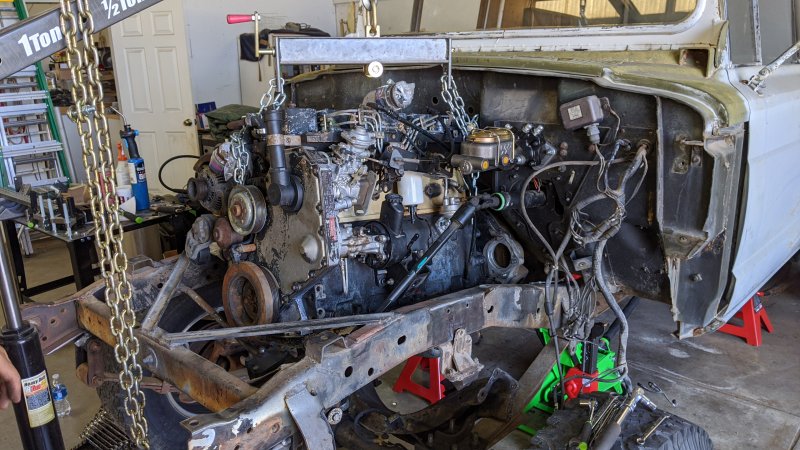
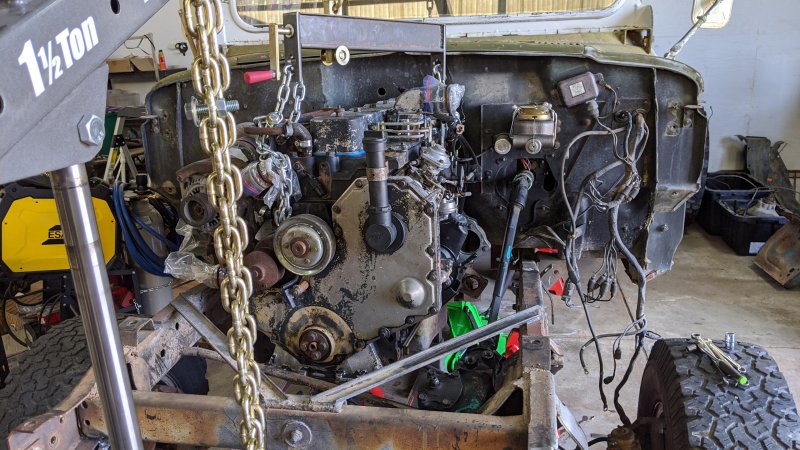
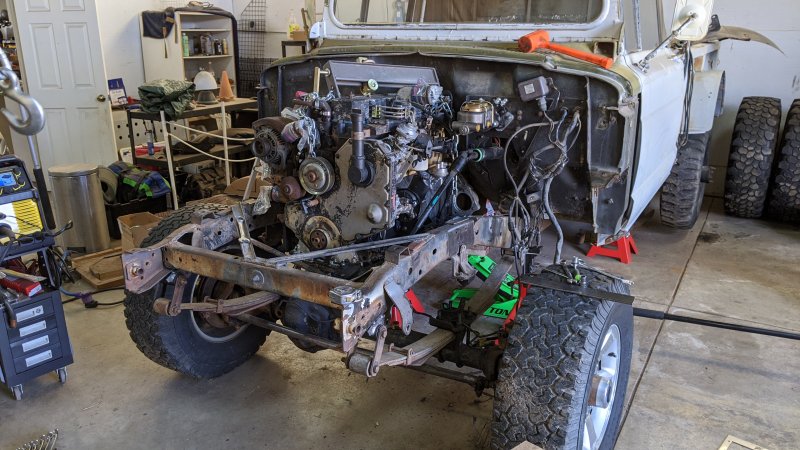
A little more about the project. The stock axles and springs are being replaced. Custom spring perches are being welded in to do stock Chevy springs in a different location than factory. The front axle is a kingpin Dana 60 out of a Chevy, not sure of the year. The rear is a Dodge Dana 80. Both are going to get 5.38 gears and air lockers. 20" beadlocks will get some 42 or 46" tires. Not sure exactly what tires will eventually end up on it. The 6BT will remain mostly stock. The Getrag 5 speed manual will also be mostly stock. Behind that will probably be an ORD Monster Box attached to an NP205. Most of the character and style of the truck will remain stock. The 24V electrical system is probably going to be replaced with a 12V, while trying to find gauges and lights that will work and still look original. It's probably going to end up with mechanical gauges for the most part when possible. Still a lot up in the air but it's going to be pretty awesome when it's done.
-
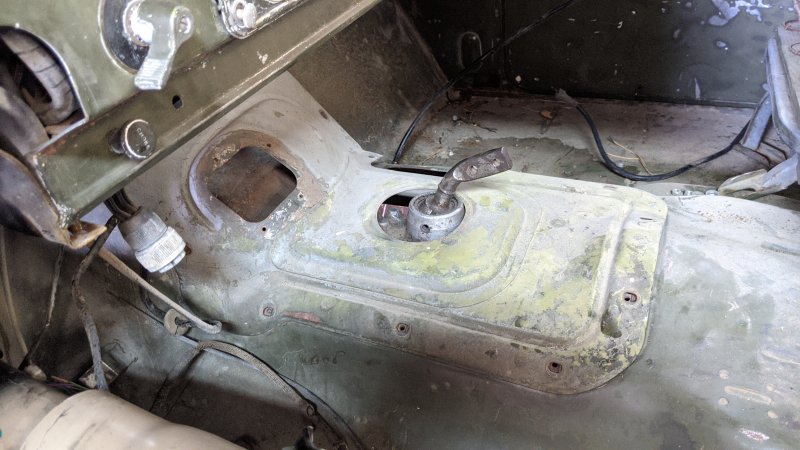
A buddy of mine has a 1968 Kaiser M715. I'm helping him with a 6BT from a 1992 Ram. Today was the day to test fit the engine. I'd say it went pretty well.
-
Clutches are cheap. No better time to replace it with new. Also, a Slip Yoke Eliminator kit would be a good replacement for the tail cone. There are several options on brands.
-
I'm helping a friend do a 12v into an M715 this summer. It's an interesting adventure. The issue is that the engine bay in the SJ platform wasn't designed for really big engines. It was designed for the AMC straight 6, Buick small block, and AMC V8. Trying to fit big engines like a big block or long straight 6es like the Cummins and Ford 300 can be a challenge and may require sheet metal modifications.
-
A 6BT is a tight fight under the hood in any full size Jeep (M715 included). It can fit, but you're millimeters away from the firewall and the radiator fan. And routing the intercooler is a challenge. It can be done but you have to know what you're doing and there isn't much room for error.
-
I believe that the YJ axle is a low pinion in addition to being a leaf spring setup. Not worth it at all. XJ donors are mostly high pinion and have all of the brackets you want to bolt them right up. Avoid 2000, and 2001 (low pinion) and earlier XJ with the CAD (axle disconnect, easy to see the big chunk of cast steel on the passenger side).
-
I like to have AC for the really hot days. But since I moved to CO, I'm seeing a lot fewer of those. Humidity is also a big factor. The Denver area is usually pretty dry so it doesn't feel as hot. Back when I lived in high heat/humidity areas, AC was mandatory. I'm still not sure whether or not I'll put AC in the trail rig. But for a daily driver, I will probably always have it.
-
GoPro Hero 3.
-
Part of it. The switchbacks are one way down only. The pass above is two way before it gets to that part.
-
I'd take an FC170. Or a 50s Willys pickup with a flathead Ford swap.
-
It's pretty common for states without income tax to have high property tax or some other way of generating revenue. The tax man always finds a way to get his money.
-
That's probably going to be your biggest limiting factor. $100K doesn't buy much in a whole lot of this country unless you're really out in the middle of nowhere. You'll need to steer clear of very large metro areas. Find smaller metro areas that meet some of your other criteria. Best bet is to figure out what areas of the country are set for major growth in the future and get in before everyone else starts buying up the land. Not only does that give you free equity in your own place, there's always tons of work as the yuppies move in and need stuff done. Trouble is, predicting that growth is almost impossible.