
SoCalManche
-
Posts
481 -
Joined
-
Last visited
-
Days Won
1
2 Followers

Recent Profile Visitors
1977 profile views




SoCalManche's Achievements
Comanche Addict (5/11)
-
Renix Engine and fuel control
SoCalManche replied to NorJeep's topic in MJ Tech: Modification and Repairs
I rotated through like 4 injectors, had noid light getting signal, but could never get the damn thing to start. Then randomly one morning, she just started up (after spraying a ton of starter fluid in the throttle body). Everything was testing well the majority of the time, and then....yeah, she started randomly. Lol Now she just backfires through the throttle body randomly that I have not figured out yet. -
Finally trying to tackle this problem again, and thought I initially fixed it. Went to swap out the injector with another "new" one I have lying around, and somehow the larger of the two o-rings increased in diameter and no longer seated in the throttle body. Snagged a new o-ring set and put the same injector back in, and boom - she starts driving like a champ again! No low rpm stutter when driving, and no cutting out at highway speeds. Well, I take this opportunity to really test her and drive an hour out to run some errands. As I'm finishing up and ready to head back home on another hour drive, the cut-out starts occurring again. Whether driving at 25mph or 70mph, the fuel cut-out kicks in at random times, and when I think I find a pattern, it changes. I've been skimming over a lot of no-start threads or poor idle threads or fuel issue threads, but I haven't seen any solutions that I haven't tried already for my persistent issue. Do fuel pumps overheat and cut-out? Is that a thing? She runs pretty damn well minus the random fuel cut-out - closed loop, O2 actively working, put in an OEM MAP & CPS sensor, idles fine, spark plugs unfouled and plug wires relatively new. At a loss, honestly.
-
19 – Headlight harness installation
SoCalManche replied to fiatslug87's topic in Cruiser54's Renix MJ and XJ tips
I know people in the comments on this tip [via the cruiser54 website] chatted about the Waggy XJ headlight upgrade being figured out, but I never actually saw any resolution to that. If there is one, are we able to post it here as well? -
86 2.5L PS bracket upgrade
SoCalManche replied to eaglescout526's topic in MJ Tech: Modification and Repairs
The rain has left San Diego finally, so I can probably knock it out this week. I found my old bracket and pump, so It'll be a quick tutorial. Also reach out if you have any questions on the '86 2.5L. 2-3 years back I scoured the web for all the information I could, but I still find information for '86s not all that, well, informative. -
86 2.5L PS bracket upgrade
SoCalManche replied to eaglescout526's topic in MJ Tech: Modification and Repairs
I'm not terribly certain, but I think I still have the old bracket and power steering pump. I can do a quick swap and then do a write-up of the upgrade since the MJ is chilling in the driveway these days (the bucking problem is out of control) and I daily my TJ. -
Blew my head gasket...again...
SoCalManche replied to Jeep88Comanche's topic in MJ Tech: Modification and Repairs
Damn, where did the rest of the gasket go between the cylinders? Yeah, looks like a crack to me. I just went through a head gasket ordeal on a Jeep 2.5L engine and I had some pitting between the cylinders on the block mating surface. I checked the entire deck for flatness to make sure it was within tolerance and it sure was. Put her back together with a Fel-Pro gasket and she is running strong! Good luck on your head... -
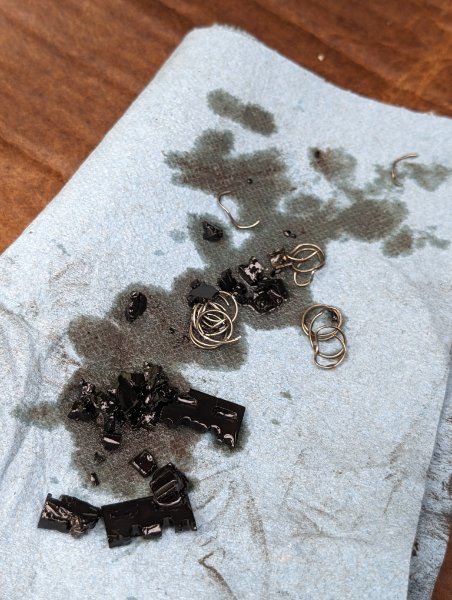
Forgot I posted this on Comanche Club! After I sent the post, I went outside and got under the engine, and just turned around so I was facing the timing chain. Saw another elongated piece of black plastic sticking out from where you can see the timing chain, and I knew immediately. I have no idea why it grenaded itself, but I'm more impressed the chain held without snapping because she was pretty loose and I should have totally grenaded my motor. Got a new timing chain and tensioner and she's good as new. Now off to the next issue...an exhaust rattle! Merry Christmas!
-
This is also the source of the main chatter when I was rotating the crank to TDC before checking rockers/pushrods/lifters. Normal? https://gopro.com/v/72GDpNdwanmXz
-
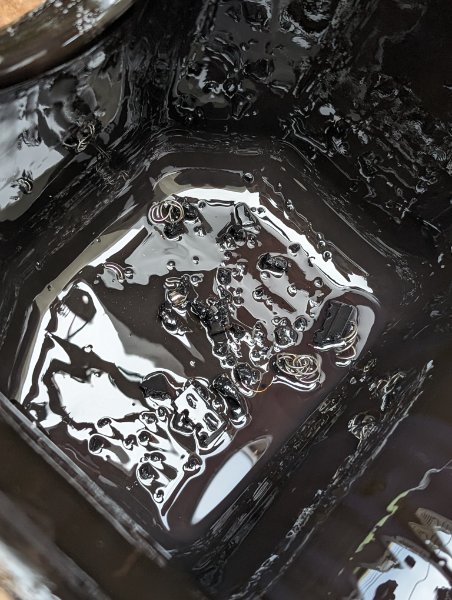
I've got a TJ that I recently replaced the head gasket on. Once I fired her up for the first time since the replacement, she was EXTREMELY chattery, well beyond the typical lifter tick. Everyone told me it was an exhaust leak, but wasn't so sure. Dropped the oil pan just now and this is sitting at the bottom. What's it look like to you? It's both metal and plastic material absolutely wrecked. She drove like a bat out of hell before I dropped the pan. She was just so damn loud I needed peace of mind before I continued to try to solve the problem, but of course, a new can of worms has opened up! So whatcha think?
-
-UPDATE- Got caught up with work crankin' 12-14 hour days for the better half of the last month or two. Hadn't been able to tackle any testing just due to lack of time, but as my days were going back to normal, the she-beast decided to spring a small leak in the t-stat housing, and once I replaced that, it gave way to a much larger issue, the water pump failing and dumping massive amounts of coolant on the ground; gotta love green street paint! Due to coolant being spat throughout the engine bay, once she was up and running again, she was bucking like the wildest horse you ever rode. Essentially my initial intermittent fuel delivery problem x100. She got all cleaned up and is now back to her regular fuel delivery issues. So away I go to test and see what I can come up with. Also, I added the splice for the fuel pump in when I did the original RENIX Tips 1-5 ages ago.
-
Because the fuel IS cutting off? Let's say I'm cruising down the highway at 65mph (give or take), and I go to increase my speed to 70mph to pass someone. Randomly, as I'm trying to speed up and essentially pushing down on the throttle more, the ST value will drop to zero, I'll get the "check engine light" on the REM, and my engine cuts out. She doesn't die perse, but if I'm on the pedal, I'm losing speed because no fuel is being supplied to the cylinders until I fully let of the pedal, ST trim values return to normal, I feel the engine kick back in, and then I can continue on. ST Trim values in normal operation hover around just shy of 100 and no higher than 152. All though, I do remember before having this issue that my ST values went up to 180 once in a blue moon thanks to the southern California hills and valleys that do a number on these 2.5L. When I stomp on it and go into WOT, it only hits 152, so I don't know if that's anything to notate. Sounds like a good test to do; I will definitely jump on that ASAP. Quick question, what is PE mode?
-
SoCalManche changed their profile photo
-
So I broke the clutch pedal on a test run up to LA from San Diego on Christmas Eve last year and the ol' girl sat the first half the year until I finally grabbed another pedal. Up until that point, she was running like she was brand new, no issues. After I got a replacement clutch pedal, she was running like $#!& for a bit, but now pretty much back to (almost) perfect. I get an intermittent issue where while driving, she cuts out completely as my foot is on the throttle, and as soon as I let up she goes back to normal. With my REM, it looks like this: Driving --- ST value is bouncing around normally Fuel randomly cuts off while foot on throttle, ST value hits zero and remains at zero until I pull off the throttle and then fuel returns. I thought I pinpointed when the fuel cut off happened, once it got up to operating temp, but there is no rhyme or reason, or at least from what I can tell...She also dies sometimes when I come to a stop, but immediately restarts and can always hear the fuel lines pressurize by the pump. I've swapped out multiple injectors, issue remains. All grounds refreshed, pretty stumped on this one. If this issue has been discussed on here before, I'd love the link to the thread.
-
Do you have a REM? If not, this is the O2 sensor test per Cruiser54: O2 sensor testing 1987-1990 Renix For the Renix years, 87-90, the O2 sensor has 3 wires, 2 black and 1 orange. The orange wire (largest gauge of the 3) is the 12-14 volt power that comes from the O2 sensor heater relay on the passenger side firewall, and that powers the internal heater in the sensor so that the sensor can work at idle, and almost immedietly after start up. Loss of that power will hurt gas mileage even with a good O2 sensor. One of the black wires is a common ground for the heater power and O2 signal to the ECU, so a poor ground will give a voltage feedback from the heater power input, to the ECU causing poor mileage even with a good O2 sensor. The third wire, also black is a voltage feed wire, 5 volts, from the ECU to the O2 sensor. The O2 sensor is an O2 concentration sensitive variable resistor. At optimal O2 concentration the 5 volt input feed to the O2 sensor drops to 2.45 volts due to losses across the O2 sensor to ground. That same wire if disconnected from the O2 sensor will read 5 volts constant to ground. At idle that voltage should read 1-4 volts oscillating quickly back and forth roughly once every second. At 2000 rpm it should run between 2 and 3 volts max, and is optimally running between 2.3 and 2.6 volts at 2000 rpm (in park). A digital meter can NOT be used for reading the O2 sensor voltage, but it can be used to test the ground and the 12-14 volts to the heater and the 5 volt feed from the ECU with power on and engine off. You must use an old style analog meter with the needle gauge on the display to see the voltage swing back and forth with the engine runing. If the O2 sensor readings are not right, say they read 4 volts or 1 volt steady, you have a problem. BUT before you blame the O2 sensor make sure it has good wiring, and make sure the proper voltage is feeding it, by turning power on, engine off to read the engine off voltage feeds (12-14 volts on the orange wire, and 5 volts on one of the two black wires), and ensure the ground wire (power off) reads less than 1 ohm to the battery negative post. A leaky exhaust system or leaky fuel injector(s), or bad compression, bad rings or leaky valves, bad plugs, wires, cap, rotor, HV coil, and so on, or combination of these, can also cause a lean or rich condition that gives you high or low O2 sensor readings that are not the O2 sensors fault, so try and verify those other items also before buying parts like an O2 sensor to fix your problem.
-
Went to swap in an injector I had that I knew was functioning last I used it; Before swap: Started truck up again to see how it would start; she retained LEAN/OPEN LOOP condition. After swap: Started truck up and same occurrence; retained LEAN/OPEN LOOP condition. I then swapped the injector around to see if orientation mattered (been told in the past orientation does NOT matter); as soon as truck started, cycled to CLOSED LOOP and O2 sensor immediately starting pinging back and forth between RICH/LEAN. Can we verify that orientation matters? I've always just thrown injectors in without looking at orientation and it didn't seem to matter - that was always luck? Also, what are ST values supposed to be in idle? She was in the 160-180 range.
-
When prior IAT was pulled, it was coated in fuel. Raw fuel can't really come from anywhere besides the injector, no? Considering that fuel regulator vent was already monitored as being dry during operation.