

AZJeff
-
Posts
1312 -
Joined
-
Last visited
-
Days Won
1
Content Type
Profiles
Forums
Gallery
Everything posted by AZJeff
-
As long as you catch the balancer before it rubs a hole through the timing chain cover, you will be OK. The actual Vibration Dampner (aka Harmonic Balancer) can be had for anywhere from $30 to $60, depending on brand and source. I bought a Dorman when I redid mine, and it was $60, but I see Rock Auto has an ATP brand for $40. Both are decent brands.
-
Need Help with XJ "SKIM" Security System.
AZJeff replied to AZJeff's topic in MJ Tech: Modification and Repairs
Yeah, I did some searching on the NAXJA site, and it appears that once I plugged the SKIM reader in and tried to start the Jeep, I "programmed" the PCM to search for a valid SKIM key (which I do not have). The ONLY solution is to have the PCM reprogrammed to NOT search for a SKIM key. So now I get to send my PCM to a computer place to have them program the PCM to NOT look for the SKIM key. That was a $145 mistake. I have already gone out and taken the connector for the SKIM reader and put a piece of heat shrink tubing over the plug, so it won't be reconnected again and repeat this mistake. -
Need Help with XJ "SKIM" Security System.
AZJeff posted a topic in MJ Tech: Modification and Repairs
I know this is a topic that does not pertain to factory OEM MJ's, but my vehicle has been modified to have the instrument cluster and PCM from a 2000 XJ, and I need the advice of an expert on this later type of XJ. The steering column in my MJ came from a 2000XJ, and it has the "SKIM" security feature as part of the ignition switch. For as long as I have owned the vehicle, the SKIM reader that surrounds the key lock inside the column has been disconnected. (This is good, because I do NOT have the custom programmed keys needed to "talk" to the SKIM reader.) This means the SKIM reader doesn't talk to the PCM, and is thus the security feature is inoperative and my MJ behaves like a "regular" 2000XJ. So here is my problem: I accidentally plugged the SKIM reader back into the wiring harness in the steering column while doing some dash work. When I finished the dash project, I attempted to start the vehicle. It started and ran for about 3 seconds, and then shuts off. I realized my mistake, and disconnected the SKIM, but I think I have created a problem. Every time I try to start it, the same thing happens where it starts and runs for 3 seconds, and then dies. Disconnecting the battery did no good. I think what has happened is that I have "taught" the PCM that a SKIM module is active the Jeep, and so it is looking for the custom keys. Short of having the dealer use a "DRB Scanner" on the vehicle to retrain the PCM that it doesn't need to "see" a SKIM, what other ways can I defeat this goofy security feature? -
Oil pressure questions
AZJeff replied to speeding_infraction's topic in MJ Tech: Modification and Repairs
For some mysterious reason, the senders on the MJ/XJ vehicles with actual oil pressure guages are kinda flakey, and don't seem to be very robust. There are countless stories of guys confirming pressure via a mechanical guage and finding it was actually within normal spec. Once the sender was replaced, all became well again. I am not saying your issue is "for certain" the sender, but starting with a mechanical guage confirmation is always a good first step. -
Cruiser is correct. It's damned near impossible to reach the bolts with a normal sized torque wrench. In addition, the torque level, if you really want to measure it, is in INCH-POUNDS. Most DIY guys don't have inch-lb. torque wrenches. After working on cars for 50+ years, I have a highly calibrated wrist just like Cruiser has, and that works fine for things like valve covers and oil pans.
-
Doing as you suggested, there is a real good chance you will kink/crack the tubes where you are bending them, or, worse yet, crack the solder joints where the tubes join the heater core end tanks inside the heater box. The tubes on the cores are surprisingly stiff. They are not dead soft copper by any stretch.
-
That vent hose should be secured up onto the crossmember over the axle with a zip tie or the like. It's positioned that way to keep water from getting into the tube when going through puddles (small creeks?) and the like.
-
Rod/Main Bearing Recommendations
AZJeff replied to howeitsdone's topic in MJ Tech: Modification and Repairs
When I put bearings in my MJ early in the summer, I found the mains were 0.001 undersized from the factory, and the only replacements I could get were Mopar branded. None of the other big makers seemed to list that undersize. The local dealer didn't have any, and said they were on national backorder. However, Summit Racing had them in stock. The rods were standard size, and I got Clevite's from Rock Auto. I don't remember seeing anything on Rock Auto about the "X" marking indicating an undersize from the factory for the rods. Then again, mine did not have those markings, so I wasn't searching out the meaning of such. -
Coolant unexplained loss.
AZJeff replied to Classy Comanche's topic in MJ Tech: Modification and Repairs
"Most" water pumps don't make any unusual noise before they fail. (The one in my MJ was the exception, in that it made an irregular screeching sound because some of the balls in the ball bearings in the shaft were disintegrating.) The most SURE way to diagnose a bad water pump is to look for weeping out of the hole on the bottom side of the "nose' of the water pump housing, where it sticks out to support the pump shaft at the pulley end. Crawl under there with a flashlight when it's running and do a visual exam. -
Coolant unexplained loss.
AZJeff replied to Classy Comanche's topic in MJ Tech: Modification and Repairs
The coolant has a nasty habit of sneakily running down the inside of the firewall, and then soaking into the jute matting that is under the carpet as a sound deadener/insulation. You don't normally see it on an floor mats because of this. When heater cores leak enough to keep refilling the cooling system, they are to the point where the heater box has enough coolant dispersed in it that the smell is hard to miss, because all the air passing through the box is passing over a coolant film. (Unless you actually have just pure water in your cooling system, in which case it evaporates and leaves no trace inside the heater box) If you are seeing a steady loss of engine coolant and regularly needing to top the system off, it's probably something more significant than a leaky heater core. This is expecially true because you stated you have checked for the usual leaks like hoses and radiator and find no puddles under the engine. One last thing you can do besides the compression test is to climb under the Jeep and look up at the weep hole in the bottom of the water pump. It should be dry, and have no evidence of a track of dried coolant that has run out the hole in times past. If you do it with a hot engine, while it's running, that is a further method for checking for a leak there. -
Coolant unexplained loss.
AZJeff replied to Classy Comanche's topic in MJ Tech: Modification and Repairs
Compression tests are done with the engine intact. All you need is tools to remove the spark plugs, and a compression tester. The compression tester can be "rented" from places like Autozone, where if you return the tool after you use it, you get a refund. Here is a good video from a respected guy on YouTube on how to do a compression test: How To Do a Compression Test -
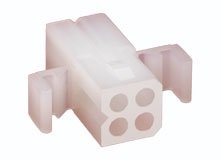
Those are good old-fashion connectors made by Molex. The ears that attach them to the panel are molded onto the connector body. The photo below shows a typical example. the ears fold back parallel to the connector body and the wedge shaped part passes through the hole in the bracket to snap into place. carefully squeezing the wedges with a pair of pliers with a large jaw spacing will force the ears inward and also push the connector back out of the bracket. A second set of pliers pulling on the BODY of the connector on the back side helps. Make sure the connector and bracket are free of crud and dirt, as they are much easier to get out in that condition. Brake cleaner works fine and won’t hurt the nylon connector body.
-
What the heck are those tracks of brown crud on the solder side of the board? They almost look like carbon tracks from arcing, but the photos are not real detailed. That's kinda disappointing on a "reman'd" assembly.
-
EMPLOYMENT TIME FOR ME: I have NODS (Night Vision), and a suitable long range "intervention tool". You pay room and board, and I guard your vehicle(s) at night as needed.
-
I would agree. Among MJ's, a 1986 is a bit more "collectable" than otehr years (except maybe a 1992). Keeping the drivetrain original might be more attractive to someone who wants a bit of Jeep history. I am thinking (hoping) someone who is savvy enough to be looking for an early MJ would be mechanically inclined enough to drive a stick. Then again, I am an old guy, and learned to drive in the late 1960's on a stick.
-
I will elaborate on what Eagle said about oil pressures. The 4.0 engine has "official factory approved" oil pressures of 13psi minimum at idle, and above 1600 rpm, it should be between 37 and 75psi. These numbers are, of course, with factory recommended 10w30 oil and with a hot (fully warmed up) engine. I think the reason the pressure range is so wide when measured at 1600+ rpm is because, in my experience, there is a pretty broad range of oil pressures reported by various owners with the 4.0 For example, on my MJ, the hot idle oil pressure is about 23psi, which is well above factory minimums. However, that same engine, when it gets fully hot (and I mean REAL hot here in Phoenix) only puts out about 42psi at 1600 rpm, which is at the low end of recommended. Another factor to consider, and this is just my personal opinion, and not backed up by any data, is that the 4.0 isn't an engine that is extremely demanding of high oil pressures to function as expected. in other words, as long as your engine is making steady oil pressure, the engine is fine with a pretty broad range of oil pressure values.
-
Thoughts on what caused this?
AZJeff replied to Warren99's topic in MJ Tech: Modification and Repairs
A shaft that wobbles is going to do bad things to that carbon "button" in the top of the dist. cap. The carbon button is chosen because it is strong in compression (the rotor spring pushing up on the button), and the carbon is conductive. However, the carbon is NOT designed to deal with "scrubbing" forces that would happen with a side to side motion of the dist. shaft. -
April 2020's Quarantine Comanche-AZJeff's 89
AZJeff replied to 89 MJ's topic in Comanche of the Month (MJOTM)
That stuff is Rhino Liner. It was put on at the same time as when the bed of the MJ was done, and was done by a professional shop. -
You are quoting some very specific temperatures for the coolant, far more precise than the factory gauges can display. What is your measurement tool to arrive at these values?
-
Transmission fluid recommendations?
AZJeff replied to Classy Comanche's topic in MJ Tech: Modification and Repairs
I am a big fan of changing the filter whenever I get a "new" car and do a trans fluid change. (The term "new" here means a older vehicle that has had unknown maintenance.) So my approach is to change the fluid AND the filter the first time, and inspect the filter (and the bottom of the pan) for any abnormal signs. Assuming nothing is found, all subsequent trans fluid changes are just the fluid, and I leave the filter alone. I am also a big proponent of changing the fluid more often than officially recommended. On my all my vehicles, I change fluid every 24K miles, but I don't tow any thing with my vehicles. -
Factory Front Bumper Flush Mount Fog Lights
AZJeff replied to oleskool's topic in MJ Tech: Modification and Repairs
Interesting. Thanks. -
Something is awry with what you have said about your MJ and its' cooling system performance. I have PLENTY of experience with MJ's and XJ's being operated under FAR more strenuous conditions that yours. (I live in the PHX metro area, and temperatures above 105* is a daily occurence here, and I run my AC all the time.) An MJ/XJ with the 4.0 is going to run what might seem to be hot, but it's within the design limits, assuming that all components of your vehicle are up to OEM standard. (That means radiator, fans/shrouds, hoses, radiator pressure cap, 50/50 coolant mix, and thermostat.) WIth all of these things up to snuff, it's normal to see (in my climate, at least) the engine run right about 205*, with a tolerance of =/- 10 degrees. If you think this is too hot, your expectations are incorrect. (I assume you have confirmed your temperatures by using an infrared thermometer measuring the temperature of the thermostat elbow on the engine.) The transmission in your vehicle should never exceed 200* for any more than a minute or two at most. If it's seeing more than that, an aftermarket fluid-to-air heat exchanger is needed. (And the trans may need investigating) There is no doubt that altitude WILL reduce the effect of cooling across the radiator, as (for example) the air is only 81% as dense at 7000 feet as it is a sea level. However, this is offset by the fact that you are probably NOT running air conditioning in your MJ at 7000 feet, so the temperature of air entering the radiator is not being increased by heat being shed from the condenser.
-
Factory Front Bumper Flush Mount Fog Lights
AZJeff replied to oleskool's topic in MJ Tech: Modification and Repairs
What is a “knuckle pod” light? -
Restoring Taillights on an MJ
AZJeff replied to AZJeff's topic in MJ Tech: DIY Projects and Write-Ups
Somehow, the original write-up I created for this forum does not exist on my computer any more. Chalk that up to some sort of screw-up on my part, since I normally keep good records. It also looks like the PDF that was posted to the forum originally is missing/corrupt. The only thing I could do was to capture screen shots of the write up off of this forum, and some clarity of text/images was lost doing that. I have those assembled into a PDF, which I have attached. Sorry, this is the best I could do. 601007367_MJTaillightRennovation.pdf -
More likely is the “park” switch in the wiper motor transmission is stuck in the “permanently on” position. you might be able to fix it by removing/disassembling the wiper motor to clean/repair the park switch, or replace the whole wiper motor/trans assembly.