

AZJeff
-
Posts
1312 -
Joined
-
Last visited
-
Days Won
1
Content Type
Profiles
Forums
Gallery
Everything posted by AZJeff
-
Seat belt replacement (but now radio doesn't work)
AZJeff replied to Virginia's topic in MJ Tech: Modification and Repairs
I dug around in my 1990 shop manual, and I found the wiring diagrams related to the seat belt chime system, plus the radio and clock systems. A cursory scan of those diagrams makes me think you have killed the ground to a bunch of stuff by cutting that wire to the seat belts, but I have not spent a ton of time tracing all the paths. I have attached the diagrams in some PDF's for you to dig into further. CLOCK WIRING.pdf RADIO.pdf SEAT BELT.pdf -
91 Comanche Ignition Coil Relocate
AZJeff replied to HOManche's topic in MJ Tech: Modification and Repairs
Magnetti Marelli? You mean the Italian Lucas? -
Unique AC compressor issue
AZJeff replied to eaglescout526's topic in MJ Tech: Modification and Repairs
I went digging around in my 1990 Jeep Shop Manual, and it says that optimal clutch air gap is 0.016 to 0.031" Attached is a drawing of measuring the air gap.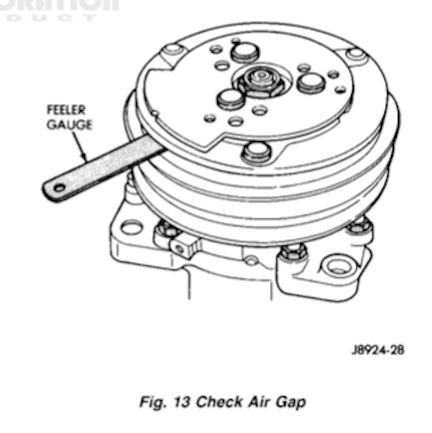
-
Tight applies when using the OEM style gasket. If you switch to a Remflex, one should be careful to not get too rambunctious with the wrench, because the Remflex gasketcan be over tightened
-
Unique AC compressor issue
AZJeff replied to eaglescout526's topic in MJ Tech: Modification and Repairs
Checking pressures when hot are ALWAYS a good idea when diagnosing compressor issues. That said, my thought is that your clutch is suffering a slow heat related failure. -
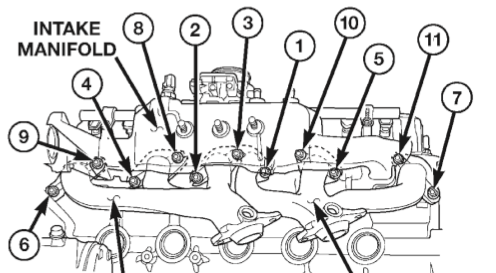
The attached picture shows the factory recommended sequence for tightening the bolts. The torque spec. is 24 ft-lbs, but I just tighten them by my calibrated forearm developed from years of working on vehicles. The most important thing is to make sure the manifold gasket is in good shape. The 4.0 manifold/cyl. head interface isn't the worlds best design, and has a tendency to develop leaks using the OEM type gasket. After the guys on Com. Club pointed me to the "Remflex" gaskets, I have had no further problems with manifold gasket leaks on my MJ.
-
If you have tested the coolant and have confirmation that there are exhaust gas products present, the first thing I would do is to run a compression test or leak down test before taking any further action. That test will tell you a bunch about how good the overall block is, particularly if the cylinder/ring/piston condition is worth investing more in the engine, or if it's time to swap engines.
-
I have 97+ plastic handles on my MJ, and I replaced the rasty OEM ones with Taiwanese copies. They are, for all practical purposes, exact copies of Mopar handles.
-
question about ordering new seatbelts
AZJeff replied to GTGMJ's topic in MJ Tech: Modification and Repairs
I have buckets in my MJ, and I bought the kind where the inboard (female) half of the belt has a stiff cable covered with plastic that holds the buckle up where it can be reached easily. -
question about ordering new seatbelts
AZJeff replied to GTGMJ's topic in MJ Tech: Modification and Repairs
When I put new seat belts in my MJ, I went with stuff from Seat Belts Plus. Here is exactly what I ordered, but you can adjust to meet your needs: MJ Seat Belts -
91 Comanche Ignition Coil Relocate
AZJeff replied to HOManche's topic in MJ Tech: Modification and Repairs
DUH. I failed to read the part about the "two pin connector", and just assumed it was the high voltage side. I agree with you in that the best/easiest/fastest solution would be to just extend the existing wires by solder and heat shrink tubing. -
91 Comanche Ignition Coil Relocate
AZJeff replied to HOManche's topic in MJ Tech: Modification and Repairs
I am confused. Is the OP wanting a custom-length coil "high tension" wire, or an extension to the DC feed wires for the low voltage terminals on the coil? -
91 Comanche Ignition Coil Relocate
AZJeff replied to HOManche's topic in MJ Tech: Modification and Repairs
Try going to a speed shop and have them make a custom coil wire to meet your length requirements. A run-of-the-mill auto parts store only stocks standard OEM sized and length stuff. -
Heater Core and Evap Coil Reccomendations
AZJeff replied to Whitaker717's topic in MJ Tech: Modification and Repairs
Those tubes are definitely some sort of copper alloy. The plates to which they are attached may be steel (magnet check to confirm). The only interesting part would be the fins. I suspect they are aluminum, but without a closeup view of how the tubes pass through them, any bonding that might be involved is anyones guess. -
Mine has a cut down XJ panel. It's fits perfectly, until you get to the back where the rear cab wall is. The OEM MJ panel had a curved portion that came down to join the cab smoothly. A cut down XJ panel lacks that. My solution was to make an "L" shaped aluminum piece that is bonded to the cab JUST above the window gasket, and it goes up enough to support the back of the cut off XJ headliner panel. I covered it in headliner material so it looks pretty invisible. The headliner "board" on an MJ, as such, is make out of the really cheesy fiber material with a foam core. I have repaired those using a layer of fiberglass cloth and resin on both sides of the damaged areas. (I cleaned up the nasty parts first so the resin would bond to the old headliner board well. Once the fiberglass has set and is cleaned up of any little fibers that stick up, new headliner fabric can be attached with spray adhesive as normal.
-
Heater Core and Evap Coil Reccomendations
AZJeff replied to Whitaker717's topic in MJ Tech: Modification and Repairs
That's kinda interesting. (Retired mech. engineer here). Modern heat exchangers are made from aluminum due to low cost, easy fabrication, and good thermal conductivity. (Not as good as copper, but pretty close.) Some portions of the heat exchangers are joined using what called "dip brazing", which is a form of soldering used on aluminum structures. Dip brazing only works on aluminum-to-aluminum joints, so copper tubes with aluminum fins would have to rely an a close (interference) fit between the tube and the hole in the fin. It's not optimal, but it can work. -
Heater Core and Evap Coil Reccomendations
AZJeff replied to Whitaker717's topic in MJ Tech: Modification and Repairs
Are the old evaporators made with copper/brass, or aluminum, like the new ones? I know all the old heater cores were copper and brass, and have switched to aluminum, of course. -
These guys might be able to help you out: GM Steering Column Parts
-
harmonic balancer. Go check yours!! right now!
AZJeff replied to Pete M's topic in MJ Tech: Modification and Repairs
I live near PHX. Out here, rubber drying up and cracking is a way of life due to the heat and the UV rays in the sunlight. The wife's KJ Liberty is 19 years old. Even though it had just about 100K miles on it at the time, I had to go through and replace all of the suspension bushings due to "dry rot" And don't even THINK about what it does to all the plastic clips and retainers on cars nowadays. Each time I remove one to do some sort of repair, I say a little prayer before I try to pop them off -
harmonic balancer. Go check yours!! right now!
AZJeff replied to Pete M's topic in MJ Tech: Modification and Repairs
It's pretty well known on all the various Jeep forums that the 4.0 harmonic balancer has this tendency to separate in such a way that the outer "pulley" portion walks in or out from the "hub" portion. I don't know if it's a poor choice of rubber materials, or something related to the design, or both. I remember reading a story on one of the XJ forums about a guy who had his balancer fail in such a way that the pulley portion walked off the FRONT of the hub, fell out on the ground, and since it was spinning at idle (the vehicle was stationary, it scooted across the parking lot and slammed into another vehicle, causing a bunch of body damage. -
Mine was all trashed when I got my MJ, and the cheesy "hardboard" Jeep had used was curled and delaminating from previous water damage. This drove me to a make a new one. I bought a piece of "masonite" from the lumber yard, and cut it to shape with a saw. (I used the old piece as a template.) Then I sanded the edges to remove the sharp corners. I obtained some black headliner material, and used spray-on headliner adhesive to attach the fabric to the masonite. The "L" brackets that attach to the bottom I cleaned and repainted, and attached them to the masonite with screws/nuts/washers. The headliner material is not as rugged as the stuff Jeep used, which was a sort of low-rent carpet type material. However, I don't put stuff behind my seats except a jacket or the like, so I am not worried about trashing the fabric.
-
Heater Core and Evap Coil Reccomendations
AZJeff replied to Whitaker717's topic in MJ Tech: Modification and Repairs
Buy stuff from Rock Auto, and try to stay with brands that have a reputation. in looking thru RA’s selection for those years, it looks like GPD might be your best choice. too bad Four Seasons doesn’t make stuff for those older models any more -
Looking for vacuum leaks isn't that hard, assuming you have some sort of vacuum pump. If you think the vacuum leak is in the dash area, intercept the line were it goes through the firewall into the heater box and plug it. Then use the vacuum pump at the point where the vacuum is sourced at the intake manifold. If the vacuum holds, then you have confirmed your suspicion that your leak is in the heater box. If the vacuum does NOT hold with this test, then at least your concerns about having to tear into the dash are over, and now it becomes a case of blocking off various parts of the system and retesting for holding vacuum until you find the area where the failure is located.
-
Seat belt replacement (but now radio doesn't work)
AZJeff replied to Virginia's topic in MJ Tech: Modification and Repairs
Given that your vehicle is 32 years old, I would strongly consider replacing the seatbelts for both seats. Heat, sunlight, and time all cause the belts to deteriorate (as you have discovered.) There are lots of aftermarket brands of seatbelts out there than will function as replacements, but both the male and female sides must be replace together, as there is no "standard" pattern between the two halves of the connection. I used these guys when I put in new belts: https://www.seatbeltsplus.com -
I agree. Inside the limits of the types of audio that are posted on this forum, it sure sounds like an exhaust manifold leak.