


gogmorgo
-
Posts
5984 -
Joined
-
Last visited
-
Days Won
4
Content Type
Profiles
Forums
Gallery
Everything posted by gogmorgo
-

TBI or Carb? '86 2.5L to 3.4L upgrade
gogmorgo replied to FigurativeGarbage's topic in MJ Tech: Modification and Repairs
x2 on the fuel injection from the camarobird. Carb swaps are for people who would rather spend a bunch of time screwing around to keep the thing running after the fact than spend a little more time on the initial install to get a better product that'll run better with less screwing around. -
Guess I'm not the only one disappointed this thread wasn't actually about axes. Not that guitars aren't cool or anything... but you know. Axes.
-
4.0l renix not starting
gogmorgo replied to speeding_infraction's topic in MJ Tech: Modification and Repairs
Your MJ was built about 15 years too late for points and condenser unless someone swapped something real old school in there. In which case all bets are off, who knows what was done. Spark comes from the coil, to the centre distributor button, through the rotor and back to the cap, and from there to the spark plugs. If the coil's good, and you've got spark at the coil and not at the plugs then there's really only four things it could be, distributor cap, rotor, the wire from the coil to the distributor, or else there's so much wobble in the distributor shaft the rotor isn't coming close enough to the contacts on the cap. It's very unlikely all your spark plug wires died or shorted at the same time, and a timing problem wouldn't leave you completely without spark. -
He wandered up, rooted around in the bottom of the hedge for a bit, then must have caught a whiff of one of the does I’ve seen wandering around because he took off on a mission with his nose in the air. This is one of the does. I’ve seen a fox or two cruising around a bunch too, but they’re pretty camera shy, don’t really stick around for long.



-
This little guy came for a visit.

-
The McKenzies album that came out a couple weeks ago is pretty good, if you're into that sort of thing.
-

-
I’ve only got metric speedometers so can’t really comment on where it sits at rest, roughly 10km/h for me, but it does rest on a stop. I had one instance where the speedometer lost power past the upper middle of the gauge and dropped clockwise to straight down. Then when it got power back it pushed itself back up clockwise against the wrong side of the stop. It dropped to straight down after I shut it off and then went back up to below the stop every time I turned it back on. I pulled the cluster apart and just spun it back around to correct it, and also resoldered the broken points that made it drop out. That’s a story for a different thread, but this is all to say the speedometer needle doesn’t stop at a specific indicated speed, it just parks itself on the stop. So if it happened to be misaligned, it would just sit on that stop regardless. And it’s fully possible if what happened to me above happened to someone else, they may have pulled the needle and put it back on above the stop, maybe your 5mph in the difference, without knowing better. All of the Jeeps I’ve owned have also had the speedometer out by roughly 10%. I’ve just interpreted this as the vehicle wanting bigger tires. But you see people saying their speedometer is out by X mph, likely because they only checked at one speed, and then with prompting discover it’s a percentage. It’s possible someone who knew just enough to be dangerous saw this and did something about it, 5mph under at 50, move the needle to incorrect it instead of getting a new speedo gear. But we can speculate all we want, and it doesn’t really get anywhere. As has been suggested, my action would be to put in the new speedometer gear, see where that gets you, then see about popping the needle off and moving it if you still need to.
-
Is it possible that the needle has slipped on the gauge? That's really the only thing I can think of, the gauge or needle isn't aligned properly. The speedometer is measuring the frequency of the pulses from the speed sensor, so it's unlikely for it to be off by a fixed amount at any speed.
-

-
brake reservoir sediment (red mud, rust, ???)
gogmorgo replied to brucecooner's topic in MJ Tech: Modification and Repairs
Huh. Don’t know why I thought that then. Weird. Sorry to put words in your mouth. It was definitely someone on here though -
If you’ve ever had to do a hill start with a heavy trailer and a manual you’d know why it would be rated for less. 5200lbs behind the ZJ and a left turn from a stop sign on a medium hill across a busy four-lane had me in low range to get moving and I still had to roast the clutch off. That’s not to say that manuals can’t be built for towing. You can definitely get a beefier clutch in there that can handle the stress better than the factory Jeep unit. My 5-speed GMC is good for 10k, near as I can tell same as the auto in similar spec. But again that’s a drivetrain built for moving the weight, not so much for being low fun and/or economical like a manual Jeep. Also the NV4500’s 1st gear ratio is 5.61:1, not 3.83:1 like the ax15 or 3.39:1 for the BA10/5 which definitely helps. Factor in the 4.10 rear axle and that’s a total reduction of 23:1, vs 11.8 for an ax15 on 3.07’s, 10.4 for the BA. You’d need an axle ratio of 6:1 to match that with an ax15, and I think that would cause more problems than it would solve.
-
What codes specifically? Not all O2 sensor codes indicate replacement, but it’s pretty common to see someone see an O2 sensor code and think that. Could be as simple as something having been left unplugged, or a pinched wire or something. Especially if the code comes back immediately after being cleared on a cold engine, before it’s had a chance to warm up and run all the monitor cycles it’s most likely to be an electrical fault.
-
This what my owner’s manual has to say about 5000lb towing. Note the requirement for a heavy duty rear axle. If you’ve only got a Dana 35 rear axle, it’s not going to like moving that much weight around regularly. If you only move your camper a short distance a couple times a year you might get away with it, but it’s not exactly legal to exceed the manufacturer’s rating. If you’re planning on putting a quad in your bed, make sure as well that you’re not exceeding rear axle weight. If you do have a metric ton package it’s probably fine, but if you’re going down the road with the rear end on the bump stops and your headlights pointed at the sky with a giant trailer behind a tiny truck, you’re probably going to encounter issues if the wrong person sees. Here’s more info on trailer, vehicle, and axle weights. Also from owner’s manual. Also I don’t know what this “class B” hitch thing is. You want a class 3 for 5000lbs. The class 1 mentioned in the manual refers to the factory bumper hitch, which I can’t recommend using if you do have, even for lightweight things. Unfortunately the bumper structure is a rust trap and they tend to bend and break right in the middle there. Not ideal.
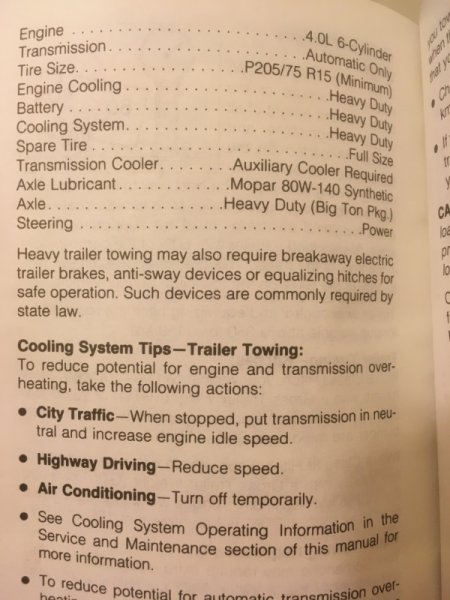
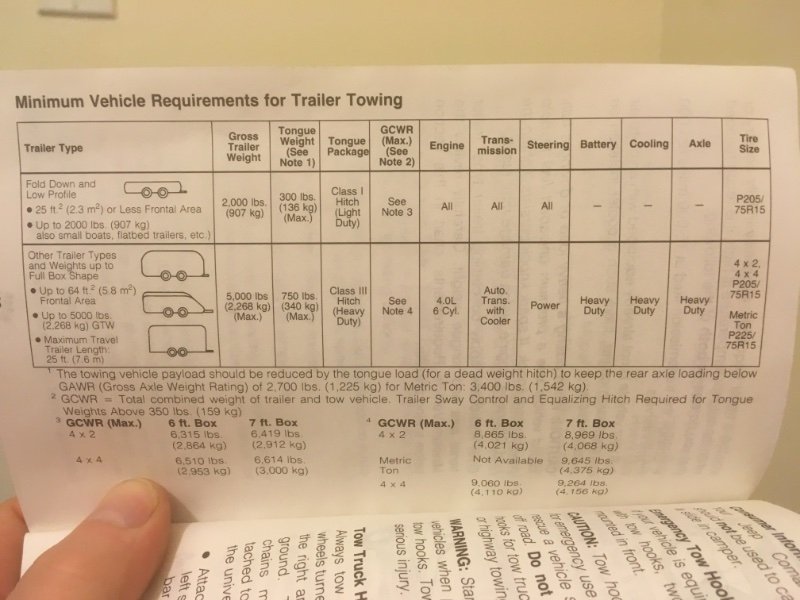
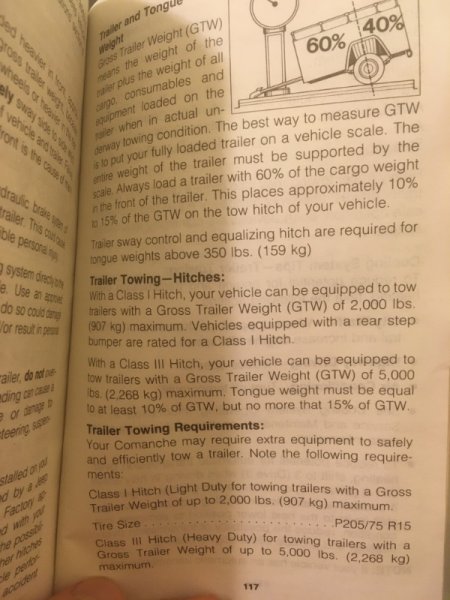
-
brake reservoir sediment (red mud, rust, ???)
gogmorgo replied to brucecooner's topic in MJ Tech: Modification and Repairs
If you’re bleeding out old murky brake fluid, you also know when you’ve hit new fluid. ;) -
brake reservoir sediment (red mud, rust, ???)
gogmorgo replied to brucecooner's topic in MJ Tech: Modification and Repairs
I first heard about it from Eagle, so no. It is possible though that it hung on for a lot longer up here. I’ve never personally seen it on shelves, but my 2001 Jimmy’s brake fluid definitely came out green. Murky for sure, but distinctly green. I never had issues with the rubber components in that vehicle’s brake system other than torn caliper pin boots. While trying to find a date that it quit being the case (I was unable), I noticed Autozone’s diy website says: “Brake fluid is usually a clear, amber, bluish, red, or greenish color when it comes out of the container and it’s new in the system.” https://www.autozone.com/diy/brakes/brake-fluid/what-color-is-brake-fluid I’ve been using the same brand of brake fluid for the last five years or so, and it’s on the amber side of yellow, but like anything else it must vary between manufacturers depending on what their magic formula is. Obviously I can’t know whether or not Bruce’s brake fluid is or isn’t contaminated, but I do know I’ve found a bunch of different colours in the brakes of the junk I drive, and everything still works fine. Almost everything I’ve worked on with old murky brake fluid in the reservoir also has a bunch of sludgy sediment in the bottom. In my mind it’s just evidence of poor maintenance history, not changing or bleeding the brake fluid regularly. If everything is still working I don’t see any sense in changing out components. But the procedure for contaminated brake fluid involves changing everything with rubber parts. Wheel cylinders, calipers, any valves in the middle of the system, everything. Not just the master cylinder. -
brake reservoir sediment (red mud, rust, ???)
gogmorgo replied to brucecooner's topic in MJ Tech: Modification and Repairs
Looks like old brake system junk. Most older vehicles have at least a little crud in the bottom of every reservoir. Might also be some dust that got into the system. What is a thing is that brake fluid used to be colourful. Back in the day when you changed your brake fluid you would put a different colour in. That way you knew when you’d got all of the old fluid bled out of the system. Red and blue were the most common colours I believe. I’ve definitely seen old brake fluid come out of a vehicle that had an orange or greenish tinge. Both in the same vehicle is probably unusual, but if you don’t know the maintenance history… ¯\_(ツ)_/¯ I would just clean out as much of it as you can. Once you’ve got it back together make sure the system is fully bled with good clean fluid. If it worked just fine before you swapped out the booster, it very likely will still work fine with new fluid. If it gives you peace of mind to swap out the master cylinder it’s probably worth doing to prevent yourself from worrying, they are generally cheap enough. -
Don’t really know for sure why they go for clamps rather than screws. It could be because they don’t want any sort of twist on the thing. The internal clearances are extremely small and you could damage one pretty easily. When I say clamped, I do mean usually there’s hold down bolts, but the injector itself doesn’t thread in. Some of them likely are doing this in part to make sure the injector sprays in the right direction to ensure intended flame propagation, and also that the fuel delivery system lines up properly to the injector to seal the connection point. I guess precise orientation and placement, proper load on the injector, not twisting the injector body on the way in all add up to not screwing the injectors into the bore. As far as whether they need covered or not, that’s probably an obstacle that’s easily overcome. I haven’t encountered any yet that were built to survive outside the engine, but that doesn’t mean they can’t. But they are usually buried pretty deep in the engine. I don’t really know what the reasoning is again but it might be to avoid getting damaged, bent, leaned on, twisted, anything, if not just that firing from the centre of the cylinder is a better place for distribution. A fully electronic injector that acts the same as a gasoline injector might be a different matter, but again I haven’t really encountered that. The pressures acting on the parts demand some serious effort to move and open the injector, and it all has to happen really quickly. You need the mechanical action to happen up at the top end of the injector where there’s space, but you need the timing to be precise so they open as close to the injector tip as they can, with the clearances between all the moving parts so tight that 30,000psi won’t push fuel between them. Even if you were actuating it with a solenoid you would want that thing in tip-top shape all the time, and leaving it exposed to the elements, even just what ends up in the engine bay, isn’t the best idea. The better sealed it is, the more it just means whatever makes it in will be trapped to do the most damage it can. So I guess there’s no particular reason you wouldn’t want to hang the injectors out the side, it’s just not a thing that’s done. Even with electronic control, a lot of them still rely on the camshaft to mechanically open the injector, and the electronic part mostly determines how much fuel gets distributed without as much control on the when. Some fuel injectors are actually connected to the oil system. There’s a separate high pressure oil pump that hydraulically actuates the injectors. I don’t actually recommend using those, though. Cat used them for a while but I don’t know of any others, there’s probably a reason. I guess a high pressure pump could probably be driven by a serpentine belt system, you’re probably only looking at 10hp to turn it, which isn’t more than a supercharger. And you’d need to be putting that much power into your alternator anyway if you went electric. I was thinking there’d be some advantage not tying its rpm to the engine speed, but that’s no different than driving it with the crankshaft, because that’s exactly what it is.
-
I don’t think you could run an injection pump off a rubber belt. Even a timing belt style cogged belt would be marginal. Injector timing has to be very precise, and any stretch or bounce at all in the belt would cause problems. One degree in either direction away from where it should be can be the difference between advanced into dangerous running conditions and running like crap because it’s too retarded. There’s a reason diesel injection pumps are almost exclusively gear driven. You could probably figure out a gear drive either via flywheel or the timing gears, but you’re doing some serious machine work there. If you were to go to a common rail injection system you could eliminate the need for precise mechanical timing. I don’t know if you’d have enough strength in the distributor drive… it’s not like it’s supposed to see much torque, and you’d probably also want to hang onto it as a cam position sensor. You’d need a pretty sturdy belt drive to run an injection pump. Hypothetically you could run an electric pump, then you’d just need to figure out your fuel injectors. Now most injectors live under the valve cover to keep them clean and lubricated. Some also run directly off camshaft, but we can’t really do that because the cam is on the wrong side of the head. If you were putting the injectors in spark plug holes you’d need to keep them covered and clean some other way, not a huge obstacle. I think the biggest thing is just going to be figuring out how to get injectors down the spark plug holes. Almost all diesel injectors are clamped in, so figuring out how to get them to screw into a hole will be something. Possibly just screw an injector cup down into the hole and drill some holes into the head nearby for the clamp system. You also need pretty good connections to get fuel to them at such high pressure. The spark plug holes also aren’t ideal for spray patterns because of the angle, but the higher pressure from the common rail system (30,000psi!) would immensely help with atomization. Something else the better atomization will help with is accommodating lower compression ratios. Most diesels are double typical gas engine compression ratios. You don’t necessarily need to be at 20:1, it just helps. Shaving the head down will help, sleeves and smaller pistons are a good idea but you don’t want to get the coolant too far away from the pistons walls either. It’s common practise to run “wet liners” in heavy diesel engines. Basically the sleeve goes straight through the cooling passage instead of just pressing down into cylinder wall. If you’re boring out the cylinder walls for sleeves I’m sure you could figure out a way to knock some holes clear through the factory cylinder walls to accomplish this while you’re in there. Also get a good solid o-ring around the base of the sleeve. I don’t know if you’d really need to mess with the cam to account for shaving the head. That would just be pushrod length. You likely will end up with an interference engine, but that’s only an issue if you lose a timing chain. As to head bolts and gaskets, the 4.0 turbo guys have kinda figured some of that out. Doubling compression ratio isn’t really much different from running 15psi in terms of cylinder pressures. I don’t think it would be too big a deal for a naturally aspirated diesel. If you want to stuff 30psi of boost down the thing on the other hand… yeah different story.
-
Not much point in speculating until the OP gets back. ¯\_(ツ)_/¯
-
Maybe it's less of an issue in warmer climates, but if you leave it in the cold with summer fuel in the lines it can drop paraffins out of the fuel. Usually it's only an issue if it was run with the summer fuel, because it collects in filters and injector screens, but just sitting in the cold can sometimes be problematic. Had it happen to a tractor at work a few years back after it sat just one winter. When we went to look at it after they couldn't start it in the spring, the filter was plugged right full of wax. But it's hard to diagnose an engine without much more to go on than it just cranks and won't start.
-
Yup. Also mine.
-
Came back off the truck today. Whole bunch of brand new Audis on the truck and my junk at the end. 😅

-
Rotors and Pads recommendations
gogmorgo replied to NC Tom's topic in MJ Tech: Modification and Repairs
Premium means different things for different brands. What Napa calls premium rotors (and drums) are significantly more corrosion resistant than the cheaper ones for not much of an increase in price. They also have a level or two above those. Same with pads, the “premium” ones are a step or two above the cheap ones with a bunch more options. The cheapest rotor option they sell is more prone to warping than the “premiums”, the cheap pads also tend to make more noise and definitely aren’t as heat tolerant. Not ideal in the mountains. My boss liked ordering the cheapest possible option. The rest of us spend an extra little bit of coin and didn’t have to deal with the extra work from buying cheap parts. To be clear I’m not saying everyone should be getting the most expensive parts out there, but when you buy the cheapest possible you end up having to deal with the cheapest possible. Whatever parts store you go with you typically will be presented with a range of options. Going with something in the middle of the road from a respected brand will usually get you something that is more than good enough for a daily driver. Unless you’re doing something high-performance, it’s not always worth paying for the high performance products. -
Did it quit and get parked, or has it just been sitting a while? If it quit before it was parked you’re likely looking at a mechanical issue. If it’s just been sitting forever it could be as simple as needing the fuel system primed and bled, or it’s gummed up from sitting and needs cleaned out. Does it do anything while cranking? Sputter a bit? Smoke out of the exhaust?