


Eagle
-
Posts
15698 -
Joined
-
Last visited
-
Days Won
27
Content Type
Profiles
Forums
Gallery
Everything posted by Eagle
-
How? They're too big.
-
Cherokee XJ from 1984 through 1996
-
Unless something has changed, there's one head bolt that has to be painted with sealant of some type because it penetrates into a coolant passage. I'd have to look it up to know which one -- I assume you have FSM around?
-
The purpose of keeping the RPMs up for the first 10 minutes is to keep the oil pressure up. You want to be certain the lifter/lobe interface has plenty of oil when the parts first get introduced to one another.
-
Coolant temp sensor location
Eagle replied to Chukkklez's topic in MJ Tech: Modification and Repairs
Which one? The one that sends a signal to the gauge cluster (or idiot light) is on the left (driver's side) rear corner of the head. The one that sends data to the ECU is on the lower, driver's side of the block. The one that triggers the auxiliary fan (if you have one) is in the diver's side radiator tank. -
4.56
-
Remember the lug pattern for the WJ is different, too.
-
Would it be worth trying to disassemble the two questionable lifters and give them a thorough, internal cleaning? Probably not, but it's a thought. That would make more sense on a 2.5L, where you can remove the lifters without disturbing the head. On the 4.0L, if that didn't work you'd have to pull the head again. Ugh!
-
"It's not the fall that hurts, it's the sudden stop at the end."
-
Under the hood -- is there a compressor mounted on top of the engine -- on the right-hand side, toward the front? On your heater control panel, what named positions can you put the air flow lever in?
-
A long time ago I think I posted a diagram showing why/how this results in a lift -- and how much. Lemme see if I can find it ...
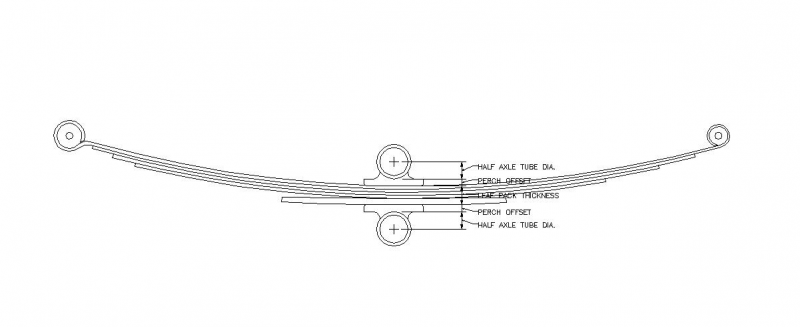
-
Good point. I don't think I've ever encountered anyone who referred to an automatic transmission as a "4-speed."
-
Steering ratio on the manual boxes is SLOOOOOOOOOWWWWWWWW
-
The 4.0 liter engine has never been available with a 4-speed transmission. Either it's a 5-speed, or it's not a 4-liter. And the Comanche has never had an 8-foot bed.
-
Exactly. Unfortunately, your goal should be to remain "average." You definitely don't want to be Private Pyle*, but you also don't want to volunteer for anything or in any way give the appearance that you are trying to stand out or suck up to the DIs (Drill Instructors). Actually, slightly better than average may be okay, but not stand-out. I have no idea how rank works in today's Army. I enlisted at the height of the Vietnam unpleasantness. I did well enough in Basic to make E2 upon graduation, and I did well enough in AIT to make E3 upon graduation. A lot of the guys didn't make E2 until they finished AIT. * You do know who Private Pyle, is, right? I'm not talking about Gomer Pyle, USMC. Fast forward to 02:50 https://www.youtube.com/watch?v=GTQAXX08A-s https://www.youtube.com/watch?v=k4eMhddTPg4
-
Or that.
-
Be sure to check your heater blower, and the resistor pack. Mice like to build nests in the blower, and if (when) the nest material builds up around the resistor pack it blows the thermal fuse.
-
I disagree on the flex plate. Been there, done that. A cracked flex plate sounds like a bad piston or a bad rod bearing when idling in neutral. Put the tranny in gear so the torque converter is loaded, and the noise goes away.
-
RPMs drop to zero, while driving - Can't solve
Eagle replied to Big Dan's topic in MJ Tech: Modification and Repairs
CPS wires touching exhaust manifold? -
Ah, yeah -- it's what I do for a living. Which is how I know that every state in the country now uses some edition or other of the International Building Code and the International Residential Code. And garages as an extension of a residential occupancy fall under the Residential Code. I still want to know how a builder can "certify" construction plans.
-
Do you ever get down to the New Haven area?
-
How about not using all the abbreviations? I'm a veteran with a box full of medals, and orders for others that I am allowed to purchase on my own if I want to add them to the box. I know what the CIB and CAB are, but I've never heard of EFMB, ARTB, or RI. How about using English?
-
Legally, builders can't "certify" plans. Any building that is on a residential lot and that will be accessory to a one- or two-family residence is constructed under the International Residential Code, not the International Building Code (which is for everything else). I went through this recently with a building inspector friend who had a case where a woman was going to build an 80' x 200' riding arena and she claimed it was under the Residential Code. What kicked it over to the Building Code was that she was running a commercial horse breeding operation and riding school out of the property. I'm not saying that a private, residential outbuilding is exempt from codes or from inspections. The exception in the code is for structures smaller than 200 square feet. And zoning is a separate matter from building codes. What I'm questioning is this "certification" of plans. The laws of every state allow the owners of residential properties to draw their own plans. They do NOT require the plans to be drawn by an architect or an engineer, and an architect or an engineer cannot legally put his seal and signature on any plans he did not draw personally or that weren't drawn under his direct supervision. A builder can also draw up plans for a residential structure but he can't "certify" them -- at least, not beyond making a statement that "I certify that I drew these plans," which is a meaningless statement. His 5-year old daughter could draw the plans with a crayon and make the same certification.
-
The Renix models also have two diagnostic connectors on the passenger side of the engine bay, behind the shock tower. One of the connections in one of those connectors is a tach signal. If you have (or can borrow) an idle tach or an aftermarket tach, you can test with that to see if the tach signal is making it as far as the diagnostic port. If you haven't already done so, download the Renix electrical manual. You'll find full information on those two diagnostic connectors in that.
-
How do you have blueprints "certified"? Who certifies them? And why do they need to be certified at all? This is next to your house, right? So it gets built under the Residential Code, and doesn't need to be drawn, signed, or sealed by an architect or an engineer.