


Eagle
-
Posts
15698 -
Joined
-
Last visited
-
Days Won
27
Content Type
Profiles
Forums
Gallery
Everything posted by Eagle
-
A "cat delete" is a length of straight pipe. On the 4.0L MJs, the cat has a 2-1/2" inlet with a square, 4-bolt flange, and a 2-1/4" outlet. So to make up a cat delete you'll need a flange, a length of 2-1/2" straight pipe, and a 2-1/2" to 2-1/4" reducer. Whether you buy a cat or do a cat delete, you'll need a flange gasket.
-
I'm referring to the second photo. I believe the first photo is a side marker light socket, not a parking light socket. I don't know what goes bad, I just know they go bad.
-
You need to replace the parking light sockets. The grounds have gone bad, and they're trying to find a ground path back through the light circuit. Once you turn on the lights, that path is no longer available. This issue has been discussed and diagnosed many, many times.
-
Paint.
-
When you replaced the u-joints in the driveshaft, did you mark the shaft to replace it in the same orientation it was originally? If not, drop the driveshaft, rotate it 180 degrees, then reinstall it.
-
another 8.25 swap conundrum
Eagle replied to luckycamper's topic in MJ Tech: Modification and Repairs
There's often a tag on the front axle with the gear ratio. Even without the tag, a 2.5L with a 5-speed is almost certainly going to have 4.10 gears. Your tires calculate out to a diameter of 31.65", which is (as ghet has noted) the metric equivalent of a nominal 32-inch tire. Even with a 4.0L engine, most folks want at least 4.10 gears with that size tire. -
Effing Continued Effing Brake Effing Issues
Eagle replied to NC Tom's topic in MJ Tech: Modification and Repairs
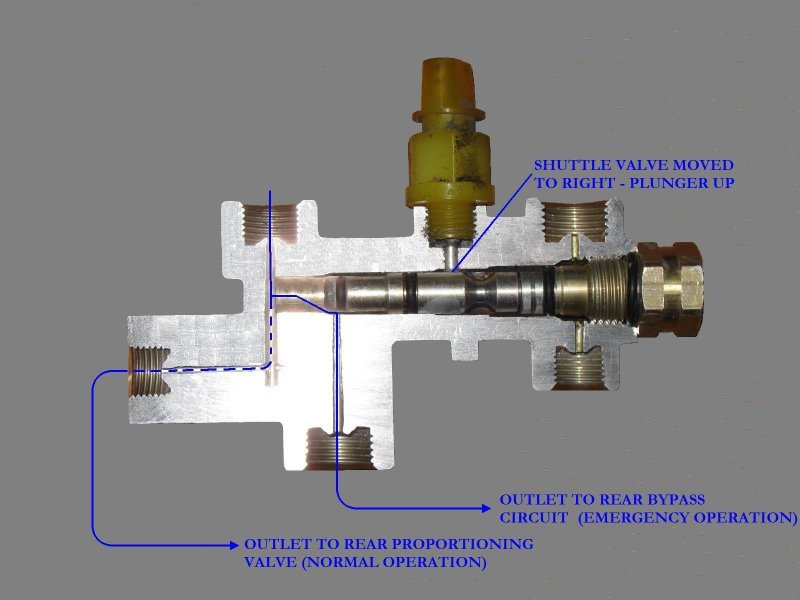
These images may help explain how the MJ rear brake emergency bypass circuit works. Normal operation: Bypass operation: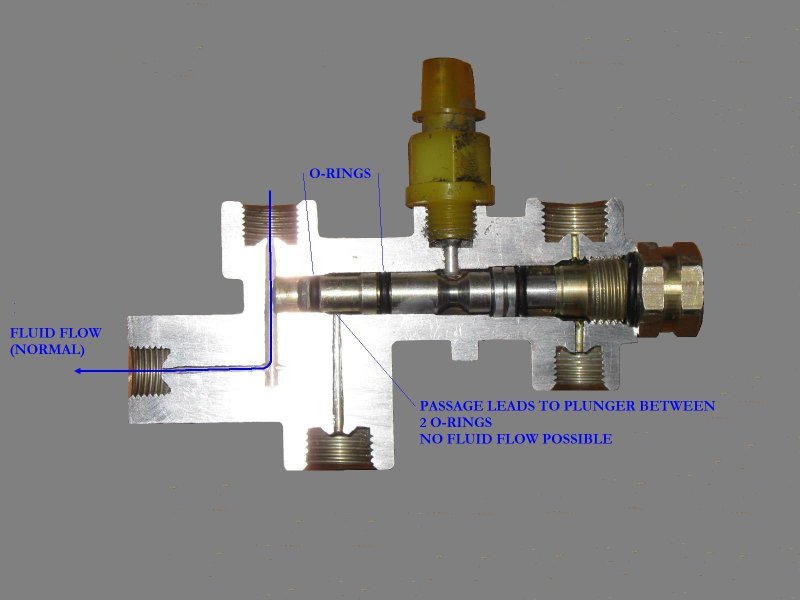
-
Effing Continued Effing Brake Effing Issues
Eagle replied to NC Tom's topic in MJ Tech: Modification and Repairs
Probably not. The warning light comes on when you open a front bleeder to simulate a front brake failure, and it usually stays on throughout the rest of the bleeding procedure. Once you have finished bleeding, you have to stomp on the brake peddle a couple/few times to reset the shuttle valve and turn off the light. -
Effing Continued Effing Brake Effing Issues
Eagle replied to NC Tom's topic in MJ Tech: Modification and Repairs
No matter how many times this is repeated -- people still don't want to believe it. -
Rugged Ridge Front Tow Hooks
Eagle replied to War_Pony89's topic in MJ Tech: Modification and Repairs
Custom 4x4 used to sell a kit with the side braces. No longer available? -
Rugged Ridge Front Tow Hooks
Eagle replied to War_Pony89's topic in MJ Tech: Modification and Repairs
Is there supposed to be a question or a link in this post? -
One of the most frequently asked questions in the Jeep world is "What gears should I run with [___] tires?" There are a lot of quick calculators for this on the Internet, but they often aren't very accurate. The reason is that they are based on total (or nominal) tire diameter, and that ignores how tires work. First, the actual size often isn't the nominal size. This is more true for the off-road tire sizes in the format such as 31x10.50-15. That tire is nominally 31 inches in diameter but, if you start researching tires in that size, most actually are closer to 30.5 inches in unloaded diameter. When you put tires on a vehicle and then let the vehicle down to put weight on the tires, the sidewalls squash down and out. The further lowers the centerline of the axle relative to the road surface. There was a time when most tire specs included a number for the actual rolling radius, but those days seem to be long gone. Back then, most manufacturers also gacve us a number for revolutions per mile, which is the most useful of all numbers for calculating engine RPM vs. road speed. When I look at tires today, it seems the manufacturers are competing to see who can provide the least useful information to prospective buyers. Many years ago, when such information was still available, I created a spreadsheet using as much actual manufacturers' data as possible to get a better, more accurate look at the relationship between tire size and engine RPM at various road speeds. I have uploaded that spreadsheet to Google Sheets to make it available to members of the Comanche Club. Here's the link: https://docs.google.com/spreadsheets/d/1pHFuhGgj6dQDfzyfFJH5z7NCDLW2KX3ABQgAJr3lBvM/edit?usp=sharing Note: I'm not sure if this file allows anyone viewing it to make edits. If it does, please DO NOT make any changes. If you want to muck around in it, make a copy and then experiment with your copy. Don't screw it up for everyone else.
-
My tire/gear ratio spreadsheet is still up on Google Docs, so let's see if this link works: https://docs.google.com/spreadsheets/d/1pHFuhGgj6dQDfzyfFJH5z7NCDLW2KX3ABQgAJr3lBvM/edit?usp=sharing
-
Good choice.
-
Narrowing down knocking noise, any help welcomed
Eagle replied to FlyingXJ's topic in MJ Tech: Modification and Repairs
Video won't play for me. What's your oil pressure? What oil do you use, and what brand of oil filter? -
You can find Monroe Load Levelers that fit the Comanche, but they won't be listed for it. The reason is that (obviously) they change the spring rate, and that changes the way the height-sensing brake proportioning valve works. Monroe doesn't want to make themselves liable if the end user doesn't take that into account.
-
IMHO you'd be better off sending your bank account to the secretary of that Nigerian banker, the woman who needs a reliable partner to help her transfer $50 million out of the country, and she'll give you half for pretending to be his long-lost heir.
-
If you want an additive that works, look at Mr. Moly. Molybdenum sulfide gear oil supplements have been around for a very long time and they have a proven track record. Do NOT run Mr. Moly in a manual transmission with brass synchronizers. Mr. Moly also has a product formulated for automatic transmissions. I have not tested it. Or just buy Redline gear oil and move on to the next decision.
-
Welcome to the borg. You have been assimilated.
-
I highly doubt it.
-
Towing uhaul car trailer with comanche?
Eagle replied to 10thta's topic in MJ Tech: Modification and Repairs
You also can't tow a vehicle with any wheels on the road if it isn't currently registered and insured. -
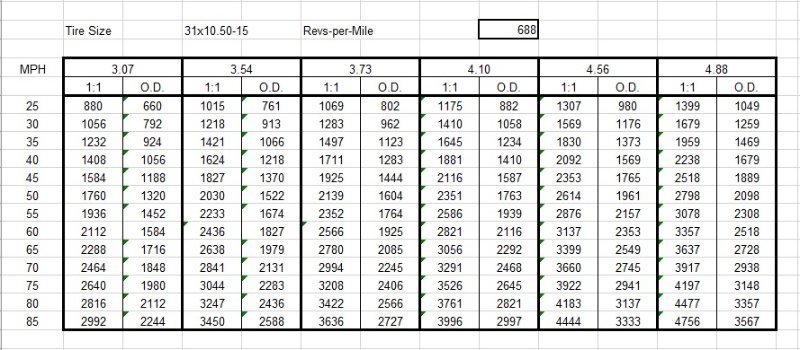
My spreadsheet with all this data seems to have disappeared from Google Docs. I guess I've been canceled. I'll look into getting it posted again but, for the moment, here's a screen shot for 31" tires: 75 MPH in overdrive is 2645 RPM. That won't destroy anything. In the "good old days," before overdrive transmissions became commonplace, standard gearing for cars with the AMC 6 (basically the same engine as the 4.0L, but without fuel injection) was set up for 25 MPH per 1,000 RPM. So, 2500 RPM was 60 MPH, and 3,000 RPM was 72 MPH. And back then the engines would still go 300,000 miles if you did routine maintenance.
-
Part numbers: Dana 35 10" backing plate -- 8350 0988-9 Dana 44 10" backing plate -- 8350 2386-7
-
I don't think that's needed.
-
I don't think so.