


Minuit
-
Posts
5139 -
Joined
-
Last visited
-
Days Won
13
Content Type
Profiles
Forums
Gallery
Everything posted by Minuit
-
Think I'd rather re-build the entire dash vacuum harness than rip it out and replace with electric - electronic HVAC motors being no paragon of reliability themselves. Knock on wood, but I've never had a single problem with the vacuum HVAC actuators on any car. Electronic? Plenty of problems. Interesting project, but I really don't see the appeal unless you absolutely MUST have the rotary HVAC controls.
-
I own a couple of padlocks that are embarrassingly bad. Simply shoving a rake pick in them opens them. No need to actually "rake" them. The locks on most of the family vehicles are not so confidence inspiring either. That's helped on the couple of occasions I've locked myself out while detailing.
-
That's why I said "roughly." My posts run on long enough as it is. To really say what I really mean and account for all of the "well, actually" situations, digressions, and your-mileage-may-varies out there, I would have to make encyclopedia length posts full of footnotes. Ain't nobody got time to write or read that. My '91 has an aforementioned healthy 4.0 with very nearly 200,000 miles on it now, and it produces those numbers quite consistently. Temperature might have an effect, cold start oil pressure showing the biggest difference, but it's a small one and well within the limits of "roughly". As an aside, look at the OP's previous posts - one is about getting 11 mpg in highway driving in their truck, which I would say is indicative of an engine in a poor state of tune in one way or another. In the pictures, note the horrific placement of the air intake. The only way that air filter would be sucking in hotter air would be if it was tucked under the exhaust. The OP's engine is not at the top of its game. If it's been running bad enough to get 11 mpg on the highway, who knows what other abuse it's been through to have low oil pressure at such low mileage. Based on the numbers OP provides (if they are trustworthy), their engine is towards the end of its life, but it's not dead yet.
-
Specification is a bare minimum of 13 psi at any time, and at least 37 psi at 1600 rpm. Maximum pressure is 75 psi set by the oil pressure relief valve. The oil pressure idiot light coming on at any time is bad news. A healthy 4.0 in my experience produces roughly 30 psi at warm idle and roughly 60 psi at cold start. That oil filter and sending unit setup is correct for a '91. Make sure you're using a decent filter. No orange Fram cans of death. The higher end Fram filters are fine.
-
Take a very close look at the bottom of the board. Look for grey circles (or visible cracks, if they're bad enough) on the solder joints. If you see any of those, that indicates a cracked joint. Very common on electronics from certain manufacturers.
-
Ender 3?
-
How is the light pattern of the Marchals? I've just realized that despite owning several of them I've never actually turned one on.
-
I swear by Sunex impact sockets even for non impact use. I have the master sets in 1/4, 3/8, and 1/2" drive. Easily one of my favorite tool purchases.
-
Are the later ones actually any better than the old ones?
-
DIY window and door lock harness
Minuit replied to ghetdjc320's topic in MJ Tech: Modification and Repairs
Let me know if there's something I didn't answer. -
DIY window and door lock harness
Minuit replied to ghetdjc320's topic in MJ Tech: Modification and Repairs
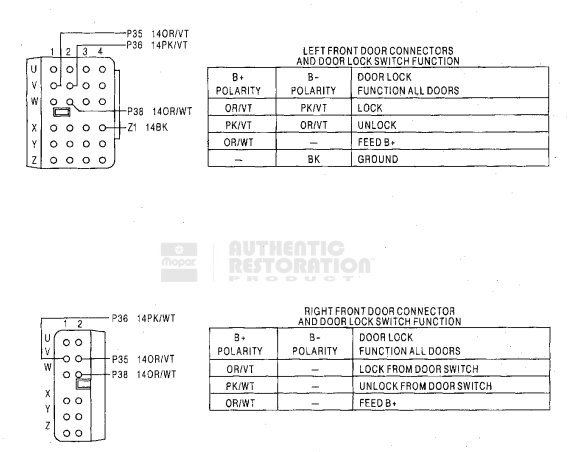
The cross cab harness can come from a 91-92, possibly 93 4-door too. Mine did, and the only way you can tell is that there's an extra connector behind the passenger kick panel. The back half is not necessary for it to work. The factory harness makes this swap "a drunk baby can do it" levels of easy. From there, keyless entry is a snap too. Power is provided from the fusebox via a fusebox insert and a circuit breaker for each system. As far as I know, all of these harnesses are pre-wired for power mirrors too, and adding that functionality is a simple matter of adding the switch, plugging in the fuse tap, and mirrors. This post on my build thread is the one where I performed the swap. If 4-door door harnesses are being used, there will be a large and a small connector at the driver door switch. If you're using a 2-door switch pack, two wires need to be switched from the small connector to the large connector, at which point the small connector can be cut out. If you are using older switch packs and the power locks act up when you plug both switches in, you need to bend up a ground tab on the driver side switch pack. Pinout, switch packs: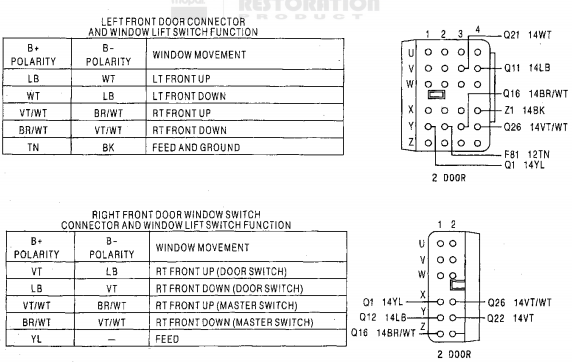
-
DIY window and door lock harness
Minuit replied to ghetdjc320's topic in MJ Tech: Modification and Repairs
Give me an hour. -
@strictlyxjs if my memory serves.
-
Silver Star 1991 Pioneer Build
Minuit replied to kryptronic's topic in Member Projects: Your Comanches
What are the plans? -
What is the brown-orange product you're spraying on the weld areas? Some type of weld through primer?
-
Old GM vehicles would have these as well.
-
Changed to a push fastener in 91. Jdog is correct. Move the cylinder around some and it should be apparent. I do not know if you can put an older cylinder in a newer column. It looks like the hole for the screw is present on the column but there is no screw.
-
Gas Guage Never Reaches Full
Minuit replied to ktmall07's topic in MJ Tech: Modification and Repairs
Do know that the float could also be bad in addition to any other electrical problem you have. It's happened to me twice. -
The Soviet Union and my truck co-existed for 7 months.
-
Recommendations for type of wire
Minuit replied to jamespwsullivan's topic in MJ Tech: Modification and Repairs
There is a time for solder and a time for crimping. If you solder a connection and that connection is going to move whatsoever, it must have adequate strain relief. In other words, the soldered area must be supported by something. I am not a fan of the red/blue/yellow crimp butt splices, and I especially hate the ones with hard insulation. They're too bulky. A properly soldered inline splice should be approximately the size of the un-stripped wire and will be strong, as long as you've soldered it properly and didn't use crap solder. Most crimp terminals (other than the non-insulated ones that are designed to be used with heat shrink tubing) contain some measure of a strain relief section which is crimped around the wire's insulation. A proper crimper will crimp the main wire section and the strain relief section simultaneously. Just like on a soldered connection, you don't want any bending to happen right where the copper is crimped. Proper crimp tooling creates a compression weld between the terminal and wire - that means if you were to cut the crimp, you would see one mass of copper with no air gaps whatsoever. If you don't have proper crimp tooling, don't bother. A pair of pliers is never the right answer. A ratchet crimper with interchangeable dies is the bare minimum I would consider acceptable. Those will get you to about 12 AWG. Any bigger than that and it's time for a hydraulic crimper, which are awesome by the way. Finally, if you're going to use crimp terminals, USE GOOD ONES. The crap you find at the auto parts store isn't good enough. I order mine through the electronics distributors Digikey or Mouser, whichever I happen to have a cart going with at the time. Molex and AMP both have quality products. I'll never advocate soldering a terminal that has already been crimped. Here is one of my favorite places to get wire, especially as someone who often needs to build harnesses with small runs of specific color/stripe wire. The site is antiquated, but the product is quality. https://4rcustomswire.com/ All of their wire is cross-linked. I wouldn't personally want to use PVC insulated wire on a Jeep, especially considering how often our trucks tend to let the outside stuff in, but I do tend towards the "build it for a nuclear apocalypse" school of wire harness design. Maybe that -
55 mph: 70 dBA 65 mph, behind a semi with very little noticeable wind noise: 71 dBA 80 mph in heavy headwinds: fluctuated but the highest number seen was 76 dBA 70 mph in moderate wind: 73.5 dBA Here is the sound meter I use. https://www.amazon.com/BAFX-Products-Pressure-30-130dBA-Warranty/dp/B00ECCZWWI/ref=sr_1_4?dchild=1&keywords=sound+level+meter&qid=1627952977&sr=8-4 Do know that dBA gives less weight to low frequency sound than other filters, and phone apps are not to be trusted. My relatively inexpensive meter only measures in dBA so that's what I'm stuck with. Like you, I found the noise in my truck extremely objectionable at speed, especially wind noise. Here's what I did/am doing. Do this realizing that this is a Jeep, not a Lincoln, and that these trucks cut through the air with all of the grace of a free-falling brick. There are lots of protrusions and gaps for weatherstripping to fill, some of them quite large by modern standards. The truck is a unibody, and tire noise is directly coupled into the cab through the bare minimum of bushings. First off, all of the door gaps need to be sealed, and all of the various weatherstripping needs to be checked. If your door seals aren't doing their job, there's going to be massive wind noise. For me, dealing with wind noise has been an ongoing problem. I still don't have it down to a level I'm happy with. But I'll freely admit that I'm a "continuous improvement" kind of guy who isn't happy with anything, ever - especially if it has to do with sound. Take an honest assessment of what you want to do with the truck, and pick tires accordingly. Highway tires are a lot quieter than all-terrains, which are massively quieter than off-road tires. I switched my all-terrains out for a set of Michelin highway tires, which not only gave better on-road feel but reduced road noise. Secondly, any panel that can vibrate and become a speaker needs a generous smattering of Dynamat or equivalent vibration damper. 100% coverage isn't needed, but don't be shy. The main goal here is to prevent panel resonance. I would advise against putting this stuff on the floor and outer door skin, or roll it on very carefully if you do. If the adhesive fails, it can trap water. These trucks have enough trouble with that already. I'm going to have to reskin my driver door eventually because of adhesive failure on the factory vibration damper in the doors. In regards to the above, the single biggest contiguous panel on the truck is the roof. Stick a whole sheet of Dynamat right in the middle of the roof and you won't have to hear that awful tinny sound on the roof when it rains. Ditch the jute padding under the factory carpet/vinyl because it holds water. You want nothing that holds water on the floor of your truck. If you still aren't happy, and you probably won't be, the most effective thing you can do to block sound from entering the cab is to coat it in a high density, limp material. Mass-loaded vinyl of at least 1 lb/sq. ft. is ideal for this. You're essentially creating as air-tight a barrier with the stuff as you can from the glass down. You don't want it in direct contact with the metal of the truck, though. You'll want to de-couple it from the floor with closed cell foam, such as as 1/8" neoprene foam rubber. Neither of these materials are exactly easy to mold into a carpet underlayment for a vehicle as you might imagine. The mass loaded vinyl doesn't stretch and won't conform to compound curves, so you basically have to make a quilt of the stuff in the shape of the floor, doors, and cab rear. HH-66 vinyl cement is great at holding it together. Use heavy duty velcro to hold the quilt to the truck. This step is a huge pain in the @$$, but it will provide results. If you want an off-the-shelf solution, DynaPad comes to mind. Some of the products on the market didn't exist when I did this, so I don't have experience with them. I'll have to dig through my build thread and find some pictures. Still not gonna be a Lincoln, though. My other car is a 25 year old almost-Lincoln that even has a sunroof, and it has zero wind noise until 80 mph, and a non-objectionable level of road noise at all speeds even though I haven't done anything to it. Gets frustrating after everything I've done to the truck.
-
It is a testament to this site's longevity that a nearly 16-year necropost is even possible.
-
Black lever on m/t steering column?
Minuit replied to Jesse J's topic in MJ Tech: Modification and Repairs
I have seen automatic YJs without the lever. -
Black lever on m/t steering column?
Minuit replied to Jesse J's topic in MJ Tech: Modification and Repairs
Wasn't present on my '91 original column, nor on the '93 auto column that is in it now. I have only ever seen that lever on a manual transmission vehicle, Jeep or not. -
This looks like an aftermarket installation for sure. All bets are completely off. The factory expansion valve is notably absent. You have one of a completely different style. You need to get someone to put gauges on it, verify that it contains no refrigerant, and then perform a vacuum test to see if there's any possibility that it can hold refrigerant. Do not run the system anymore. If the compressor turns on without refrigerant in the system, there is a wiring defect somewhere that NEEDS to be fixed before you can have a viable system again. I would almost be inclined to take it all out and install an OEM system if the wiring isn't all hacked up. You can at least get most of the parts for the OEM system still.