


Minuit
-
Posts
5139 -
Joined
-
Last visited
-
Days Won
13
Content Type
Profiles
Forums
Gallery
Everything posted by Minuit
-
I feel like this is the perfect choice for my work commute.
-
I started work again on September 13th. Similar work, making more money than I was, and growth potential. I put money into my savings account for the first time since April 2020 today. Feels good.
-
-
1989 4.0 5 Speed MJ Running Slightly Cool?
Minuit replied to oleskool's topic in MJ Tech: Modification and Repairs
That's where mine is too. I'm using an OEM temperature sender and my gauge is verified. I don't think you have anything to worry about. The factory gauge is no more or less trustworthy than any other temp gauge as long as you do three things: - Use an OEM sender for the gauge. I had an aftermarket sender read a needle high one time and haven't trusted anything but OEM sense. - Clean the electrical connection at the sender wire, and make sure the connector fits on the sender firmly. - Cross check the gauge with something else. Infrared thermometers are popular for this. -
What Minuit knows about stock Jeep radios
Minuit replied to Minuit's topic in MJ Tech: DIY Projects and Write-Ups
Hello, The display for that radio is no longer available new, so any parts would have to come from another radio. The display is soldered into the front panel circuit board and can be hard to remove. -
What Minuit knows about stock Jeep radios
Minuit replied to Minuit's topic in MJ Tech: DIY Projects and Write-Ups
Hello, and sorry for the late response. I do not have much direct experience with this model in particular, but in general the radios manufactured by Automatic Radio in Korea are of generally poor quality compared to the ones made by Mitsubishi in Japan or Singapore. It is possible that this one is an exception. It resembles the RX-135 but to my knowledge shares few to no parts. How does the DAB adapter work? More specifics on the one you plan to use would be helpful. -
I summon the electrical gurus again!
Minuit replied to OldSch88L's topic in MJ Tech: Modification and Repairs
Post a picture of the clock plug. It and its pinout changed frequently. -
I think the factory's waterproofing "solution" was to pack the connector full of dielectric grease. Sealant on the connector to firewall mating surface should help. The SEM does look really good. It's an amazingly forgiving product and goes on extremely well. Also, the pdf of the FSM that I sent you has a diagram of how the harness is routed behind the dash that might be helpful when you go to re-install. This is a common problem when pulling the dash on these trucks. It's in the beginning of the wiring diagrams section.
-
29 year average for me. 27.5 for the ones I would have absolutely no qualms driving cross-country tomorrow if I had to. Newest vehicle in the family is a 2008.
-
Sometimes a starter can fail in a way that it cranks, but very slowly. That happened to my original starter. This can very easily be confused with a dying battery. Make sure the large cable leading from the battery to the starter has clean and positive connections at both ends.
-
The Renix computer requires either a certain RPM or all of the relevant sensors to "check in" for a certain time, I forget which, before it will allow the engine to start. Either way, it's normal. The High Output trucks start a little faster. "neer-neer-neer-neer-VROOM". If it ever takes more than about 3-5 revolutions for the truck to start but it does start eventually, that would point to a fuel pressure retention issue.
-
I summon the electrical gurus again!
Minuit replied to OldSch88L's topic in MJ Tech: Modification and Repairs
What year is the donor harness from? -
What auto trans options in 86 4x4 with 2.8L?
Minuit replied to 10thta's topic in MJ Tech: Modification and Repairs
The AW4 stopped being available behind the 2.5L engine in 1991 in XJs and MJs. -
Gauge cluster is not correct for the year and would have required replacement of the speedometer cable to make work, so this one may have been "optioned up" a bit. Not necessarily a bad thing, but something to know about. The seat fabric, color keyed dash bezel, and radio are all correct for that year though.
-
Shifter Interlock operation on 1992
Minuit replied to ozz4wd's topic in MJ Tech: Modification and Repairs
Our trucks predate the brake-shifter interlock becoming a common feature by quite a while -
Windows...Can they be swapped???
Minuit replied to p0lel0ck's topic in MJ Tech: Modification and Repairs
If you do get a regulator from the junkyard, make sure you clean and lubricate it to prevent this from happening again. You can convert to power windows too if you add the appropriate wiring. The glass does not have to be replaced. -
This is a more common problem with the smaller later drum brakes in my experience, but another common cause of a grinding noise is the adjuster lever. It can slip off of the ratchet wheel and make contact with the braking surface of the drum.
-
Cluster swap from '96 to '91
Minuit replied to acfortier's topic in MJ Tech: Modification and Repairs
I seem to remember a distinct difference between 91 and 96 warning light arrangements. Everything still works out - the check engine light is still the check engine light although it may be a different color or in a different place, etc., but some have been changed. -
Renix VS 1996 full cluster fuel gauge comparison
Minuit replied to OldSch88L's topic in MJ Tech: Modification and Repairs
I did a test on this a while back. Reversing wires will not make it correct in any configuration. I'll see if I can find the post later today. -
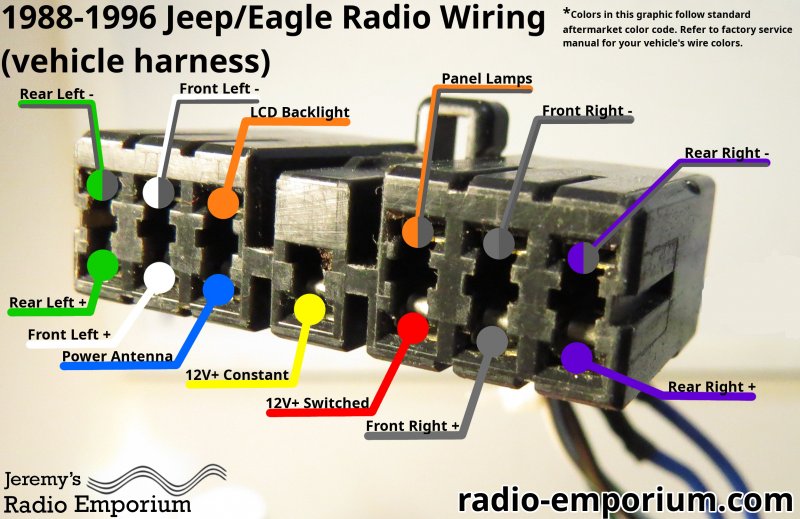
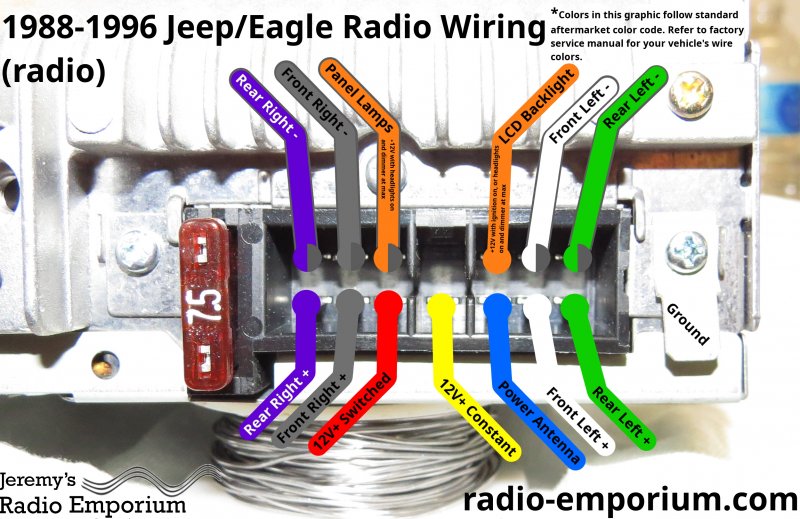
It is quite possible that the lcd backlight bulbs on the one radio are burnt out. If the wiring checks out and speakers are present, all it can be is the radio.
-
-
This looks like the "deep dish" wheel that was used on the other Jeeps. If you put this on an MJ you may find that the wheel rim sticks out way too far.
-
Do it right with proper equipment or don't do it at all. A/C is not a system to be trifled with using that extremely basic kit. You can cause serious harm to yourself or very expensive damage to your truck by making mistakes here. You'll need, at a bare minimum, a set of manifold gauges, a vacuum pump, and a scale to weigh the amount of refrigerant you've put into the system. You should also replace the receiver-drier if you have not already done so. To prevent moisture entering the system from causing corrosion, it must be replaced any time the system is opened for any significant amount of time. Other items that are nice to have are an assortment of A/C o-rings and a bottle of the appropriate refrigerant lubricant, which in your case would be mineral oil. You should also be aware that R-12a is a flammable gas mixture and take appropriate precautions. That kit only comes with one adapter, but it looks like a standard R-12 to R-134a adapter. You would also need the one for the high side to use a set of standard manifold gauges.
-
The XJ shaft is actually used as an upgrade in some other vehicle. The exact one eludes me now, but I think it's used to eliminate a rag joint. The XJ shaft I'm thinking of has u-joints at both ends and an injected plastic crash structure which breaks to allow the shaft to collapse. Mine had the tiniest little bit of play in one of the u-joints that could be felt but not seen. I replaced it with the Crown part when I installed my ZJ steering box (which itself is going to have to come out again at some point) and it's providing good service. Be warned, the shaft does not collapse easily - it's only intended to collapse under crash forces. This makes it a major PITA to install.
-
91 HO Shut Off While Driving
Minuit replied to kryptronic's topic in MJ Tech: Modification and Repairs