
gogmorgo
-
Posts
5984 -
Joined
-
Last visited
-
Days Won
4
Content Type
Profiles
Forums
Gallery
Everything posted by gogmorgo
-
Finally, switch trim covers!
gogmorgo replied to ghetdjc320's topic in MJ Tech: Modification and Repairs
Only just saw this thread. It would also be pretty cool to see switches that look OEM for things that aren’t, although I realize custom combinations for things that don’t already exist are a lot more work. I think I’d want to have a front and rear locker on right side, and then a fog and sport bar light on the left side. Some of us might also want to see fan switches, possibly other options as well. I personally can’t stand switches that don’t match the overall aesthetic of a dash, and it’s awesome to see someone reproducing OEM likenesses. -
So this is probably one of those dumb wild goose chases that’s going to go nowhere, but it may prove useful for a handful of us in the long-term. Can anyone think of a reasonably simple way that involves reasonably inexpensive, reliable, and easily sourced off-the-shelf components, that takes a single input (the high beam pin at the socket), can tell whether it’s receiving nominally 5 or 12V, and accordingly put the 5V straight through to the high beam filament, but when it receives 12V triggers a relay to deliver battery voltage? (And also stays off when receiving no voltage?) I’m pretty good with switches and relays, and can wrap my head around resistors and diodes, but this is beyond my skill set. Where this comes from is that daytime running lights are a legal requirement on all vehicles sold new in Canada after Dec 1, 1989. As we know, the factory headlight wiring on the xj/mj is maybe a little less than optimal, and most of us make up for it with the relay harness which supposedly retains all factory functions. Thing is, the relay harness doesn’t play well with the DRLs. The function of the DRL is that the module sends 5V to the high beam filaments when the vehicle is moving. The result when paired with a relay harness, depending on the relays used, is either: •5V isn’t enough to trigger the relays, so you have no DRL; or •You have high beams on full beam whenever the vehicle is in motion and you don’t have the low beams on. In my case, it’s the former, but I’ve definitely encountered other vehicles on the road running full beam high beams and no other lights in the middle of the day. To avoid the albeit minuscule risk of being pulled over for no DRL, or the risk of running full high beams everywhere, I’ve always just driven with the low beams on. But at some point in the future I will be faced with an inspection before I can register my long bed, and pretending won’t be good enough for that. Returning to stock for the inspection is the obvious answer, except that when I built my relay harness i found my headlight harness was in such poor shape that it became more a matter of building a new headlight harness with added relays than it was adding a supplementary harness... so going back to stock isn’t going to be quite as simple as unplugging the supplementary harness and plugging factory sockets back in. It would also be nice to be able to be able to recommend the relay harness to fellow Canadians as an upgrade without having to add the caveat that a side effect of preventing setting your truck on fire is that it’ll no longer be compliant with CMVSS lighting requirements, and that they may need to take extra steps or even undo it from time to time to make it look compliant. The second obvious answer is to ditch the factory DRL module and just add a couple relays to run either the parking light or low beam circuits whenever the key is on. This is actually how they added DRLs “at the port” to Canadian-spec Ladas. However now you’re tapping into additional circuits on the vehicle, and moving away from the spirit of a simple plug and play supplementary harness upgrade. And also interfering with my personal perversion for maintaining original functionality whenever possible. So to that end, can anyone help with this?
-
I got my flu shot the other day, first time ever. I don’t really get sick much, but figure it might help keep me and maybe a few others around me out of quarantine. And to tell the truth, the needle jab sucks a lot less than a swab shoved up the nose. When I got tested back in September they told me negative results take longer to come back because they rerun the test a few times to reduce the likelihood of false negatives. Supposedly positive results came back in 12-24 hours, but I got my negative result in after a couple days. Oddly though my roommate who got tested the afternoon before I did got his negative result the morning after I did.
-
That’s interesting. I’ve seen the spare pressure option on the scan tool when relearning sensor positions, but never encountered one with a sensor in the spare. I always liked that the Dodged could figure out that you rotated your tires on their own. Chevs learn specific sensors to specific positions, which means if you rotate them without relearning, then you get the truck back in the shop one day because the truck says the front left is low even though it’s way over pressure, meanwhile the rear right has 5psi in it. What’s crazier than the spare having a pressure sensor in it, is that newer Subarus know their tires are low without even having pressure sensors. If the steering angle sensor says it’s pointed in a straight line, but one of the wheel speeds is consistently different than the others, it knows there’s an issue and triggers the light.
-
That’s tough to say. Jeeps weren’t really a thing in my family, or any other 4wd for that matter. I bought my first MJ as my first vehicle when I needed one to move myself to school. The MJ was the most interesting thing I found at the time, not in small part because it still had a valid safety inspection from when the PO first registered it not quite 11 months earlier, and I only had a week to get whatever I bought registered (and safetied) before I needed to move. I think I may have been interested in an XJ at the time which had me looking at Jeeps, but I don’t really remember what all I was cross-shopping. The MJ was only the second vehicle I looked at. The first was a very brown ~1980 Firebird with the most godawful teal screaming chicken on the hood, that needed more than a few things beyond what I thought was reasonable to address within a week. I’m pretty confident there’d be some major differences in my life had I got that Firebird instead... to think that a Comanche was the “responsible” choice.
-
Another one from my oddball collection has been stuck in my head all day.
-
Axles, transmissions... it all should have a drain. Almost everything in the heavy equipment world that could possibly be drained has a convenient way to do it, even going so far as to add remote drains to make it easier. Heavy equipment that’s easy to work on sells, because it means less down time. It’s funny how that’s not what happens in the automotive world. And not “haha” funny.
-
Build date of 4/20. Why are you surprised something went a bit weird putting in the data?
-
Some more CanCon from when I was a kid. One of the albums worked its way onto my phone, makes for not bad driving tunes when you’ve got a 200 mile drive to get done before 7:30am.
-
Same. I didn’t really give the ZJ much though until I found this one, and with the factory manual I couldn’t pass it up. But it’s so much more comfortable to drive than any of my XJs or MJs... although I’ll admit the XJs were mostly parts rigs that went on the occasional stupid road trip. I’ve been doing some long highway commutes with the ZJ the last couple weeks, and it’s a noticeable difference over the 2.5 MJ that screams along at 3000rpm. I don’t need to shout at passengers, it’s happy doing 80mph, it’s great. And the cruise works. And I can get parts at any old parts store, and find them in wrecking yards not completely picked clean.
-
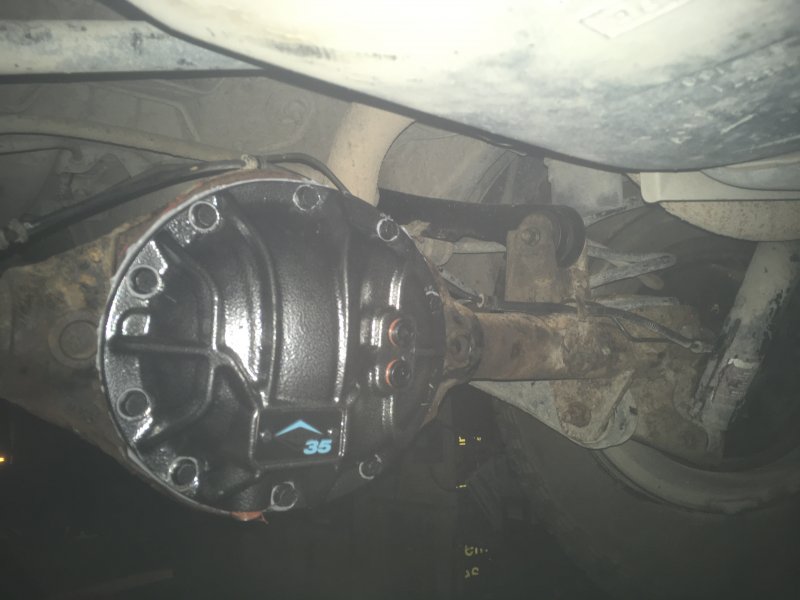
Added a bit of bling, so now everyone will know about my very expensive Turdy5. In reality, I mostly just wanted a cover with a drain plug. Easier said than done. This one seemed one of the more legit options, a bit more beef, but a solid casting, not a welded design, which seems to maintain factory splash properties, and possibly enhances cooling. My only complaint is the inlet for the drain plug in the cover looks to be higher than the bottom of the housing. I took a die grinder to it to deepen than somewhat, hopefully leading to a better drain, but we shall see. So far so good though. I wanted to drain out the break-in oil after the diff rebuild, otherwise I wouldn’t have been so quick to dump the new gear oil. And so far so good on the rebuild as well. I’ve got about 700 miles on it so far, and it’s doing great.
-
I also really dig the utilitarian feel from the AMC design, as opposed to the luxury twist Chrysler added to the ZJ, although mine’s a base model, so no luxuries here. I’ve been on the fence about going back to an OEM radio as well. The PO put in a reasonably decent head unit in, and while I appreciate the fact that I’ve got Bluetooth and can play music off my phone, it looks pretty seriously out of place. I unfortunately don’t live too close to any wrecking yards, so I haven’t put much effort into trying to find anything to replace it. Good looking example though. But it’s cool to see the contrast in how they wear. Up here they rust out from the bottom up, but the interiors mostly stay in decent shape.
-
If it’s allowing different wheel speeds across the axle in the “locked” mode, then it’s not a locker. There’s different kinds of auto-locker, and some of them do require a speed differential to lock in, while others operate more like a spool that disengages under low load. I’m sure there’s other varieties out there as well... but if they allow for slip between the axle shafts, then it’s a limited-slip diff, not a locker.
-
No, if it’s locked, it’s the case. Not all of them act quite like a typical differential when unlocked, and not everything locks under the same conditions, but anything locked effectively has an infinite:1 torque bias.
-
It’s just a converter dolly. But slightly less sketchy-looking than this one: Or worse, this one: https://www.caranddriver.com/news/a30296894/chevy-silverado-ticketed-towing-long-trailer/
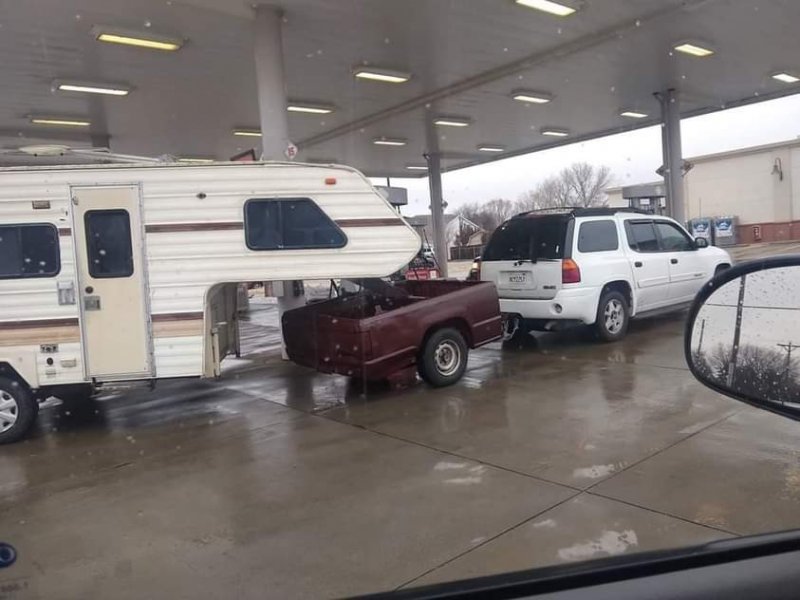
-
Yeah, it would probably make a very excellent tow pig as well. But even with all it’s modern comforts, I imagine it’ll be pretty decent offroad, much like the Range Rover still is.
-
The Truetrac, and any other limited slip diff, has a torque biasing ratio. Actually, all other diffs do as well. An open differential is 1:1. This means that whatever torque one wheel is seeing, the other will see the same torque. If the torque it takes to spin one of the tires isn’t enough to move the vehicle forwards, you won’t move forwards. A limited slip alters the torque bias. Depending on the model, a Truetrac could be as much as 3.5:1. This means that it’s going to bind up so that it pushes 3.5 times as much torque onto a “stationary” wheel as it does on the free-spinning wheel. 50ft-lbs of torque to spin the tire puts 175lb-ft into the stationary wheel to push you forwards. And yes, if that’s not enough to move you forwards, it’ll just keep spinning the one wheel. When a wheel is in the air it takes next to no torque to turn it, and three times almost nothing is still not much more than nothing. A locker could be seen as having an infinite:1 bias ratio. The shafts are locked together, or at least to the carrier, so really it stops being a differential at that point. It doesn’t matter how much torque it’ll take to turn either wheel, the other will always turn at the same speed. It’s also not entirely true to suggest the Truetrac doesn’t have a wear life. You hear sometimes that it functions through the principal of a screw gear can turn a worm gear but a worm can’t turn a screw, which isn’t what’s happening. What’s happening is that helical gears thrust themselves away from each other axially, essentially parallel to the shaft they’re on, and this forces the helical gears into the side of the housing, which then slows down the helical gear. The bigger the difference in wheel speed, the harder those gears get rammed into the housing, and vise-versa, which is why it’s so invisible and seamless in operation. And that’s where the wear life comes in, eventually the gears cut themselves into the side of the housing. I’ve seen it happen on a unit with about 200,000 miles on it. Not terrible life I suppose, though. Spider gears eventually wear out too. The original Torsen T1 with its crazy (and very difficult to manufacture) helical gears that run 90° to each other jam the whole side gear into the carrier, which gives it more surface area, so it’ll bind up much harder. They also use clutch packs in the middle of that to increase traction even further, and those clutches will burn out. Not as quick as a clutch-type LSD but they do go eventually. Torsen tells you they’re not serviceable, but if you’re really keen you can pull it apart and change them. I’ve done it. It sucks. The crazy gears all need timed in a very specific set except you can’t actually see the timing marks once they’re installed, and you can’t install them straight in, so you have to set everything up perfectly with the timing marks completely misaligned and then roll everything together all at once so the marks meet up. And if any one of the gears is off by one tooth once they go together, the whole thing locks right up, and you end up with a very complicated and expensive spool that you need to pull all the way back apart and start all over. Not much fun at all.
-
It’s coil suspension, but it’s still a solid axle unless that’s changed recently. The JT does share some rear suspension components with the Ram, but not all of them.
-
Do you have a source for that? I’ve also heard this said (less the IRS) about the JT as well, which isn’t true at all.
-
I still haven’t seen much description beyond the cosmetics, but also I’ve been on data all day so I haven’t wanted to watch any of the videos, just read the articles. The big question is whether it’s body on frame. Most of the competitors in the segment are still, I think. It looks a lot like a bigger, boxier Grand Cherokee, though, so it’s hard to say. But even if it is, it’s definitely got independent suspension, so very unlikely to be on the JT chassis like some of the speculations I’ve seen. The overall concept is pretty similar to the competition in the target market. Large luxury, which means lots of technology (count the screens), and a “hybrid”, although no real info about powertrain options out there yet. This is still just a concept. It’ll be interesting to see how similar the real deal (if it does go to market) will be to this. Initial concepts are usually pretty easily distinguished from what comes off the assembly line. I also don’t think recycling the nameplate is going to mean much for sales. I doubt those interested in a classic Waggy share the same market as a new, premium, modern luxury SUV. That much is pretty obvious from how few people remember the ZJ Waggy ever existed. But yes, I do wish they’d tried to distinguish it a little bit from the modern Jeep lineup. Going full retro and recreating the OG Waggy also isn’t the answer though. It needs to be modern to compete in its target market, not 60 years old.
-
Don’t need to “run” the vin through anything. 10th digit is always model year, and it’s a standardized digit across all manufacturers. ‘88 is J.
-
Trying to bleeding the clutch
gogmorgo replied to blanzawa's topic in MJ Tech: Modification and Repairs
Yes, definitely worth checking. But just because one example has it doesn’t mean the next one hasn’t already been replaced with one that doesn’t have, so it’s good to have a strategy on hand to manage that situation. Interestingly the slave cylinder I got for my external swap on my 2.5 had the spot shaped and threaded for a bleeder, but no bleeder in the box, and the original bleed screw from my internal setup was the wrong size. I went to a great deal of effort tracking down and ordering a bleed screw to fit it before discovering that the thing wasn’t drilled through and I didn’t actually need one. -
Any time I’ve had to move curbs I’ve either done a team lift, or moved them around with forks on a skid steer. But then I haven’t worked legit construction, so who knows what they would use for that. We use a loader for barriers on the highway. I have seen similar concept Jeep cranes, though. Just not specifically for moving curbs around.
-
Yeah good thing there’s a few of those around out here.