Eagle
-
Posts
15698 -
Joined
-
Last visited
-
Days Won
27
Content Type
Profiles
Forums
Gallery
Everything posted by Eagle
-
You have 2-1/2" of lift in the front. As I mentioned, I'm less certain what the number should be for the rear. If stock is 21" then you have no lift in the rear, but if it's 20" then you have a 1-inch lift. And that's consistent with your first measurements. Measuring from the wheel center (axle centerline) to the flares means tire size doesn't matter. The attached photos are my '88 MJ at stock height. The tires are 215/75-15s and I don't have flares in these photos, but the wheels are the same as yours. You can visually extend body lines to get a sense of where they run relative to the top of the wheel rim (not tire). Based on my attempt at that, I'd say the numbers showing about a 2-1/2" lift in front and a 1" lift in the rear aren't too far off.


-
I agree 110%. Cutting into an OEM bed liner should be a hanging offense.
-
??? You can't "send" resistance. Resistance is a parameter of each part of a circuit. Wire has resistance. Each connector has resistance. A resistor has resistance (:duh:). A light bulb has resistance. An electric motor has resistance. You can measure resistance, with an ohmmeter, but you can't "send" resistance. You also can't send current. You can send voltage. Current is draw -- the amount of current used is a function of the device that uses the power -- you don't "send" current. Go back and re-read what Green Mesa posted.
-
Ring and pinion break in question
Eagle replied to Jacob Ochs's topic in MJ Tech: Modification and Repairs
In 2WD the front differential will be coasting, with the ring and pinion contact on the non-load side of the gear teeth. In terms of break-in for driving purposes, driving in 2WD won't be doing anything for you. -
You don't use a feeler gauge to measure backlash, you use a dial indicator. And before you get to that stage, you need something to check the pinion depth if you're regearing. The factory service manual provides all you need to know for the job.
-
I think you measured incorrectly. If the tires in those photos are really 31s, that's a lot more than a 1-inch lift. In the front, at stock height 31s really fill the wheel opening, right up to the flares. Not as definitive as the method in the FSM, but since you still have factory flares and factory wheels, for verification you could do the approximate method of measuring. Measure from the center of the wheel center cap straight up to the bottom edge of the flare. For the front, stock height is 17-1/2". For the rear, we know that XJs (Cherokees) are 17". I don't think we have a definite, confirmed number yet for the MJ, but it's probably around 20" to 21"/
-
You do realize that the normal operating temperature is around 210 degrees (F), right? And the temperature at which water boils at sea level is 212 degrees. All internal combustion engines are too hot to touch at normal operating temperature. You can't go by touch, that's why we have temperature gauges.
-
Rear ends....Comanche rear ends that is.
Eagle replied to coolwind57's topic in MJ Tech: Modification and Repairs
Yes. -
I'm not familiar with that piece of crap carburetor, but I've never heard of a carburetor with a return line. Remember, it was designed to operate off a mechanical fuel pump, and a mechanical fuel pump doesn't shut down if the pressure exceeds 7 psi. You are using an aftermarket fuel pump, so you need to take a look at how you wired it, and how the manufacturer says it works. My expectation is that it's supposed to run all the time. Fuel flow into the carburetor is controlled by the float and the needle valve. But ... you originally posted that if you keep working the throttle, the engine stays running. Is that correct? If that's true - then you obviously don't have a fuel delivery problem.
-
Carburetors 101: The carburetor doesn't take gas directly from the fuel pump into the intake manifold. The fuel pump pushes the fuel at around 5 to 7 psi. From the inlet line the fuel goes to a reservoir in the carb body called the float bowl. There's a float in there, that activates a needle valve. When the fuel rises to the upper limit, the needle valve closes and shuts off the flow of gas into the carb. From the carb to the engine, the venturi (or venturis, if it's a 2-barrel or 4-barrel) such the fuel out of the float bowl. Gas in the float bowl is only under atmospheric pressure, it's not being pushed by the fuel pump, as it is in a fuel injection system. The faster air flows throiugh the throat and past the venturi, the more fuel gets sucked out of the float bowl. When you step on the throttle, the throttle plate opens wider, which actually causes the velocity nof the air through the carb throat to slow down -- which, in turn, reduces the suction effect on the venturi and starves the engine of fuel. So there is also a plunger deally called the accelerator pump, which gives a squirt of gas into the throttle bore when you step on the gas to copensate for the momentary leaning out when the throttle plate first opens. If you can keep it running by working the throttle, you're getting enough gas. You have a problem with the idle circuit -- either that idle mix screw isn't adjusted correctly, or the idle air circuit is dirty and clogged.
-
They won't fit.
-
No, they can't. The Chinese don't understand the distinction between "correct" and "sorta close-ish." I found the same thing looking for wheel centers for a set of factory alloy rims for the 2000 Cherokee. Amazon and eBay had lots of people selling them, and claiming they were OEM Chrysler, citing part numbers, yada, yada ... and it was obvious from the photos they weren't a match for the factory centers.
-
No, you can't have one made. It's not flat, it's curved.
-
One liter is 61 cubic inches, so a 3.4 liter engine displaces (approximately) 207 cubic inches. Carb sizing isn't rocket science and you don't have to be accurate down to the third decimal place. Pick a carb for around 200 cubic inches if you'll never see high RPM, or pick one for 225 to 250 cubic inches if you drive with a lead foot.
-
Rear ends....Comanche rear ends that is.
Eagle replied to coolwind57's topic in MJ Tech: Modification and Repairs
Okay ... but the optional heavy-duty rear axle in 1987 XJs and MJs was the Dana 44. -
Brakes and prop valves, options?
Eagle replied to Skorpyo's topic in MJ Tech: Modification and Repairs
You're on the right track, but your explanation is technically incorrect. Many years ago, in my AMC days, a young friend bought a used 2-seat AMX. For some reason,m the AMX used a rear proportioning valve but the Javelin didn't. I guess the short wheelbase of the AMX made it more prone to "swapping ends" in panic stops. Anyhoo ... the previous owner of this particular AMX had FUBARed the entire brake system by filling it with something other than brake fluid (ATF, I think it was), which caused all the seals to swell up and lock up the brake system. By the time my friend bought it, we could still buy every part of the system ... except the proportioning valve. So, we removed it. To compensate, he used wheel cylinders from a 6-cylinder Gremlin (smaller bore). He drove it that way for many years, autocrossed it, and never had a problem. So it's a valid approach. BUT ... it means reduced braking to the rear axle ALWAYS. Not a problem when running an unloaded pickup, but something to keep in mind if fully loaded. It's a work-around to deleting a proportioning valve, not a functionally equivalent solution. The smaller wheel cylinders do not result in reduced pressure to the rear. In any hydraulic system, pressure is always uniform throughout the hydraulic (fluid) part of the system. But FORCE is pressure applied to an area. So if a brake system is pressurized (by your foot on the peddle) to, say, 1000 psi, then a wheel cylinder with a piston that's one square inch in area will apply a total force of 1000 pounds to the rear brake shoe. That 1000 pounds is then spread out over whatever the area of the brake shoe lining is. If you use a smaller wheel cylinder with a piston area of 3/4 of an inch, that same 1000 psi of hydraulic pressure applied over an area of .75 sq. in. will now apply a force of only 750 pounds to the brake shoe. That 750 pounds is then distributed over the same lining area, so the force applied to the rear brakes is only 75%. -
Brakes and prop valves, options?
Eagle replied to Skorpyo's topic in MJ Tech: Modification and Repairs
Yes -- you are incorrect. You will NOT lose all braking power by eliminating the rear height-sensing valve. The MJ has dual-circuit brakes. There is one hydraulic circuit to the front, and a separate circuit to the rear. With the height-sensing valve in place as designed, under normal conditions the output from the "nose" of the distribution block goes through the height-sensing valve, which reduces (proportions) the braking force to the rear wheels. The forward, bottom outlet on the distribution block, which only opens if the front circuit fails and loses pressure, by-passes the height-sensing valve and sends full pressure to the rear wheels. If you properly eliminated the height-sensing valve, by connecting the "nose" outlet directly to the flex hose at the rear axle, you will ALWAYS be sending FULL braking pressure to the rear wheels -- both when the front brakes are working, AND if the front brakes fail. The downside to eliminating the height-sensing valve, especially if you also put disks on the rear, is that under normal conditions you may have too much braking in the back. In rain, snow, or if the road has oil or sand on it, the rears may lock up before the fronts, resulting in spin-outs. Obviously, this is more likely when the bed is unloaded than when it's loaded to capacity, but that's the way most of us drive our MJs probably 90% or more of the time. It's also more of an issue when going down steep inclines, because more weight is transferred to the front end when going downhill. I'd suggest finding an empty parking lot and testing how your new setup behaves under heavy braking. -
Speak for yourself, Matey. That pile of excrement sure isn't anything I've been asking for. It certainly isn't a successor to either the Comanche or the J-trucks. The Ram is a full-size pickup. When my wife was alive, I spent a couple or three months every year in her native country, in South America, every year. Cherokees and Comanches were VERY popular, along with a 4-door, crew cab version of the Chevy S-10, with a box that was probably only five or five and a half feet long. I only remember seeing ONE Dodge Ram pickup in all the time I spent there, and it was so huge (comparatively) that it was totally out of place. It took up two of their parking spaces. I know about the American love affair with monster trucks but, worldwide, there's a healthy potential market for a smaller pickup, and Jeep is a well-known and respected brand in South America. It would sell. This pseudo 4-door "Scramber" wannabe? Highly unlikely it will sell in South America. People there want multi-purpose vehicles that can carry a family and still do some real work.
-
Jeep hasn't been Jeep since 2001, when they killed off the Cherokee and stopped trail testing all new vehicles over the Rubicon Trail, instead driving over a couple of logs in a parking lot and calling them "Trail Rated." How can it be Trail Rated if it has never seen a trail? Put a Jeep logo on a Ram? That's not what I'm talking about. The Comanche competed against the Dakota, and that's why Chrysler killed the Comanche. The Comanche in stock trim could go places no Dakota could possibly get to. Years ago, several clubs banded together to do a clean-up of a power line trail in Rhode Island. Deep into the trail, somebody found a huge pile of old roofing shingles on top of a hill off to the side of the trail. I said I'd get them and bring them to the dumpster. There was a local cop working with us. He said, "You'll have to go back out and miles around to get to them." I told him I was just going to drive up the hill. He said, "That's impossible." Three minutes later I was parked on top of the hill, loading shingles. When you talk about function over form, people who buy pickup trucks generally aren't interested in the sun on their heads and the wind in their faces. A ragtop isn't part of the pickup truck scene. Jeeps are Jeeps because they can (or used to be able to) go off-road better than just about anything else. The new Wranglers can't even to that without a couple of thousand dollars worth of reinforcement for the front axle. And the dinky little bed on that thing isn't big enough to carry anything that really needs to be carried. It's a toy, not a truck. Plus -- the proportions are all wrong. It's just UGLY.
-
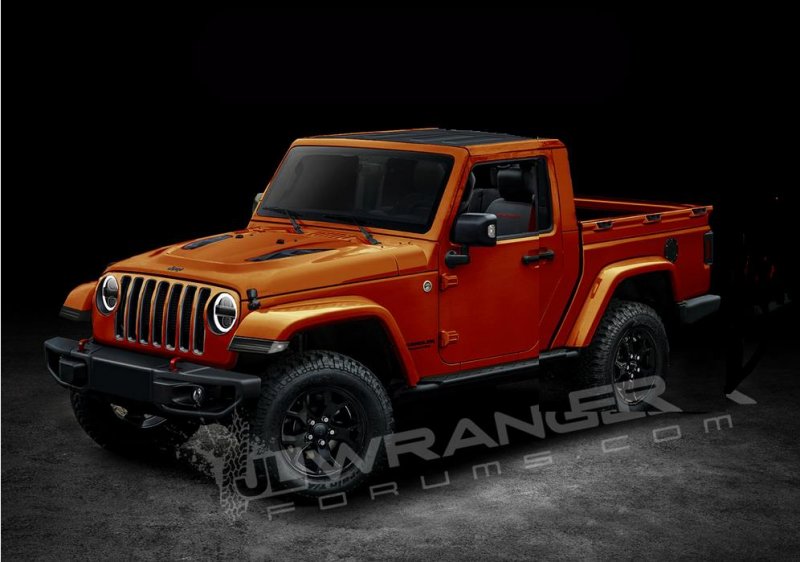
This thing is not a pickup truck. It's a Wrangler with a slightly longer/larger cargo area. I want Jeep to introduce a pickup again, which means a TRUCK, with a metal roof, an enclosed back to the cab, and a separate load box. If they want to make a new version of the Scrambler, it would have to be more like this (excuse the crude MS Paint edit):
-
As you've all probably noticed, the emoticons aren't working yet. As a temporary work-around, a friend has a gallery of smileys, and he's given me the link to it. If you're feeling emoticon-deprived, you can go here, copy, and manually insert an emoticon using tags. http://herohog.com/images/icons/smileys/
-
Almost had to be that. You don't go anywhere near that relay bank to change the CPS.
-
Ten bucks says that mechanic had an '87 XJ that was missing the relay cover.
-
No. Cherokees are 17" at the rear. Years ago I measured some stock MJs and I estimated that a Comanche was 21" from center of axle to bottom of flare. It might be as low as 20" but not 19".
-
Where are you going to find a 10:1 box? Special order? From an old dirt track stock car? :yes: They would be super twitchy on the road. 12:1 was the quickest factory bolt-in Saginaw box I know of, and they are super hard to find. AGR Steering offers Saginaw boxes with a 10:1 ratio. I don't think it would be especially twitchy at all -- it would be about like newer cars with rackety pinion steering.