


Minuit
-
Posts
5139 -
Joined
-
Last visited
-
Days Won
13
Content Type
Profiles
Forums
Gallery
Everything posted by Minuit
-
What Minuit knows about stock Jeep radios
Minuit replied to Minuit's topic in MJ Tech: DIY Projects and Write-Ups
Depends. If you have a very consistent commute every day, it might just be buildings, trees, or other things you drive around blocking your reception. Of course, it could be a problem with the radio too. I've not heard of a single solid state device that isn't very high precision lab equipment that needs to "warm up" to work in specification, so if it doesn't depend on your surroundings, it is a problem and not at all normal. What kind of vehicle/radio is this? Also: the only thing better than a blue VFD is a green one. This is the familiar AR-7650, but as installed in an Eagle car with green lighting as opposed to the Jeep blue. -
The only employees I need.
-
What Minuit knows about stock Jeep radios
Minuit replied to Minuit's topic in MJ Tech: DIY Projects and Write-Ups
You could of course order rear speakers as a separate option. I'm just saying that a truck with an AM-FM radio is less likely to have rear speakers than one with the cassette radio. -
What Minuit knows about stock Jeep radios
Minuit replied to Minuit's topic in MJ Tech: DIY Projects and Write-Ups
AR-7750. I'm guessing your truck is an 88? If so, that's very likely the original unit. Your truck might not even have rear speakers. Those were optional, and normally came with the cassette radio. These radios are quite repairable. The repairability of these radios took a steep dive off a cliff after 1990, but these are pretty robust. A repeatable loss of sound after 10 seconds could possibly be an intermittent connection inside the radio, or a thermally failing chip. The loose volume knob is probably a loose nut inside the radio. They were not put on very tight from the factory, and I've seen a few of them get loose. -
I am one of the few people who actually un-deleted his heater control valve. I noticed pretty much no difference in heater performance, but a small but significant improvement in A/C performance. The heat in my truck has always been pretty damn good considering the absolutely minuscule heater core. Certainly more than enough for what passes for winter in TN. Definitely not "luke warm" - my heater vent temp clocks somewhere in the 130s at the vents when warmed up. The heater control valve piping does have a few places where an air bubble might get trapped. Does the heat get any better when the engine is above idle?
-
You didn't say it had to be a ground vehicle.
-
another connector question......
Minuit replied to watchamakalit's topic in MJ Tech: Modification and Repairs
Probably a diode pack in there. -
found a company that rebuilds wire harnesses!
Minuit replied to Pete M's topic in MJ Tech: Modification and Repairs
Device connections. A lot of sensors on the HO models mate with proprietary Chrysler connectors. Stuff like the Renix EGR solenoid. The stupid 60s-era Pack Con and Packard 56 series connectors in the interior that plug into things like the steering column, blower fan switch, and a number of other things. Those were standard in the day, but supply of those old Delphi/Packard connectors are starting to become spotty. The bulkhead connector at the driver side firewall looks quite similar to something in the Metri-Pack catalog... but not exactly. A lot of those proprietary Chrysler connectors look very much like pull-to-seat Metripack stuff... but not exactly. One thing we can absolutely agree on is that Metri-Pack (sealed and unsealed) was a HUUUUGE upgrade from the older junk. Those came out in the 80s and are still being used to this day, and for good reason. Upgrading to modern connectors is a great idea where possible, and on anything where reliability over originality was the top concern, I strongly recommend doing so if someone has the skills and tools needed to do a proper job. Sadly, not everything can be upgraded like that. Sure would be nice if someone started making HO sensors that mated to Deutsch or Metri-Pack 150 connectors instead of whatever weird crap was laying around the Chrysler factory that day. -
What Minuit knows about stock Jeep radios
Minuit replied to Minuit's topic in MJ Tech: DIY Projects and Write-Ups
Here are the perfect accessories for the 2.5L AX-4, 2WD, vinyl bench seat without headrests crowd: AR-7600 (86-87; possibly up to 1990) You wanted a radio, but not the very cheapest AM-only thing in the catalog. Your morning FM talk shows are important to you, but you think this fancy "digital tuning" thing is just a fad. Stereo? Is that the thing the kids like? The AR-7600 is for you. Offered with several different model numbers and even more factory part numbers, this is as basic an AM-FM radio as you can get. The tuning knob is connected to a gear and one of those fancy tuning capacitors. Only one channel of amplification is offered. Station presets are handled mechanically - pull the button out and press it back in to save your station. Under no circumstances would I advise hooking more than two speakers to this radio. That single amplifier chip works hard enough to drive two. Radio reception is excellent thanks to the mechanical tuner. Also, these things are stupid reliable. Mechanical issues with the tuning dial are pretty much the only real problem they suffer from, and even then even a crappy one of these still usually works. If you can bear with only mono sound, maybe one of these isn't such a bad idea. Jeep may have offered these until as late as 1990. AR-7550 ('85) Wait, what's that? You have two ears? You want to hear two different things in your two different ears? Fine, fat cat - here's a damn stereo radio. I bet you want power steering and air conditioning too. And radios don't need two gigantic shafts at either side anymore? Fine, be that way. While you're at it, have a separate bass and treble knob. And one of them fancy "Light emittin' diodes" to tell you when you've got the dial set right. That's a bigger deal than you might think. LEDs of any type in the commercial area was a relatively new thing at the time. Typically, you'd see LED based displays in high end test equipment and calculators, not a mid-level car radio. In a revolutionary step up from less luxurious offerings, there are two whole audio channels. Two amplifiers, a balance and fade knob, and support for four whole speakers! 8 ohm, naturally. And since this is 1985, you only get six wires for your four speakers. The negatives are shared between the front and rear of each channel. Catalogs and anecdotal evidence suggest that this radio was discontinued in 1986, replaced by the digitally tuned AR-7650. As a result, this a fairly rare find. -
found a company that rebuilds wire harnesses!
Minuit replied to Pete M's topic in MJ Tech: Modification and Repairs
I'd be very interested in their process. I'd especially be interested in how they handle the many obsolete and proprietary connectors in the MJ's wiring harness. Pretty sure I already know the answer to that, but still. -
Transparency Report: 13 July 2020 Projected orders shipped this week: 3 Number of people on waiting list: 98 In the past month, I have been doing a lot of work, but most of it is invisible to anyone but me - laying the groundwork to turn a dormant business into a functional one. While I would love to spend every hour of the day in the lab getting work done, a lot of emailing, estimating, planning, procurement, and other stuff that doesn't directly involve my hands touching a radio has to happen in the background. In addition, the process of turning a messy basement corner into a functional, safe, and organized electronics lab again has required several full days of hard labor among other things. That's not counting the other things needed to start a business back up. For example, I spent several hours yesterday doing nothing but scanning and stitching together schematics from service manuals. Some selected pics of what I've been working on in the background: In addition, R&D continues on a few new very interesting (and in-demand) projects. Today, a major update to the website was published, bringing the site to version 20.7.01. It includes updated product line info, more (and better) pictures, and an early expansion of the Knowledge Base into the 1984-1985 AMC years. Go try and break it, and look for all of the grammar and formatting errors I haven't found yet! In addition, I'm proud to announce a new addition to the JRE product line: Do-It-Yourself Wire Harness Repair Kits. If you have an open-barrel crimping tool (a ratcheting one is strongly recommended) and basic electrical knowledge, I am now offering a kit to restore a factory radio wiring harness to its stock condition. Included will be an OEM connector body, enough wire terminals to fully populate the connector plus some extras in case of accidents, and a wiring diagram showing proper connector pinout. I enjoy working with customers who have a DIY spirit, and I'm happy to offer professional-level materials to people who are willing and able to make use of them. Currently, kits for 1988-1996 Jeeps (excluding Grand Cherokee) as well as 1986-1987 Jeeps and AMCs are available and in stock.
-
replacement splashguard material?
Minuit replied to TheJeepNut's topic in MJ Tech: Modification and Repairs
I got a long, wide piece of conveyor belt from a facility I did some work for last year. I ended up cutting it up to make a mat for my workbench, but thinking about it that stuff would have made a perfect engine splash shield. -
Dash wire identification help
Minuit replied to marcial88's topic in MJ Tech: Modification and Repairs
The original radio harness is intact. The mess with the crimp caps is plugged into it. The original radios for 1984 through 1987 had wires hanging out of them, as opposed to 1988 and later, when the vehicle's harness usually plugged directly into the radio. The plug with all 8 pins populated goes to the speakers, and the other one is power, illumination, and ground. This is a diagram of the radio's connections - so the connector that says "POWER" on this diagram is actually the "SPEAKER" connector on your truck. Here's what the 1986-1987 radios looked like. They had several inches of wire coming out of the radio, which plugged into the truck. This one is connected to an adapter for the later style of plug.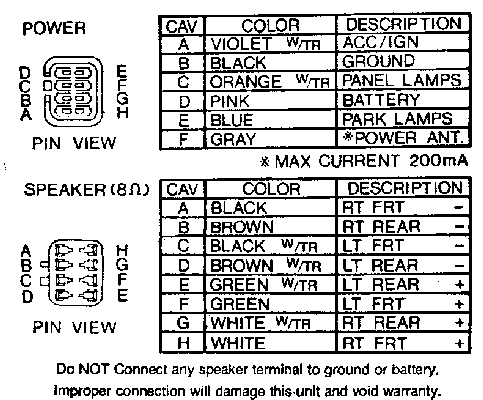
-
My guess is the XJ/MJ "distinctive smell" is a direct result of the many, many leak paths that exist in the cab design, almost all of which will leak right under the carpet and leave no evidence.
-
While doing other things in the bunker, I went and looked at my records: I currently have 3060034 and 3070914. Both are in poor condition with dead CD mechanisms. I have repaired 3070374 and 3070927, and as far as I know both are still in service. 3070120 and 3070914 donated parts in repairing those two. I had plans to work on another, but that was put on hold a few months ago.
-
120mph speedometer
Minuit replied to ghetdjc320's topic in Craigslist/Marketplace/eBay... i.e. Not Your Stuff
That was my experience too. I mean, doing triple digits in a 30 year old Jeep pickup probably isn't the safest thing in the world, but it's nowhere near as dramatic as people might think. I have every reason to believe mine could pin that 120mph speedometer. -
The serial number is very close to ones I've worked on in the past. Just as an FYI for anyone who is curious - these things are very cranky and unreliable. The CD mechanism is an early Sony designed unit that has problems at pretty much every step of the way, the faceplates are cheap and break frequently (especially the pushrods for the buttons), the FM tuners have a number of problems, and I have very few parts. Quality of build is a step or two below other factory Jeep radios. A NOS one right out of the box is probably good to go, but don't expect top notch reliability. Chances are it won't be working 10 years from now. Power and sound quality are not significantly different from other Jeep offerings. The ones I've worked on would play CD-Rs just fine though. Cool novelty, but my honest opinion as someone who's gotten elbow deep in several of these things: they're a bucket of trouble. I was thinking of restoring one for my '91, but I had so much trouble sourcing parts that I pretty much gave up on the idea.
-
Must have MJ upgrades for a cross country drive?
Minuit replied to jazzyjeeper's topic in MJ Tech: Modification and Repairs
I drove my MJ from Tennessee to Pennsylvania and back last year and had absolutely no issues whatsoever. I didn't take breaks and only stopped for gas and food. About 1600 miles in a weekend. The key to it is to make sure you can be confident in the truck. Give everything that could break a once-over. Check every fluid, change if necessary. Make sure every single hose on the entire truck is in good condition and that all the clamps are tight. Check the u-joints for any rust dust around where they spin. Make sure the belt is in good shape, tensioned properly, and that all the pulleys rotate smoothly and without wobbling. Check all of your wheel nuts and make sure they're tight. Make sure the brakes are in good condition. A properly serviced MJ in "confidence inspiring" condition should have absolutely no issue whatsoever driving for as long as you need. -
Here we have a textbook example of a tastefully restored truck, but with some upgrades done under the hood to make it more reliable and enjoyable. This is exactly what I like to see, and from a new member to boot. Nicely done. I wonder how many states have a CC member that is using the "MANCHE" vanity plate for their state. I bet it's at least half
-
Maybe they do, and we've all just gotten used to it I have very little sense of smell and go "noseblind" very quickly. I never can tell what my vehicles smell like.
-
86 Diesel MJ to VW TDI conversion
Minuit replied to johnj92131's topic in MJ Hardcore Tech: Epic Journeys to Greatness
Sounds like this MJ is in good hands. We all really liked your granddad around here, and it's good to see it passed on to someone who will continue to do it justice. -
Yup. No fancy technology in there, but the gauges are designed to work with sending units that work opposite from each other.
-
This is mainly intended as a response to Eagle, but I think a real fix to this problem would be to swap the fuel gauge to match the sending unit. I haven't tried it, but just comparing the clusters I think it would work out OK. You may or may not be able to keep the low fuel warning light. Torturing a Fuel Gauge for Science Hypothesis: Reversing the connections at the fuel gauge will allow you to use a Renix fuel sending unit in a High Output truck (or vice versa) without the fuel gauge working backwards. Conclusion: NO, the fuel gauge and sending unit must match. Background All Comanche fuel gauges determine the amount of fuel left in the tank by reading the resistance of the fuel level sensor. The fuel level sensor is a variable resistor, that on all Comanches, has a varying resistance to ground based on the fuel level. As the resistance of the fuel level sensor changes, the current passing through the gauge will also change, causing the gauge to deflect depending on the amount of fuel left in the tank. The fuel gauge has three terminals: ignition power, ground, and fuel level sense. The resistance between "fuel gauge sense" and "ground" varies as follows: 1991-1992: 105 ohms when empty. 5 ohms when full. (Source: 1991 Factory Service Manual) 1986-1990: 0 ohms empty, 88 ohms full. (Source: 1990 Factory Service Manual) Other years are outside of the scope of this writeup. Due to this difference in fuel level sensors through the years, replacing the fuel sending unit with one from an incorrect year will result in a fuel gauge that reads backwards. Testing Setup Here's the fuel gauge I will be using for this test, out of a High Output Comanche. While I know this gauge worked when I removed it from my truck years ago, we'll go ahead and test it using the correct resistances for a 1991 model year truck. The ground terminal is in the center of the picture, with a black test lead connected to it. The 12V ignition switched terminal is located to the left with a red test lead connected. The fuel level sense terminal is on the right, and a resistor has been placed between it and the ground terminal. For testing purposes, the fuel sending unit can be approximated by connecting resistors between the "fuel level sense" and "ground" terminals when not installed in a vehicle. With no sending unit connected, the gauge reads below empty. With a 100-ohm resistor connected (I don't have a 105-ohm resistor handy), the gauge should read at approximately empty: To simulate a full tank, I have connected two 10-ohm resistors in parallel between the ground and fuel level sense terminals, creating an equivalent resistance of 5 ohms: Therefore, we can conclude that the gauge is working correctly. Renix Fuel Sending Unit with an HO Gauge As discussed, the Renix-era fuel level sensor reads from 0-88 ohms empty-full. Not only is the scale the reverse of the HO, but the resistance range is different. Just for demonstration purposes, here is what your fuel gauge will read when connected to a Renix sender. Here's two 47-ohm resistors connected in series, which provides an equivalent resistance of 94 ohms: Not exactly 88, but close enough for this demonstration. As expected, the gauge reads empty: Let's try an empty tank - 0 ohms: A very predictable "full" on the gauge. But what if we swapped the gauge connections around? There's three leads, so there's a few different combinations you could make. Let's start by switching the fuel level sense and ground terminals: That's way, way past full, but still a promising start. Let's try an empty tank: The gauge does not move in this position. Why? Remember how the "fuel level sense" terminal reads the resistance between itself and ground? When you switch the "fuel level sense" and "ground" terminals, you connect the fuel level sense pin straight to ground, which pins the gauge at "full" no matter what! Now, I don't think I'm making a controversial statement when I say that reversing the positive and ground terminals on electronics is generally a bad idea. I'm going to do it anyway: Here's 100 ohms: And 0 ohms: I guess it works, just upside down? At least you're on the right side of the gauge. Conclusion In summary, connecting the fuel gauge backwards does not "correct" the gauge in any of the combinations tested here. While this test was done with a High-Output era fuel gauge (with the reasoning that it's much more likely for someone to be installing a Renix sending unit in a High Output truck than the other way around), I believe that repeating this test with a Renix fuel gauge would provide a similar outcome. The gauge and sending unit must match. It looks like the HO and Renix era fuel gauges can be swapped. I do not know about the "low fuel warning module" There are more combinations of leads that could be tried. I tried the combinations that seemed to make the most sense to me. I could test the rest of the possible combinations, but I already have almost two hours of my time into doing this test and writing up the result already. If this is something anyone wants to see more of, let me know.
-
Based on a quick look at the schematic for the fuel gauge, I don't think reversing the wires would make it work in the right direction. I might have enough spare parts sitting around that I could throw together an experiment.
-
Nice thermometer. Made some hamburgers, T-bone steaks, and pork chops yesterday. I'm not much of a cook, but they turned out pretty great.