

AZJeff
-
Posts
1312 -
Joined
-
Last visited
-
Days Won
1
Content Type
Profiles
Forums
Gallery
Everything posted by AZJeff
-
Flushing radiators can be hit or miss, as it all depends on what sort of residue is clogging the radiator to begin with. For example, out here in AZ, our water is VERY alkaline, and radiators that are filled with that water WILL develop lime residue in the tubes that will eventually clog them. The only thing that removes lime residue are acid flushing agents, and acids can and will attack the metal of the radiator as well as the lime inside the tubes. That means the flushing process might result in a radiator with holes in it, or worse yet, one that does not leak, but one that has weakened walls that will burst once it's put under pressure and temperature. Bottom line---flushing may or may not improve radiator performance.
-
That snaps into the hole in the firewall. On the older MJ's, I think the firewall will need to have the existing hole expanded to accept this new bushing/boot.
-
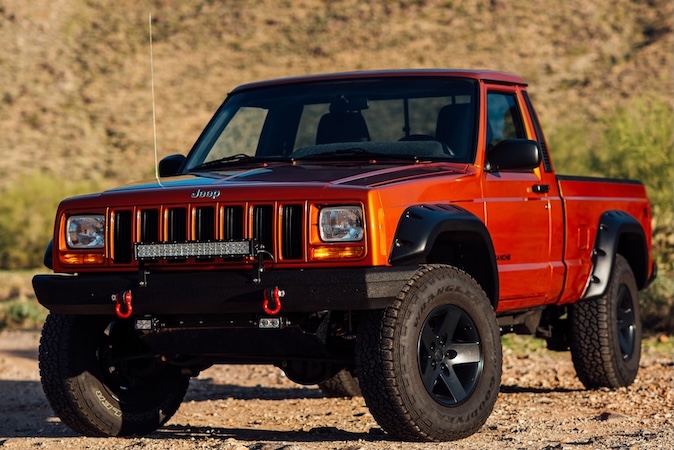
April 2020's Quarantine Comanche-AZJeff's 89
AZJeff replied to 89 MJ's topic in Comanche of the Month (MJOTM)
The console in my MJ came with it, along with a very sad looking headliner, when I bought the vehicle. It wasn't hooked up correctly at all, but from what I can determine, it came from a later XJ. It's not the same overhead console that was in my 2000XJ "Classic", which was long and contained rear maps lights, so I don't know exactly what year it may have been donated from. The console has a central courtesy dome light, and two map lights, all of which work now. It is fastened to an XJ headliner board that I cut down and recovered with new headliner material. The back of the headliner does not curve down to connect to the rear of the cab like a MJ would, so I added in an aluminum channel (covered in black cloth) that is attached to the inside of the cab with structural adhesive. The blunt end of the back of the cut-off XJ headliner slides above this aluminum channel to be retained in the rear of the cab.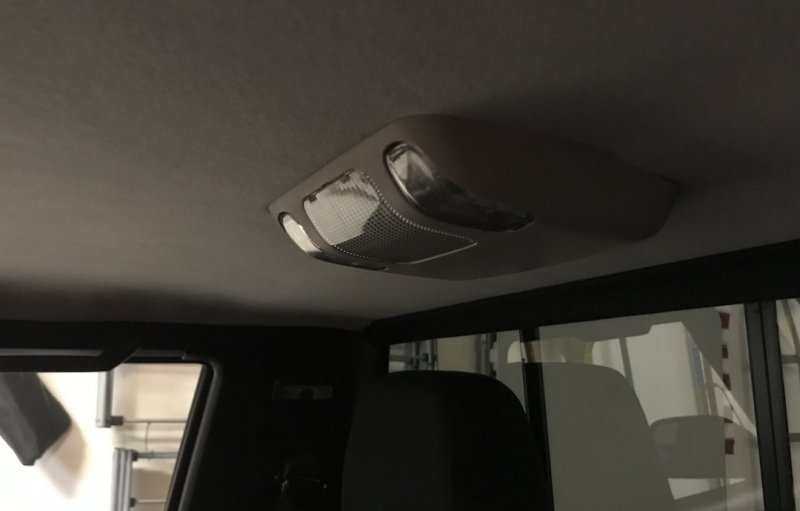
-
April 2020's Quarantine Comanche-AZJeff's 89
AZJeff replied to 89 MJ's topic in Comanche of the Month (MJOTM)
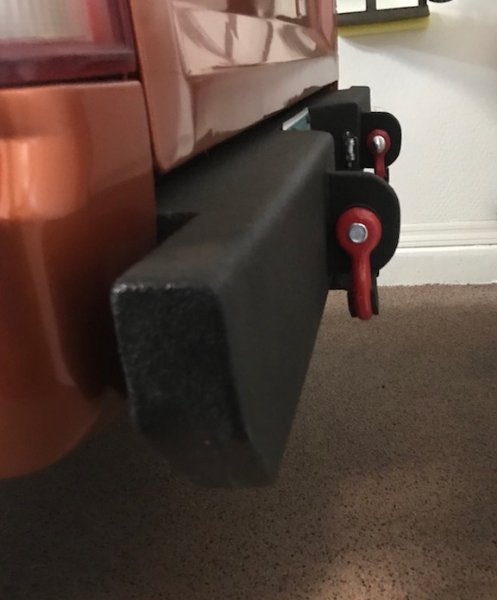
The rear bumper is a complete, from scratch, fabrication using rectangular tubing. After welding/grinding, the entire thing is coated in bed liner. The rear receiver hitch is relatively light duty, but the clevis lugs are serious, and pass through both side of the tubing and are welded on both sides, making them pretty substantial. They are also located very close to where the bumper mounts to the "frame" of the MJ. Here are a couple of pictures.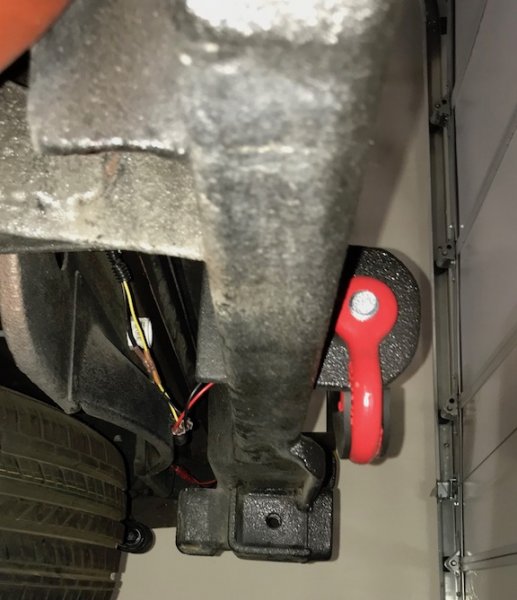
-
April 2020's Quarantine Comanche-AZJeff's 89
AZJeff replied to 89 MJ's topic in Comanche of the Month (MJOTM)
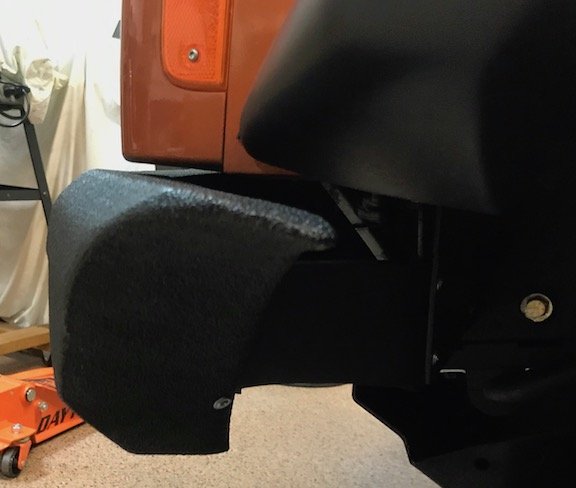
The front bumper is actually a fabrication using several MJ/XJ front bumpers as pieces. Notice that the contour of the front bumper is segmented, showing that various pieces were cut and then butt-welded together to create the angles needed to match the curve of the front grille. The end caps (which I am not really happy with) were further butt welds with some flat sheet stock to finish the end proper. The entire bumper is covered in bed-liner, so the welds/grinding are concealed under the final coat. Because the bumper is made from factory pieces, the attachment method is factory. BTW, I wouldn't actually use the front clevis' for serious towing/pulling, they are mostly for looks.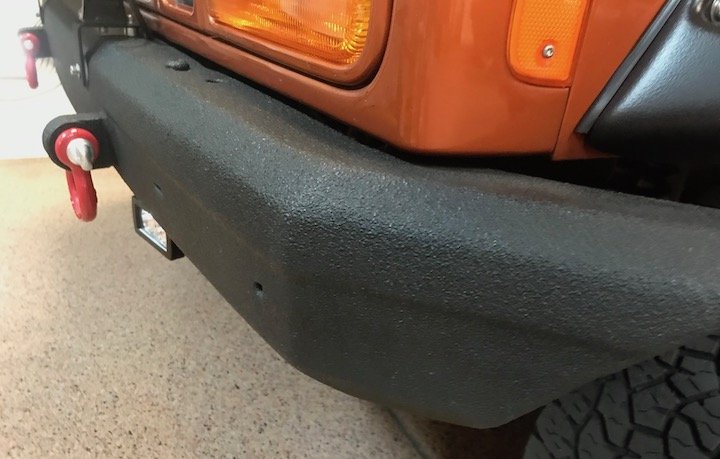
-
Jeep Comanche Bench Seat, Belt/Buckle replacement
AZJeff replied to Tonynguy's topic in MJ Tech: Modification and Repairs
I have them in my MJ. Their products are good to go. -
If you've thought about moving your airbox...
AZJeff replied to Big Dan's topic in MJ Tech: Modification and Repairs
Ah...I have never seen a nickle copper line before. Now I know. -
If you've thought about moving your airbox...
AZJeff replied to Big Dan's topic in MJ Tech: Modification and Repairs
I notice one thing that nobody has mentioned: in your picture where the master cylinder was shown, the brake lines seem to be made from copper. Are they? If they ARE made from copper, that is NOT a good choice for hydraulic brake lines. They should be made from a steel alloy. -
Glamour shots and final resting place of my MJ
AZJeff replied to ghetdjc320's topic in MJ Tech: Modification and Repairs
That's a beautiful MJ. I wonder what the cost to ship it back to the US would be? It's a shame you have to give that up, as it looks like the work was a labor of love. I assume you are going to be in Micronesia long enough that taking it with you is not cost-effective. -
Remove stuck driveshaft bolts?
AZJeff replied to KatahGii's topic in MJ Tech: Modification and Repairs
I use socket head cap screws in place of the normal OEM hex head Bolts. They are normally built to ASTM std. 574, which is better than grade 8 SAE. -
I have put CSF rads in both my MJ and my previous XJ's, and found them to be the best, most durable solution. The plastic tanked rads don't seen to survive here in the Arizona heat very long, even if you are religious about keeping the coolant clean and fresh, as I am.
-
Good suggestions in the entire write-up, but I have a proposed BETTER solution than just the self-adhesive foam around the cable track: wrap the foam ENTIRELY around the track, and add a small "tie-wrap" (wire tie) to keep the foam secure to the track. Here in AZ, the heat causes the foam to come loose of the track and then fall off in the door. The tie wrap is added security.
-
It would not surprise me if the center of that PCB (printed circuit board) is attached with something like double stick foam tape (or an industrial equivalent.) A PCB that is only supported/attached at the edges/corners can flex up and down like an old oil can in the middle, leading to solder fatigue cracks. When I worked for Motorola, they made PCM's for Ford, and they were worried about PCB flexure as I described. To deal with this, Ford insisted that the early PCM's be "potted," which essentially encapsulated the PCB in epoxy. Needless to say, a potted PCB is unrepairable, and Ford quickly changed to supporting the PCB more evenly. I agree that looking for a problem with the PCM is the LAST thing to consider. Those devices are surprising reliable. If you become absolutely convinced the PCM is misbehaving, there are places that can test/repair them, but I don't know if they can deal with a Renix PCM.
-
Thermostat housing, mounting "mod"?
AZJeff replied to MLT Lulu's topic in MJ Tech: Modification and Repairs
Clean the gasket surface with a rotary sand disk or a rotary Scotchbrite pad. Then use a straightedge to check for any raised surfaces where the numbers are stampeD. If there are, dress them down CAREFULLY with a file. Use blue RTV sealant on the gasket on both sides when reinstalling. -
Ebay is your friend here.
-
Fuse Block instead of Fusible Links
AZJeff replied to Torq_Shep's topic in MJ Tech: Modification and Repairs
I am an old guy, and the first cars I drove were from the 1960's and tended to be hand-me-down Ford products from the family. Fords in those days did use the "starter relay bus-bar" approach, but on the other hand, they used mostly water-resistant connectors. Fords were FULL of 'bullet' connectors back from the late-50's until the late 80's. Why AMC didn't use this approach with their connectors back then is a mystery, unless it was just pure economics. It's not like bullet connectors were new or proprietary in 1984 when the XJ was introduced. -
Sway bar drop brackets or extended links?
AZJeff replied to WahooSteeler's topic in MJ Tech: Modification and Repairs
Correct. In my photo above, you will notice my custom-made drop brackets not only drop the sway bar mount about 1 inch lower from the frame, but they also move the centerline of the sway bar mounting clamp forward about 1.5 inches as well. I had to do this in order to get the sway bar links to be essentially perpendicular to the ground when the Jeep is at normal ride height with my 3.5 inch lift. -
90-96 footwell light connector
AZJeff replied to BeaterComanche86's topic in MJ Tech: Modification and Repairs
Given that the AMC-era connectors were such a piss-power excuse for completing electrical circuits, I would go out of my way to replace that junk with something better (unless you are attempting a "pure" restoration of your MJ/XJ.) I cannot beleive the connectors that were chosen, even in the period when the MJ/XJ was designed (the mid-1980's). There were SO MANY better connectors that had been in use for MANY years by other auto makers at that point. It's almost like the AMC electrical design team tried to surpass British Leyland in choosing the most worthless interconnect systems for the elecrtrical wiring. -
A/C whats the difference?
AZJeff replied to ftpiercecracker1's topic in MJ Tech: Modification and Repairs
Others have talked about the expansion process, but I will address your other questions: You will need to acquire an evaporator and a compressor intended for use with R134a, if that is the refrigerant you have chosen. R134a is not as efficient as the old R12, and so components were resized when the switch over was made. Likewise, your receiver/drier will need to be R134a sized. You cannnot use hydraulic hoses for refrigerant lines. The refrigerant molecules are MUCH smaller than oil molecules, and will litterally escape through hoses that don't have the proper barrier layer in them as would a true refrigerant hose. There are shops out there that will make custom refrigerant hoses, you will just need to search for one. -
90-96 footwell light connector
AZJeff replied to BeaterComanche86's topic in MJ Tech: Modification and Repairs
That's a good alternative, if you actually have crimp tools. If you don't (like me), I just solder/heatshrink the connector pigtails into the wiring. The old Molex "Econo-Latch" connector is PERFECT for this role for interior lighting connectors, as it's cheap and simple, as well as being polarized. Too bad it requires a lugging tool to attach the contacts to the wires correctly. -
As an "old school" ME (FEA did not come along until I was in management, so I only know the theory, and have never actually used it), here is my take: If you have interior hat sections that are reusable, by all means, reuse them (with appropriate plug welds as shown in photos elsewhere in this thread.) If your interior hat sections are trashed (or missing) and you want to achieve OEM stiffness (or better), plating the sides of the uniframe will do more to improve the moment of inertia of the "frame" of an MJ that those silly hat sections would ever do. And yes, we can be friend, both profession career wise and otherwise. Don't you LOVE it when engineers start arguing the best way to do something?
-
90-96 footwell light connector
AZJeff replied to BeaterComanche86's topic in MJ Tech: Modification and Repairs
Unless you are trying to restore your MJ to factory condition, ditch those weird proprietary connectors and go buy something on Amazon. Given that the application is an interior electrical connector, the need for environmental sealing (waterproofing) is non-existent, so a bunch of stuff is out there for cheap. Here is a good example of something you can use: https://www.amazon.com/MUYI-Waterproof-Connector-1-5mm-Terminal/dp/B01A6LTK44/ref=psdc_15729341_t1_B01F54PFLE -
While I agree that (as a retired engineer), the 'designed it that way for a reason' is a good logic, keep in mind that the XJ did NOT have this added "hat section" welded to the top of the floor pan. They only relied on just the lower "hat section" that forms the uniframe with the floor pan for that vehicle. Putting on my mechanical engineer hat here, I suspect the issue has to do with the fact that the MJ lacks a roof that extends all the way to the rear of the vehicle, and the transition point from the cab to the "pickup truck frame" section is a critical point in the chassis stiffness, and adding this hat section added some stiffness. HOWEVER.......The size of those hat sections, and thus the amounted of added stiffness they provide, is NOT significant (compared to the lower uniframe hat sections), so I do not know if their loss would be monumental. One can duplicate the added stiffness of those hat sections in a variety of other ways, not the least of which is plating the sides of the uniframe on the bottom of the floor pan. My point is that the loss of the upper hat sections is not SUPER critical, but if you feel you need to add stiffness, there are other ways to do that that might actually be BETTER (but were not done by Jeep for economic reasons.)
-
Steering rack and pinion
AZJeff replied to SeasToSwamps's topic in MJ Tech: Modification and Repairs
Now that I have heard the ZJ is superior to the original MJ/XJ box, this interests me too. I would be interested to hear more of the sucess of those who dropped in a ZJ box in their machine. -
Steering rack and pinion
AZJeff replied to SeasToSwamps's topic in MJ Tech: Modification and Repairs
I learned my lesson when I went through multiple reman’d steering boxes from AutoZone for my old F150. They tended to be short lived. I got lots of practice changing boxes in that truck. When my MJ needed a box (the PO had adjusted the box in a manner that trashed the box), I bought a reman’d unit from AC Delco via Rock Auto. I figured that Delco ought to know how to reman a Saginaw box, since they are/were both divisions of General Motors. Thus far, I have been happy with it.