


AZJeff
-
Posts
1312 -
Joined
-
Last visited
-
Days Won
1
Content Type
Profiles
Forums
Gallery
Everything posted by AZJeff
-
The Moog's I installed had self-tapping zerk fittings.
-
There are companies out there that will make custom lines to your specifications. I know there are such outfits here in the Phoenix area (probably because auto AC is virtually a necessity here). Try looking around in Atlanta. I would bet someone is in that business there.
-
There is an “L” shaped bracket that attaches the top part of the radiator core support to the front grille surround. That is what those Torx head screws do, and they need to come out. there will be six 10mm bolts (3 each side) that attach the top cross bar of the core support to the top of the inner fender (2 face up, one faces rearward). The two nuts you see that are spinning actually attach the AC condenser to the cross bar. I think they are called condenser mounts or the like. “EagleScout526” can tell what the formal name of this part is, and can tell you where to get them.
-
Need Source For Jeep Liberty Advice
AZJeff replied to AZJeff's topic in MJ Tech: Modification and Repairs
Thanks, guys. Since I know this engine has been well cared for it’s entire life (along with PM to the cooling system like new rad, new WP, new hoses (twice for those) plus 4 coolant changes in 120k miles, I think I am safe with the engine as is. Here in PHX, a cooling system that is not absolutely PERFECT will kill an MJ/XJ real quick in the summer. I have carried over that practice into the wife’s KJ, and it seems to be paying off. -
My MJ didn’t have a tire carrier on it when I got it. I looked at pics of the OEM design, and fabricated a new bracket from 1” square tubing and some plate steel. my actual tire winch is one from a late 90’s Ford Explorer. I welded a small 1/4” drive socket onto the input shaft on the winch, and thus use a 1/4drive extension and cheap ratchet to run the winch up and down.
-
Need Source For Jeep Liberty Advice
AZJeff replied to AZJeff's topic in MJ Tech: Modification and Repairs
I actually have the Liberty shop manual, and to measure chain wear as described above, you have to remove the Timing chain cover and all the crap in front of it.🙁 once I am that far in on a 120k engine, I AM putting new parts in. -
Need Source For Jeep Liberty Advice
AZJeff replied to AZJeff's topic in MJ Tech: Modification and Repairs
Just in case you are wondering why I am concerned about the camshaft drive system on the 3.7L engine: My son has a Ford F150 with the infamous 5.4L Triton engine with the VVT. These things are NOTORIOUS for having the "cam phasers" that control valve timing dying and causing catastrophic valve train damage. In addition, the chain drive wears inordinately, and can cause chain jump because the tensioners cannot accommodate gross chain stretch. Owing to this, we decided to be proactive on his truck at just below the 200K mark. (Many of these engine croak LONG before this due to this valve train problem.) Because my son had been VERY diligent about oil changes and using synthetic oils, the valve train was still functioning, but there was no doubt that the chains were getting sloppy, and it was inevitable that the system would die in a catastrophic way in the not-too-distant future. We dodged a bullet by doing the cam drive system proactively. Parts were not cheap, but they were cheaper than a new/used engine. I just want to make sure the 3.7L Jeep engine doesn't have a similar latent defect in the cam drive system as does the Triton, and this is why I asked the question. -
Need Source For Jeep Liberty Advice
AZJeff replied to AZJeff's topic in MJ Tech: Modification and Repairs
I figured you might have some intelligence on this. That would be appreciated if you could check the library.. -
Need Source For Jeep Liberty Advice
AZJeff replied to AZJeff's topic in MJ Tech: Modification and Repairs
Its been living on Mobile One, changed every 4-5K miles since new. I changed the valve cover gaskets last year, and the top end was a clean as could be, so I guess the change intervals and oil choice is doing it's part. -
My wife has a 2004 Liberty that we have owned since knew. It has 121K miles on it, and it runs just fine, with no issues...no noises, no leaks, no oil consumption. However, I know that the 3.7L engine in the vehicle has timing chains the drive the camshafts, and these are tensioned by oil pressure driven tensioners. I am seeking some advice as to when it would be considered prudent to replace these chains and tensioners. Since this is an "interference" engine, I don't want to wait until a chain jumps time and trashes the engine. Can anyone point me to a reliable source as to how long this valve train can go before it should be replaced. Thanks.
-
What kind of differential is this?
AZJeff replied to Rhys Chalmers's topic in MJ Tech: Modification and Repairs
That's what I am used to seeing. I guess just because a diff. has LSD does NOT mean it will look like all other diffs with LSD. Everybody who makes an LSD carrier does them a little differently. -
What kind of differential is this?
AZJeff replied to Rhys Chalmers's topic in MJ Tech: Modification and Repairs
I guess I learned something new. I always assumed the normal LSD looked something like the attached photo inside. I guess I was wrong, and there is more than one way to make an LSD, and some of them don't show the clutch packs so obviously.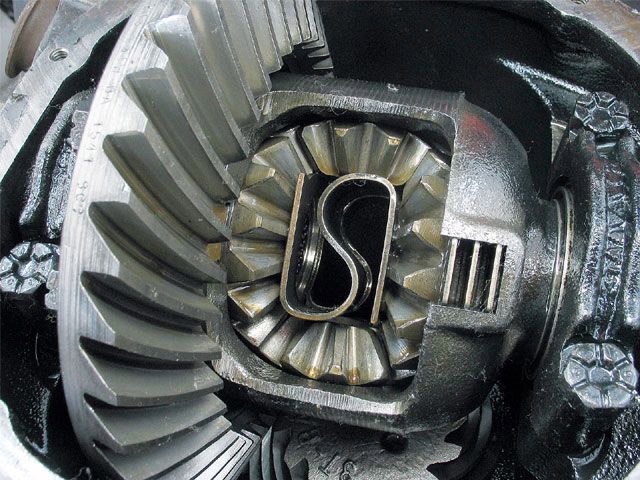
-
What kind of differential is this?
AZJeff replied to Rhys Chalmers's topic in MJ Tech: Modification and Repairs
That must be some aftermarket design you describe, as I have never seen an OEM diff. with that configuration. -
What kind of differential is this?
AZJeff replied to Rhys Chalmers's topic in MJ Tech: Modification and Repairs
You can see the clutch packs (partially) in an LSD housing. Those are not present in the photos, so that is a traditional "open" differential. -
A/C leaking and will hold vacuum
AZJeff replied to Blaine.D's topic in MJ Tech: Modification and Repairs
The method you suggest is commonly used at professional shops to find leaks in an auto AC system. The system needs enough refrigerant in it to cause the compressor to cycle. Once that happens, the dye that is added into the system is then used with a black light to find the leak(s). If the leak is in the heater box (due to a bad evaporator), the only way to find that is with a refrigerant "sniffer", but I am betting you will find it via the dye and blacklight. -
Rock Auto A/C R134a Replacement Kit Fit?
AZJeff replied to robfg67's topic in MJ Tech: Modification and Repairs
There is no reason to replace all of the components in your system if you convert to R134a. There is another thread on this topic that is active right now where I make some suggestions on what needs to be done -
Head gasket replaced, now no start..
AZJeff replied to Jeep88Comanche's topic in MJ Tech: Modification and Repairs
The Chiltons and Haynes manuals are marginally useful, at best. The ONLY real way to go for a service manual is the factory one. -
I normally buy stuff like the receiver/drier from a reputable place like Rock Auto. At least that way, you get some decent brand name stuff. The O-rings can be had at virtually any auto parts store, as can the oil. The later Sanden compressors use PA100 oil. I don't know what the older ones use, but lacking any other suggestions from the forum, I would assume the PAG100 would be acceptable.
-
The conversion to R134a should not be very expensive, especially if all the existing system parts are in good working order. In fact, I would say it would CHEAPER to convert than to stay with R12. Having done several conversions, here is my advice: If your existing hoses are all in good condition, with no cracks or dry rot, they can be used as is. However, ALL of the o-rings that join those hoses to the various parts of the system will need to be replaced. The old o-rings will be dried out and are likely to leak with the smaller molecules that are present in R134a. The condenser and evaporator can be reused. If you want optimum performance, it would be beneficial to flush those two items with a refrigerant flushing agent, and blow them out with compressed air while they are disconnected getting new o-rings installed. The idea behind flushing them is to try to drive out as much of the old R12 compatible refrigerant oil as possible. It's not harmful to leave it in the system, but the old oil will reduce system capacity and function to some degree. I would recommend taking the compressor off and draining as much of the old oil out of it as possible for the same reasons you want to flush the condenser and evaporator. Installing a new receiver/drier (accumulator) is a must. This item has a dessicant in it that is probably long since used up, and since you have the system apart, it has probably sucked up some more moisture during that process. When you fill the system with new R134a compatible oil, you should fill various parts of the system based on this ratio: 1. the accumulator gets 50% of the total oil for the system 2. the condenser gets 12% of the total oil for the system 3. the evaporator gets 25% of the total oil for the system 4. the compressor gets the remaining oil I don't have the numbers for how much oil your model year takes, unfortunately. As far as how much R134a refrigerant to use, the rule of thumb is to fill the system with 80% of whatever amount was supposed to be used when the system was charged with R12.
-
Unless parts of your existing system are damaged, worn, or missing, there is no reason you have to replace all of the pieces when converting to R134a. The heat exchangers in the system (evaporator and condenser) would probably benefit from a flush. The existing lines will probably be oil soaked with R12 oil, so they will provide enough of a barrier to prevent R134a molecules from leaking through the old "non-barrier" style hoses. Changing the accumulator (receiver/drier) is HIGHLY recommended, of course. You will also need new R134a compatible oil for the system.
-
New noise coming from engine
AZJeff replied to Classy Comanche's topic in MJ Tech: Modification and Repairs
A stethoscope will help you isolate the location of the noise in the engine. Some of the conditions you describe sound like pistol slap might be the source. Since the 4.0 engine uses pretty short skirts on the pistons, and this can contribute to creating slap. That said, slap, while annoying, can exist for many thousands of miles without any significant issues. A compression test can help to determine if the piston to bore clearance is just enough to create slap, or bad enough to lead to oil consumption issues, etc. -
OME shocks are excellent items, assuming you can find ones that fit the MJ correctly. (The fronts are the same as an XJ, so that won't be a problem. The backs, which are unique to the MJ, are the challenge.)
-
Very nice adaptation👍
-
warped air cleaner housings quick fix
AZJeff replied to Htchevyii's topic in MJ Tech: Modification and Repairs
If the plastic rods cannot handle the steady strain on the, some all-thread rod would CERTAINLY be up to the task. -
If you lived in AZ, I would be glad to help. NC is a bit far away for a quick road trip.