


gogmorgo
-
Posts
5984 -
Joined
-
Last visited
-
Days Won
4
Content Type
Profiles
Forums
Gallery
Everything posted by gogmorgo
-
If that's just using the fuel pump wire to trigger the fan relay, that's not the worst place to put it, so long as it was done right. It would run whenever the key was on, but shut off during cranking. Of course that's still not a legit fix for whatever the problem with the fan was, but I can think of far worse ways to bodge that.
-
X2 on the headlight switch connector being the first place to check. Once you've got that sorted, you'll want to look into this to prevent cruiser's photo from happening to you: As the switch ages, the contacts get weak, and bad contacts mean heat, and the heat melts the connector and burns off the insulation on the wires. After mine caught fire, I tried to find a connector in junkyards, and every one of a dozen or so I checked was already melted.
-
Seems the rail company will just run them through the shredder when that happens. Too much liability sending them back out on the road. Too bad. I'm in southern Idaho right now, was wondering how far it was to go snag a pair of the max tow axles...
-
I got talked into some Icebreaker hiking socks recently. Merino wool, lots of different styles. They seem like decent socks, and even the heavy wool isn't too warm sitting around in work boots all day. Only trouble is they come in left and right, and if you put them on the wrong foot, it's noticeable. I've been spending a little more on socks lately. I'm not super convinced they're better for my feet or anything, I'm just sick of wearing out the cheap ones under the balls of my feet, or tearing the back of the heel out as I pull them on.
-

Dana 30 inner axle seals
gogmorgo replied to 88mancheman's topic in MJ Tech: Modification and Repairs
I've never run outer shaft seals so can't really comment. I can see them being advantageous if you do a lot of deep mud, just an extra barrier to keep chunks of stuff off the inner seals. I have yet to see an axle shaft with a proper sealing surface machined into it though, so I do expect a non-perfect deal and that trapping water behind them could be a thing. I don't know if I'd want to run them on something that regularly sees road salt, for example, just because the axle tubes might not drain so well. -
Anyone use yahoo Japan or familiar with it ?
gogmorgo replied to Strokermjcomanche's topic in The Pub
I buy parts out of Eastern Europe on a semi-regular basis. No issues yet. I can't see a Japanese company being any sketchier than anything out of Russia... White Rabbit looks pretty legit in comparison. If you know of anyone into the JDM car scene, they likely would have recommendations. -
Dana 30 inner axle seals
gogmorgo replied to 88mancheman's topic in MJ Tech: Modification and Repairs
The inner seals should be fine against water intrusion, so long as your vents are clear. When you put your diff into water, the warm air and oil inside get cooled off, which drops the pressure, and everything contracts; if fresh air can't come in the vent quickly enough, it may start pulling stuff through the seals. -
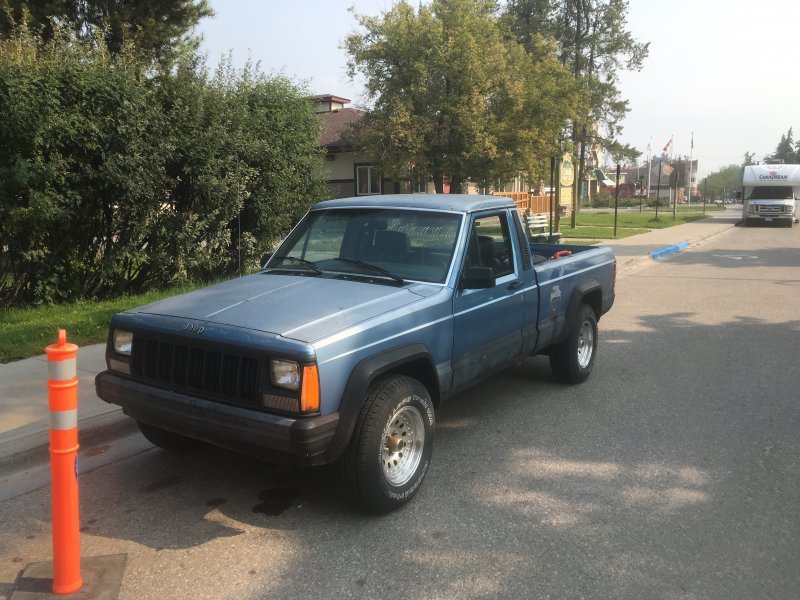
Whereabouts in Canada are you? Piecing together a lift is usually a better bet than trying to find a kit, and what works best is very dependent on what you're doing with it. Eagle speaks truth on lifts as he generally does about all things. Tire size does more to determine how much ground clearance you've got, getting your axles further off the ground. Lifts just allow for more tire size. You can run 31's on a stock MJ, just need to adjust steering stops, although 2" lift is decent at that size, 2" coil spacers and lift shackles would do you fine for cheap. Higher than 2" you'll want to look into aftermarket control arms and track bar in the front, longer sway bar links, and probably need to correct pinion angle in the rear. The higher you go, the more complex your lift becomes. If you're close to Jasper I'll trade you these wheels with a little more poke for your factory set if you still have them. Also, happy Canada day!
-
Yes, I should have been more clear when I said "can get away with". Having water freeze in your cooling system is a much more immediate consequence to running straight tap water, but not all climates experience it, hence being able to "get away with it". Corrosion and mineral deposition are usually long-term consequences, unless you have tap water like my parents' where a dripping faucet produces a stalactite, in which case they're much less long-term, even when mixed with antifreeze. I wouldn't even use that water in my cooling system in an emergency.
-
In many cases if the heater doesn't get much use it can lead to accumulation of crud and corrosion inside the heater core and valve, meaning when you do eventually try to use the heat, either the valve is seized shut, the heater core has plugged solid, or some thin corroded part lets go when exposed to flow. This is especially true in climates where you can get away with running straight tap water year-round in the cooling system, where the mineral content just makes everything worse, which it seems is where many people for whatever reason seem to prefer to live. These are also the reasons many people choose to delete the heater valve in XJs and MJs. The much more complex modern systems as a result tend to be more reliable, at least until the electronic control system fails, depending on the vehicle in question.
-
Thoughts on gear ratios for highway use?
gogmorgo replied to Minuit's topic in MJ Tech: Modification and Repairs
I want to say you could get 3.73's in tow package XJs. Early years especially you could get all kinds of weird combos... I know of an '86 2.5 MJ with the "fuel miser" spec 3.31s. But that's the wrong direction. I have seen a few XJ d30's on [choose your classifieds page] that have already been regeared to 3.73 and sometimes mildly (or extremely) built, generally not too far off what junkyard asking price would be. ZJ axles also came in 3.73's with the v8 and tow-pack 4.0s, but that's a low-pinion d30. -
random informative picture thread
gogmorgo replied to maddzz1's topic in MJ Tech: DIY Projects and Write-Ups
What year is this from? Just asking cause one of my '91s had PB8 from the factory, which supposedly wasn't a thing. Well it does according to FCA at any rate. I want to say the bits of paint sticking through where the respray is flaking off look more like they could be PQ9... but I can't run out and check cause it's parked at the welder's place right now. -
I saw one of those here... I also laughed. Its like showing off that you don't need your left foot while driving. Which, um... yeah. Real cool.
-
It's cast into the intake manifold. I just needed to know where #1 should be, and on the later distributor with a fixed position, where #1 goes matters. The diagram in the Haynes manual is clocked wrong, despite supposedly being for the fixed distributor.
-
I had a Haynes... for a short while at least. Cheap manuals are like cheap tools. They may work a few times, but they don't last very long, and they'll probably strip out your fasteners on their way to the scrap pile. My Haynes disappeared shortly after I swapped out the distributor and then spent the better part of a day trying to diagnose this problem: https://www.cherokeeforum.com/f2/distributor-cap-rotor-78168/#post872564 Note that's not my thread, but I'm pretty confident that's the thing I found that put me back on track. I don't specifically remember tossing the manual, but I also definitely no longer have it. I've never really looked too hard for one, but a '91 FSM would be cool to own, even if I don't use it much. I kinda prefer the digital manuals. The paper ones are great for comparing a couple pages side by each, or for tracing along circuit diagrams. But if I can load a PDF on my phone I can have it right there where I'm working and greasy handprints will come off my phone case easily enough, or sometimes with particularly dirty jobs I've dropped it in a ziplock, or plastic wrap over a laptop keyboard works great as well.
-
Subarus continue to rank at the bottom for quality. https://jalopnik.com/subarus-trying-to-fix-its-quality-problem-before-its-to-1835819521 113 problems per 100 vehicles built is... well it's not great. Yet they have a HUGE fan base. Seems everyone and their dog wants one or has one. We have a dozen or so in our work fleet. By 200,000km, even the highway miles we put on them, they're junk. Half of them sound like they're about to spit rods out of the block. A bunch of them hit the surplus block this winter, only to be replaced with more Subarus, because under federal fleet rules, you can't replace a vehicle with a different type of vehicle for no good reason, and when you spec a wagon, you don't have many options to choose from. Lots of friends keep asking about them... they've made up their minds that that's what they want already. If that's the way you want to go, the only way I'd recommend is with warranty, and then, make sure you have a dealer nearby and a good roadside assistance plan, and don't trade in your old car on it cause you'll still need it as backup. Especially if you're not mechanically handy. Friggen junk.
-
Is it like the GM ones that are secured with nylon that you need to melt out? Talk about pain in the butt...
-
The crazy thing is that when I stripped the interior out of my parts XJ, with waaaay more rust (all passengers can participate in Flintstoning it along), it didn't even put up much of a fight. Pretty sure I got them all by hand. I did have one other bolt casualty on the MJ. Driver's side lower seatbelt bolt. With so much rocker gone around it, it had no chance. Total ball of rust, without even much of the Torx teeth left to grab, not just hella tight. We cut the carpet out from around it and then used the newfound space to cut the head off, just behind the seatbelt's plastic guard thing. Tons of meat left on it to weld on a nut when it comes time, and between the XJ and all the seatbelts I've robbed from junkyards, I've got tons of extras bolts.
-
Doing some work on this thing for the first time in a long time. Too long. Got the interior stripped out of it, for the most part, to get started on fixing the rust. It's... not ideal, but still better than I expected. Since the rockers are gone completely, I'm getting square tube put in. Conveniently found a 14' length of 2x6 3/16-wall tube in a scrap pile. Instead of putting it up against the pinch seam like most people do, we're just going to butt it up against the inner rocker. There's almost no pinch seam left on the passenger side anyhow, so I'm not super concerned about it losing structure. I'm still going back and forth whether to just run it the length of the cab, or to extend it out under the bed to the wheelwell, but the 14' length leaves options there. I had picked up a replacement floor pan for the driver's side a while back, so that's going in as well, and the passenger side will need a couple patches. I'm not sure what the plan is for the bedsides yet. It's unclear whether they actually need fixing for the out of province inspection or not, but while the truck's parked at the welder's, it may as well happen. I may yet have to pull the dash to get the firewall padding pulled back, but we'll see. Like all projects, most of the weekend was spent trying to remove a single fastener. The driver's side inboard seat nut refused to come out. 3/8" impact got the stubborn front ones on the passenger side off, and the back nuts all came out easy, but this one just wouldn't go. We didn't want to risk setting the carpet on fire, which eliminated many options, and the fact it sits in a bit of a divot of compressed carpet meant we couldn't get at it really well. Eventually I came home and grabbed my 1/2" impact, and proceded to turn the hexagon into a circle. No bueno. many hours spent with an air chisel eventually got it spinning and off... Bad photo, but yeah... not a whole heck of a lot left of the nut. Or stud.
-
Went for a quick paddle last night. Same small lake looking opposite directions.
-
-
Pretty sure the 15x7 canyons are ZJ wheels. TJ canyons appear to be 15x8.
-
We've got into the weeds on this. If your wheel bearing is still good, there's no need to replace it. Undoing the axle nut is a pain and so you're trying to avoid doing that. It's especially difficult to do without damaging the wheel bearing. Changing the ujoint without removing the axle nut is awkward but can be done. It's the most financially economical way to go about it. It'll probably be fine if the holes in the yokes aren't stretched out from rattling around, damage is unlikely if the ujoint caps are still around. If you can afford a new shaft and unit bearing, in my mind avoiding screwing around with the ujoint, axle nut, etc., is worth saving the time and hassle, but it's going to cost more money, obviously. Offhand I'll say your procedure is correct. The hub bolts are 12-point so require a socket if you don't have... I wanna say 12mm but maybe 13? Make sure you've got the correct size socket as 12-points can strip easily. Hitting them with a wire brush first to knock any dirt or loose rust off will help the a key sit properly. The bolts go into the hub from the back and the threads are exposed on the outer side of the hub, hit those with penetrating oil first, you want to be able to reuse the bolts. Getting the hub out of the bore in the knuckle might not be easy either. You might be able to get a chisel in behind the ears (where the bolts thread in) but I found a trick online, where you use a bolt to jam against something behind the hub, (possibly inside the ujoint yoke?) then fire up the truck and turn the steering wheel, using the power steering to push the hub out. Be careful doing this, as the far wheel on the ground could pull the truck off a precarious jack stand. The only bearings relevant here are the hub assembly/unit bearing/wheel bearing/whatever you want to call it. The bearings have their own seals, but you shouldn't have an issue with those. You do want to worry about the seal in the axle tube. It's down by the diff. Be careful sliding the axle shaft out of the diff to avoid damaging it. Replacing it means popping open the diff, pulling the axle shaft on the other side, and removing the diff carrier and bearings. I would leave it alone unless you've got signs of leaking, which would show as gear oil coming out the end of the axle tube before you pull the shaft. It's worth mentioning that you will get a small amount of gear oil out of the diff when you pull the axle shaft. Not a big issue, just top up the diff when you're done. Jacking up the side of the axle you're pulling will minimize oil loss, because gravity.
-
It is pretty sad. Even my ZJ, the nicest in my small fleet, is a little beyond "a touch of rust around the edges". And it got hit by a fresh splash of road salt again today. To all the locals the snow today would be nothing, but the unfortunate part of being in a resort town is all the tourists who've never driven in snow in their lives, in rental cars with garbage for tires, means the plows and sanders come back out.
-
Yeah... Your trouble is removing the axle from the unit bearing, yes? If you're breaking tools, there aren't going to be many non-destructive methods of undoing the nut. The one I did successfully undo had a 3' breaker bar on it, braced by another guy with a 4' lining bar, and we still had an oxyacetylene torch on it to get some heat into the nut, which will cook the grease out of the bearings. I'm with Dirty on attempting the ujoint. The point of changing the shaft is to avoid having to get the old one out of the wheel bearing. If you hang onto the bearing, you need to get the shaft out of it. A new ujoint is probably all you need, and it's like $30. With careful handling you might even be able to change it without pulling the shaft, but that's definitely not the easy way. But with the shaft out, having the wheel bearing on the shaft shouldn't be a huge obstacle to changing it on a workbench, or tailgate, or wherever. I can't say I've had a problem with the ch8220/8221, I've probably only got about 30,000miles on them. Both boots are torn though. Don't know when specifically it happened, but the truck's been through some deep mud, pushed deep snow/ around, chunks of ice, been through brush, etc, so it's not a huge surprise. I would still say it's a worthwhile upgrade, especially for just a daily driver. The advantage of CVs over ujoints is the Constant Velocity. At high steering angles, the ujoints force the wheels to accelerate and decelerate every rotation, which leads to a feeling of wobbling, the steering wheel jerks around, etc. There's none of that at all with the CV shafts. Ironically after the talk of ZJ cv shafts, I've got to point out that my ZJ has ujoints, not CV's. It doesn't really look like the shafts have been changed, unless whoever did it bought used shafts. Must be a base model thing I'm guessing, along with the AX15 and np231.