


Eagle
-
Posts
15698 -
Joined
-
Last visited
-
Days Won
27
Content Type
Profiles
Forums
Gallery
Everything posted by Eagle
-
Idiots!
-
I did the ZJ box swap in the 2001 XJ. I wasn't unhappy with it, but I also didn't get an "OH, WOW!" feeling from it, either. The old box had a lot of slop over center, and it was bad enough that it couldn't be adjusted out. The ZJ box eliminated the slop over center. Other than that, to be honest, I didn't think it drove any different than my two 2000 XJs. The difference in ratio, in practical terms, is 3-1/2 turns lock-to-lock for the XJ/MJ 14:1 box and 3 turns lock-to-lock for the ZJ 12.7:1 box. That means with the stock box, from straight ahead, you have to turn the steering wheel 1-3/4 turns to hit the steering stop. With the ZJ box, it's 1-1/2 turns. That's just not much of a difference. If I were buying a new box from Borgeson, I would ask if they can do one in a 10:1 ratio. I would especially ask about that if I had a long wheebase MJ.
-
1987 auto trans won't shift out of 1st
Eagle replied to mark corbitt's topic in MJ Tech: Modification and Repairs
If you read the instructions for that test, they tell you it won't shift into second. Did you test the fuse? Is the TCU getting power? You have an '89 -- that has the Power/Comfort switch on the dashboard, right? Have you tried flipping that switch? -
Anything CAN be done. The question is whether ir SHOULD be done. You can probably find a way to hang a Cherokee tank under the back of an MJ, beneath where the spare tire is supposed to be. Of course, you lose access to the spare tire, which means you have to carry it in the bed ... which means you'll need to figure out a way to lash it securely in place. More importantly, the tank won't fit neatly up inside the frame rails (or X) -- it will have to hang below the frame. It will be at the very rear of the chassis, so it will be exposed to "tail strikes" (aviation term) when transitioning to steep grades, plus it'll be RIGHT THERE, waiting to get smacked if you get rear-ended. If you want to know why that's not a good thing, Google "Pinto gas tank issues." Here's a start: https://users.wfu.edu/palmitar/Law&Valuation/Papers/1999/Leggett-pinto.html https://philosophia.uncg.edu/phi361-matteson/module-1-why-does-business-need-ethics/case-the-ford-pinto/ https://www.history.com/this-day-in-history/fatal-ford-pinto-crash-in-indiana https://florinpopa.files.wordpress.com/2011/03/ford-pinto.pdf
-
Did I over pay???LOL still glad i bought it..lol
Eagle replied to early comanche owner's topic in The Pub
-
What radiator neck? Your signature says your truck is an '89, and your opening post says you replaced the coolant bottle, so you must still have the coolant pressure bottle on the firewall. The radiator for the closed system doesn't have a filler neck. Did you "burp" the system after filling it? The closed system is very hard to fill, and almost impossible to fill in one try when cold. What I have found works is to fill it unti the level in the pressure bottle is half full, start it up with the cap on the pressure bottle loose, and let it warm up until the coolant starts to bubble out of the bottle. BE CAREFUL -- it's hot enough to scald you. As soon as it starts to bubble, shut off the engine. Remove the cap from the bottle. Wait while it cools down. In a couple of minutes it will start sucking coolant back out of the bottle -- when that starts to happen, add coolant to replace what's being sucked out, keeping the level in the bottle at least to the halfway point. When it stops sucking, start it up and repeat. You may have to do this three or more cycles to "burp" all the air out of the system.
-
Cherokee tank won't fit under an MJ.
-
Nope. Guages attach to the printed circuit board with two or three nuts. Temp gauge I think has three.
-
The best/easiest/most cost effective swap by far is the GM 3.4L V6. But it has to be from a rear-wheel drive vehicle -- Camaro or Firebird.
-
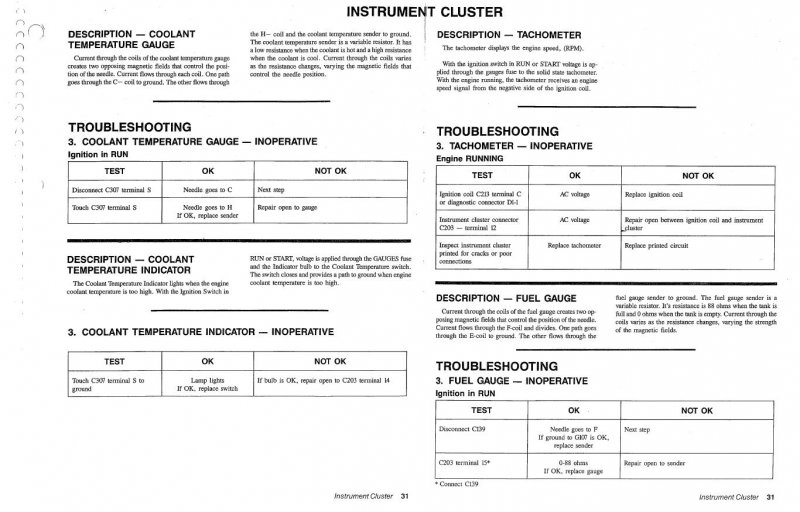
First question: What cluster did your MJ start with? The idiot light cluster, or the cluster with gauges but a large gas gauge instead of a tachometer? (Sometimes referred to as a "3/4" cluster.) If you started with a 3/4 cluster, then you already have the correct sensors to work with gauges. The temperature sensor is a variable resistor. The ratings are 1600 ohms at 100 degrees, 309 ohms at 180 degrees, and 113 ohms at 240 degrees. So a quick test would be to remove the pigtail from the sender. With the pigtail not contacting anything, that should cause the gauge to go to cold with the ignition on (engine NOT running). Then touch the pigtail to a good ground. The gauge should swing to the HOT side. If the original cluster had a temperature gauge, have you tried swapping your original gauge into the "new" cluster?
-
1987 auto trans won't shift out of 1st
Eagle replied to mark corbitt's topic in MJ Tech: Modification and Repairs
The purpose for removing the fuse for the TCU is to determine whether the problem is mechanical (the transmission) or electrical (the TCU, or one or more of the solenoids). If he doesn't run this test, we'll be guessing forever. -
Is the cooling system filled properly, and the thermostat opening properly?
-
Track bar stuck beyond belief
Eagle replied to billyblankss's topic in MJ Tech: Modification and Repairs
Remove the bracket from the truck. Remove the castle nut. Place the bracket over a large socket, with the cut-off stud centered on the socket. Smack top of stud sharply with a large (heavy) hammer. -
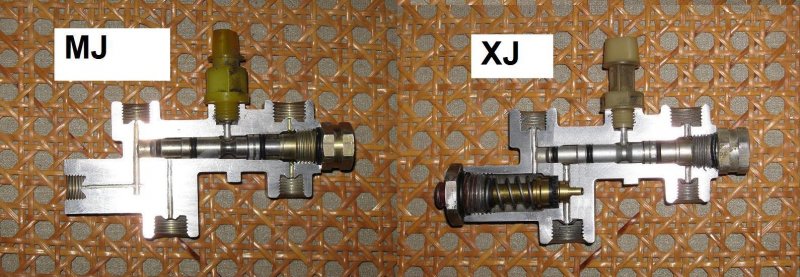
You're new here, so a little background. The XJ (Cherokee) has a distribution block in front, below the master cylinder, that also functions as a proportioning valve. The MJ has a similar looking distribution block under the master cylinder, but it is NOT a proportioning valve. The proportioning in the MJ is handled by the load/height sensing valve mounted to the left side of the frame, above the rear axle. Where things get more complicated is that the MJ system has two hard lines from the front to the back. One of them, the one that comes out of the "nose" of the distribution block, is for normal operation. It feeds brake fluid into the rear height sensing valve, so the amount of rear braking is proportional to the amount of load in the bed. But, if the front brakes fail, that would leave you with reduced (proportioned) braking at the rear wheels. So they built in a bypass circuit that opens up only if the front brakes fail, and bypasses the height sensing valve to send full pressure to the rear brakes. No, the rear height sensing valve is not available. Yes, it can be bypassed, and you can find instructions on doing that on this forum. Here's why you may not want to do that: Why do they proportion the braking to the rear? Because a pickup truck, when empty, has very little weight over the rear axle and wheels. That means the rear brakes would lock up long before the front brakes, especially when the bed is empty. Premature lockup of the rear brakes causes spin-outs. So they proportion the rear braking as a safety feature, to reduce the likelihood of spin-outs. I had to delete the rear height sensing valve on one of mine, because it exploded in a panic stop situation. So I did the bypass/elimination. Guess what? My rear brakes lock up early. In my case, that's not too bad because I'm old enough that I grew up and started driving long before there were such things as proportioning valves. I got my driver's license in 1960. The first vehicle I bought with a proportioning valve was my '88 Cherokee. By that time I had 28 years and almost a million miles of driving behind me, so my right foot expects the rear brakes to lock up. I can deal with it. You younger guys, who have probably never had to deal with that, probably should think seriously about intentionally creating a situation that invites premature rear wheel lock-up. It's better to repair the brakes and keep them operating the way they were designed.
-
24 LB Injectors on a (mostly) Stock 4.0
Eagle replied to AeroNautical's topic in MJ Tech: Modification and Repairs
You're still running the Renix system? Stock injectors are 19 lb. I'd say 24 pound is too much, but you might be able to dial them in with an adjustable MAP sensor. -
1987 auto trans won't shift out of 1st
Eagle replied to mark corbitt's topic in MJ Tech: Modification and Repairs
We do need more information, but you still don't understand how the AW-4 works. Either that, or you're not explaining it correctly. Here's the manual shift diagnosis procedure from the FSM for the AW-4: -
looking for evidence of 3.73 gears ever coming in an MJ
Eagle replied to Pete M's topic in MJ Tech: Modification and Repairs
Never heard that one before. I like it. Too true! -
Did I over pay???LOL still glad i bought it..lol
Eagle replied to early comanche owner's topic in The Pub
There can be many reasons for a low brake peddle. The height sensing valve may be one of them. Deciding to eliminate the height sensing valve (which serves an important purpose) before knowing what the problem is is not a logical approach. -
Brake pedal goes to the floor!!! Need help
Eagle replied to istaywikkid's topic in MJ Tech: Modification and Repairs
You do realize that this thread is almost six years old, right? -
Did I over pay???LOL still glad i bought it..lol
Eagle replied to early comanche owner's topic in The Pub
No. -
There are only two connectors for the instrument cluster, both over on the left side (left as the cluster is installed in the dash). Both are rectangular and snap directly into the cluster. You make reference to "the dimmer/headlight switch," but those are two different things. Let's try again -- the headlight switch pulls out to turn on the headlights. It also rotates to control the brightness of the instrument lights, and at one end of the rotation it's OFF. In addition, the control is an old-fashioned rheostat, with a fixed contact blade that slides along a length of coiled resistance wire. Over the years, this may develop dead spots, causing the lights to flicker or go out even if the knob isn't rotated to the OFF position. So ... have you tried rotating the dimmer control on the headlight switch?
-
With a 5-speed, you should have 4.10 gears. Asking for advice after you bought the tires is unfortunate, because my advice would have been to NOT buy tires that big. The 4-cylinder isn't going to be happy trying to roll those big tires. Unfortunately, DesertRat is incorrect. Even 4.88 gears won't get you back anywhere near stock. Your factory tire size was probably 195/75-15, and the RPM in fifth gear at 60 MPH would have been 2411. With 31" tires, 4.10s at 60 MPH will only have the engine turning 1842 RPM at 60 MPH, and 4.88s will only bump that to 2192 RPM. That's way below where the 2.5L likes to run.
-
Aftermarket power window conversion. "Stripped down to the chassis."
-
1987 auto trans won't shift out of 1st
Eagle replied to mark corbitt's topic in MJ Tech: Modification and Repairs
The fuse for the TCM (Transmission Control Module). -
1987 auto trans won't shift out of 1st
Eagle replied to mark corbitt's topic in MJ Tech: Modification and Repairs
No, not when shifting manually. It should manually shift through the gears. I believe it starts in first and skips second, then you can manually shift to third, and then OD. Either that, or it starts in second and then you can manually shift to third. But the transmission should respond to manual shifting. If it does, then you have an electrical or TCM issue. If it doesn't, then you have a transmission issue.