
DirtyComanche
-
Posts
7945 -
Joined
-
Last visited
-
Days Won
11
Content Type
Profiles
Forums
Gallery
Everything posted by DirtyComanche
-
what all should be in this forum?
DirtyComanche replied to JeepcoMJ's topic in MJ Hardcore Tech: Epic Journeys to Greatness
Is the original question of swapping an LS engine in on par with asking what axles a stock Jeep has? Number of Jeeps here with one or more stock axles >95%. Number with LS engines <1%. And I am posting this calmly. -
Yup a silly shackle thread
DirtyComanche replied to Cmorris24's topic in MJ Tech: Modification and Repairs
Getting an inch or so out of shackles isn't a big deal. And if you only need that much it is the easiest thing to do. Personally I'd probably add a leaf from a S10 (or similar) though because I find the stock MJ springs are a little softer than ideal. Where is it actually rubbing? You never answered, but I'm assuming it's the rear lower part of the front fender? You might be able to fix that somewhat with adjustable control arms or shims. -
Year? Did it just start doing this, or did you acquire it this way, or did it happen after doing some maintenance task?
-
LS swap questions- yes, another one.
DirtyComanche replied to RustyRodder's topic in MJ Tech: Modification and Repairs
I debated between the LSx and the TDI. The TDI doesn't seem like a terribly expensive swap and probably would work nicely for a MJ with smaller tires, puttering around town, mild wheeling, etc. I don't believe they're reliable if you try to get a lot of power out of them, I'm sure people will refute that but I do not believe they are anywhere near as overbuilt as commercial diesel engines are. There's a lot of different generations with their own unique quirks, so it's a lengthy topic regarding the pros/cons of each and what all is needed to make each swap work. Adapters are available to go to various transmissions, including the AX-15 and AW4 (you will likely have to manually control the AW4). Motor mount kits are also out there to go into the XJ/MJ chassis, which may work depending on which engine exactly you get, along with some other needed small parts. There is tuning software available to make the engine happy after you butcher it out of the car, assuming you go with a newer generation one rather than an older mechanical injected one. I decided against it because most of the TDI donors I looked at were either of the wrong generation, too much money, or the engine itself was iffy. I also hate driving diesels in the winter, done way too many years of that, the TDI makes very little waste heat which is a bonus from the aspect of the cooling system, but sucks if you want to be warm when you're driving it. The lack of power output was another issue, as I wanted to put it in my LWB with some 1-tons and things, so it was going to be heavy. That said, it's not off the table that I won't do this at some point, but currently I'm swimming in LSx parts for my Gladiator so it makes it easier to go that route. The LSx is not necessarily the easiest engine to swap into things, but the aftermarket does support swapping it into pretty much everything. I've also had lots of personal experience with the 4.8/5.3 truck engines in their natural habitat, and I think they're hands down better than the comparable Dodge/Ford/Toyota V8s, and that there is almost zero comparison in quality between them and an earlier V8 with the 4.8/5.3 easily being able to last half a million miles with minimal maintenance while getting excellent fuel economy. The other great thing about GM engines is they're a GM engine, so you can bolt excellent GM patterned transmissions to them, without wasting money on adapters to go to some less than ideal Jeep transmission. I was going to use a NV4500, which is a truck transmission by nature, but would do exactly what I wanted being that it's brute strength with a bull low and overdrive. The NV3500 is available as a more compact and slightly nicer shifting option, but it does give up much in regards to brute strength (it's basically the same as the Jeep NV3550). The 4L60E, 4L65E, 4L80E, 6L90E, etc all also bolt to them and will play with the ECM so they basically just work (there is some odd things that happen when swapping between generations and whatever, but it's all well documented). The T56 is also natively found behind LSx car engines, and it's a great transmission for the 2wd pavement pounder with double overdrive and very nice shifting. Tuning software is readily available, along with places that will do a tune for minimal money, and there is access to a ton of parameters doing this; IE you could speed density tune it if you're just looking to make power with minimal sensors, or on the opposite end of the spectrum you can retain the very conservative stock tunes but just delete the VATS and whatever unneeded emissions controls/etc. The big downside to swapping one in is that it's going to cost a bunch to do it correctly, and it will take a bunch of time. As I mentioned before, getting the hood to clear, the motor mounts correct, the exhaust to fit, etc, can take some figuring. Or you could basically just give Novak your credit card, but I really don't recommend that. Any V8 or high HP swap presents issues regarding the cooling system. Most engines are just not thermally efficient enough to not tax the stock XJ/MJ cooling system when making much more than the original 190~HP. Engines with aluminum heads and blocks do help shed heat, but you can't expect to throw a 300HP engine in and have the factory radiator keep up. Adding more cores/thickness to the radiator helps, but ultimately most of the successful higher HP swaps wind up cutting out the core support and going to a totally different radiator. -
Voltage Regulator Issue
DirtyComanche replied to AeroNautical's topic in MJ Tech: Modification and Repairs
Rockauto has a listing for a 93 with regular emissions and no police package for what looks like about $200 US core included. https://www.rockauto.com/en/catalog/jeep,1993,cherokee,4.0l+l6,1180178,electrical,engine+control+module+(ecm+computer),2896 Not sure if that link from mobile will work. -
So... what changed? I can't sleep as you'll notice.
DirtyComanche replied to gogmorgo's topic in The Pub
Seems odd. I would have thought the longest ones would be fitted with optional accessories like the swing out spare tire carrier and the brush guard, which I believe were only in early years. -
LS swap questions- yes, another one.
DirtyComanche replied to RustyRodder's topic in MJ Tech: Modification and Repairs
For the gauges I would probably go to an aftermarket speedo and tach, as I think it would wind up costing a lot of money or headache to make the stockers work. That said, I believe you could probably get the tach working correctly if you spent enough time farting around with it, as the earlier tachs were adjustable between the 4 and 6 cylinder engines, and the LSx type engines put out a standard 8 cylinder tach signal, so there is a chance you could tweak the adjustment to cover that. Failing that, Dakota Digital or somebody else probably sells a signal converter that would work, but it will be a few bucks and is another module to wind up failing. For the speedo I don't know what Novak's kit looks like, but I shudder to think that fitting a mechanical speedo is really a good option in this day and age. The actual speedo output from the ECM might play with the 91/92 HO tach, which will fit in the Renix gauge cluster (or so we proposed in another thread), and I believe the pulse per rev setting can be edited in HPTuners (the VSS setting can for sure). I also question how Novak's speedo drive kit works, and I hope it does not delete the VSS? And you're going to use a 4l60E or...? A 4L65E would be a lot better. Don't get a 4L60. Really for simplicity buying the trans with the engine is probably the best bet for the first go at this as then you already know it will play correctly with the engine and ECM. No idea on HVAC, I don't see why it shouldn't work, but I also don't believe in A/C. You need the heater to be hooked up though, the LS tstat needs a bypass loop. My main concern with keeping the A/C would be getting it to fit with the motor mounting and exhaust, plus getting a condenser core that will fit with whatever radiator you wind up with. Column shift might be a PITA to hook up correctly, but I'm guessing it will work... It's a GM column so I'm sure there is a cable that will work if the one you have doesn't. Or you can have one made. The hood is another matter. Firstly, what engine are you getting? In general, car engines with their low intake and accessories will clear the hood assuming the engine is placed correctly. However, they generally don't clear the steering box. Truck engines with truck accessories and intake will not clear the stock hood, not even close. Lots of guys butcher the hood, or just don't run it, as converting to a car intake and then buying an accessory bracket kit that works takes a fair amount of money and some farting around. I have some accessory drive kits picked out I can share if you want. Electrical is 'easy' with the Renix. Sorta. Not. But basically the Renix already has the ECM and engine harness standalone, so it's fairly easy to pull that part out. You will want to cut down your new engine harness (fairly easy) and put it on it's own little fuse block. Then cut all the other uneeded junk out of the Renix harness and integrate the few things that are needed. Or at least that was how I planned to do it. I could give you more specifics if you want. I've researched this a bunch but I'm not sure where you're at on picking components. Getting the motor mounted correctly, the exhaust to fit, and a cooling system that actually works seems to be the biggest hurdles to me for a 2wd swap. -
If you bent the brackets on your 91 HP D30 in the wreck, there is a good chance you bent the tubes or the Cs. I would not trust it. As said, the 00 one is low pinion, personally I would never use one as I have a hatred for low pinion front axles. You could use it though, at least it will have the newer style axle shafts/ujoints and you know it is in good shape. The auto trans changed from Renix to HO to OBD-II, and while it is possible to swap them around I don't know if the outcome will be desirable. Likewise for the tcases the input spline count changed. The Renix AW4 had a 21 spline output, so the tcase used a matching 21 spline input. The later AW4 and tcase is 23 spline. The gear cut in the planetaries (and the input) changed in 95, so you can't swap the inputs around. Hopefully I followed your post correctly on what you were proposing to do, I'm tired.
-
At that price I ordered one... Why not.
-
Ditto on the comments about adjusting them and checking the height sensing valve. I'd probably consider disconnecting the valve and zip tying it in the up position (full braking) for the sake of passing the emissions crap. Beyond that you'll have to start changing parts.
-
You can just bypass it if it actually fails. At least for long enough to get a new one.
-
That's a Renix. HO has totally different wiring.
-
Junkyarding today. Needs/ideas?
DirtyComanche replied to coolwind57's topic in MJ Tech: Modification and Repairs
Interesting about the headlight chime module. I had no idea. And I think $70~ was probably a score for those seats. -
Hmm. I'd better check. Not many XJs left in the junkyard here so I'm not sure if I'll find a 94 to check again. I swear I used a set of 94 seats the one time... But I go off whatever the yard wrote on the vehicle too, so that's not always accurate.
-
It won't affect MPG unless there is something really weird going on. And if you remove it in CA you'll probably go to jail.
-
Assuming you're talking about the cylinder bolted to a bracket on the top of the frame rail, center of the second pic, that is your charcoal canister/evap canister. It 'stores' the gas vapours from the gas tank, and a valve in it allows them to be vented into the intake when the engine is running. You can delete it in some jurisdictions.
-
And you'll want 2dr seats or to modify them so they tilt forwards.... Otherwise it sucks trying to get stuff behind the seat.
-
94 and earlier.
-
Junkyarding today. Needs/ideas?
DirtyComanche replied to coolwind57's topic in MJ Tech: Modification and Repairs
Is it nice? What did you pay? What's with the blue headlight module? -
Oddly enough it has been nice here.
-
Or you can just buy the Raybestos line and throw the quick coupling out in favour of a union. That said, it's a PITA to fish the prebent line into place.
-
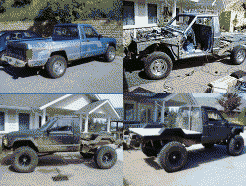
I have worked on it but didn't update. So I'll update a bit, this isn't actually catching it up but I don't have pictures on this laptop. No, it's not done and drivable, it's closer though. So, needed a rear bumper... Because there isn't one, and you couldn't attach a stock one even. Weld 'er up. I think the D-ring tabs were from TMR or Ruffstuff, the hitch is a PA special (comes painted even though it's a weld on, f-ing PA ), the bolts were just threaded into some nuts welded inside which are for later use (integration with the gas tank skid). Done for now. \ Youtube if you want to waste time: https://youtu.be/7S0xyFm8FIw
-
I made the trans crossmember into a belly skid: I didn't use countersunk hardware because I figured it would be okay for now. Maybe next time around. Nutplates were made and welded to the unibody in the rear or the rear crossmember. Then a rear crossmember (to support the NP205) was made, and a skidplate was integrated between it and the front one. Everything was test fit before final welding: Paint: I hate painting in the shop... Installed: With the NP205 there isn't much option for making the belly any flatter, it's just too big.
-
Comanche power/towing
DirtyComanche replied to SatiricalHen's topic in MJ Tech: Modification and Repairs
Nope, 4.56 with 35s is effectively lower by a fair margin. Using 1:1 drive (4th gear in the manual trans, 3rd in the auto) and 65mph you will tach 2400RPM with the 28s and 2850RPM with the 35s. Now that said the auto would normally come with lower axle gears, as the first gear ratio is fairly high, but it's honestly a mistake on the design end that they did this from a street driving perspective as the converter slip allowance means the AW4 first gear is "lower" than the Peugeot or Asin manual tranny. There is also a slight difference in OD ratio between auto and manual, .75 for the later AW4 vs .79 for the Peugeot, but it doesn't matter as much as the auto shifts automagically so people don't notice the lack of power in OD. Basically what I"m getting at is that the 3.07 gears were a terrible idea from the perspective of the driving experience, but they did make sense as far as meeting fuel economy requirements because they gave you a true miser gear for coasting. Factoring in OD ratios will produce about 1900RPM for the 5spd, and 2140rpm for the auto. 200 and change RPM will still make a significant difference to how it drives when you're that low in the RPM range. -
Comanche power/towing
DirtyComanche replied to SatiricalHen's topic in MJ Tech: Modification and Repairs
I think the truck is totally fine, or as good as it will be short of rebuilding the engine, regearing, or adding power through modifications. A 87 Renix is 173HP on the showroom floor. That said, I'm not driving it, and power is subjective. But no, you can't just put it in 5th and cruise around. It has a gearshifter because you need to change the gears according to engine loading and speed.