


Eagle
-
Posts
15698 -
Joined
-
Last visited
-
Days Won
27
Content Type
Profiles
Forums
Gallery
Everything posted by Eagle
-
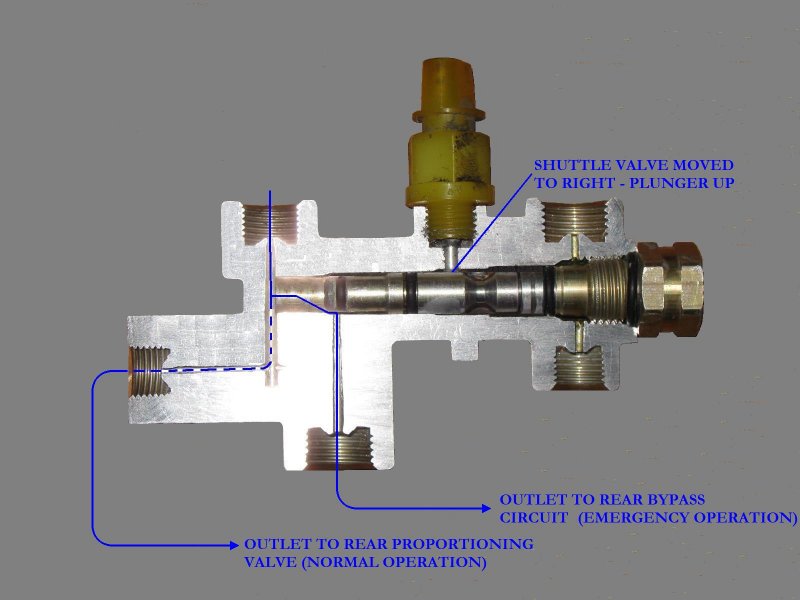
What you are missing is that your #2 is the normally-open line/circuit that feeds the rear brakes (through the height-sensing valve) under normal operating conditions. Your #1 is the line for the emergency bypass that sends full pressure to the rear brakes (bypassing the height-sensing valve) in the event of loss of the front brakes. Port #1 only sees flow/pressure if the front brakes fail. Note that this photo shows the shuttle valve (that horizontal slider across the top) in the tripped position, as it would be when the front brakes have failed. Under normal conditions, the shuttle valve would be about 1/4-inch to the left, with the left-most O-ring blocking fluid flow to the outlet at the bottom.
-
This thread is about a no-start condition, and it has been resolved. You'll get more/better answers to your question about a fuel level sender if you start your own thread. I'm closing this one.
-
Bump steer? Between my XJs and MJs, I must have driven well over a half million miles on the stock steering. I have never experienced a hint of bump steer.
-
That's definitely not a hack job. Whether or not you like it, it's very well executed. I can appreciate the workmanship, although I don't think I'd care to own it.
-
Who is this "we" to whom you make reference? I'm not sure, but I sort of think that "we" means Kryptonic and Kryptonic, and his other brother, Kryptonic. Nice work, Amigo. We are in your debt.
-
Are the pads not retracting, or is the wear only on one pad on each side? Check the caliper mounts. I think I remember someone awhile back posting photos of where the calipers had worn a groove into the slider arm on the bracket, causing the calipers to hang up rather than float. I think he repaired it by welding up the groove and then re-shaping it with a file to the original configuration.
-
Checked that while playing musical tires. Both wheels spin freely. I think Minuit got it. I have a bag of those shims somewhere. Now it it would just stop raining ...
-
Because it's their standard protocol when a vehicle is in a front-end collision. They did the same thing with my wife's 2000 XJ (the other 2000 XJ) when the "damage" was just scraped paint.
-
I know how it's done, but I have never had to do it with an XJ or an MJ.
-
Your guess is incorrect. I called it a fender bender for a reason -- that's what it was. The damage was sheet metal and a headlight. The factory foglights survived, so you can get an idea of the [lack of] severity of the impact.
-
Yes. Pulls to the right, fairly strongly, regardless of what tires are on the front.
-
Since my 2000 XJ was repaired after the fender bender two years ago, it has had a constant pull to the right. I know the body shop had the front end aligned, and I'm sure that's what created the problem -- but I didn't get a before and after report, so I have no idea what they did. The steering wheel is straight, so it's not the drag link. Camber can't be adjusted, so it's not camber. So we're down to toe-in or caster. The tires aren't wearing funny, and toe-in doesn't usually cause a constant pull to one side, so unless someone tells me otherwise I think I've ruled out toe-in. So I'm basically down to caster. If it's constantly pulling to the right, which side to I want to change, and do I want to increase the caster or (if possible) decrease it?
-
A 79 Wagoneer was a full-size. The hubs will be 6-bolt.
-
Exhaust manifold suggestions
Eagle replied to Tamadrummer's topic in MJ Tech: Modification and Repairs
That's why the flex pipe. It takes strain off the header. -
Makes sense. So I should probably revert to letting the answering machine take all calls.
-
For a long time I stopped answering my telephone (landline) because the overwhelming percentage of calls were marketing. I've started answering some calls lately, and I don't understand what's happening. I answer a call, and all I hear is several seconds of dead microphone, then a click and the connection is broken. They aren't the typical robo calls, because there's no canned announcement that starts playing as soon as I pick up. These are strictly just dead air, then disconnect. Has anyone else experienced this? Do you have any idea what it's about?
-
Looks like there's no front axle. $500 tops.
-
Wait a couple of years, maybe the dummies are listening?
Eagle replied to Jeep Driver's topic in The Pub
In the video they made reference to a 7,000 pound tongue weight, which was obviously an error. Even if they meant tow weight, I don't think a regular Wrangler chassis could be rated that high. To be honest, even though I like the 2-door much better than I like the "Gladiator," I wouldn't buy one. If I were to buy a new (or nearly-new) pickup, I would want an extended cab. The only reason I bought an XJ in 1988 rather than an MJ was that the MJ didn't have an extended cab. I needed a daily driver, and I wanted some space behind the driver's seat for things like a briefcase or a suitcase large enough for a long weekend. The standard cab just didn't (and doesn't) cut it. -
I'm glad you mentioned those knuckles, because I have two or three of those axles in a pile that I was getting ready to scrap.
-
Wait a couple of years, maybe the dummies are listening?
Eagle replied to Jeep Driver's topic in The Pub
It'll never happen. It's too close to what Jeep people want, and FiatChrysler (or whatever they call themselves these days) aren't interested in selling Jeeps to Jeep people. They want to sell expensive toys to the yuppies. -
Perches and shock mounts are typically welded to the axle tubes, not to the differential housing. It's extremely unlikely that you would (or could) warp a tube by welding something to it. The factory spring perches certainly look like they were welded with continuous beads, not a bunch of spot or tack welds. Welding a brace (or anything) to the differential housing is a different matter. Those are cast iron (or cast steel), and that requires different welding techniques (that I consider to be over my head).
-
Incorrect. The XJ didn't start using a rubber seal until years after the end of the Comanche. All the windshield glass is the same for both the XJ and the MJ. The rubber seal was used only on late XJs, the early XJs used the same stainless steel trim found on the MJs. It is possible to use the rubber seal when installing a new windshield in an MJ, and I recommend doing so ... but it's not necessary. And the rubber is trim, not a gasket. It doesn't do anything to prevent leaks.
-
-
how many miles on your truck's factory engine?
Eagle replied to Pete M's topic in MJ Tech: Modification and Repairs
You said "trucks," so I didn't include my original '88 Cherokee. 287,000 miles and still running (when I get around to replacing the leaking injectors). -
To me, a pump that doesn't shut off combined with no fuel suggests a pump that's not pumping. The regulator on the Renix models, IIRC, allows over-pressure to be routed back to the fuel tank. The pump is supposed to shut off when the fuel system reaches a pre-set pressure. That's why the pump shuts off after a few seconds of priming when you go to start the engine. It's not on a timer -- it reacts to the pressure in the system. So ... the engine won't start, and the fuel pump won't stop. Possible correlation, which is why I suggested checking for pressure in the fuel rail.