


Minuit
-
Posts
5139 -
Joined
-
Last visited
-
Days Won
13
Content Type
Profiles
Forums
Gallery
Everything posted by Minuit
-
RX-135 Radio on ebay
Minuit replied to eaglescout526's topic in Craigslist/Marketplace/eBay... i.e. Not Your Stuff
I'll beat this guy's price by 10 bucks! Why is there a 10A fuse in it? Supposed to be 5A. Naughty naughty. -
It's common for them to leak absolutely goddamn everywhere. Any hole in the cab can, will, and has leaked. The waterproofing engineer at AMC was out sick when the cab design for the XJ was approved, and the MJ has all the same problems. Sometimes they even leak where there aren't holes. If you want a waterproof Comanche, there's no easy way out. You've got to eliminate every possible leak point, and if that means stripping the entire interior, so be it. There are so many potential leak points it's honestly impossible to point to any one source in a "yep, that's where the problem is" way.
-
'91. The columns are cross compatible, but the key cylinders are different. '91 and up cylinders "snap" into the column with a spring loaded latch, '90 and down cylinders are held in with a screw. I do not know at this time if the key cylinders can be swapped across that year split.
-
That's honestly what I do most of the time. Nothing I do these days really depends on me being awake during the day, and if I'm left to my own devices I work on a 25-26 hour day, going to bed about 1-2 hours later every night. Still doesn't help with the bugs though, and I don't have enough room in the garage right now to park a vehicle in it and close the door. Now you know why my about half of my CC posts are made in the middle of the night and the other half during the day.
-
Air stopped blowing suddenly
Minuit replied to WanderingAccountant's topic in MJ Tech: Modification and Repairs
Pop the hood and give the blower motor (on the extreme passenger side of the firewall) a good smack and see if the air starts blowing again. If so, it's time for a new blower motor. Got a multimeter? -
Pretty sure the XJs they have never even had a heater control valve, so coolant always flows through the heater core anyway. It's basically just a second radiator. Probably in series with the heater core.
-
"only" 87% humidity here. It's been weeks since I ventured out of the house for anything other than going to the post office/grocery store, or routine yard work. Please send help. Would like to work on projects during the day but not worth being boiled alive.
-
Better than usual, but they didn't measure them out. The Comanche fender badges are too close to the doors. The 4.0L badge should be closer to the left side of the tailgate. The Pioneer stripes might be right. Not sure on that. The badge positioning sets off off the "BAD REPAINT" alarm bells at max volume. Nowhere near an 18k truck based on those details alone. I'm sure it gets worse the closer you look, and I'm sure there's a reason that they didn't want to show us the interior, undercarriage, or engine bay.
-
What Minuit knows about stock Jeep radios
Minuit replied to Minuit's topic in MJ Tech: DIY Projects and Write-Ups
Very nice work. As a side note: for 1991 and newer radios, the top and bottom covers have to come off before the faceplate can come off, but other than that the process is similar. I'll be honest: I very rarely see capacitors cause serious issues with these radios. I measure every capacitor that I remove from these radios, and almost all of them still meet their capacitance and series resistance specs even after 30 years - they generally used very high quality capacitors in these radios. The corrosion on top would raise alarm bells for me too, though. If I were working on this radio for a customer, I'd probably want to at least remove the capacitors that show corrosion around the top and measure them with my LCR meter - but at that point, you're halfway to replacing them anyway. On the very similar RX-170, those three capacitors are part of the audio amplifier circuit. A bad cap there may cause audio problems. The 1988 radios are extremely well made and can be taken completely apart without de-soldering anything, but the downside of that is that there's a ton of connectors. It may be a good idea to unplug all of the various connectors, spray the contacts with contact cleaner, and plug them back in. Also, the solder joints can be trouble, but it's not as much of a problem on '88 models as it is on the others. As a side note: on certain models of these radios you'll see brown stuff around the capacitors. That did not leak out of the capacitor; that's glue. Still good to get rid of it, because it can turn corrosive. Anyone who's worked on Japanese-made audio equipment from the 70s and 80s will no doubt be pretty familiar with the "brown death glue" - this is the same stuff. -
anyone have a pinout for the 87-90 clusters handy?
Minuit replied to Pete M's topic in MJ Tech: Modification and Repairs
Just wait until you have interchangeable custom made test jigs to test all gauges and lights at the same time, two lab power supplies, a signal generator to sweep the tach, precision trimmed pots to sweep the gauges, and the ability to completely strip a cluster to the case and put it back together blindfolded. It'll be sooner than you think! -
What Minuit knows about stock Jeep radios
Minuit replied to Minuit's topic in MJ Tech: DIY Projects and Write-Ups
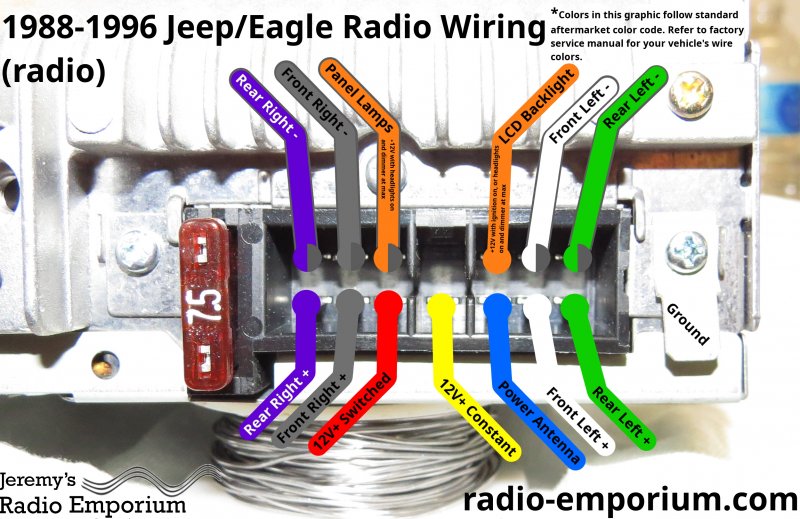
Sure. A 1990 should have the following connector pinout. And on the back of the radio: The 12V+ Constant should have battery voltage at all times. The 12V+ Switched wire should have battery voltage any time the ignition is turned to RUN or ACC. The ground is a separate wire with a 1/4" quick connect terminal, not part of the main plug. It eventually connects to the ground wire at the bottom of the metal dash frame under the headlight switch. Check the DOME fuse and the RADIO (for some years, ETR) fuses. DOME controls the constant power, RADIO/ETR controls the switched power. I'm not aware of any wiring differences for a radio delete truck. There will not be speakers, but all wiring up to where the door harnesses plug in should be present. Installing a radio "should" be as simple as installing speakers, installing (or making) the small wire harnesses that run from just inside the truck under the kick panels into the doors, and plugging the radio in. The antenna may or may not have been installed from the factory - my 91 started life as a radio delete but still had the antenna installed.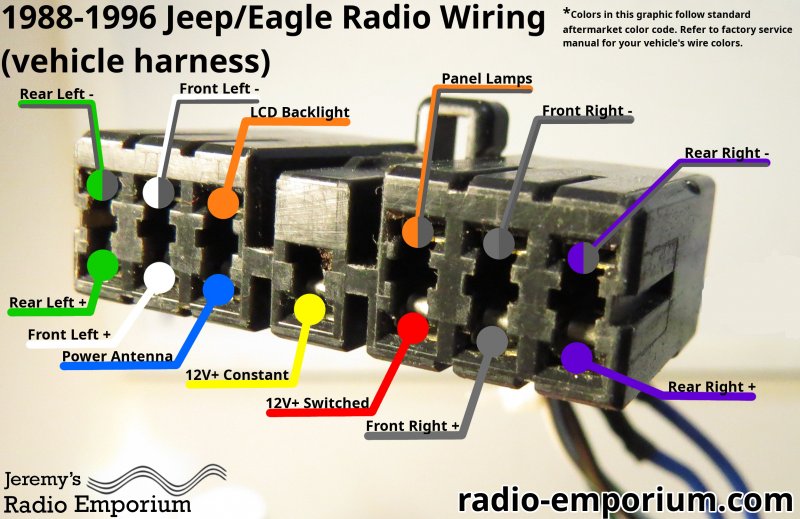
-
Would I be an idiot if I? AW4-BA10/5
Minuit replied to Knucklehead97's topic in MJ Tech: Modification and Repairs
I suspect that the CC members with long lasting BA-10s are better at driving stick than the typical populace that got the BA-10 its reputation. I suspect they also don't do stupid stuff like burnouts, power shifts, or hard launches, and those who have wheeled with a BA-10 drive with a little more nuance than just "dump clutch, see what happens". You would think that anyone who's owned a manual vehicle for any length of time would have gotten pretty smooth at it, but riding with others I'm constantly surprised at how rough people who should know better are. I bet a BA-10 is perfectly fine for any kind of "normal" driving, setting aside age-related wear and tolerance for abuse. I bet the factor of safety on the AX-15 is quite a bit higher, making it more tolerant of the stupid $#!& that a lot of Jeep owners tend to do - especially back when older XJs were cheap, expendable offroad toys and young kids got them, put huge tires on without changing the gearing to match, and bounced them off rocks. If I had a choice I would not install a BA-10 over an AX-15. I would not spend money on a BA-10 if an AX-15 swap was an option. But if I knew I was going to be careful and not deliberately abuse the transmission and had to have a manual transmission in my truck RIGHT NOW, I don't think I'd lose too much sleep over installing one that is known to be good. -
Don't expect any performance improvement from replacing the cat unless the old one is plugged or broken. If it is clogged or broken, whatever common replacement is legal in your area will be fine. If the original flanges are still intact for the mounting, a direct-fit one will be easier to install than a universal one.
-
All of the CG- codes on the back of my 1991 factory build sheet are related to restraint systems or airbags. CGW is not on the list.
-
HO myth buster buster: + Significantly better electrical design out of the box, affecting almost all systems. + Cleaner engine bay layout. + More options easily added, including cruise control. + Easier upgrades, including 95/96 brake booster, ZJ disc brakes on D35s starting in 1990, and 120mph speedometer. Larger pool of drivetrain parts with year-correct spline counts for easy 4WD conversions or replacements in case of mechanical failure. + No more cable-driven speedometer or janky cruise control setup with outboard computer. Cruise control functionality is now built into the ECU. + Standard oil filter thread out of the box. + No more dealer-installed A/C hackjobs. + Larger A/C compressor. + Improved cooling system reliability. + Self-adjusting ECU that learns a tune, supports bi-directional controls, and throws fault codes. 1996 uses the bare minimum required OBD-2 integration with the old body style. + Significantly simplified vacuum system. + Adjustable rear proportioning valve. + One key for all locks. + Grille can no longer be installed upside down. + 2.5L engine uses multi-point injection with similar design to 4.0L engine. + Deliciously corny early 1990s graphics and stripe packages, essentially standard issue. + HO Comanches are far rarer than Renix-era Comanches, and will probably go up in value more. -Not so nice if you're in the market for one. - Boring interior choices. +but all of the interior parts save the gauge clusters and clocks are the same as the Renix years. - No Renix Engine Monitor substitute - Power windows and locks removed from Comanche option list +but can be added back seamlessly using entirely factory components that are correct to the year by making two wire splices. - Less factory chrome, if you're into that. +but that has not historically been much of a roadblock for ***chrome freaks***. - Less like owning an old car, because for the most part it just works. Some people enjoy the tinkering factor, which is essentially the only reason I still own my 89. - Smaller pool of fuel sending unit donors. - 1996 has a lot of one-year parts. +but they made more XJs in 1996 than any other year. These are the real benefits of the HO years. 8 HP and a single ft-lb of torque is academic. All of Renix's faults can be overcome by a savvy and persistent owner, but a HO truck is so much more likely to just damn work. This is factory-vs-factory and does not factor in a Renix to HO swap, which is by its very nature a lot of work and presents plenty of opportunities for hackjobbery. Not necessarily an exhaustive list. I wouldn't strip a truck to the firewall for the sole purpose of de-Renixing it, but the temptation would be very real if I were also doing an engine swap.
-
Must have MJ upgrades for a cross country drive?
Minuit replied to jazzyjeeper's topic in MJ Tech: Modification and Repairs
This is the Fluke 101, one of Fluke's cheaper meters made for the Asian market, so it's probably not the industrial-grade brick $#!&house construction that most Fluke meters have. Still a well made tool, but maybe not as "nice" or as well made as others. High voltage safety is probably excellent. Almost certainly a perfectly fine meter for automotive use. The big downside I'm seeing is that meter cannot measure current whatsoever. For me, the most common use for current measurement on cars with a handheld meter is if you're having a problem where your battery goes dead if the truck sits and you need to find out what circuit is causing the problem. It's not a feature you'll miss extremely often for general work, but when you need a meter that measures current you really need it. I'd say buy a mid-level $30 to $70 multimeter with voltage, current, continuity, resistance, and auto-ranging. Do some research, read some reviews, and look for features that you think you might want. If you decide that you find electrical troubleshooting fun or something you do often, you'll start to develop strong opinions on features you like and don't like. I work on radios with a soldering iron that cost almost $300, because there are days where I spend several hours with it in my hand, and that experience led me to have strong opinions on features that I want in a tool I use that often. That's when you start going for the Flukes of the world. For entry level use, I don't think you need to immediately spend $100 or more on a multimeter just to have confidence in it. -
Must have MJ upgrades for a cross country drive?
Minuit replied to jazzyjeeper's topic in MJ Tech: Modification and Repairs
I'm not so sure that paying the Fluke Tax for a first multimeter is the best advice for someone who's brand new to car electrical work. I'm willing to concede on the $5 cheapo, but I don't think going fully in the other direction is the right choice either. That's about like telling someone who's never so much as changed brake pads before to buy a Snap On socket set or don't bother. Sure the Fluke is the better (maybe even the best) tool, but you can definitely get the job done for less money. If the OP has the finances to pay for a Fluke, by all means get one, but spending $100 or more on a real Fluke isn't an option for everyone. Fluke makes lower priced models, but at that point you're essentially paying for a name. I've had my cheap HF meter since I was a freshman in college and it's still kicking. I'm pretty sure I got it for free with a coupon. Not feature rich or satisfying to use, but it'll tell you whether or not you have 12V and it's small enough to fit anywhere. I would classify auto-ranging as nice to have, but I'd hesitate to call it an absolute requirement. This is basically the "manual vs. automatic transmission" debate of measuring tools. Best if you can turn the auto-ranging off. My go-to mobile multimeter has been the manual-ranging Ideal on the right for years. It's pretty much either on the 20V range or in continuity mode, maybe in current mode once in a blue moon. With a little intuition you can pretty much tell what range you need to be in to make your measurement, but waiting for a slow auto-ranging meter to slooooowly ponder through all of its ranges (seriously, I've used meters where this takes like 10 seconds) to get to the one you actually need is a pain in the @$$. Better auto-ranging meters will do this much more quickly, however. I would say that you should definitely get one that has an auto-off feature in case you forget to turn it off once you're done. I do that all of the damn time. -
Must have MJ upgrades for a cross country drive?
Minuit replied to jazzyjeeper's topic in MJ Tech: Modification and Repairs
Seems like you're on your way to having things figured out. As the resident neeeeeeerd of the group, I'll use my turn to emphasize the electrical side of things. Relying on other people for your maintenance will get painfully expensive in a hurry, and doing it yourself is much more educational and fun... if you can do things in a safe manner. Get a multimeter and learn how to use it. Get an incandescent test light too - they're incredibly useful, and dirt cheap. I like my fancy Fluke and Tektronix toys, but the cheapo multimeter you can get with a battery for like $5 from Harbor Freight or your regional equivalent will be perfectly serviceable for automotive use. Just, whatever you do, don't ever probe anything much higher than 12V with one of those Harbor Freight meters. They have next to no protection for high voltage or current. A lot of electrical diagnosis on a truck this old boils down to "is this part getting 12V on one side and a low resistance connection to ground on the other?" or "is this switch/corroded connector making a good connection or is it causing voltage drops?" or "I am missing power or ground to this part. Where does it go away?" - even the crappiest multimeter can tell you that. A light bulb on a stick can tell you that 75% of the time. Study up on some basic electrical theory so you have a foundation to build on, and then go down Cruiser's Tips refreshing connections and fixing AMC's weird thoughts on electrical design. Does the FSM you have include the book with the wiring diagrams? You'll need those at some point. -
Do we have codes for 91?
-
What Minuit knows about stock Jeep radios
Minuit replied to Minuit's topic in MJ Tech: DIY Projects and Write-Ups
I've bought multiple NOS AMC radios for literally a tenth of that. I sent him an offer for $40. We'll see how that goes. -
What Minuit knows about stock Jeep radios
Minuit replied to Minuit's topic in MJ Tech: DIY Projects and Write-Ups
https://www.ebay.com/itm/164328461436?ul_noapp=true Please nobody spend $950 on an RX-135. Also, it'll only fit 86 and 87 AMCs. -
It's clear that we aren't really talking about the same thing, or speaking from the same body of experience, so here's where I'm coming from. If you look at any of my post history you know how much I push sound deadening and "make it sound better, don't just add more power" in all its forms in these trucks. You don't need me to tell you that it doesn't take much to change what the listener hears. Even a tiny movement of a speaker can make a big difference if the situation is right. I'm sure I don't have to tell you that every room is its own puzzle. The cab of my truck has noticeable peaks in the midbass and midrange bands. There are a few very noticeable hot spots in the midrange, and a couple of them were extremely offensive to my ears. This was a constant no matter what I did to my system. From junky, 20 year old cheap speakers in the dash running off an aftermarket headunit and no amp, to a Morel component set running off an amplified factory headunit, same thing. This is probably a combination of my ears and the truck's acoustics - what sounds fine to some people sounds absolutely dreadful to me, and I'm sure it works the other way too. As I slowly improved the components of the system, sure it started to sound better but there were still a few things that either didn't quite sound the way I wanted them to or caused very unpleasant ear fatigue after more than about 20 minutes of listening. My 1991 original headunit has reasonably linear frequency response that starts to drop off at about 24 kHz, way above what a human can hear in a real life situation. Any changes being made across the audio range is a limitation of the analog circuitry of the radio and not intentional by the designers. Ditto my amplifier. So we can rule out the equipment. My truck had the same peak at ~1.25 kHz through four sets of speakers, three headunits (two aftermarket and one factory), and an amplifier. The environment is everything. The only way to account for the truck's acoustics is by using tricks - or by finding a speaker with a frequency response curve that's a perfect complement to the truck's interior and position of the listener's head, which ain't gonna happen. Tuning car audio systems on a professional level can pretty much be considered it's own trade, and you'll find people making a lot of money because they know how to design and build a car audio system that sounds like a concert hall and wouldn't raise an eyebrow to anything but the most knowledgeable observer. They offer their services to people who aren't satisfied with a headunit and speakers, and they generally charge a $#!&load of money for an essentially fully custom build. Fiberglass tweeter enclosures made to look factory, hidden subwoofers, all components completely hidden from view behind custom panels that are a near perfect match for the factory materials, the works. EQ (on basically every driver in the system), time alignment, and other forms of tuning are extremely important to getting a car audio system sounding right no matter how good the speakers you use are. In other A/V disciplines the "rules" might be different, but a car is pretty much the worst possible listening environment you could possibly dream of and designing a decent system is all about overcoming those drawbacks in whatever way possible given the customer's requirements and preferences (believe me, I make my life more difficult by being utterly insistent on a factory look throughout the truck, even if someone starts poking their head behind the seats or under the dash). The sound system is probably literally the last thing anyone at AMC thought about when designing these trucks, and you're never going to get around that. A perfectly flat EQ may or may not sound worth a damn in a non-moving building that isn't full of protrusions, panels made of multiple materials, and glass all around the listener's head, but in a car there will be tuning of some sort required pretty much no matter what. Some of these hurdles are properties of the equipment (crossover points and slope, sub enclosure design, etc), and some of them have to do with the fact that a tiny, moving, vibrating room with speakers firing every which way is a horrible place to listen to music with anything approaching a critical ear. I know this thread started off about what size speakers to put in, but car audio is such an iceberg of a topic that it's hard for me to just give a small answer. One of these days I'm gonna get off my @$$ and make a big, public project of making my truck sound awesome and it'll be tons of fun. I'll show people setting amplifier gains with an oscilloscope, go over DSP controls and what they do, show what I ended up with and what I'd do differently if I started over, and post some demonstrations of what you can make an ancient tin can do. Just gotta get some dominoes into place first.
-
People like what they like, and I've never heard your system. That being said, behind adding an amplifier and installing component speakers, the single biggest improvement in sound quality I ever saw was by getting rid of the rear speakers entirely. A properly EQ'ed and powered set of front speakers provides all the soundstage I'll need. Details aside, my opinion these days is that this is all basically academic anyway, because even a very good car system can frequently be beat by even the simplest home hi-fi system with properly positioned speakers. It's all in the speakers and their locations. My testing "setup" for the radios I work on (which doubles as my garage sound system) is to plug whatever radio I'm working on at the time into a pair of 8-ohm bookshelf speakers that I bought for cheap on eBay and replaced the tweeters in. Bass aside, it sounds better than a LOT of car audio systems I've heard, and we're talking about 35+ year old car radios that are good for 13 watts per channel into 8 ohms at the very best and speakers with 5" woofers that weren't exactly top of the line when they were made 20 years ago. I do agree that a pair of small, shallow mount subs in the factory rear locations is an interesting idea. Designing a half-decent enclosure that fits back there and keeping the B-pillar trim panels from rattling would be the biggest challenges I think. It's something I really want to look into in a few months.
-
My suggestion is to not even bother with rear speakers. The MJ cab has enough frequency response and speaker location problems as it is. All you'll do is kill any imaging you may have had by adding a pair of full range speakers behind the seats.
-
do any renix era MJs have a low washer fluid sensor?
Minuit replied to Pete M's topic in MJ Tech: Modification and Repairs
One more point to the HO team!