


Eagle
-
Posts
15698 -
Joined
-
Last visited
-
Days Won
27
Content Type
Profiles
Forums
Gallery
Everything posted by Eagle
-
Fuse Block instead of Fusible Links
Eagle replied to Torq_Shep's topic in MJ Tech: Modification and Repairs
There's nothing wrong with using fuses. A fusible link is a fuse. That's not the problem with your idea. Where you went off the rails was when you described your plan. You said you would research what size fusible link each circuit needs and replace the fusible links with the same size fuses. So far , so goo. BUT ... then you said if the fuse blows, you would increase the fuse size until it doesn't blow. THAT's the problem. In any circuit, the wire size is selected based on the current to be carried. The fuse size is then selected to protect the wire. If you have a circuit that carries 17 amps, it's probably wired with the appropriate gauge of wire for 20 amps and protect by a 20-amp fuse (or fusible link). If you keep blowing 20-amp fuses and then replace the fuse with a 30-amp fuse -- now the circuit isn't proteted, and the entire length of the wire becomes a de facto fusible link. It's like in the old days when houses still had screw-in fuses. A fuse would blow, they didn't have a replacement fuse, so they put a penny in the socket. The lights went on ... and then they wondered why the house burned down. -
Wheel center to Flare on rear for stock.
Eagle replied to Sir Sam's topic in MJ Tech: Modification and Repairs
19" sounds very low for the back, and 18.25" is an inch too high for the front. -
Wheel center to Flare on rear for stock.
Eagle replied to Sir Sam's topic in MJ Tech: Modification and Repairs
Fuzzy recollection says around 21" to 21-1/2" ... but that's VERY fuzzy memory. What does yours measure? -
Along with this question, what are you using for an ignition system? Do you still have the factory coil from the 2.8L, and are you using that?
-
87/88 Comanche CPS question
Eagle replied to 88ComancheGA's topic in MJ Tech: Modification and Repairs
There should be a matching connector on the driver's side in the engine compartment, back near the firewall, in between the brake booster and the intake manifold. -
Weber Carburetor 38 Dges/Dgas
Eagle replied to AMC86Kid's topic in MJ Tech: Modification and Repairs
Coolant temperature doesn't make much difference to the spark plugs. What's important is running plugs that ere the correct heat range for the engine. -
Are you asking about the hard lines (tubing), or the flex hoses at the front calipers and rear axle?
-
It's in the box. If you ever looked at the custom steering box part of AGR's web site, they offer (or used to) an option to select which spool valve you want, to give you more assist and less road feel, or less assist and more road feel. I think they had three or four different valvings to choose from.
-
AMC was notorious for engineering in too much boost in their power steering systems. The late-model (97+) XJs have less boost and much better road feel.
-
Weber Carburetor 38 Dges/Dgas
Eagle replied to AMC86Kid's topic in MJ Tech: Modification and Repairs
Do you know how to read spark plugs? https://www.wikihow.com/Read-a-Spark-Plug https://www.onallcylinders.com/2012/12/20/reading-101-how-to-read-your-spark-plugs/ https://www.dragstuff.com/techarticles/reading-spark-plugs.html https://www.hotrod.com/articles/mopp-0612-reading-spark-plugs/ -
The factory parts manual only shows 60, 85, and 100 amps. I think anything larger than that is an interference fit (i.e. won't physically fit the space). I don't remember the specifics but when I had the alternator for my '87 rebuilt, the guy initially said he could modify it for higher output, then he said the higher output parts needed a larger housing and he couldn't do the upgrade.
-
Years ago I used to hear good things about a company called (IIRC) West Texas Offroad for steering gear. Haven't heard anything of or about them for quite awhile, though. Their web site is active, but it seems to suggest that they specialize in hydraulic assisted steering -- which is massive overkill for 97% of our MJs. But you could call and ask about a plain vanilla steering box. https://www.westtexasoffroad.com/ When I needed a box for the 2001 XJ, I went to a salvage yard and bought a low-mileage ZJ box. That was cheaper than a rebuilt, and probably better.
-
My computer can't open your image, so I'll assume that FiatSlug is correct.
-
Those add-on gauges look pretty nice. If it were mine, I'd do the cluster swap AND keep the aftermarket gauges. Yes, it's redundant, but they're already there, so use the redundancy as a reliability check. As long as they both read about the same, you're good to go. If one of them suddenly starts to act funky, then you investigate why.
-
How clean and smooth is the nose of the driveshaft yoke that fits into that seal? If there's any rust or pitting, the seal won't be able to make a good seal. Also, if you replace the seal, wipe some oil or ATF around the lip of the seal and on the yoke so you're not sliding a dry part into a dry seal.
-
Some of the guys I used to wheel with had bad experiences with AGR, too. There's another source, that's supposed to be pretty good, if I can remember the name. [Don't hold your breath -- I'm a senior citizen, after all.] Got it: https://www.borgeson.com/xcart/home.php They also make steering input shafts, if you need one of those.
-
The difference is that the 4WD transmission has the output end set up to have a transfer case attached to it. The 2WD transmission has a long tailshaft with a splined end that accepts the front yoke of the driveshaft directly. It's easier to swap the transmissions than it would be to try to take the 2WD transmission apart in the vehicle and reassemble it as a 4WD tranny.
-
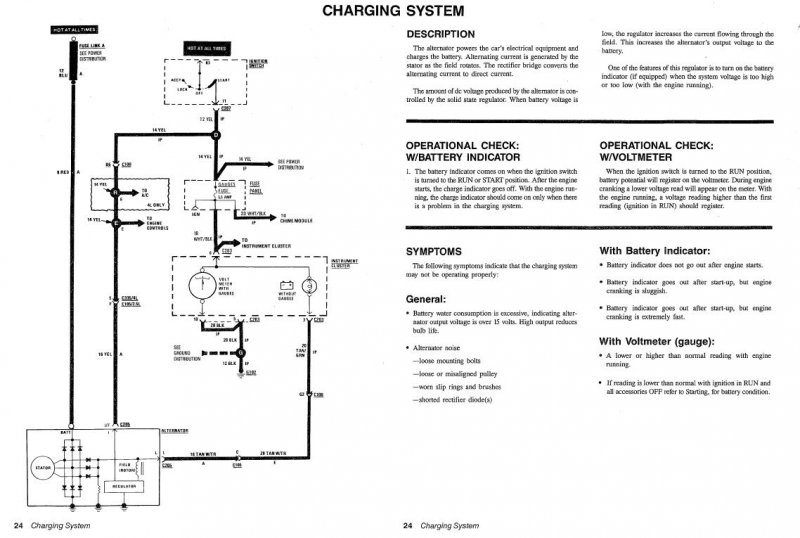
Correct. It's an internally regulated Delco alternator. Whatever you do, DON'T solder any wires to it. If you can't find the connector, use individual spade terminals or something.
-
2.8 Timing & Distributor Questions
Eagle replied to AMC86Kid's topic in MJ Tech: Modification and Repairs
Basically, drive it. With the radio OFF. If you feel a hesitation / flat spot when you accelerate from, let's say, 45 to 55 in high gear, it's possibly retarded (not enough advance). If you hear pinging under load at low speed, it's too far advanced. -
Or if you don't have the box centered when you adjust the over-center lash.
-
The Jeep steering box is a GM Saginaw unit. There are also two adjustments to take slop out of those boxes, but be sure to read up on the process and to it carefully, because if you do it wrong it can trash the box.
-
I had to replace the front fenders on my red '88 because the previous owner had cut off the flange where the flares mount, and I got ticketed for tires extending beyond the sheet metal. I used Keystone fenders, which I'm sure are the Chinese ones. They weren't a perfect fit, but not bad. I didn't have to modify them in any way, but the gap where the top rear of the fenders meets the A pillar isn't as tight as factory.
-
As someone who ticks ALL the boxes for being at high risk for COVID-19, those who don't/won't practice social distancing could kill me without even thinking about it. IMHO we can't be hard enough on the idiots. A few days ago I read an article about the pastor of a church that insisted on holding live services despite the guidance to avoid groups. Sure enough, he caught the virus, and he died. Now his [adult] daughter is telling people not to be stupid. But ... how many of his parishioners were infected because that idiot thought the rules didn't apply to him and his parishioners?
-
The Comanche doesn't use rack and pinion steering, it uses recirculating ball steering. So you won't find a new or remanufactured rack and pinion for a Comanche. Are you looking for a kit to replace the factory steering with rack and pinion, or do you have a steering problem you're trying to fix? If the issue is just the "loosey goosey" aspect -- have you confirmed that the looseness is in the steering box rather than the tie rod ends, drag link, ball joints, and/or pitman arm?
-
2.8 Timing & Distributor Questions
Eagle replied to AMC86Kid's topic in MJ Tech: Modification and Repairs
I have no idea. Finding TDC was not a wasted effort, though. You still need to find TDC and mark it on the damper (it's already marked, of course) and on the block. Your photo shows TDC lining up pretty nicely with a bolt, but I'd go a bit farther and put some bright yellow paint on that bolt, and in the groove on the damper. Or just set the dial to zero and use the degree tape you already glued to the damper.