


Eagle
-
Posts
15698 -
Joined
-
Last visited
-
Days Won
27
Content Type
Profiles
Forums
Gallery
Everything posted by Eagle
-
It's often places of employment. The company I work for has a contract with my state's Department of Transportation. My current work assignment is on a construction project that's located inside a railroad maintenance yard, on property owned by the state. The state has a law prohibiting firearms, and so does the federal government. The site is under the double jurisdiction of the transit district police and Amtrak police. (Also the State Police, but they don't have a presence in the yard. They would come in only if called in.) There are only two entrances into the yard, both gated and manned. There are signs at both entrances that all vehicles are subject to search. Likewise, as a veteran I get a lot of my medical care at a nearby VA hospital. There are signs at the entrances to the property that no firearms are allowed on the property, and that vehicles are subject to search. Firearms are not allowed on U.S. Postal Service property. For most government agencies the prohibition is only in the buildings, but the Postal Service operates under a different section of federal law, and their prohibition includes parking lots. So ... park in a post office parking lot, and your vehicle is subject to search. A few states have passed laws that don't allow employers to prohibit employees from having a firearm in a vehicle on the premises. In states that don't have such protection, emplyers can prohibit workers from having a gun at work and they can even extend that to storing a gun in the car while parked on company property. They include permission to search your car in the personnel manual, and you're required to sign that you accept this when you are hired. It's not a law, it's a contractual agreement between the worker and the employer.
-
It appears to me that both the U.S. (and its allies) and Russia are using the Syrian conflict as a way to testing new weapons developments against the other side's new weapons by uring their surrogates in Syria. This allows both sides to evaluate how they'd do in a war, without having to go to war directly in order to find out.
-
That's what I call hard core!
-
New questions: Whether the rifle is an M16 or an M4, what type of sling is on it? Simple, 2-point sling, GI Loop Sling, or 3-point (or 1-point, depending on how you regard it) tactical sling? When I enlisted in 1966, each Christian soldier was given a pocket-sized copy of the New Testament. Do they still do that?
-
Some states allow vehicle carry even if you don't have a carry permit. Every state is different. We shouldn't generalize. That's what police reports are for. Biometric safe. (Thumb print) Not if it's locked in a safe and the person doesn't have the key or combination. If you have a small arsenal in a gun safe in your house, does a friend have possession of your arsenal when he stops in for a beer on Saturday afternoon?
-
Agreed. Assuming the axle is straight, the camber should be zero, so no problem there. Caster will probably be close. Toe-in would easily be affected by manufacturing tolerances on the steering knuckles, but toe-in is the easiest part of the alignment to check and adjust using a tape measure.
-
Kewl. Symbiosis is good.
-
Reusing a Comanche "frame"
Eagle replied to omega_rugal's topic in MJ Tech: Modification and Repairs
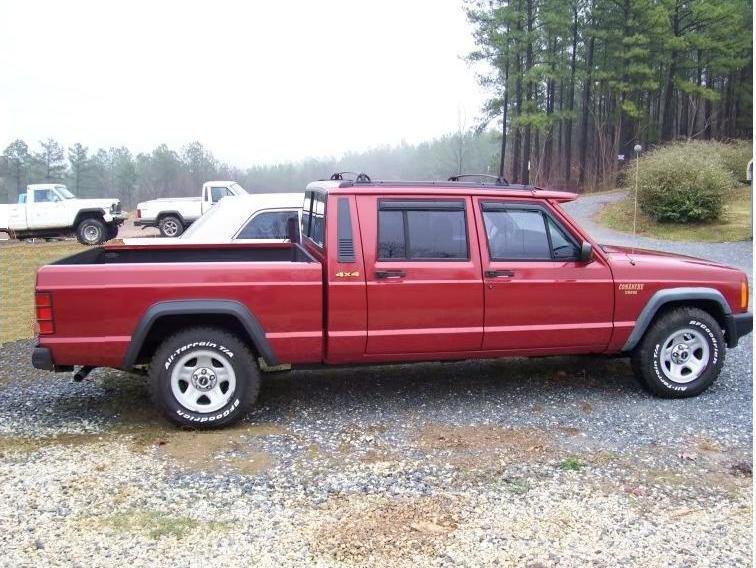
He's in Mexico. I doubt they have a problem with rust there. I wonder if Cherokees and Comanches are as popular there as they used to be in Chile (my late wife's native country). The hybrid splice has been done before. I thought we had photos of one somewhere on this site. If we didn't -- we do now. This is a bit too long for my taste. I think it would be better with a shortbed box. Sort of like this (edited photo):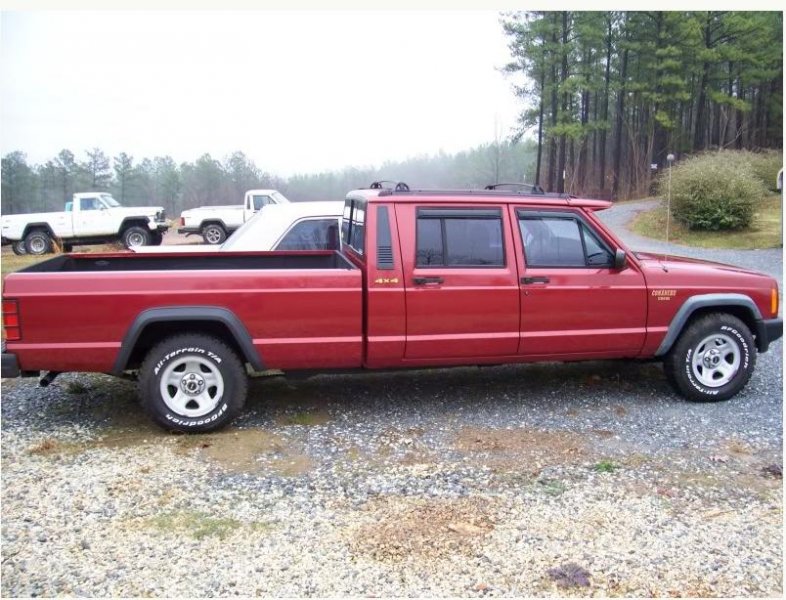
-
The daughter of a friend is enlisting in the Army. More accurately, she has enlisted, and will report for Basic Combat Training in July. Trying to get her a bit of a leg up on what to expect, but my BCT was 52 years ago, and I'm certain it's not the same now as it was then. What weapon do they train with in BCT these days, M16 or M4? A2 open (peep) sights, or optics? If they use optics in BCT, what do they use, ACOG?
-
HO Catalytic Converter End of Life?
Eagle replied to kryptronic's topic in MJ Tech: Modification and Repairs
I'll have to try to remember to look under the two 2000 XJs. After looking at the 2000 XJ parts manual, the change I was thinking I remembered may have been a change to a flange on the inlet end of the muffler, instead of a traditional male/female pipe mating. -
HO Catalytic Converter End of Life?
Eagle replied to kryptronic's topic in MJ Tech: Modification and Repairs
Don't forget the gasket for that flange. I always use new, stainless steel bolts. Doesn't seem to help much, they still get pretty well trashed within a couple or three New England winters, but it lets me feel like I'm at least trying. IIRC, the two that go through the bracket need to be 1-1/2" long and the other two can be 1-1/4". (Unless it's 2" and 1-1/2") -
HO Catalytic Converter End of Life?
Eagle replied to kryptronic's topic in MJ Tech: Modification and Repairs
I own two 2000 XJs, one early (built in October 1999), the other late (built April or May of 2000). The early one has the flange, the late one does not. -
HO Catalytic Converter End of Life?
Eagle replied to kryptronic's topic in MJ Tech: Modification and Repairs
If the cat you took off is original, it has a 2-1/2" input, not 2-1/4". The factory system runs a 2-1/2" catalytic converter, and the pipe necks down to 2-1/4" between the converter and the muffler. That will make it difficult to weld the flange from your old cat onto the new one. Every replacement cat I've installed came from Summit Racing and came with the proper square flange as an integral part of the converter. -
I think any height problems with conversion buckets is if you use the early XJ buckets with the tilt-a-whirl feature. That mechanism adds height to the seat.
-
98+ hood different from older hoods?
Eagle replied to crumbscomanche's topic in MJ Tech: Modification and Repairs
Yes, but the difference has to do with the two latches at the outer corners. The 84-86 hoods didn't have those. I believe that's mostly a matter of drilling a couple of holes for attachment. Not certain, but I believe the basic hood is the same and could be adapted to work. -
As noted, check the sockets. The XJ/MJ sockets are known to go bad, resulting in the turn signals trying to seek a ground through the parking light side of the circuit. Since you have things happening when you step on the brake peddle, start at the rear. Also check the point where the taillights ground to the body.
-
https://www.autozone.com/powertrain/clutch-hydraulic-hose?filterByKeyWord=clutch+hose&fromString=search&isIgnoreVehicle=false Don't even think about used parts for this. You'd be asking to get stranded with a blown hose.
-
Need a favor -- Junkyard division
Eagle replied to Eagle's topic in MJ Tech: Modification and Repairs
Thanks, all. Don, I don't know why I never remember to check Team Cherokee. Thanks for the link -- if someone doesn't come up with some, I'll order them from Team Cherokee. In fact, I didn't know about the metal retainer, so today isn't a total loss -- I learned something. -
We have no u-pull junkyards in Connecticut -- they were outlawed at least 20 years ago. That makes it tough when it come to miscellaneous small parts, because the yards just don't bother with them. I'm looking for four of the little white nylon thingies that go into the driver's and passenger's doors to retain the upper end of the "hockey stick" armrests. If some kind soul could grab me a few of those on an upcoming trip to a u-pull junkyard, I'd appreciate it. Naturally, I'll reimburse for cost + postage.
-
Twice, in a Dana 35 in my XJ. The first time, the Trac-Lok stopped working and we literally rebuilt it. A good friend was a retired service manager from the dealership where I had bought the XJ. We tore it down in his garage and stuck in a couple of replacement shims and clutch pads, reassembled, and I got another 50,000 miles or so out of it. When it stopped "locking" (I know -- I'm using the term loosely) the second time, I put in a complete rebuild kit. -- new clutches and new shims/spacers.
-
91 HO or Renix 4.6? Getting mixed advice.
Eagle replied to Bonkers's topic in MJ Tech: Modification and Repairs
As others have commented in this thread, parts availability for the Renix system is drying up. Take what my colleague, Hornbrod, says with a small grain of salt -- he's a staunch advocate of the Chrysler HO platform. I don't have any "HO" vehicles, I have three Renix MJs, a Renix XJ, and two 2000 XJs. The 2000s have OBD-2, which is even beyond the HO diagnostics -- but the few times I've had to actually use the OBD-2 diagnostics, the text that was supposed to "explain" the code I was getting was less than helpful. The engine work, as I posted earlier, is going to be the same. The advantage to doing an HO stroker is simply the newer system. Is it worth it if you already have a functional Renix vehicle? Only you can decide. Speaking for myself only -- if I were replacing an engine on one of my Renix vehicles, whether I was going stock or stroker I would not even consider swapping out the entire wiring harness to get the Chrysler system. To me it's just not worth the labor and hassle. Among other things, with close to a half million miles among the several Renix Jeeps I own and have owned, I find them to be just as reliable as the newer ones, easy to work on, and they give better gas mileage. But -- if I came into possession of a nice HO Comanche would I change it to Renix? Heck, no! Each has its advantages and its disadvantages. I'm just too old to feel like swapping out a complete wiring harness when the one in the vehicle gets the job done just as well. -
I like it, too. But what do you do about a license plate and light? The cops are strict about license plate lights around here.
-
It does NOT sound like the clutch packs are worn out. I've been there and done that. When the clutch packs wear out, it reverts to acting like an open diff. As such, if he jacks it up and blocks one wheel, the other wheel should turn freely. It sounds like his Trac-Lok is functioning but doesn't have friction modifier in the gear lube. In that situation, the clutches don't release.
-
You've been looking at my cutaway photo? That one had to be defective. Since the second line is screwed into a blanked-off port in the front distribution block, it would not have functioned as a bypass ... but since it was not drilled through, if it were a return line it also couldn't function as a return line. I haven't cut apart any others to see if they are likewise defective, but it's clear from the design that the intent is for the second line to serve as a bypass circuit to provide full pressure to the rear brakes if the fronts fail. The description in the FSM confirms that it's a bypass.
-
91 HO or Renix 4.6? Getting mixed advice.
Eagle replied to Bonkers's topic in MJ Tech: Modification and Repairs
Is this what you intended to write, or did you mean you're NOT planning on spending a lot on the build? Building a stroker engine is going to be basically the same whether you do a Renix or an HO. You'll need the same stroker crankshaft, the same rods, and the same pistons. What you do to the head will be the same, whether it's a Renix head or an HO head. The basic question is, do you want to build the engine and drop it in, or do you want to undertake rewiring the engine compartment while the engine is out? You have an additional option that hasn't been discussed - rebuild a stock engine and put a different cam in it.