Eagle
-
Posts
15698 -
Joined
-
Last visited
-
Days Won
27
Content Type
Profiles
Forums
Gallery
Everything posted by Eagle
-
Ranger SLA Front d35 interchangeability.
Eagle replied to gogmorgo's topic in MJ Tech: Modification and Repairs
I can't answer your question about compatibility with the Ford Dana 35 diff, but I can say that I have a TrueTrac in the rear D35 of my 4-liter '88 MJ and I have been VERY happy with it. -
Bypassing the fuel pump ballast resistor. WHY?
Eagle replied to Ωhm's topic in MJ Tech: Modification and Repairs
The ballast resistor was introduced in the 1988 year for the purpose of reducing pump noise. The 1987s didn't have it. -
No, we are Jeep Truck lovers. The Gladiator was a truck. The Willys 463 was a truck. The J10 and J20 were trucks. The Comanche was a truck. This new thing is a Wrangler. It's more like a 4-door reintroduction of the CJ8 Scrambler, rather than being a purpose-built truck. They should have just called it "Scrambler."
-
Ummm ... just "No." Not even, "No, thank you."
-
3" Lift kit w/o Add a leaf
Eagle replied to Chief Falling Rock's topic in MJ Tech: Modification and Repairs
That's not a choice. We have a saying among my Jeeping compatriots: "Friends don't let friends buy from Rusty's." I was involved in the very beginnings of NAXJA when it evolved out of an older Cherokee forum that went defunct when the one guy who had started the forum solicited monetary contributions to "help pay expenses," then took the money and let the forum die. A bunch of us who really missed it anted up a bunch of bucks, and NAXJA was born. Rusty's was around then, starting up either shortly before or shortly after the birth of NAXJA, almost twenty years ago. Some of his stuff was junk, other of his stuff was outright dangerous. If your choice is a 3-inch lift from a quality manufacturer or a 4-inch lift from Rusty's -- take the 3-inch lift and give thanks to the deity of your choice that you didn't throw money at Rusty's. -
Not "they were just imported." "It" (as in the only one) was imported.
-
I do. I need a boring (reliable), utilitarian vehicle with enough room to occasionally carry a couple of passengers, have a moderately useful load bed, and not cost as much as a starter house.
-
No actual trucks. The article says they built one prototype.
-
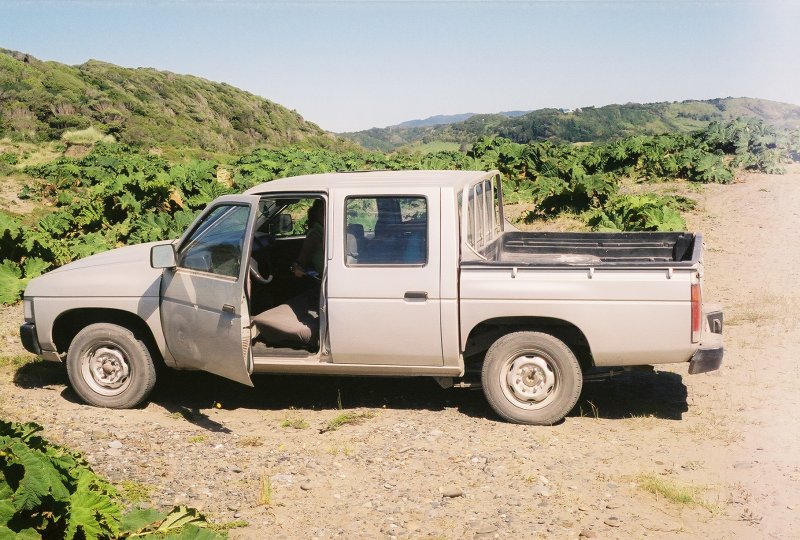
Crew cab pickups with short (about 5-foot, I think) pickups are very popular all over South America. But they're not all tricked out as $50,000 to $75,000 rolling living rooms, they're regarded as work trucks. My wife and I rented one for out honeymoon:
-
Have you watched the movie?
-
It's a locator/support that fits into a hollow in the baffle at the bottom of the tank. Aftermarket replacements don't have it, so I guess they assume it's not needed. However, since without it the entire weight of the pump and sender assembly is supported by the two metal tubes coming through the mounting flange, I would expect to see that seal fail in short order. The factory doesn't list that as a separate part. It's included in what the factory called the "Fuel Pump Package," part number 4637 192 for the 4.0L, or 8350 2752 for the 2.5L TBI. (Oops -- those numbers are Renix era. Just realized you have a '91.) Looks like the same numbers for '91 - '93. That's apparently for a fuel pump repair kit, not the complete pump.
-
.48 what? Is that an ohm reading or a voltage reading? How long does it run? Could the water have cracked the fuel pump resistor? Try jumpering that.
-
I like this much better. Optimum for me would be an extended cab (2-door) version, with just a bit of enclosed cargo space behind the front seats. If AMC/Jeep had offered an extended cab version of the Comanche in 1988, I would have bought that in a heartbeat rather than my first Cherokee. Their version of the new "Gladiator" looks like exactly what it is -- a hastily thrown-together pistache (or parody) of the Wrangler. I am completely underwhelmed by it.
-
I'll never forget when I first heard Alice's Restaurant. 1967. I was in the Army, stationed at Edgewood Arsenal, Maryland. My parents were still alive and living on the family patch in Connecticut. I had gone home for a visit on a weekend pass. The route back to the post was I-95 out of Connecticut, across the George Washington Bridge in New York, down the full length of the New Jersey Turnpike, reconnect with I-95 at the Delaware Memorial Bridge, and follow I-95 to an exit a few miles from Edgewood. The car I had back then only had an AM radio. I was driving back to the post late on a Sunday night. I turned on the radio and started cruising the dial to find a good station. What I picked up was Alice's Restaurant. I caught it right near the start, and it lasted a good portion of the ride down the NJTpke. Curiously, it turned out that the station I had found was WBZ out of Boston. WBZ used to crank up the power at night, and with the atmospheric skip that was possible with AM signals you could hear them in places where it shouldn't have been possible. My grandparents were on the coast of Maine, at the head of Penobscot Bay, and WBZ was one of the only radio stations we could receive there. Keep in mind, this was 1967, when the anti-war activists were spreading the stories that American soldiers in Vietnam were slaughtering entire villages across the length and breadth of Vietnam ... and Arlo was an anti-war activist. So, the song was amusing, but the message wasn't. Not as bad as Hanoi Jane, though ...
-
Brake Fluid Pressure Sensor
Eagle replied to josehuerta's topic in MJ Tech: Modification and Repairs
Short answer: No. Long answer: The switch connects the two wires to complete the circuit. If you tie the two wires together, the circuit will be closed and the light will be on permanently. The switch won't be doing anything. -
Turkey was always the traditional Thanksgiving dinner in my family. Since my wife came here from South America when we married, it was no problem indoctrinating her into the tradition. Cranberry sauce was a staple (the clear kind, not the type with whole berries in it), green beans for the vegetable, and Mom usually made both mashed potatoes and sweet potatoes. (I liked the mashed.) When I was growing up, we didn't know that you'd die if you cooked the stuffing inside the bird, so Mom's home-made stuffing got cooked in the bird, and nobody died. Most of the family liked pumpkin pie. My grandfather and I liked mincemeat pie. Mom used to make two, one for Grandpa and the other for everybody else. I tried to hog as much of the "everybody else" pie as I could.
-
Brake Fluid Pressure Sensor
Eagle replied to josehuerta's topic in MJ Tech: Modification and Repairs
Won't work -- that one's for a single wire connection. -
Brake Fluid Pressure Sensor
Eagle replied to josehuerta's topic in MJ Tech: Modification and Repairs
It's not a pressure sensor. It's a mechanical switch with a plunger that's actuated by the shuttle valve in the distribution block (or "manifold," as you called it). The factory parts manual doesn't list the switch as a separate part -- it comes as part of the "proportioning valve" assembly (so-called, although in the MJ it doesn't do any proportioning). Your best bet is a junkyard, or one of our members who has a few spares. -
My brother and I used to crew on a stock car that was powered by a Hudson Hornet engine. The body (such as it was) was taken from an early 30s Essex Terraplane (which was Hudson's stable-mate brand back then).
-
What, only 25 years? You get to wash schardein's feet. Seriously, thanks for your [many years] of service, and welcome to civilian life. I hope your adjustment is smooth.
-
I snatch all the OEM relays I can get from XJs in scrap yards. I have a box of them on a shelf in the basement. As for the 120-amp rating -- it's on Amazon, so it's almost certainly Chinese. So their 120-amp is probably really more like 12-amp.
-
Amazon sent me a link to an automotive lighting relay of a type I've never seen before. Just wondering if anyone knows anything about this type of relay. https://www.amazon.com/gp/product/B01N1IEWCU?ref=em_1p_2_ti&ref_=pe_3743270_373016350 I think I like the fact that the power terminals are studs and nuts rather than slip-ons ... but I'm accustomed to working with relays that allow them to be wired for normally open or normally closed. This only works as normally open (which is generally what's needed for auxiliary lights). What do you say, gentlemen?
-
I would still try fiddling with the shift rods in the BA 10/5 before swapping it out. The shift tower is already out -- there's nothing to lose other than a few minutes to try moving them around.
-
Bump stops... Now it has DW
Eagle replied to Wounded_Fighter's topic in MJ Tech: Modification and Repairs
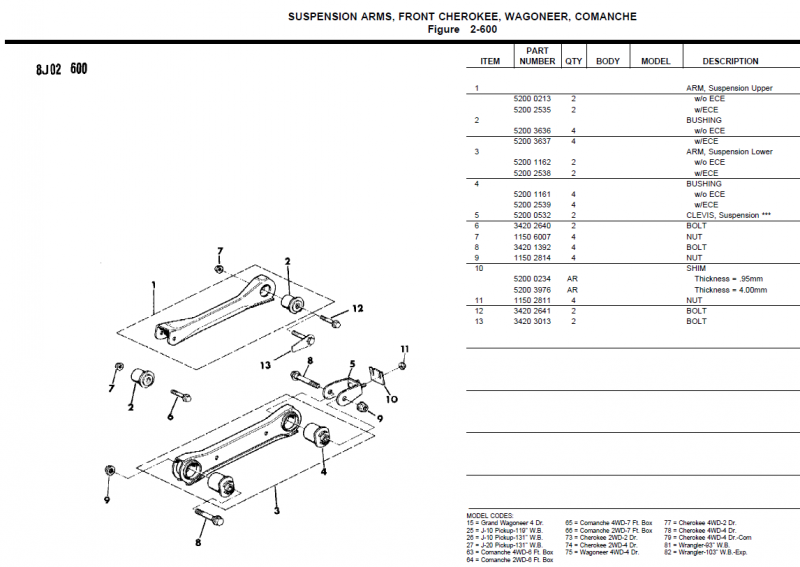
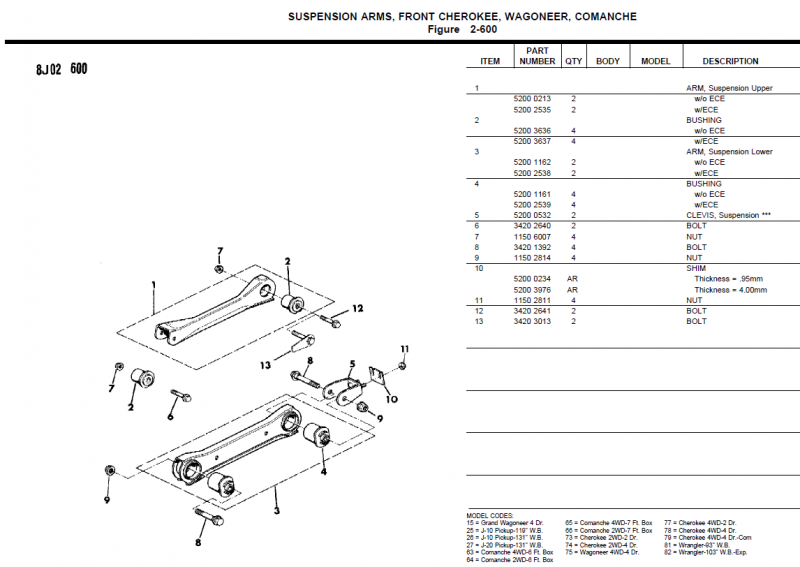
To elaborate on Hornbrod's answer: The openings in the frame pockets for the LCAs are slotted. The actual locating of the LCAs is accomplished by an insert called a "clevis," which has round holes and which has two studs coming off the back to anchor it in the frame pocket. When you adjust caster, you're not actually adjusting the LCA, you're shimming the clevis, which moves the LCA mounting hole forward or aft. [Part #5 in the diagram below.]