
derf
-
Posts
1996 -
Joined
-
Last visited
Content Type
Profiles
Forums
Gallery
Everything posted by derf
-
I trust the brand the shop buys and warranties. Installing gears requires precision work with specialty tools. You can probably do it. But there's a lot to be said for having a shop give you the guarantee.
-
Even with 33s, you'd want to regear. For an automatic, 4.56s or 4.88s at least. For a manual, 4.10s or 4.56s are good.
-
I don't know too many shops in the area since I do my own work for the most part. I can ask around and see what I can find. One question to ask though. Would you be open to doing a Camaro 3.4 V6 swap? It's an easier swap to replace the 2.8 but still a really good upgrade.
-

NOS tail light on eBay
derf replied to SatiricalHen's topic in Craigslist/Marketplace/eBay... i.e. Not Your Stuff
$600 more than I paid for a pair of them.... -
Yeah, the Peugeot BA 10/5 uses a different crossmember that interferes with a lot of long arm kits. Reason number 40279 to upgrade to an AX15.
-
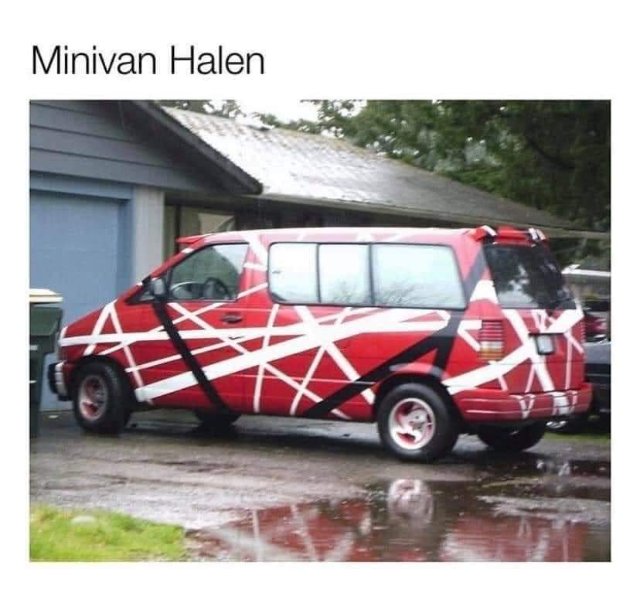
It actually made me think again about getting an old E350 van with a diesel to be my tow rig/camper. I could paint it like that and call it Van Haulin. The plate would be VNHAULN
-
Just when you thought all the leaks were gone pt.2
derf replied to Muncher's topic in MJ Tech: Modification and Repairs
I learned long ago. The leaks are never gone. -
This would be perfect for running with the devil on the mean streets. If it was for sale I'd jump on it because everybody wants some. We could drive it down to Panama.
-
A low pinion Waggy 44 is still stronger than a high pinion 30. The stronger, of course, is a high pinion 44. But the low pinion is no slouch. A Waggy 44 is an upgrade no matter how you look at it. The whole housing from hub to hub is bigger and beefier. The ring and pinion are bigger and stronger. Sure, the low pinion is driving the coast side of the gears but people put too much emphasis on that. It's a front axle. It's pulling a lot less of the vehicle weight than the rear. By a long shot. That being said, tire size and limitations are different from person to person. I had a JK with 35's and I went all over the place. The biggest reason for me to let it go was that the wheelbase wasn't enough for the hill climbs here in Colorado and Moab. And I had a little bit of limitation on the top end trails. So I'm building my MJ with 40"+ tires. It has the wheelbase and will have the tires so I can go big and not have to go home. But I also wheel with a bunch of people who stay on 35's and have tons of fun on 80-90% of the trails out here. Are 35's enough? That's a question only you can answer.
-
The timing for me to buy this is way off. It looks like a good all around truck and he's throwing in a bunch of extra parts. https://denver.craigslist.org/cto/d/denver-1989-jeep-cherokee-comanche/7210469736.html
-
I'm interested too. I may be looking at a rebuild in my XJ soon and that would be a good time for a cam or other things like that.
-
Up until about 1972, engines were rated with the SAE gross method. That was the engine by itself. No belt drive, open headers, no air cleaner. And it was at the flywheel. Ot didn't give you a true sense of what it would do in the car. So they switched in around 1972. The SAE net rating is still at the flywheel but it is the engine as it is installed in the car. All the accessories like the alternator, power steering pump, water pump, AC compressor are attached. The factory exhaust is installed, the factory air cleaner is used. The exact details have been tweaked over the years but the measured ratings are more accurate. Numbers dropped a good 20-40% when they made the switch. And then the emissions stuff hit by 1974 and they dropped a bunch more. Then there is the chassis dyno. It measures the power at the wheels. That takes the net rating one step further. It accounts for the parasitic loss from the transmission, transfer case, axle, and tires. This is usually in the neighborhood of 15-20% lower than the flywheel measurement. But it's going to be the best predictor of how fast you're going to accelerate.
-
Horsepower is a number that a lot of people obsess over but it's really a meaningless number in the grand scheme of things. It's really easy to make 230 horsepower in a naturally aspirated 4.0 without a lot of work. All you need to do is to swap in an aggressive cam that opens up the top end. Maybe a little port work on the head. Since horsepower is a function of RPM, all you need to do to up the horsepower is to move the torque curve higher in the RPM range. Trouble with that is that you lose all your bottom end torque and the motor is not good for street driving or slow trail riding/rock crawling. For a Jeep, I focus on a flat, usable torque curve from as close to off-idle as I can get to up to 4500-5000 RPM. If I can bump up torque around there and have good idle and throttle response, I'm much happier with the engine. The peak horsepower number just doesn't matter in that context. My 2012 Wrangler had the 3.6 Pentastar V6. It was a terrible Jeep engine with the manual transmission. It didn't start to make usable torque until it reached 2,000 RPM. So I couldn't crawl worth a darn until I put in the 4 speed Atlas. It was decent getting up to speed on the highway because I could wrap it out to 6,500 RPM. So that engine is good for a car but not for a Jeep. Sure, the high stall torque converter they use with the automatic does help compensate and it's not as terrible as trying to crawl with a manual. But a better engine wouldn't need to have compensation like that. Regarding the 800+HP engine in the original post, It is interesting to see that they proved the concept. It's fun to watch people do builds that challenge conventional wisdom. It really does sound like it wouldn't be practical in any vehicle because of what they did to the coolant passages. But it's still cool to see that they were able to push the engine like that.
-
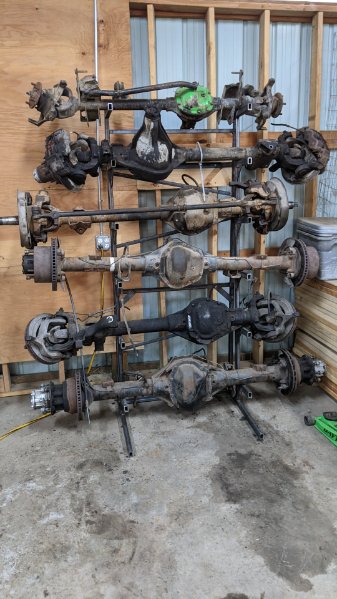
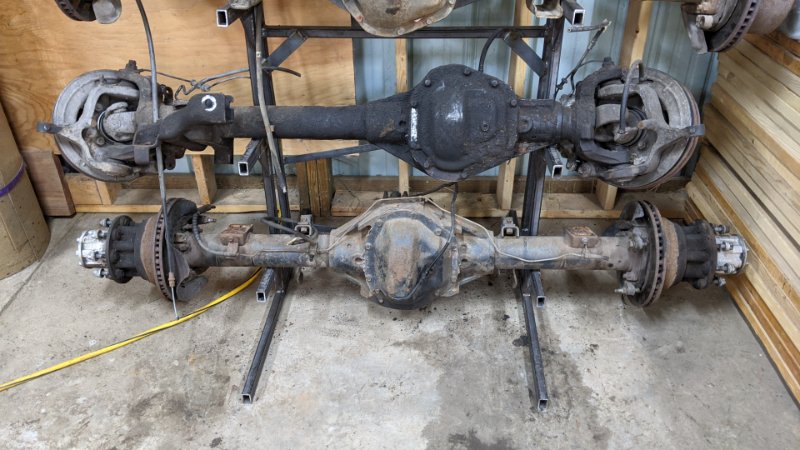
The whole stand with one 80, four 60s, and one XJ 30.
-
We got the axles up on a stand to get them all off the floor and make room for a TJ. These are my two axles.
-
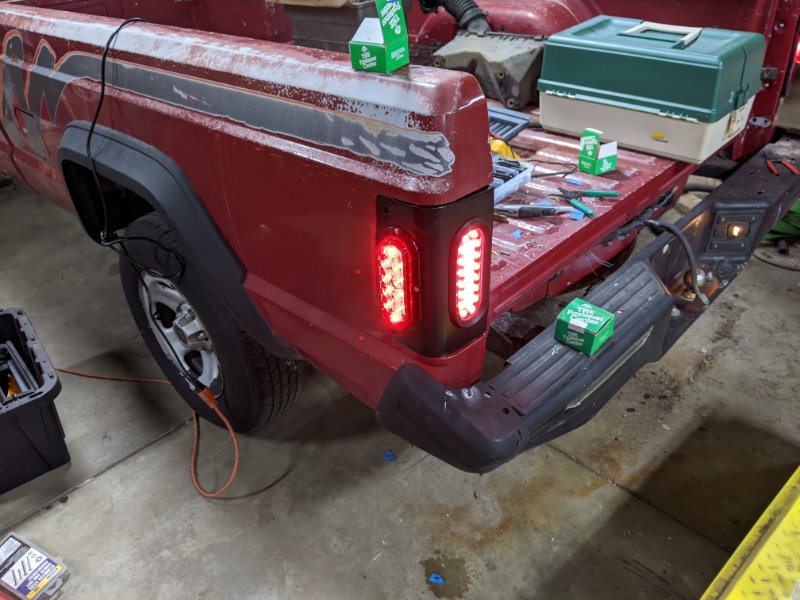
Already traded, installed, and working.
-
He's the one who bought my second project MJ and is registered here. I sent him this link and he'll respond here.
-
I might know someone with those parts. He'll look and get back to me.
-
I've had half a dozen full size Jeeps over the years. I've done a lot of the AMC V8s mostly. Enough to never want to do another. Parts are just about impossible to find. Small block Chevy/LS swaps are well documented and stupid easy. Both the 4L60 and 4L80 fit well in the tunnel. An NV4500 works well too. You can do a floor pan swap easy enough. Dropping or clocking the tcase is easy enough too. Lots of info on the FSJ forums. http://www.fsjnetwork.com and http://www.ifsja.org are the two big ones. And of course groups on facebook.
-
Heater core is a good candidate.
-
Does it have a drivetrain in it right now? Is it the 230 straight six or the AMC 327? Or is it a swapped in drivetrain? The axles are passenger drop from the factory. It's not too difficult to change that over to driver drop. The floor pan changed in 1980 when Jeep did the swap to driver drop so they could fit the transfer case easier. But it changed seat brackets for bucket seats. Brackets to swap in an LS are available in the aftermarket and you can find a bolt-in radiator to support Chevy engines. Buick 350s were offered in the late 60's and early 70's so that's an interesting somewhat unique option. Of course, AMC V8s were introduced in 71 or 72 so you could easily swap one of those in if you feel that Buick parts are too easy to find. Universal weld-in brackets work too and you can fit any small block easily. Big blocks can fit but they're tight and may require some tweaking. The transmission tunnel is a good size and will easily fit a TH400 or similar size transmission. There are two different core supports available. One for the straight six and one that fits a wider radiator for the V8. They are mostly interchangeable from 1963-1991 though the later front sheet metal got extra holes as well as brackets welded to it. It's easy to swap the front sheet metal from one core support to the other so you can keep that style grille (the Rhino grille). If it was a running and driving vehicle in good working order, I'd give $2,500 for it. Not running or driving, I'd start taking off from that price. Missing drivetrain would have me drop it down to $1,000 or less. Yes, it's a rare old Jeep truck but it's not in high demand so the price support just isn't there. If the frame and body panels are in good shape, it's worth something and would make an interesting project vehicle.
-
As it turns out, the radon system wasn't the cause. The PO ran some storm drains into the sewer. The junction got clogged and caused the backup. Good news is that the plumbers have made the first round of repairs. So at least I can use the facilities now. But we have to solve the other drains. I'm going to have to have a conversation with the home inspector and the crew he subcontracted the sewer inspection out to. And then maybe call an attorney.
-
I was giving serious thought to a ZR2 S10 in the late 90s before I bought my first Jeep, an XJ.
-
Both axles can go with 3.07, 3.55, 3.73, 4.10, 4.56, 4.88, and 5.13. The numbers may be off by one like 3.54 or 3.55. Those still go together. One thing to think about too is to consider swapping in a stronger rear axle. A Dana 35 is somewhat weak and something like a Dana 44, Ford 8.8 or Chrysler 8.25 would be a good upgrade.
-
The only dumb question is the one you don't ask. The math you use is actually simple. You just multiply the gears together. Pick a transmission gear and whether you're in high or low range. Then multiply those two numbers times the axle ratio. That gives you the overall ratio you're running. That website shows you all of those calculations in the chart done for you so you don't have to remember the math. Any time you change the axle ratio, you affect both high and low range. When you go with shorter (higher number) gears, it's like down shifting. If you regear but you want the same type of performance off road in low range, you're just going to have to upshift the transmission. Say you liked running in first gear low range. Changing to 4.88s would have you doing the same stuff in 2nd or 3rd gear instead. If you are used to running in high gear (4th or 5th) in low range, you may consider putting it in high range in 1st or 2nd gear after the regear. Just about every person I talk to who has regeared said they loved the fact that they got effectively more low range than they had. Even if they didn't use it all the time. They liked having it available. And the only people who didn't like it were people who took their regear too far.