


gogmorgo
-
Posts
5984 -
Joined
-
Last visited
-
Days Won
4
Content Type
Profiles
Forums
Gallery
Everything posted by gogmorgo
-
 Is there actual electrical feedback to the regulator? My understanding is it's just a spring and diaphragm setup with vacuum signal from the intake, and that the pump just runs for a couple seconds regardless for priming on key-on. A pump that doesn't shut off would indicate an electrical problem. Usually problems immediately after a fuel pump is changed out are either a new filter that was installed backwards (they typically have check valves) or else the small rubber hose from the pump to the sending unit (inside the tank) failed. But an electrical issue causing it not to turn off if it worked fine before hand... (or did it?) If the fuel gauge wires are a switched ground, is there a chance the harness for the sending unit was damaged during the swap and now the gauge and power wires are shorting against each other? Why was the fuel pump changed in the first place? Was anything else done at the same time that could interfere with a diagnosis?
 -
I've found seatbelts through car-part.com. I don't imagine junkyards would inventory them if it wasn't legal to sell them. When the buckle failed on my MJ I found one yard that wouldn't sell me a seatbelt part due to their own liability policies, but I then turned around and bought a couple at another yard in the same jurisdiction. I am north of the 49th but I doubt that has much to do with it. It's unlikely a junkyard belt is worse off than the one you're replacing, especially ones that retract and don't get much UV exposure. But given the option is usually better to go new on safety gear if you can... you just don't know the history of the old gear. I wouldn't pull belts from a vehicle that shows signs of a front end wreck, for example. Those have clear evidence of thorough use, and while belts aren't necessarily single-use, you just don't know after they've taken collision stresses once. The 2-dr XJ belts attach to the outer side by hoop that slides over a bar. They're way different.
-
It's worth whatever someone is willing to pay for it. I can't imagine there being anything super complex on a 2.8's wiring harness that can't be fixed for well under $400. It's a carb'ed engine.
-
I mean, this thread isn't just for firewood.
-
It doesn't happen too often, but on older threads in the waaaay back some of the links to other threads don't work any more. Usually this is stuff that's on the more obscure side because common knowledge gets repeated. But there's been a few occasions where I find a handful of threads asking the question and answers referencing the same thread, but I can't always uncover the original thread the others reference. As an example, the first link in this old thread of Jim's, which I'm 99.99% confident points at the "Official MJs earning their keep" thread: I'm pretty sure the reason is the forum changing formats back in 2012(?) but it would be pretty cool if the old links worked again. Or even if there was some workaround.
-
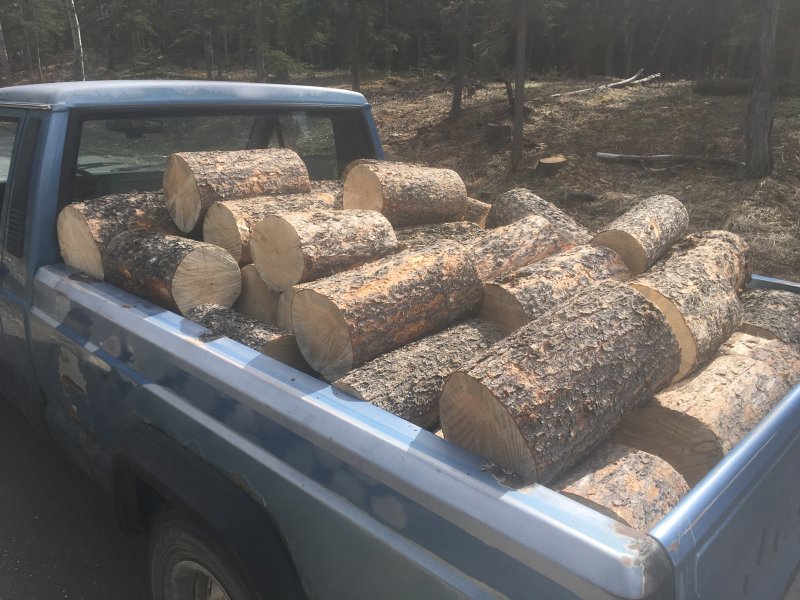
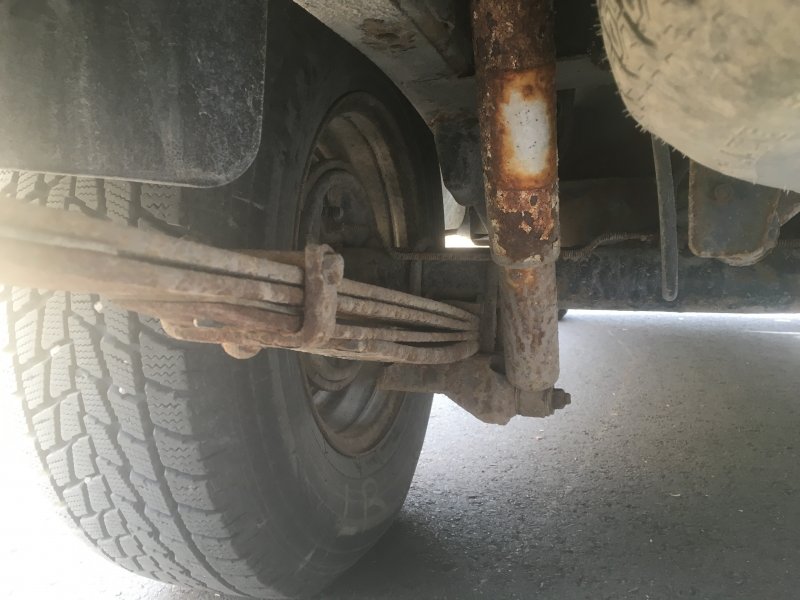
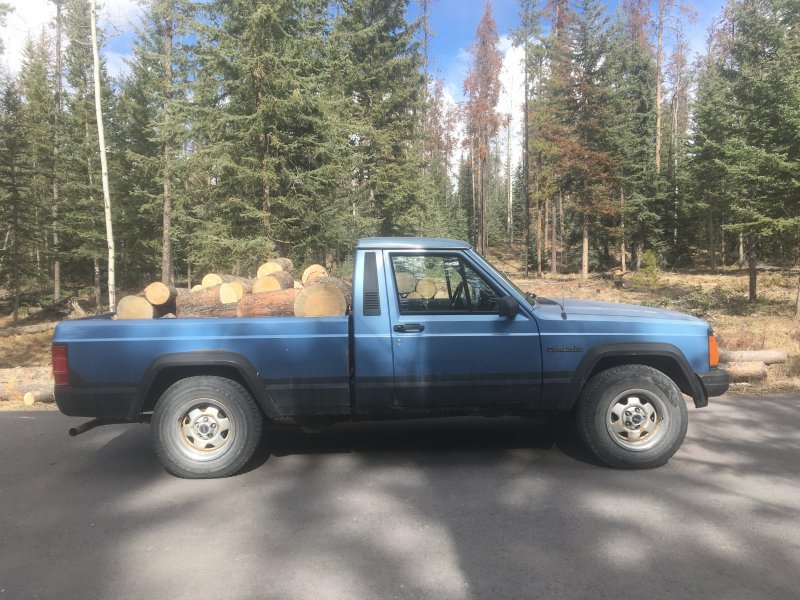
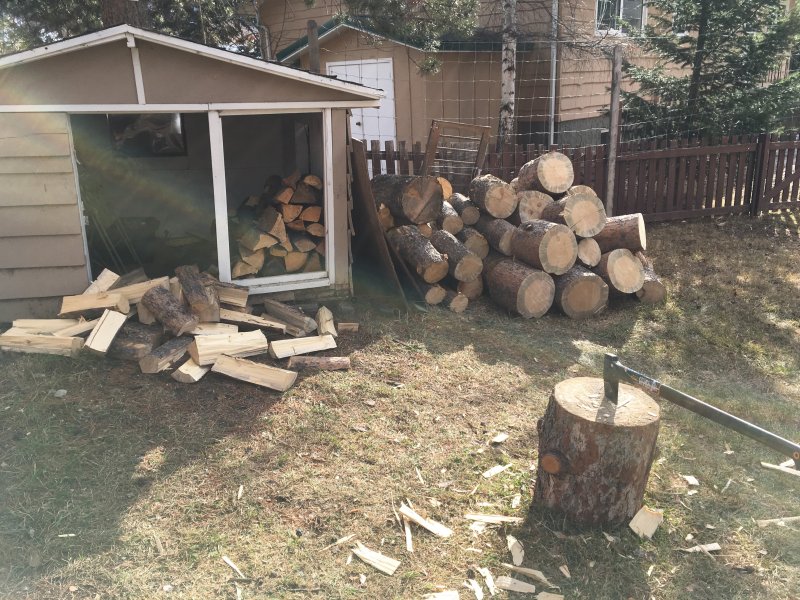
Resurrecting this thread from 23 pages deep to post up more pics of hauling firewood. That much was noticeable behind the 2.5, but it definiely wasn't struggling. No idea how much weight it was... I was well into the overloads but nowhere close to the bump stops. I couldn't help but think about how this compares to what you'd be able to get into a JT Gladiator. It would likely handle the weight just as well as my 28-year-old springs, but a five-foot bed... I doubt the volume is there. Definitely not compared to a LWB MJ. And I'm also confident a JT wouldn't have made it so nicely around the corner into my back yard to unload at my woodshed. I unfortunately don't have a fancy hydraulic splitter so I guess you could say I've got my work... chopped out for me.
-
Factory cruise control info (91+)
gogmorgo replied to Minuit's topic in MJ Tech: Modification and Repairs
I remember trying to find one for my dad's '85 Chevy van. They had a drawer up at the front desk of the wrecking yard with an assortment of GM stalks. There were about a half-dozen different versions in it with cruise control, and none of them matched the one in my dad's van. The cruise control didn't work anyway and I found a better match in one without cruise. -
Factory cruise control info (91+)
gogmorgo replied to Minuit's topic in MJ Tech: Modification and Repairs
This is the well-worn cruise control stalk in my '91 MJ. -
Xjjeeps.com has parts manuals. I had to deal with motor mounts when dropping the 2.5L into my '91 MJ, although in my case my exact concern was because my engine/mounts came out of a '92 YJ. But I do remember there being breaks in years in the MJ/XJ mounts that didn't really seem to correspond to any major redesign. I ended up changing the passenger side engine bracket. Part numbers are cast into them.
-
There are Lemons racers running around on 30+ year old tires. There's one 80's Cadillac out there where the original spare looked good, so they ran it on one of the front wheels more as a joke than anything else, and when it eventually blew apart they were going to replace it, except after hundreds of laps it's still fine. Tire degradation is almost entirely due to prolonged UV exposure. If it's been under a trunk floor or some other sort of cover and hasn't been sitting in daylight then there's likely nothing wrong with it. Even the quoted articles goes on to say there are people running around on old tires that are totally okay, just keep an eye out for cracks or anything and keep them inflated properly, and this straight from the tire distributors whose interest is in selling you new tires. Also, suddenly the guy who refuses to use a torque wrench cares about safety But back on topic. I'm not really a fan of the five-tire rotation. In part it's not very often I have a spare that matches the rest of the set, but that's another issue. Having a tire that isn't as worn down as the others means it's a slightly larger diameter, and this puts more stress on your differentials. Especially if you're incorporating a brand new tire into a rotation of half-worn tires. The more often you rotate tires the less of a problem this could be, more frequent rotations means less change in treadwear. If you're on a tight budget it can make your tires last marginally longer, but if force to put off spending money on tires until it's an absolute necessity, then now you're forced to buy five tires instead of four, or else run around with a crappy worn-out spare. You don't generally get to choose the weather or location to have a flat, so it's better in my mind to have a spare in good condition than to have to trust a craptacular one to get me where I need to go without backup. If I was doing a six-tire rotation, I think I would want to rotate out two tires at a time. Doing just one at a time would mean the sixth tire sits out two full rotation intervals before hitting the road at probably a noticeably larger diameter than the rest. In the heavy duty world there are rules (and laws) for not only tread wear but also matching diameters, not just between a pair of duals where a larger tire will take more load and potentially overload it, but also across an axle which means the axle doesn't sit horizontal and the tires are no longer perpendicular to the road surface, and also between driven axles, where it effectively alters final drive ratios.
-
Yeah that's a $20 tarp, a spool of twine, and ten minutes in the bush with a hand saw.
-
The J6 would've looked amazing in the Scrambler trim. From other sources it looks a lot like the two-door is just a chopped JLU, and I suspect if it's ever offered it'll just be a kit like the jk8, meaning it'll have diddly for payload and towing. But that doesn't mean it isn't waaaay for appealing than the minivan-spec Gladiator.
-
I still consider my ZJ an AMC. Sure, ChryCo got their dirty paws all over it, but AMC did most of the leg work. On an '88 MJ there's incredibly little Chrysler content.
-
Parts are parts question
gogmorgo replied to JEEP_cannible's topic in MJ Tech: Modification and Repairs
I would just leave the "third" headlight socket unplugged. Sure you could clip it off but the plug is insulated and it's less likely to introduce corrosion to somewhere important than a wire that was cut off and taped up or something. -
Parts are parts question
gogmorgo replied to JEEP_cannible's topic in MJ Tech: Modification and Repairs
The relay harness doesn't have a specific connector. It goes between the factory headlight harness and the headlights. You unplug both the headlight bulbs, plug them into the relay harness, then plug the relay harness into one of the factory headlight sockets. The result is that the factory headlight wiring remains unchanged and completely functional, but now the power that would've turned on the headlights triggers the relays which turns on the headlights. -
No fuel after a day of driving
gogmorgo replied to Swampy's topic in MJ Tech: Modification and Repairs
Been there. The adapter kit that came with my Delphi pump was junk, so it ended up pulling fuel out of the middle of the tank, meaning I "ran out" of gas at around 1/3 tank remaining. I once coasted to a stop about 200 feet from my driveway, had to siphon a gallon out of another vehicle to get the MJ started and into the driveway, then the next morning I had to siphon again and hope I made it to the gas station five miles away, and then only squeezed about 17 gallons into the 23gal tank. -
So far I'm not all that optimistic about that two-door. Yes the six foot bed is a step in the right direction, but the fact it's sitting on a JLU wheelbase tells me in this iteration it's not going to be much more than a JK8-style package and likely won't get much payload or towing capacity. On the other hand it could be testing the waters to see if further development on the JT platform is worthwhile. Or someone at Jeep is playing a cruel joke on some of us, teasing us knowing they'll never put it together.
-
The stock bumper was only good for about 2000lbs. That said I haven't seen one yet that isn't bent or rusted out and as was said I wouldn't really trust it for much. Many but not all parts are interchangeable with the same-year four-door XJ Cherokee. Basically everything from the doors forward is the same with a couple small exceptions, and the common parts are easy to come by through regular parts channels. From the seat brackets back the rear is almost completely different with a couple small exceptions. Those MJ-specific parts aren't so easy to find. Keeping a close watch on eBay, Craigslist, etc, is often your best bet, the classifieds on here are pretty good as well. You might also get lucky at your local wrecking yards. But no matter how you go, you're unlikely to find those parts new.
-
Parts are parts question
gogmorgo replied to JEEP_cannible's topic in MJ Tech: Modification and Repairs
175mm is what my MJs both listed as rear axle as well. I'd say it's pretty safe to assume it indicates a d35, whatever it's for now. It would be interesting to compare the option codes on original build sheets to what pulls up from a dealer search. How many of the option codes from the build sheet are on the vin tag under the hood? -
I did the BC one last year. It was a pretty good time. Lots of interesting vehicles that are totally inappropriate for the terrain they're sent through. This was my ride: Pretty sedate in comparison, but it was my daily driver at the time so I felt excused. Don't know if I'll be able to make it this year. Too many other things on the go this summer.
-
I don't really know what restrictions you have on your "antique" plates, whatever the term may be in your jurisdiction, but here (and anywhere else I've registered a vehicle) they're pretty seriously restrictive. Participation in a parade, club event, an exhibition, and transport to and from any of those events or a mechanic shop. The last jurisdiction I was in sets a mileage cap as well that is less than I've managed to accumulate more than once on a two-week road trip, and also requires maintaining an appraised value over $5000. The accompanying insurance is dirt cheap because it covers almost no use except display, and as a result if something happens and you can't prove you were operating within the restricted use of the plate, you won't be covered. I realise it's not like that everywhere, and Manitoba is a little more strict than some because the antique plate allows you to forgo the provincial safety inspection, but it's something to think about.
-
Parts are parts question
gogmorgo replied to JEEP_cannible's topic in MJ Tech: Modification and Repairs
On intitial rollout every ZJ had a Turdy5, including the V8s. It was a couple years in before they offered the 44A. I think there were a couple packages where the 44A was also offered with a 4.0, but the base axle was the d35. -
Parts are parts question
gogmorgo replied to JEEP_cannible's topic in MJ Tech: Modification and Repairs
4/98 is early enough in '98 it's unlikely to be a '99 model year, even on a new generation. It could easily be an error on the title, although I'm surprised that it could slip in like that. Digit 10 of the VIN is the model year regardless of make or model, and almost any system should be able to pick that up. '98 is W, '99 is X. -
We never use antiseize on lug nuts, and never have problems, and we're the guys putting the salt on the roads. Yeah we use impacts on the nuts to loosen them in the shop, but we've never had someone complain they couldn't loosen them if they've had a flat. 200 some vehicles in the fleet, many of them driven by kids with no clue about vehicle care or maintenance. We had plows and sand go out this morning, and likely will on the regular until late May, plus a couple runs a month throughout the summer... that's life in the Canadian Rockies. But salt is an element in this climate. Torque on the head of the fastener is a pretty poor way of measuring clamping force. As you point out, there are just too many variables. Any contaminants on the threads can increase or decrease friction, sometimes drastically. The friction between the two materials also depends on their exact composition, and isn't even guaranteed to be the same between manufacturers or suppliers. In precision applications where it actually matters, the correct clamping force is determined by measuring how much the bolt stretches. Manufacturers mostly specify a range between the safe minimum where the nut won't back off and a safe maximum that won't cause damage because they know the guy at the tire shop is going to hit them with his torque socket on the rattle gun, but they know he won't have a bunch of them in every single size and torque set, so they give a range to pick one. I suspect the increasing specs are moving upwards to more middle-of-the-road numbers to add an extra factor of safety. That and higher vehicle speeds since the 80's which put more load and vibrations on the wheels. Now as much as torque specs aren't particularly accurate, there's still a reason manufacturers specify bare and dry threads. Especially as they're moving towards the top of the safe range you could be getting close to damaging things. Current half-tons are specced at up to 150lb-ft, and at that point a 15% increase in clamping load vs fastener torque is pretty significant. The other factor is it's not just clamping force and stretching the lugs to be convened about, conical lug nuts are also exerting outward pressure on the wheel, which stretches the lug holes, can erode the wheel or nut material, and in both cases increases internal stress which reduces the stress the wheel can take from driving, making it more susceptible to damage. But ultimately, I see no need for the antiseize. If you rotate your tires on a regular basis like you're supposed to, you're undoing and doing up your lug nuts on the regular, which breaks free and cleans up corrosion. Clean the threads, torque the nuts back down to spec, re-torque after 25 miles or so, and call it good. We do use antiseize on the wheel mounting surfaces to avoid having to use a sledge hammer to get them off, but like I said, never on the lugs, and it's never been a problem. And don't go thinking our fleet is all newer equipment, generally the light fleet vehicles get surplussed at 200,000 miles or 20 years old. Last winter we surplussed out a '93 f150 with 305,000 miles on it. Old enough it was still reasonable to have a clutch pedal in a light fleet vehicle. We've got some heavy trucks from the 80's as well, still in service with 25,000 hours on the clock. Pulling off lug nuts isn't a problem on any of them.
-