


Eagle
-
Posts
15698 -
Joined
-
Last visited
-
Days Won
27
Content Type
Profiles
Forums
Gallery
Everything posted by Eagle
-
The '86 XJ hulk I have out back has 3.73 gears. 2.8L auto.
-
^^^ Truth
-
My house (which I inherited) is probably around 1500 to 1700 square feet. I need less house, but more garage, shop, and storage space. But ... a tiny house? No thanks. I'd go nuts.
-
Quoted for truth.
-
I remember a few months ago watching a YooToob video about the "ultimate" tiny house. It was something like 8x8 or 10x10 feet, and the author/producer of the video was extolling it as the greatest thing since sliced bread. Except -- it was on a lot with another house. The tiny house had no water -- he ran a hose from the main house. It had no kitchen -- his "kitchen" was a plywood counter nailed onto one end of the tiny house with knee braces to hold it up. There was no bathroom -- IIRC, he used the hose for showers, outdoors, and he either used the bathroom in the main house (which was owned and occupied by someone else) when he needed to do number two, or he had a chemical toilet. I don't recall. Bottom line -- it wasn't a "house." It was a ramshackle bedroom, nothing more. It was also in southern California, so heat wasn't an issue.
-
One simple (partial) check is to park it on a flat, level surface (in a garage would be ideal, if you have one) with the wheels pointing straight ahead, and use a tape measure or even a length of wire to measure the distance between the front and rear hubs on both sides. IIRC, you can find the correct dimensions in the FSM. See if both sides are the same, and if they match the specifications.
-
Expect the '95 and '98 to be totally different from the '89.
-
The evaporator goes in the box under the dash with the heater core, so this would be the time to install that even if you don't hook it up immediately. I don't know if the box is the same, so I'd suggest getting a donor XJ and taking everything (controls, vacuum lines, everything from that. But don't re-use the old evaporator -- it's worth dropping a few bucks to egt a new one to go along with the new heater core.
-
UGH! Great video -- except that I have acrophobia (fear of heights). I got about halfway through the video, imagined me in that Jeep opening the door with about 6 inches of rock between me and the edge, and just about tossed my cookies.
-
IMHO, doing a stroker is not a cheap way to gain power. Your idea of cheap may be different from mine, but as you've seen a stroker involves a lot more than just "dropping in" a crankshaft. If you farm out the machine shop work and do the assembly yourself, you're still looking at a couple of thousand bucks or more. For something to just drop in, I think a camshaft make more sense. But you will have to decide whether you want a cam that produces high end/high RPM power, or something that's more like an RV cam that increases the low- and mid-range power but doesn't like to rev. Just replacing the lifters and springs won't gain anything. A stroker might make sense if you're going to do a complete rebuild anyway -- otherwise, it doesn't make sense.
-
You could always pass it along to another good home. Doors from Cherokees are all over the place, ditto front fenders. It looks complete and basically straight. IMHO it would be a shame to part it out.
-
My thought, too. That doesn't look nearly bad enough to part out.
-
Yes, but this forum software hides the edit option, unlike most forum software packages that make it plain and simple. This software looks pretty, but functionally (for the users, dunno about for the admins) it's huge pain in the butt.
-
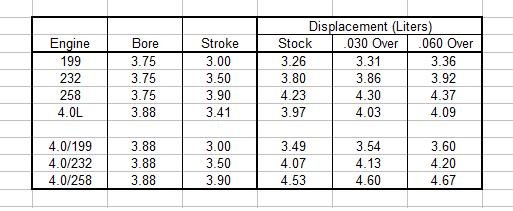
I made a slight error in my post on the engine displacements above. I used 3.1412 for the value of Pi in the formula -- it should be 3.1416. For anyone interested in such esoterica, here's how the purmutations and combinations work out: The Holy Grail 4.7L stroker is a 258 crank with a .060" overbore. Some engines can be bored to .090 or .120 over but, due to core shift, this is not always possible and most builders just stop at .060 over.
-
Just going from dim memory here -- assuming you have the block and head cleaned and machined by a shop but you're going to assemble the engine, you would need: A torque wrench A ring compressor (you can see that being used in the video, to insert the pistons on the block The ring pliers to install the new rings without breaking them Valve spring compressor Plastigage (for verifying the bearing clearance If you'll be buying new pistons, either you'll need a way to press the cross pins out of the old ones and into the new ones, or (recommended) you'll pay the shop to do that. I'm sure there's more that I'm forgetting, but it's late, I'm tired, and it has been literally decades since my last engine build. Also, there's at least one thing in that video with which I disagree. He recommends using the newer, lighter 4.2L crankshaft. That reduces reciprocating weight (rotational mass), so the engine will rev up marginally faster. I'm not interested in that. It's a Jeep, not a dragster. I'm interested in torque, low-RPM efficiency, and pulling power off-road. The heavier, fully-counterweighted crankshaft, because of the greater reciprocating mass, is better for off-roading because that mass has more angular momentum. It's less likely to stall at low RPM when crawling over an obstacle. It also runs and dles smoother. If I were to do a stroker, I would want the heavier crankshaft.
-
Which part? He sort of mixed two topics into that one paragraph. "The short 4.2 rods have kind of a borderline rod angle. The most economical stroker is a mini stroker. Use a 232 crank and the 4.0 rods." All the old AMC engines, from 1966 on, shared the same block. They were offered, depending on year, as a 199 cubic inch (3.3 liter), 232 cubic inch (3.8L) and 258 cubic inch (4.2L). IIRC, they also all shared the same bore, so the displacement was controlled by the crankshaft throw. The 232 crank with the 4.0L bore would result in an engine with a 3.88 inch bore and a stroke of 3.50", compared to the 4.0L crank throw of 3.41". This would displace 248 cubic inches, or 4.1L compared to the 4.0L, which is actually 3.9L. The displacement wouldn't be much different from the stock 4.0L, but the longer crank throw would mean an improvement in low-end torque. "Ideally use the 4.2 or scat crank and longer 4.0 rods but you’ll need specific pin height pistons. Keep quench real tight " There are two ways to do a stroker using the 4.2L crank. You can use the stock 4.2L rods, which are shorter and not as strong as the 4.0L rods, or you can use the 4.0L rods. The 4.0L rods are longer and stronger, but with stock pistons they push the top of the piston higher than the top of the block. So with 4.0L rods you need special pistons that have the holes for the pins located higher in the pistons. The actual wrenching on building a stroker engine isn't difficult -- it's the same as rebuilding a stock engine. The "gotchas" are in all the little details that crop up because you're mixing and matching components from different engines. If it was easy, I would have done it years ago. I've built several V8s, including race engines, so the wrenching doesn't bother me. Once I began investigating all the details involved in getting a stroker to run right, I decided that it was more than I wanted to take on. YMMV, but don't just start throwing parts at a block and think it's going to purr like a kitten when you fire it up.
-
Brake Lights Stopped Working
Eagle replied to BP_MJ_978's topic in MJ Tech: Modification and Repairs
Excellent. I'm happy that some of my long out-of-date recollections were helpful. I can't remember when was the last time I saw a pressure-actuated brake light switch. I wasn't familiar with that brand of adjustable proportioning valve, so we both learned something. Did you even know that you had an adjustable proportioning valve? Even though you got the lights working, I would still recommend that you contact the manufacturer to get whatever documentation they have on it so you can file it with your FSM (you DO have a FSM, right?) for future reference. Depending on how you use your MJ, you may want to learn what setting to use for running empty and running loaded. Also: Note what I posted above. The description of that proportioning valve says that switch is the brake system warning switch. If that's correct, it's not supposed to operate the rear brake lights, it's supposed to operate the warning light on the dashboard if either the front or the rear brakes fail. The description also says that unit is a distribution block as well as an adjustable proportioning valve. If that's correct, that means the lines to the front brakes should also be run through that unit and, from your photo, it doesn't appear that was done. This raises a couple of concerns: You may not have a functioning brake system warning light. In practice, you'll most likely know immediately if your front or rear brake circuit fails, but the warning light should be functional as a confirmation. If only the rear brakes are run through that valve, and the pressure switch is what controls the brake lights, then if the rear brakes fail you will not have brake lights. The front brakes do the majority of the work on an MJ, especially when there's no load, so you can drive it on just the front brakes. (Not recommended nor legal, but possible.) If the brake light switch is a pressure switch in the rear circuit, you won't have brake lights if the rear circuit springs a leak. -
Brake Lights Stopped Working
Eagle replied to BP_MJ_978's topic in MJ Tech: Modification and Repairs
I think I found it: https://ssbc-usa.com/products/a0730 That thingie IS a pressure-actuated brake switch. It should have wires connected to it. The item description says that switch is for brake system warning, though. I'm not sure just how that works. I would suggest contacting the company that makes that unit to request an instruction sheet, so you'll know what you've got. Maybe you can talk to someone in their technical department (if they have one) and ask for guidance with your problem. -
Brake Lights Stopped Working
Eagle replied to BP_MJ_978's topic in MJ Tech: Modification and Repairs
It does sound like a bad switch. Looking at your photos, it appears the modified system has an adjustable proportioning valve just below the master cylinder. There's a "thingie" in that that looks suspiciously like an old-school, pressure-actuated brake light switch next to the dial for adjusting the proportioning. I haven't seen one of those pressure switches for decades, but that's what was used back in the 1950s and 60s when I first started driving and wrenching. I would begin by checking out the adjustable proportioning valve. See if you can determine the make and model, then maybe you can figure out if that thingie is a switch. {Edit to add} Looks like NAPA still carries hydraulic brake light switches. https://www.napaonline.com/en/p/GRO822159 https://www.napaonline.com/en/p/TWR8629BX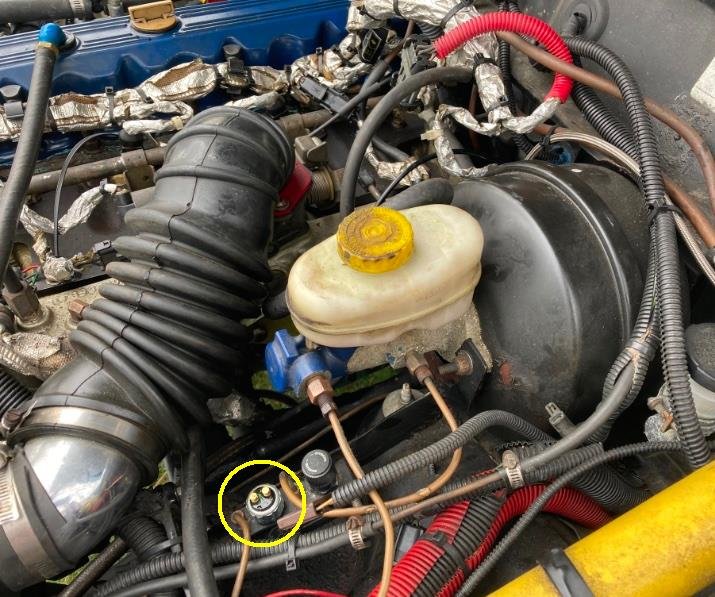
-
I'm working on the out of state move. I'm watching for jobs in "free" states. Earlier this year I applied for a job with the VA hospital in Fort Harrison, Montana. I made it to the interview round (telephonic) and I thought the interview went well, but I didn't get the job so I guess somebody else did better. (Or, as I suspect, they looked at the fact that I'm a Vietnam veteran, figured out my age, and cut me out based on my age. That's illegal, of course, but there's no way I could ever prove it.) Fast forward to this week, and the same job showed up again on Indeed.com and USA Jobs. So I have re-applied. I wonder if I'll even make the interview round this time. On the computer front, while my cable Internet was out I was using a Verizon mobile WiFi hotspot. Until it suddenly died, and decided it didn't want to talk to the Internet any more. Verizon sent a replacement -- same problem. They sent a second replacement -- still the same problem. Both replacements were refurbished, so this week they sent me a new unit, which is a different brand -- the old ones were Elipsis Jetpacks, this newest one is an Orbic. It arrived late Thursday evening. I have it charged up, but it came with a new SIM so I have to call a special number to have that SIM assigned to my account and activated. I didn't get around to doing that yesterday or today, so I'll have to do it on Sunday (if that number works on Sundays). In the meanwhile, my actual cell phone works okay as a mobile WiFi hotspot, it's only the dedicated devices that are acting up. Figure that one out if you can. Multiple tech support people at Verizon haven't been able to figure it out.
-
A properly done stroker will not be less reliable than a stock, rebuilt 4.0L. The problem is that "properly done" doesn't mean just swapping the crank and connecting rods. The 4.2L engine did not have the same deck height as the 4.0L. This means if you just swap the crank and rods, using stock 4.0L pistons, you get higher compression. That's great for performance, IF you can control detonation ("ping"). But controlling detonation isn't a simple problem. You get into things like enlarging the combustion chambers, controlling quench, and other things that I used to know but forgot years ago. Most of the stroker engines being sold today, I believe, use custom pistons that produce a correct piston height and compression ratio. Look up Dino Savva's web site.
-
More from the "You can't make this [___] up" department: Back in August, when they put in this "temporary" repair, they managed to cut the phone line while diddling with the cable. The crew that was supposed to make the permanent repair within three weeks never came (of course). There was another outage in October, which got fixed. Then there was an outage on November 24 that didn't get fixed until November 30. And it went out again on December 1, less than 24 hours later. It turns out the temporary fix was to just drape a line on the ground along two neighbors' properties to the street behind my house. The neighbors didn't like that ... so they disconnected it. Apparently the "technician" who came on Monday just reconnected it, but he didn't tell me what the problem was. And the next day, the neighbors just disconnected it again. So today a guy came and ran a new cable from the street in front of the house to the house. He didn't put it up on the poles, he just left it on the ground, but it should work (until it doesn't). And HE somehow managed to cut the phone line again. This time I caught it while he was here and he fixed it, but YIKES! This cable company is the worst of the worst.
-
Millionaire. Lift, or no lift?
-
Probably. I was promised a credit the last time I was out for a week, and I'm still waiting to see it. When I called in this morning, I was again promised that a credit will appear on my next invoice. I will be extremely surprised if that happens.