


Eagle
-
Posts
15698 -
Joined
-
Last visited
-
Days Won
27
Content Type
Profiles
Forums
Gallery
Everything posted by Eagle
-
HVAC mode actuator location
Eagle replied to GreasemonkeySC's topic in MJ Tech: Modification and Repairs
The problem is almost certainly where the vacuum line runs from the vacuum reservoir behind the front bumper under the battery tray. The hose deteriorates, a vacuum leak developes, and with no (or low) vacuum the vents default to the defrost position. It could also be a leak in the reservoir canister itself. -
Tailgate latch linkage bumper
Eagle replied to Blaine.D's topic in MJ Tech: Modification and Repairs
I've considered trying to carve those out of hockey pucks ... -
Yes, but the 2.8L V6 didn't use a crankshaft position sensor. The '87 2.5L used the Renix throttle body injection system and it uses the same CPS as the Renix 4.0Ls.
-
Where did people get the idea he has a 2.8L? He has stated that he has a 1987 2.5L 2WD. That means whatever he uses has to have provision for a CPS, and the flex plate has to be Renix-compatible. Are we all on the same page now?
-
A 2.5L XJ will probably have the Chrysler 904 automatic transmission. I don't think that used a TCU. It'll work in an MJ, but I don't think MJs used that transmission.
-
Been there, done that. I keep a half dozen sets around, some sized for the D35 and some for the D44.
-
This is looking more and more like one of those situations where everyone "knows" it shouldn't be done, but everyone has a different reason. What I know: I have reused factory u-bolts on several vehicles, including my race car back in the 1970s, without having any problems There must be dozens of people who have done the added main leaf AAL budget boost in XJs, and I'd bet that none of them bought new u-bolts The new u-bolts I see in the parts stores look to be 3/8" or 7/16", max, and I'm sure they're made in China. MJ factory u-bolts are 14mm (.5512", which is close to 9/16" - .5625"). I would much prefer to take my chances with used 14mm u-bolts than play around with Chinese replacements that are of questionable steel, and smaller to begin with.
-
https://www.eng-tips.com/viewthread.cfm?qid=256363
-
Great trip. I really like the early photos, in the Rockies. Spectacular scenery. I need to scare up the $$$ for another road trip.
-
Because if I'm going to pull parts off the hulk in the back yard, it helps to know which part is needed, and I can't see the part numbers when the parts are on a wreck. Follow the discussion, Donald.
-
Are you really talking about death wobble? Death wobble is in the front end, and it's characterized by shaking of BOTH front wheels so violently that you almost can't hold onto the steering wheel and you're sure you're going to die, like RIGHT NOW. If your life isn't replaying before your eyes while you pray you can stop before the truck is thrown violently off the road -- it isn't death wobble. No, I am not exaggerating.
-
Based on the parts diagram Hornbrod kindly provided, which part do you need?
-
Speedometer cable removal ( gauge cluster )
Eagle replied to a bum with money's topic in MJ Tech: Modification and Repairs
The cable in your photo is the '87 - '90 type. It is a pinch-to-release retainer. If yours doesn't come off, either you're not pinching in the right place or you're not pinching enough. There is no "single push to release" type. -
How did you get it to work? You must have modified the factory wiring harness, so it might help someone else if you would explain what you did and how you made it work.
-
'84 through '86 Cherokee. Which part do you need, the hood side or the body side? I have an '86 XJ hulk in the back yard. Let me know exactly what you need and I'll see if it's still there.
-
Death wobble affects the front. Nothing about the rear axle contributes to death wobble.
-
No. Both stop/tail/turn bulbs on each side operate in tandem -- the dim filaments are the taillights, the bright filaments are the brake lights. The turn signals use the brake light filaments, and the turns override the brakes. Likewise, the hazard flashers override the brake lights.
-
No spark on my 86Comanche 2.5
Eagle replied to MrBill61's topic in MJ Tech: Modification and Repairs
Well, I'm 74 years old and I was working on cars before you were born. The way you describe may get the timing close (sort of), but it won't get it "dead on." That said, if there's no power to the CPS or coil, there's obviously something amiss. But I would suggest trying to figure out where the problem is before you start throwing parts at it. Was it running and suddenly stopped, or is this a vehicle that's new to you? -
No spark on my 86Comanche 2.5
Eagle replied to MrBill61's topic in MJ Tech: Modification and Repairs
Impossible. You can't check the timing if there's no spark, and you said you have no spark. -
I bought a Cherokee Pioneer new in 1988. The operable vent windows were an extra cost option, which I bought. They leaked. The factory had a "fix" -- replace the operable windows (that I had paid extra for) with fixed glass -- but they wouldn't refund the price of the option. I told the factory rep to pound sand. I smeared the gaskets with silicone grease, closed the vents, and they haven't been opened since. That was 30 years ago. Bottom line -- DON'T DO IT.
-
No spark on my 86Comanche 2.5
Eagle replied to MrBill61's topic in MJ Tech: Modification and Repairs
How do you know the timing is dead on if there's no spark? -
Gauge cluster with tachometer
Eagle replied to Warren99's topic in MJ Tech: Modification and Repairs
That's the early type, which doesn't have the potentiometer. If it came from a V6 and you're using it with a I6, it should be okay. You can use the diagnostic connectors under the hood to connect the tach and bypass the dashboard wiring. On the passenger side, near the bank of relays, there are two rectangular connectors with yellow covers on them. The smaller one has the output and ground connections for testing a tachometer.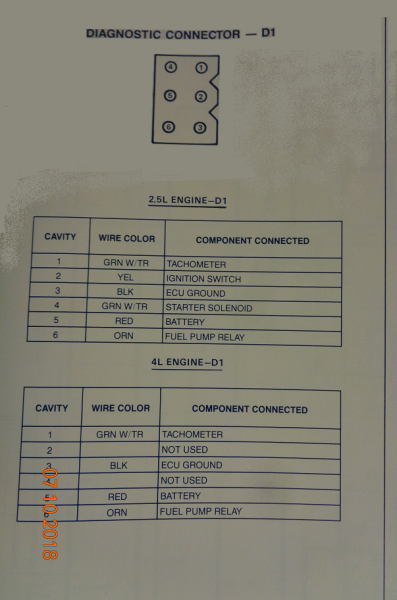
-
I've never heard of any option on the clutches, but I can say that the Trac-Lok in my 2000 XJ 5 speed is more aggressive than the Trac-Lok in my late wife's 2000 XJ automatic. The 5-speed is actually mildly annoying -- just making a low-speed turn into my driveway the clutches bind up and release with a series of loud "bangs." If your driving is 80 percent street/pavement, I'd say go for the smooth.
-
Gauge cluster with tachometer
Eagle replied to Warren99's topic in MJ Tech: Modification and Repairs
Right. The needles apparently can be removed -- that's how the white dial faces are installed. Personally, I'm terrified by the notion of pulling a needle off a gauge. I'm sure I'd break something trying to reinstall it. But -- if you have a tachometer that's off by 6,000 RPM -- what have you got to lose by trying? {Note: I actually don't see how it can be off by 6,000 RPM. The dial only goes to 7,000 RPM. If it's already reading 6,000 when the engine isn't running, then it'll be nearly pegged as soon as you start the engine, and if you rev the engine past 1,000 actual RPM the tach needle absolutely will be pegged.] -
Gauge cluster with tachometer
Eagle replied to Warren99's topic in MJ Tech: Modification and Repairs
No switch on the 84-86 clusters. It has to match the cylinder count, there's no way to adjust it. '87 was the "swing" year. The gauge faces are the old style, and I've never pulled an '87 tachometer to see if it has the potentiometer. But -- even a wrong cylinder count wouldn't make it off by 6,000 RPM. That's past the redline with the engine at idle -- or shut off. Think about it -- the tachometer counts firing pulses. It's a 4-stroke engine, so each cylinder fires once every two revolutions. Each revolution generates 2 pulses for a 4-cylinder, 3 pulses for a 6-cylinder. So -- for a 6-cylinder 1,000 RPM means 3,000 pulses. Now connect it to a 4-cylinder tach. For the 4-cylinder, 1,000 RPM is 2,000 pulses. The tach is seeing 3,000 pulses, so it's going to register that as 1,500 RPM.