


Minuit
-
Posts
5139 -
Joined
-
Last visited
-
Days Won
13
Content Type
Profiles
Forums
Gallery
Everything posted by Minuit
-
Here is a very small update. More will come later. Jeep Comanche Buyer's Guide v0.05 Disclaimer: This guide contains information and dates specific to the Jeep Comanche (MJ) and dates in this guide reflect Jeep Comanche (1986-1992) model years only. Outline 1: Introduction 2: Overview 3: Maintenance Information 4: Issues and Solutions 5: Conclusion 6: Credits (this is where all of the major contributors will be listed, including anyone who contributes pics) It is advised for new Comanche owners to read the Introduction and Issues and Solutions sections before others. The Overview section contains a large amount of information that may be overwhelming to new or prospective Comanche owners! Part 1: Introduction I: What this guide is for This guide is designed to be a comprehensive, yet relatively simple introduction to the Jeep Comanche, providing information that new owners and interested buyers will need to know. This guide is not intended to be a complete resource for every detail of these vehicles, but rather an easy to understand overview that still contains the most important details. While as many important aspects will be covered as possible, the newest Comanche is now twenty two years old, and conditions vary wildly. If you are purchasing a Comanche or have purchased one recently, you are encouraged to familiarize yourself with the vehicle and its quirks. This guide is intended to help you along in doing so. With that said, you don't need to read the entire guide - in fact doing so may be overwhelming at first glance! This guide is mainly intended to cover stock trucks, so some specifications will vary if your vehicle has been modified. II: What this guide isn't for This guide isn't an owner's manual - the information here is mainly intended to get new Comanche owners started with the basics. This isn't a guide for setting up your truck for wheeling, in fact virtually none of this guide involves modifying the truck at all. III: A brief history lesson Part 2: Overview I: Basic Specifications II: Model Year Breakdown Although the Comanche was only offered for a short period of time, it went through many iterations, with significant changes occurring each model year. Each model year is widely considered an improvement over the previous year. 1986: Often considered the "odd duck" year, 1986 Comanches are considered the least desirable, mostly due to some key differences in the engine bay, as well as its weak 2.8L engine. Despite this, the 2.5L engine, when paired with a manual transmission, is similar to its 1987-1990 counterparts and is an excellent engine. All 1986 Comanches are fitted with the 7-foot long bed. 1986 Comanches are typically identified by an uppercase fender badge. A stock 1986 Custom. Note the long bed and uppercase 'COMANCHE' badge. 1987: A significant improvement over the 1986 model year. The carbureted 2.8L engine was replaced by the multi-point injected 4.0L inline six, and the 3-speed TorqueFlite 727 was replaced by an Aisin-Warner 4-speed. 4.0L engines could also come equipped with the somewhat troublesome Peugeot BA-10/5 manual transmission. 100 1987 "Street Comanches" were produced, with the 4.0L engine, a manual transmission, and special racing-style cosmetic body parts. 1988: The most widely produced model year, 1988 brought relatively few changes. The 10-slot grille was replaced by an 8-slot grille, and the 4.0L engine received a slight power upgrade. A special edition, the Olympic Edition, was offered. 1989: (no C101 connector blah blah AX-15 blah blah) 1990: (what changed for 1990?) 1991: Besides 1987, the 1991 model year brought the most drastic changes to the Comanche. Both the 2.5L and 4.0L engines received significant upgrades, with the 2.5L engine receiving multi-point fuel injection similar to that of the 4.0L engine, and the 4.0L engine's fuel injection system was upgraded substantially. 1991 Comanches feature On-Board Diagnostics (OBD I), interfaced through a check engine light. 1991 and later gauge clusters are fully electronic, lacking a speedometer cable. Cosmetic changes were significant, including several new colors and a new front fascia. The SporTruck package also received a significant facelift, and became quite rare. A stock 1991 SporTruck in Silver Star Metallic paint, one of the paint colors introduced that year. 1992: The final model year for the Comanche, and the most desirable. Changes for 1992 were cosmetic, with a new color (Hunter Green Metallic) and a new graphics package (Sport) introduced. III: Drivetrain Engines 2.1L Renault J8S I4 Turbo Diesel (1986, early 1987): The rarest by far of the available engines. Although this engine has a poor reputation and parts are extremely scarce, many Comanche Club members consider 2.1L-equipped Comanches highly desirable due to their rarity (less than 100 diesel Comanches are estimated to exist in the United States). The 2.1L is a belt-driven overhead camshaft engine. Diesel Comanche owners: Automan2164, opsled/jeepcoMJ (former), Power output: 87hp, 132 ft-lbs 2.5L AMC 150 I4 (1986-1992): The standard and most common engine found in the Comanche throughout its production, the 2.5L engine is based on the highly reliable AMC Inline 6 family of engines. It was offered in two major generations during its production run. Although lacking in power compared to 6-cylinder engines, 2.5L engines are considered strong for their size and are expected to last well past 200,000 miles if well maintained. The manufacturer specifies 10W-30 motor oil, but recommendations vary. The 2.5L is a chain-driven overhead valve engine that does not require regular timing maintenance. - Renault-Bendix Throttle Body Injection (1986-1990): A fairly simple and reliable single-port injection system, the 2.5L TBI was Renault-Bendix's first Jeep engine control system. It is considerably simpler than Multi-Point Injection systems and is not prone to as many electrical issues as a contemporary 4.0L engine. 1986 and 1987 model year vehicles with this engine have a '2.5 Litre' badge on the tailgate. - Mopar 'Power Tech' Multi-Point Injection (1991-1992): An updated system similar in design to the system used in the 4.0L engine, the Mopar 2.5L engine is similar in many respects to the 4.0L version and much of the same information applies. Vehicles with this engine do not have a badge on the tailgate. Fluid capacity: 4 qt. Power output: 117 HP/ 139 ft-lb (1986-1990), 130 HP/ 149 ft-lb (1991-1992) 2.8L General Motors LR2 V6 (1986): The original 6-cylinder option in 1986 Comanches, the 2.8L engine featured an unreliable carburetor and failure-prone oiling systems, tarnishing its reputation in the Jeep community. With its low power output, poor reliability, and marginal fuel economy compared to later engines, 1986 Comanches with the 2.8L engine are considered some of the least desirable examples. Despite its poor reputation, some 2.8L engines are known to have lasted well past 200,000 miles. The 2.8L is a chain-driven overhead valve engine that does not require regular timing maintenance. Vehicles equipped with the 2.8L engine have a 'V6-2.8L' badge on the tailgate. 2.8L engine bay. Note the carburetor and small radiator. Fluid capacity: 4.5 qt. Power output: 110 HP/150 ft-lb (1986) 4.0L AMC 242 I6 (1987-1992): The legendarily reliable successor to the 258 inline 6, the 4.0L engine appeared in Comanches in two different generations, with a great deal of difference between the two. The manufacturer specifies 10W-30 motor oil, but a wide variety of recommendations can be found. Due to their high zinc content (which an engine of this vintage was designed for), diesel engine oils such as Shell Rotella T5 are frequently recommended. 4.0L engines are generally expected to easily reach 200,000 miles without rebuilding if well maintained. The 4.0L is a chain-driven overhead valve engine that does not require regular timing maintenance. The 4.0L engine existed in two forms: - Renault-Bendix (Renix) Multi-Point Injection (1987-1990): The first iteration of the 4.0L engine's fuel injection system, the French-developed Renix engine control system was considered quite advanced for its time and is in some ways more complex than its successor. Although a significant improvement on the electronic carburetors used by its predecessors, the Renix system is prone to electrical issues, particularly revolving around its insufficient chassis grounds. The Renix system does not feature easily testable diagnostics. Certain tools can interface with this system, but it does not store trouble codes, requiring testing while the engine is running. Although the Renix system is more prone to electrical issues, a well cared for Renix example can equal a Mopar engine in reliability. Vehicles with the Renix 4.0L engine have a '4.0 Litre' badge on the tailgate. - Mopar 'Power Tech' (High Output) Multi-Point Injection (1991-1992): A significant upgrade to the previous Renix system, the Mopar system eliminates the knock sensor, EGR valve, a number of vacuum lines and adds first generation On-Board Diagnostics (OBD1) controlled through a 'Check Engine' light. The electrical system of this engine is considerably more robust than the Renix system, with far fewer ground-related issues. Revised cylinder heads and intake manifolds considerably increased high-end power at the expense of a higher torque peak. Vehicles with the Mopar 4.0L engine have a '4.0 Litre HIGH OUTPUT' badge on the tailgate. Fluid capacity: 6 qt. Power output: 173 HP/220 ft-lb (1987), 177 HP/224 ft-lb (1988-1990), 190 HP/225 ft-lb (1991-92) Transmissions Chrysler TorqueFlite 904 (1986): The only automatic transmission option for the 1986 model year and the only Chrysler transmission used in Comanches, this 3-speed automatic was paired to some 2.8L and 2.5L engines. Although quite reliable, it was replaced for 1987 by the computer-controlled AW4. The manufacturer specifies ATF+3 fluid, which is no longer in production. Substitute ATF+4 fluid. Fluid capacity: 8-11qt. split between fluid pan and torque converter. Verify fill level using dipstick. Gear ratios: Aisin-Warner AW4 (1987-1992): The only automatic transmission found behind the 4.0L engine (as well as some 1987+ 2.5L engines), the 4-speed computer-controlled AW4 has an excellent reputation for reliability and power handling. From 1987 to 1991, this transmission featured a selectable "Power/Comfort" switch on the dash that adjusts shift points. Later AW4 units are permanently wired in the "Power" position. The AW4 is prone to overheating, so the installation of an external transmission cooler (writeup link goes here) is recommended. The AW4 is designed for Dexron-Mercon transmission fluid only. Fluid capacity: 8-10 qt. split between torque converter and fluid pan. Verify fill level using dipstick. Gear ratios: Aisin AX-4/AX-5 (1986-1992): The manual transmission options for the 2.1L, 2.5L, and 2.8L engines, the AX-4 and AX-5 are light-duty transmissions considered sufficient for the output of their engines. While both transmissions are essentially the same design, the AX-5 features an added fifth overdrive gear for highway use. 10W-30 motor oil (regular or synthetic) is specified by the manufacturer, but Pennzoil Syncromesh and Redline MT-90 fluids are also frequently recommended. DO NOT lubricate Aisin manual transmissions with GL-5 gear oil, as the transmissions feature brass synchronizers that will be destroyed by standard gear oils. Fluid capacity: 3.3 qt. Gear ratios: Peugeot BA-10/5 (1987-1989.5): The 5-speed manual transmission found behind 4.0L engines from 1987 to mid 1989. The BA-10/5 is a light-duty manual transmission that is considered inadequate for the 4.0L engine's power output if not driven carefully. While many owners have seen success with this transmission, it is considered inferior to the later AX-15 transmissions. The BA-10/5 can be identified by a square shaped drain plug that few tools will fit. The BA-10/5 is designed for standard gear oil. Fluid capacity: 2.45 qt. Gear ratios: Aisin AX-15 (1989.5-1992): The 5-speed manual transmission option found behind 4.0L engines in trucks built after March 1989. The AX-15 is a medium-duty manual transmission that is considered adequate for the 4.0L engine's power output. As with the AX-4 and AX-5, the manufacturer specifies 10W-30 motor oil, but Pennzoil Synchromesh and Redline MT-90 fluids are frequently recommended. DO NOT lubricate Aisin manual transmissions with GL-5 gear oil, as the transmissions feature brass synchronizers that will be destroyed by standard gear oils. Fluid capacity: 3.3 qt. Gear ratios: Transfer Cases New Process 207 (1986): New Process 228 (1986): New Process 231 (1987-1992): The standard transfer case for all non-1986 trucks, the NP231 is a simple, manually shifted, chain driven transfer case. The 231 is considered more than strong enough for any stock drivetrain. The NP231 is designed to use Dexron-Mercon transmission fluid. Shift Pattern: 2WD - 4WD (Part Time) - N - 4WD Low New Process 242 (1987-1992): The "full-time" transfer case for 1987-1992, the NP242 is similar to the NP231 except for the addition of a full-time 4WD option, allowing for the use of 4 wheel drive on surfaces with good traction. As with the NP231, the 242 is designed to use Dexron-Mercon transmission fluid. Shift Pattern: 2WD - 4WD (Part Time) - 4WD (Full Time) - N - 4WD Low Axles Dana 30 (1986-1992): The only front axle to equip Comanches, the Dana 30 (or D30) is considered a highly reliable axle well-suited for light to moderate off-road use. 2 wheel drive models feature a solid beam in place of this axle. Dana 35 (1986-1992): The standard rear axle to equip Comanches without the Metric Ton package. The Dana 35 (D35) has a poor reputation in the Jeep community due to its weakness under extreme use with oversized tires. The Dana 35 is typically reliable when equipped with tires less than 33 inches tall. Dana 35 units after 1989 use C-clips to retain axle shafts. AMC 20 (1986): The "heavy duty" rear axle for 1986 Comanches, the AMC 20 is a rare axle identified by its perfectly round differential cover. While not as highly prized as Dana 44 rear axles, the AMC 20 is far stronger than the Dana 35. Dana 44 (1987-1992): The rear axle of Comanches with the "Heavy Duty Axle" option or the Metric Ton package, the Dana 44 is highly regarded for its strength in extreme use situations with tires up to 37 inches tall. Comanches with the Dana 44 axle are highly sought after. Final Drive (axle) ratios: Part 3: Maintenance Information Part 4: Common Issues and Solutions I: Rust Since the newest Comanche is now 22 years old, rust is simply a fact of life for all but the most well-cared-for examples. Comanches operated in areas of high road salt use are particularly prone to rusting, with vehicles in deserts or temperate climates (such as the Southern United States) least prone to rust. Floor Pans: Virtually all Comanches are expected to have at least some rust here, and this is generally the first place a Comanche rusts. If the vehicle has not been meticulously checked for leaks during its entire lifespan, water can (and will) leak onto the floor pans and collect under the carpet without any place to go. Depending on how the vehicle has been stored, rust will range from minor surface damage to complete destruction of the vehicle's floor. A number of methods to repair floor pans exist, including ready-made patch panels, although these are often of extremely poor quality. Rocker Panels: Generally the first place rust is visible to the naked eye, rocker panel rust occurs mostly as a result of road conditions or poor maintenance. A number of methods to repair rocker panels exist. Rear Wheel Wells: After a Comanche rusts in its rocker panels, the rear wheel arches are generally the next areas to go. Salt, mud and other debris builds up behind the rear tire, and if allowed to sit uncleaned, will eventually destroy the area around the rear fender flares. Due to the Comanche's rarity, repairs to the bed will generally have to consist of either cut-out sheet metal sections from other Comanches or custom fabrication work. Part 5: Conclusion Part 6: Credits Information Minuit, Critical Input Pictures Minuit: 1991 Comanche redwolf624: 1986 Comanche, 2.8L engine bay Up next: Finishing the overview and common issues. I still need pics.
-
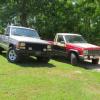
The Start Of Something... 86' Comanche Custom
Minuit replied to TheDirtyJeep401's topic in Member Projects: Your Comanches
A touch of color helps everything :thumbsup: -
I'm a huge fan of this build. Similar story here, except mine sat for ~8 years after a fuel pump died and didn't have any mice in the engine bay. Rock on! :thumbsup: P.S. That truck looks fantastic with the dark silver and those wheels.
-
Comanche Rear Sway Bar, Short Box
Minuit replied to Jeep Driver's topic in MJ Tech: DIY Projects and Write-Ups
So let me get this straight: Sway bar: 95-05 Blazer Axle brackets: Blazer End links: WJ End link brackets: XJ Looks like it belongs on the truck. Great work. How does the truck handle? -
Better Then Oem Suspenion In Rear
Minuit replied to EzRam's topic in MJ Tech: Modification and Repairs
I'm also very interested in this. -
I'm curious of how he got the old style instrument cluster to work with his 99 swap. Does the stuff (lights etc) in the interior work?
-
Why would someone junk this? Seriously? My truck was in that sort of shape when I came across it. On a side note, my local JY has 2 MJs - an 89 that got T-boned HARD, and a loaded 86 with cargo light, etc. Some delightful idiot stripped the Torx bolts on the cargo light and most of the other parts on both were either broken or rusted past the point of usefulness.
-
I'll be able to make it any time but as I said in the text I'd prefer a weekend. I can bring some supplies with me if y'all need something. My cell is
-
Here's the promised update for today. Jeep Comanche Buyer's Guide v0.04 Disclaimer: This guide contains information and dates specific to the Jeep Comanche (MJ) and dates in this guide reflect Jeep Comanche (1986-1992) model years only. Outline 1: Introduction 2: Overview 3: Maintenance Information 4: Issues and Solutions 5: Conclusion 6: Credits (this is where all of the major contributors will be listed, including anyone who contributes pics) It is advised for new Comanche owners to read the Introduction and Issues and Solutions sections before others. The Overview section contains a large amount of information that may be overwhelming to new or prospective Comanche owners! Part 1: Introduction I: What this guide is for This guide is designed to be a comprehensive, yet relatively simple introduction to the Jeep Comanche, providing information that new owners and interested buyers will need to know. This guide is not intended to be a complete resource for every detail of these vehicles, but rather an easy to understand overview that still contains the most important details. While as many important aspects will be covered as possible, the newest Comanche is now twenty two years old, and conditions vary wildly. If you are purchasing a Comanche or have purchased one recently, you are encouraged to familiarize yourself with the vehicle and its quirks. This guide is intended to help you along in doing so. With that said, you don't need to read the entire guide - in fact doing so may be overwhelming at first glance! This guide is mainly intended to cover stock trucks, so some specifications will vary if your vehicle has been modified. II: What this guide isn't for This guide isn't an owner's manual - the information here is mainly intended to get new Comanche owners started with the basics. This isn't a guide for setting up your truck for wheeling, in fact virtually none of this guide involves modifying the truck at all. III: A brief history lesson Part 2: Overview I: Basic Specifications II: Model Year Breakdown Although the Comanche was only offered for a short period of time, it went through many iterations, with significant changes occurring each model year. Each model year is widely considered an improvement over the previous year. 1986: Often considered the "odd duck" year, 1986 Comanches are considered the least desirable, mostly due to some key differences in the engine bay, as well as its weak 2.8L engine. Despite this, the 2.5L engine, when paired with a manual transmission, is similar to its 1987-1990 counterparts and is an excellent engine. All 1986 Comanches are fitted with the 7-foot long bed. 1987: A significant improvement over the 1986 model year. The carbureted 2.8L engine was replaced by the multi-point injected 4.0L inline six, and the 3-speed TorqueFlite 727 was replaced by an Aisin-Warner 4-speed. 4.0L engines could also come equipped with the somewhat troublesome Peugeot BA-10/5 manual transmission. 100 1987 "Street Comanches" were produced, with the 4.0L engine, a manual transmission, and special racing-style cosmetic body parts. 1988: The most widely produced model year, 1988 brought relatively few changes. The 10-slot grille was replaced by an 8-slot grille, and the 4.0L engine received a slight power upgrade. A special edition, the Olympic Edition, was offered. 1989: (no C101 connector blah blah AX-15 blah blah) 1990: (what changed for 1990?) 1991: Besides 1987, the 1991 model year brought the most drastic changes to the Comanche. Both the 2.5L and 4.0L engines received significant upgrades, with the 2.5L engine receiving multi-point fuel injection similar to that of the 4.0L engine, and the 4.0L engine's fuel injection system was upgraded substantially. 1991 Comanches feature On-Board Diagnostics (OBD I), interfaced through a check engine light. Cosmetic changes were significant, including several new colors and a new front fascia. The SporTruck package also received a significant facelift, and became quite rare. A stock 1991 SporTruck in Silver Star Metallic paint, one of the paint colors introduced that year. 1992: The final model year for the Comanche, and the most desirable. Changes for 1992 were cosmetic, with a new color (Hunter Green Metallic) and a new graphics package (Sport) introduced. III: Drivetrain Engines 2.1L Renault J8S I4 Turbo Diesel (1986, early 1987): The rarest by far of the available engines. Although this engine has a poor reputation and parts are extremely scarce, many Comanche Club members consider 2.1L-equipped Comanches highly desirable due to their rarity (less than 100 diesel Comanches are estimated to exist in the United States). The 2.1L is a belt-driven overhead camshaft engine. Diesel Comanche owners: Automan2164, opsled/jeepcoMJ (former), Power output: 87hp, 132 ft-lbs 2.5L AMC 150 I4 (1986-1992): The standard and most common engine found in the Comanche throughout its production, the 2.5L engine is based on the highly reliable AMC Inline 6 family of engines. It was offered in two major generations during its production run. Although lacking in power compared to 6-cylinder engines, 2.5L engines are considered strong for their size and are expected to last well past 200,000 miles if well maintained. The manufacturer specifies 10W-30 motor oil, but recommendations vary. The 2.5L is a chain-driven overhead valve engine that does not require regular timing maintenance. - Renault-Bendix Throttle Body Injection (1986-1990): A fairly simple and reliable single-port injection system, the 2.5L TBI was Renault-Bendix's first Jeep engine control system. It is considerably simpler than Multi-Point Injection systems and is not prone to as many electrical issues as a contemporary 4.0L engine. - Mopar 'Power Tech' Multi-Point Injection (1991-1992): An updated system similar in design to the system used in the 4.0L engine, the Mopar 2.5L engine is similar in many respects to the 4.0L version and much of the same information applies. Fluid capacity: 4 qt. Power output: 117 HP/ 139 ft-lb (1986-1990), 130 HP/ 149 ft-lb (1991-1992) 2.8L General Motors LR2 V6 (1986): The original 6-cylinder option in 1986 Comanches, the 2.8L engine featured an unreliable carburetor and failure-prone oiling systems, tarnishing its reputation in the Jeep community. With its low power output, poor reliability, and marginal fuel economy compared to later engines, 1986 Comanches with the 2.8L engine are considered some of the least desirable examples. Despite its poor reputation, some 2.8L engines are known to have lasted well past 200,000 miles. The 2.8L is a chain-driven overhead valve engine that does not require regular timing maintenance. Fluid capacity: 4.5 qt. Power output: 110 HP/150 ft-lb (1986) 4.0L AMC 242 I6 (1987-1992): The legendarily reliable successor to the 258 inline 6, the 4.0L engine appeared in Comanches in two different generations, with a great deal of difference between the two. The manufacturer specifies 10W-30 motor oil, but a wide variety of recommendations can be found. Due to their high zinc content (which an engine of this vintage was designed for), diesel engine oils such as Shell Rotella T5 are frequently recommended. 4.0L engines are generally expected to easily reach 200,000 miles without rebuilding if well maintained. The 4.0L is a chain-driven overhead valve engine that does not require regular timing maintenance. The 4.0L engine existed in two forms: - Renault-Bendix (Renix) Multi-Point Injection (1987-1990): The first iteration of the 4.0L engine's fuel injection system, the French-developed Renix engine control system was considered quite advanced for its time and is in some ways more complex than its successor. Although a significant improvement on the electronic carburetors used by its predecessors, the Renix system is prone to electrical issues, particularly revolving around its insufficient chassis grounds. The Renix system does not feature easily testable diagnostics. Certain tools can interface with this system, but it does not store trouble codes, requiring testing while the engine is running. Although the Renix system is more prone to electrical issues, a well cared for Renix example can equal a Mopar engine in reliability. - Mopar 'Power Tech' (High Output) Multi-Point Injection (1991-1992): A significant upgrade to the previous Renix system, the Mopar system eliminates the knock sensor, EGR valve, a number of vacuum lines and adds first generation On-Board Diagnostics (OBD1) controlled through a 'Check Engine' light. The electrical system of this engine is considerably more robust than the Renix system, with far fewer ground-related issues. Revised cylinder heads and intake manifolds considerably increased high-end power at the expense of a higher torque peak. Fluid capacity: 6 qt. Power output: 173 HP/220 ft-lb (1987), 177 HP/224 ft-lb (1988-1990), 190 HP/225 ft-lb (1991-92) Transmissions Chrysler TorqueFlite 904 (1986): The only automatic transmission option for the 1986 model year and the only Chrysler transmission used in Comanches, this 3-speed automatic was paired to some 2.8L and 2.5L engines. Although quite reliable, it was replaced for 1987 by the computer-controlled AW4. The manufacturer specifies ATF+3 fluid, which is no longer in production. Substitute ATF+4 fluid. Fluid capacity: 8-11qt. split between fluid pan and torque converter. Verify fill level using dipstick. Gear ratios: Aisin-Warner AW4 (1987-1992): The only automatic transmission found behind the 4.0L engine (as well as some 1987+ 2.5L engines), the 4-speed computer-controlled AW4 has an excellent reputation for reliability and power handling. From 1987 to 1991, this transmission featured a selectable "Power/Comfort" switch on the dash that adjusts shift points. Later AW4 units are permanently wired in the "Power" position. The AW4 is prone to overheating, so the installation of an external transmission cooler (writeup link goes here) is recommended. The AW4 is designed for Dexron-Mercon transmission fluid only. Fluid capacity: 8-10 qt. split between torque converter and fluid pan. Verify fill level using dipstick. Gear ratios: Aisin AX-4/AX-5 (1986-1992): The manual transmission options for the 2.1L, 2.5L, and 2.8L engines, the AX-4 and AX-5 are light-duty transmissions considered sufficient for the output of their engines. While both transmissions are essentially the same design, the AX-5 features an added fifth overdrive gear for highway use. 10W-30 motor oil (regular or synthetic) is specified by the manufacturer, but Pennzoil Syncromesh and Redline MT-90 fluids are also frequently recommended. DO NOT lubricate Aisin manual transmissions with GL-5 gear oil, as the transmissions feature brass synchronizers that will be destroyed by standard gear oils. Fluid capacity: 3.3 qt. Gear ratios: Peugeot BA-10/5 (1987-1989.5): Aisin AX-15 (1989.5-1992): The 5-speed manual transmission option found behind 4.0L engines after late 1989. The AX-15 is a medium-duty manual transmission that is considered adequate for the 4.0L engine's power output. As with the AX-4 and AX-5, the manufacturer specifies 10W-30 motor oil, but Pennzoil Synchromesh and Redline MT-90 fluids are frequently recommended. DO NOT lubricate Aisin manual transmissions with GL-5 gear oil, as the transmissions feature brass synchronizers that will be destroyed by standard gear oils. Fluid capacity: 3.3 qt. Gear ratios: Transfer Cases New Process 207 (1986): New Process 228 (1986): New Process 231 (1987-1992): The standard transfer case for all non-1986 trucks, the NP231 is a simple, manually shifted, chain driven transfer case. The 231 is considered more than strong enough for any stock drivetrain. The NP231 is designed to use Dexron-Mercon transmission fluid. Shift Pattern: 2WD - 4WD (Part Time) - N - 4WD Low New Process 242 (1987-1992): The "full-time" transfer case for 1987-1992, the NP242 is similar to the NP231 except for the addition of a full-time 4WD option, allowing for the use of 4 wheel drive on surfaces with good traction. As with the NP231, the 242 is designed to use Dexron-Mercon transmission fluid. Shift Pattern: 2WD - 4WD (Part Time) - 4WD (Full Time) - N - 4WD Low Axles Dana 30 (1986-1992): The only front axle to equip Comanches, the Dana 30 (or D30) is considered a highly reliable axle well-suited for light to moderate off-road use. 2 wheel drive models will feature a solid beam in place of this axle. Dana 35 (1986-1992): AMC 20 (1986): Dana 44 (1987-1992): Final Drive (axle) ratios: Part 3: Maintenance Information Part 4: Common Issues and Solutions I: Rust Since the newest Comanche is now 22 years old, rust is simply a fact of life for all but the most well-cared-for examples. Comanches operated in areas of high road salt use are particularly prone to rusting, with vehicles in deserts or temperate climates (such as the Southern United States) least prone to rust. Floor Pans: Virtually all Comanches are expected to have at least some rust here, and this is generally the first place a Comanche rusts. If the vehicle has not been meticulously checked for leaks during its entire lifespan, water can (and will) leak onto the floor pans and collect under the carpet without any place to go. Depending on how the vehicle has been stored, rust will range from minor surface damage to complete destruction of the vehicle's floor. A number of methods to repair floor pans exist, including ready-made patch panels, although these are often of extremely poor quality. Rocker Panels: Generally the first place rust is visible to the naked eye, rocker panel rust occurs mostly as a result of road conditions or poor maintenance. A number of methods to repair rocker panels exist. Rear Wheel Wells: After a Comanche rusts in its rocker panels, the rear wheel arches are generally the next areas to go. Salt, mud and other debris builds up behind the rear tire, and if allowed to sit uncleaned, will eventually destroy the area around the rear fender flares. Due to the Comanche's rarity, repairs to the bed will generally have to consist of either cut-out sheet metal sections from other Comanches or custom fabrication work. Part 5: Conclusion Part 6: Credits Up next: Finishing the overview and common issues. I still need pics.
-
Thanks a bunch. I don't want to go too crazy with hiding things, but I'll definitely keep them in. @glundblad: That's another little intricacy that I'll have to lay down. Thanks.
-
Crown Auto Cupholder!!
Minuit replied to 1989 Eliminator's topic in MJ Tech: DIY Projects and Write-Ups
Yeah, MJs have enough problems with passenger legroom but it looks like it's probably no wider than the bottom of the transmission tunnel. -
Doesn't matter what your political opinions are, this is spot on.
-
Yep, I've found several stories just like yours in my brief research. I'm gonna try my best to find alternate vendors for everything I was planning to order. You've had 10 times the patience i would have had in a situation like this.
-
Terribly sorry for the hiatus in updates - hopefully it won't last long. This time, I've incorporated some of your suggestions (for example, I hid those evil, evil gear ratios behind spoiler tags. Think of the children!) and started the year breakdown since that seems to be a pretty popular request. More will come tomorrow. This is the part where you all get to contribute! I'd like to have pics of trucks from each model year, preferably showing the visual differences between the years. Mostly stock trucks would be preferred but anything that identifies a truck as a particular year is wanted. Grille shots, engine bay shots, anything unique to a particular model year. Send me your pics! Jeep Comanche Buyer's Guide v0.03 Disclaimer: This guide contains information and dates specific to the Jeep Comanche (MJ) and dates in this guide reflect Jeep Comanche (1986-1992) model years only. Outline 1: Introduction 2: Overview 3: Maintenance Information 4: Issues and Solutions 5: Conclusion 6: Credits (this is where all of the major contributors will be listed, including anyone who contributes pics) Part 1: Introduction Part 2: Overview I: Model Year Breakdown Although the Comanche was only offered for a short period of time, it went through many iterations, with significant changes occurring each model year. Each model year is widely considered an improvement over the previous year. 1986: Often considered the "odd duck" year, 1986 Comanches are considered the least desirable, mostly due to the. Despite this, the 2.5L engine, when paired with a manual transmission, is similar to its 1987-1990 counterparts and is quite useful. All 1986 Comanches are fitted with the 7-foot long bed. 1987: A significant improvement over the 1986 model year. The carbureted 2.8L engine was replaced by the multi-point injected 4.0L inline six, and the 3-speed TorqueFlite 727 was replaced by an Aisin-Warner 4-speed. 4.0L engines could also come equipped with the somewhat troublesome Peugeot BA-10/5 transmission. 1988: The most widely produced model year, 1988 brought relatively few changes. (??) 1989: (no C101 connector blah blah AX-15 blah blah) 1990: (what changed for 1990?) 1991: Besides 1987, the 1991 model year brought the most drastic changes to the Comanche. Both the 2.5L and 4.0L engines received significant upgrades, with the 2.5L engine receiving multi-point fuel injection similar to that of the 4.0L engine, and the 4.0L engine's fuel injection system was upgraded substantially. 1991 Comanches feature On-Board Diagnostics (OBD I), interfaced through a check engine light. Cosmetic changes were significant, including several new colors and a new front fascia. The SporTruck package also received a significant facelift, and became quite rare. A stock 1991 SporTruck in Silver Star Metallic paint, one of the paint colors introduced that year. 1992: The final model year for the Comanche, and the most desirable. Changes for 1992 were cosmetic, with a new color (Hunter Green Metallic) and a new graphics package (Sport) introduced. II: Drivetrain Engines 2.1L Renault J8S I4 Turbo Diesel (1986, early 1987): The rarest by far of the available engines. Although this engine has a poor reputation and parts are extremely scarce, many Comanche Club members consider 2.1L-equipped Comanches highly desirable due to their rarity (less than 100 diesel Comanches are estimated to exist in the United States). The 2.1L is a belt-driven overhead camshaft engine. Diesel Comanche owners: Automan2164, jeepcomj (former), opsled (former), I'm probably forgetting a few. Power output: 87hp, 132 ft-lbs 2.5L AMC 150 I4 (1986-1992): The standard and most common engine found in the Comanche throughout its production, the 2.5L engine is based on the highly reliable AMC Inline 6 family of engines. It was offered in two major generations during its production run. Although lacking in power compared to 6-cylinder engines, 2.5L engines are considered strong for their size and are expected to last well past 200,000 miles if well maintained. The manufacturer specifies 10W-30 motor oil, but recommendations vary. The 2.5L is a chain-driven overhead valve engine that does not require regular timing maintenance. - Renault-Bendix Throttle Body Injection (1986-1990): A fairly simple and reliable single-port injection system, the 2.5L TBI was Renault-Bendix's first Jeep engine control system. It is considerably simpler than Multi-Point Injection systems and is not prone to as many electrical issues as a contemporary 4.0L engine. - Mopar 'Power Tech' Multi-Point Injection (1991-1992): An updated system similar in design to the system used in the 4.0L engine, the Mopar 2.5L engine is similar in many respects to the 4.0L version and much of the same information applies. Fluid capacity: 4 qt. Power output: 117 HP/ 139 ft-lb (1986-1990), 130 HP/ 149 ft-lb (1991-1992) 2.8L General Motors LR2 V6 (1986): The original 6-cylinder option in 1986 Comanches, the 2.8L engine featured an unreliable carburetor and failure-prone oiling systems, tarnishing its reputation in the Jeep community. With its low power output, poor reliability, and marginal fuel economy compared to later engines, 1986 Comanches with the 2.8L engine are considered some of the least desirable examples. Despite its poor reputation, some 2.8L engines are known to have lasted well past 200,000 miles. The 2.8L is a chain-driven overhead valve engine that does not require regular timing maintenance. Fluid capacity: 4.5 qt. Power output: 110 HP/150 ft-lb (1986) 4.0L AMC 242 I6 (1987-1992): The legendarily reliable successor to the 258 inline 6, the 4.0L engine appeared in Comanches in two different generations, with a great deal of difference between the two. The manufacturer specifies 10W-30 motor oil, but a wide variety of recommendations can be found. Due to their high zinc content (which an engine of this vintage was designed for), diesel engine oils are frequently recommended. 4.0L engines are generally expected to easily reach 200,000 miles without rebuilding if well maintained. The 4.0L is a chain-driven overhead valve engine that does not require regular timing maintenance. - Renault-Bendix (Renix) Multi-Point Injection (1987-1990): The first iteration of the 4.0L engine's fuel injection system, the French-developed Renix engine control system was considered quite advanced for its time and is in some ways more complex than its successor. Although a significant improvement on the electronic carburetors used by its predecessors, the Renix system is prone to electrical issues, particularly revolving around its insufficient chassis grounds. The Renix system does not feature easily testable diagnostics. Certain tools can interface with this system, but it does not store trouble codes, requiring testing while the engine is running. Although the Renix system is more prone to electrical issues, a well cared for Renix example can equal a Mopar engine in reliability. - Mopar 'Power Tech' (High Output) Multi-Point Injection (1991-1992): A significant upgrade to the previous Renix system, the Mopar system eliminates the knock sensor, EGR valve, a number of vacuum lines and adds first generation On-Board Diagnostics (OBD1) controlled through a 'Check Engine' light. The electrical system of this engine is considerably more robust than the Renix system, with far fewer ground-related issues. Revised cylinder heads and intake manifolds considerably increased high-end power at the expense of a higher torque peak. Fluid capacity: 6 qt. Power output: 173 HP/220 ft-lb (1987), 177 HP/224 ft-lb (1988-1990), 190 HP/225 ft-lb (1991-92) Transmissions Chrysler TorqueFlite 904 (1986): The only automatic transmission option for the 1986 model year and the only Chrysler transmission used in Comanches, this 3-speed automatic was paired to some 2.8L and 2.5L engines. Although quite reliable, it was replaced for 1987 by the computer-controlled AW4. The manufacturer specifies ATF+3 fluid, which is no longer in production. Substitute ATF+4 fluid. Fluid capacity: 8-11qt. split between fluid pan and torque converter. Verify fill level using dipstick. Gear ratios: Aisin-Warner AW4 (1987-1992): The only automatic transmission found behind the 4.0L engine (as well as some 1987+ 2.5L engines), the 4-speed computer-controlled AW4 has an excellent reputation for reliability and power handling. From 1987 to 1991, this transmission featured a selectable "Power/Comfort" switch on the dash that adjusts shift points. Later AW4 units are permanently wired in the "Power" position. The AW4 is prone to overheating, so the installation of an external transmission cooler (writeup link goes here) is recommended. The AW4 is designed for Dexron-Mercon transmission fluid only. Fluid capacity: 8-10 qt. split between torque converter and fluid pan. Verify fill level using dipstick. Gear ratios: (omitting Borg-Warner T5, no proof has been found of its use in MJs) Aisin AX-4/AX-5 (1986-1992): The manual transmission options for the 2.1L, 2.5L, and 2.8L engines, the AX-4 and AX-5 are light-duty transmissions considered sufficient for the output of their engines. While both transmissions are essentially the same design, the AX-5 features an added fifth overdrive gear for highway use. 10W-30 motor oil (regular or synthetic) is specified by the manufacturer, but Pennzoil Syncromesh and Redline MT-90 fluids are also frequently recommended. DO NOT lubricate Aisin manual transmissions with GL-5 gear oil, as the transmissions feature brass synchronizers that will be destroyed by standard gear oils. Fluid capacity: 3.3 qt. Gear ratios: Peugeot BA-10/5 (1987-1989.5): Aisin AX-15 (1989.5-1992): The 5-speed manual transmission option found behind 4.0L engines after late 1989. The AX-15 is a medium-duty manual transmission that is considered adequate for the 4.0L engine's power output. As with the AX-4 and AX-5, the manufacturer specifies 10W-30 motor oil, but Pennzoil Synchromesh and Redline MT-90 fluids are frequently recommended. DO NOT lubricate Aisin manual transmissions with GL-5 gear oil, as the transmissions feature brass synchronizers that will be destroyed by standard gear oils. Fluid capacity: 3.3 qt. Gear ratios: Transfer Cases New Process 207 (1986): New Process 228 (1986): New Process 231 (1987-1992): Shift Pattern: 2WD - 4WD (Part Time) - N - 4WD Low New Process 242 (1987-1992): Shift Pattern: 2WD - 4WD (Part Time) - 4WD (Full Time) - N - 4WD Low Axles Dana 30 (1986-1992): The only front axle to equip Comanches, the Dana 30 (or D30) is considered a highly reliable axle well-suited for light to moderate off-road use. 2 wheel drive models will feature a solid beam in place of this axle. Dana 35 (1986-1992): AMC 20 (1986): Dana 44 (1987-1992): Final Drive (axle) ratios: 2.5L, 5-speed manual: 4.10 2.5L, 4-speed manual: 3.55 2.5L, 3-speed automatic: 4.56 4.0L, 5-speed manual: 3.07 4.0L, 4-speed automatic: 3.55 Up Next: Completing the year breakdown and adding visual aids. More drivetrain info.
-
Eagle, that shakes up quite a few assumptions I've made. How would the ride height of the MJs compare to the XJ? Would a 2WD be the same ride height as the XJ or 1" lower?
-
Yeah, that really, really sucks. I just recieved a small ($30) order from them today and I have a list of parts well over $250 put together for later. It really is a shame, since so much of their stuff can't be found anywhere else. Keep us informed.
-
Crown Auto Cupholder!!
Minuit replied to 1989 Eliminator's topic in MJ Tech: DIY Projects and Write-Ups
How are the quality on these? -
How haven't I heard of these before? They look fantastic! Any reports of how well they actually work?
-
No sir, I was just wondering, and since you don't have any plans to go to 3"+ here anytime soon, I agree 100% percent with you. And a 2" TJ lift coil would give you an 1" or less over stock. If it were me, I would get a 3" lift coil if they have one- if you're going that route...that way it would net you 2" or less over stock. :thumbsup: That's where I'm hung up - is a TJ coil 1" shorter relative to a 4WD or a 2WD vehicle? There's an inch of difference there and I'm just assuming that they're comparing based on a 4WD XJ. If a 2" TJ lift coil is indeed 1" shorter than a 4WD XJ coil, then it would be a 2" lift coil to me as well, whereas to a 4WD XJ or MJ it would only be a 1" lift coil. But I'm not sure if that IS the case. I'm planning on doing this a couple of months from now, so there's plenty of time to research my options but I want to be perfectly clear before I start emptying my wallet. Thanks for the advice - I was planning on jacking up the body and seeing how it looked as well. :thumbsup: @ Hornbrod: From what you're saying, the OME coil will lift a 2WD 2" as well? When I measured the ride height from the frame rail (based on instructions on this forum) my ride height was exactly where the page said it would be. That leads me to believe my coil springs are in good shape as-is.
-
Another thought just hit me: TJ springs are 1" shorter than 4wd XJ springs, and thus are the same length as a stock 2wd MJ spring. OME offers a "2 inch" TJ lift coil. Would this fit my needs? Is there any reason that using a spring meant for a TJ wouldn't work for me? 2 inches is about as high as I'm willing to go in the front.
-
As much as I'd love to have OME stuff on my truck the smallest spring I see in their catalog gives about 1-3/4 inches of lift over stock. I assume these "stock" values are for a 4wd model - I'm not prepared to do a nearly 3 inch lift on my truck. If the stock values are for a 2wd XJ, then it's bang on, but I'm not sure why they would use a 2wd vehicle as the benchmark for a lift spring. :dunno:
-
I don't want any spring lift in the rear. The only reason I'm even mentioning a lift at all is my truck has a pretty steep forward rake and I'd like to level it somewhat while using as many OEM-spec parts as possible. The load leveler shocks in the back will add at the very most most a half inch to the back, but their main purpose is to make the bed sag less when loaded. I'm very, very picky when it comes to stuff that goes on my truck and I just don't like the idea of coil spacers. It seems to me like a shortcut (even though to most of you it may not) and the whole point of my build is to not take shortcuts. This truck has been in the family since new and since I've taken it in I feel like I have the responsibility to be as meticulous as possible. Nothing against any of you and I appreciate your answers, I'm just explaining myself. :thumbsup:
-
The fact that you're trying to understand (and are learning quite quickly) a concept that isn't exactly easy to get your head around reflects well on you.
-
1. No. 2. Look at the diff cover to identify the axle. Jack up both rear tires (jack the truck up by the diff housing) and spin one. If they both spin in the same direction at the same time you have a limited slip diff. 3. No. 4. No. Ring gears do not swap between axles and even then, there's more to a gear change than just the ring gear. You can't turn a D35 into a D44 - they're completely different units. Axle work is quite complicated. I think you're a bit confused here. Dana 35s, Dana 44s, etc. are NOT carriers or any other single part. They are completely different types of rear axles.