

DirtyComanche
-
Posts
7945 -
Joined
-
Last visited
-
Days Won
11
Content Type
Profiles
Forums
Gallery
Everything posted by DirtyComanche
-
Nice that they're offering it, but I don't know if it's a good enough deal to go that route. Honestly the electric vehicles seem easy, as long as you're willing to accept marginal results. You could do a simple DC motor conversion and use Leaf or Bolt batteries and be into it for only $5000~ max. A Matzilla controller will do that and you're pretty reliable with not much else save an electric vacuum and P/S pump. Put the battery in the box and you don't even have to modify it, totally hack but it gets you going. If you want something better you're really stuck as far as what way to go. Tesla drive units are made for a car, period. I don't know what they're planning to do in the truck, or if it actually will ever hit the market, but if they're using the same basic drive units then it's worthless. Everything else is far enough behind in power that you might as well just buy an actual race/performance motor, like a Hyper-9 or whatever, and buy or build the adapter. That's all assuming you want a 4wd truck, otherwise just use a Tesla rear drive unit and the horrible Tesla IRS, it will work. My tentative "plan" if I was to go electric in an MJ would be a battery box where the gas tank is, and another on the other side, and one where the spare tire goes. There's enough cubes there to get you maybe 150 miles of range, given how bad aero and rolling resistance would be. If you want more it's going to get a lot harder. But like I said, that's a long time down the road. So I'm not thinking about it too much because everything will change in the next few years.
-
I had a chance to buy an R2.8 for well under list and passed. At the time it was very unclear if it would fit in the XJ/MJ chassis and if the emissions systems would fail or could be removed. I have no idea how many they have sold or if there is any programming available for them now, but I was very leary of what might turn into something that would be unworkable.
-
I'd do a TDI over the factory diesel. To start my current project over I would go TDI.
-
I realized I need some ubolts to do my rear axle swap and for my Ford Trailero, so I'm going to put them in the card. I've got until sometime next week to figure this out anyway.
-
That's boring. What if you're going to treat yourself?
-
Not in stock for my application. It was the first thing I thought of.
-
So say you had $150 in Summit Bucks for Summit Racing, and they're about to expire. What would you buy right meow?
-
Door Removal/Bolt Upgrade?
DirtyComanche replied to CrustyBoy's topic in MJ Tech: Modification and Repairs
The design principle of the Torx is that you don't need pressure on it to stop it from camming out. If the bit is in straight and fully seated, and the torque is applied only in the correct direction, and it is undamaged, it will not cam out. I used to hate them until I realized how they work. Clean them out, use the correct bit (and not some 10 cent junk you got from Mao's Candyland either), make sure it's seated, apply the torque correctly. You will snap the bit off before camming it out or rounding the fastener. OP is still at the point he probably has to remove the fender, and should just to avoid making things worse. Things are going downhill rapidly for him. I'd try a rounded bolt extractor, then probably just get annoyed and weld a nut on to it. One might be able to get it turning with a cold chisel and a hammer too. Eh, I don't know, not getting in this situation is the ideal solution. -
Dana 44 Axle Shaft Replacement
DirtyComanche replied to gdobble7's topic in MJ Tech: Modification and Repairs
Does the shaft have any machining defects on the splines? It might be what is stopping it. Or they may not have splined it far enough down the shaft. -
Looks like you've got firewood now.
-
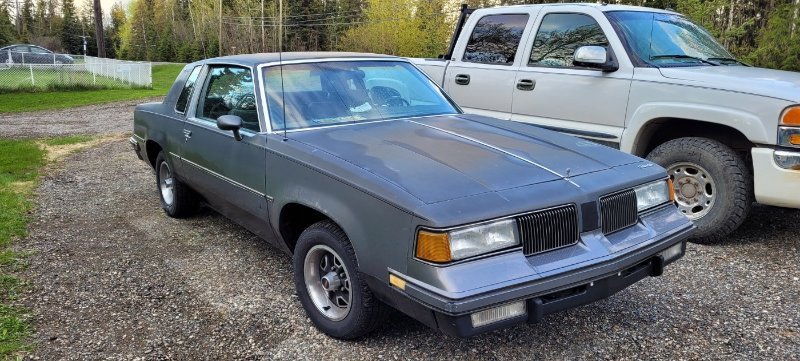
So I bought an '88 Cutlass Supreme. I used to have an '87. Nostalgia hit me. And I wanted something fun to drive for the summer, given that my Comanche won't likely get to that point with all the other things I've had going on. Originally I was eyeing up a '72 Buick Riviera, but it was $5000 more and turned out to be quite the bondo princess, then I got sad and impulse bought this instead. Plan is to do as little to it as possible. It needs some interior pieces put back in, the rear window sealed, some trim put back on, new wiper blades, and the oil changed. It looks way better in pictures than it actually is. Drives nice though.
-
Something else is wrong then. It should be just roasting them.
-
Exactly. Like I said, I think if he can get it to hook he should run a 12 flat in the quarter.
-
Locking Handle for Tailgate
DirtyComanche replied to MuchRespect's topic in MJ Tech: Modification and Repairs
Somebody definitely has. Not sure if I saw the pictures on here or ZuckerbergBook. -
I bet you got yourself a low 12 second car. In the 1/8th. Honestly, I think you should be able to do an 12 even in the quarter if you can get it to hook. I'm guessing that was the issue?
-
There's different throttle pedals that are bent differently... or they bend over time. Not sure which it is. I put one that was much higher in my XJ because it hit the floor otherwise at full throttle (floor isn't stock shape because doubler).
-
what to start with
DirtyComanche replied to williamlynch's topic in MJ Tech: Modification and Repairs
Depending what kit you get they will come with more things. Some have shocks and control arms included. Also I'd try it before changing the ujoints, unless they're already worn out, it may be totally fine with the old ones. I don't really do stockish/mild builds that often so I can't say what products are better or worse. I also can't tell you the best way to build it. My last mild build was a 3.5" lift and I was never happy with how it rode due to the control arm angles, hence the current build will be a long arm setup, but it may just be that I'm spoiled as most of the time I've gone with long arms or other major changes to improve ride quality. I would stand by the earlier comments to use Bilstein shocks for what you want to do though, there is some other options but the Bilsteins are great for a mild build. -
what to start with
DirtyComanche replied to williamlynch's topic in MJ Tech: Modification and Repairs
Yup. Ride quality has a lot to do with springs and other aspects of the suspension too. At 3" lift with short (stock style) control arms the ride isn't too bad, but it won't be as good as stock, all other things being equal. It's also going to wander on the road a bit unless you either buy adjustable/longer lower control arms, or shim you the frame side mounts (not sure if you can get enough adjustment just with shims). Also, if you have any worn components in the front suspension, you're likely to find out they're a problem once you lift it, as the lift tends to exaggerate wear issues. Likewise you may find you need to change out the u-joints in the driveshafts too, since they may have worn a set that was working fine at stock height, but now gives you some vibration. If you change one thing it inevitably affects other things. -
what to start with
DirtyComanche replied to williamlynch's topic in MJ Tech: Modification and Repairs
Is the truck stock or not? If it's lifted, what 3" lift? -
I'm in the crowd of throwing new gaskets at it and putting it back together. Those dry numbers are great. Also if the stud didn't break flush or below I'd just take it out with the welder. 10 minutes to do that if it goes well.
-
The tcase shifter being stuck in 4lo could be as simple as needing to drive it around a bit while pushing it to get it to come out, or it could need some adjustment or new bushings, or the tcase could be screwed internally. $200 or so for a used tcase and a few hours to swap it should be worst case scenario. I'd have already bought it.
-
Replaced RMS. Now oil leak really bad.
DirtyComanche replied to howeitsdone's topic in MJ Tech: Modification and Repairs
Maybe, but not likely. Rope seals were largely obsolete by the 1960s. I don't think there would be any AMC I6s that would use one and have any sort of interchangeable crank with a 4.0 based on that. -
Replaced RMS. Now oil leak really bad.
DirtyComanche replied to howeitsdone's topic in MJ Tech: Modification and Repairs
Rope seals use those, they basically pump the oil back out of the seal. As to it being right in this application I just assumed it is, as I don't recall if any of my 4.0 cranks looked like that or not, and I'm not aware of any way to add those short of a machining process with the crank out of the engine. -
Replaced RMS. Now oil leak really bad.
DirtyComanche replied to howeitsdone's topic in MJ Tech: Modification and Repairs
I'd try putting it back to stock if nothing else. There is a partial vacuum on it the way it was designed and routed into the intake. That filter *should* be okay like that but when you mod anything and there is another unexpected result, it is always good to back up a few steps and see if the modifications are causing the new issue. -
Replaced RMS. Now oil leak really bad.
DirtyComanche replied to howeitsdone's topic in MJ Tech: Modification and Repairs
Before you give up, make sure your CCV system is venting right. I toasted a 400 SBC because of that. Couldn't get the rear main to seal, tried multiple times, finally one day I ran it out of oil. Turns out it was a breather issue pressurizing the crank case. But yeah, those gashes aren't going to play will with a double lip seal, assuming they're as bad as they look.