gogmorgo
-
Posts
5984 -
Joined
-
Last visited
-
Days Won
4
Content Type
Profiles
Forums
Gallery
Everything posted by gogmorgo
-
The diffs care even less about what's in them than the engine. Go for gear oil, 75w90, 80w90, whatever. If you load up your truck frequently with heavy towing or hauling you could go for 75w140 but there shouldn't be anything wrong with the 90. If you've got a limited slip diff you'll want to add friction modifier to the gear oil, but if you've got stock diffs it's probably safe to assume they're not limited-slip. Its a good idea to pop the diff covers and dump them when you pick up a new Jeep... somehow I keep managing to buy jeeps that "haven't really been off-road" that have diffs full of water. Water isn't great for differentials, and there aren't many ways it gets in, and almost none of them involve clean water. That said, unless you see a lot of dusty environments or do a lot of water crossings, once you know it's got clean oil in it, the factory change interval is huge. Diffs are pretty simple mechanisms and don't really produce their own contaminants, unlike an engine or even transmission. Just making sure the level is fine is usually enough for street machines. As far as the rest of the fluids go, it's usually best on a new purchase to at least make sure they're all there. I like to change them out myself (see above about diffs full of water) but if your coolant is a nice bright colour and nothing looks milky or murky it's probably fine for now. Brake fluid's a big one that gets ignored a lot too. Bleeding the brakes out and replacing the fluid has been a big improvement on brakes on a few of my vehicles that have been neglected. As for other tips, there's a big thread full of them pinned to the top of this sub-forum.
-
What you're trying to acheive is having the output shaft of the transmission more or less parallel with the pinion shaft of the diff at ride height. Ideally the diff will point "down" a degree or two to make up for it torquing backwards under power. You've got custom transmission mounts and custom ride height, so no one will be able to tell you exactly what angle to run.
-
Careful when you put the valve cover back on. Torque spec for the bolts is something like 7 lb-ft which isn't all that much more than snug. You don't want to crank them down, as it'll warp your valve cover and probably cause worse leaks than you started out with.
-
This can of worms question is one you'll ask three people and get six answers, none of them incorrect. Factory called for 10w30 or 5w30 in climates that regularly see 0°F or less. Stepping up to a 5 or 10w40 may help increase oil pressure if you're seeing low pressure on the gauge, but there are slight efficiency losses because it takes more hp to pump it. I'm not as convinced a 40 will make your engine last longer than a 30 will as some people seem to be, but it's not going to hurt it to run it. Some people will recommend diesel oils as well. Engine oils have changed a bit in the last 30 years, and modern diesel oils contain ZDDP (zinc) levels that are more consistent with gasoline oils from 30 years ago, which can be beneficial to cams and lifters, and modern gasoline oils don't necessarily have the ZDDP the engine manufacturers initially wanted. Diesel oils are also much higher in detergents, so do a decent job of keeping your engine clean inside. Modern gas oils have moved away from ZDDP because it's mildly damaging to your catalytic converter, and will lead to reduced cat life, which could be a concern were e-testing is required. Synthetic or conventional is your choice. Synthetics are more expensive but the fluid properties are more consistent and the oil has a longer wear life before it breaks down. You won't kill it running conventional. Which brings me to a bigger point. What you put in it is less important than maintaining proper maintenance schedules. You can use cheap oil and filters and be fine if you're changing every 3000 miles, or you can use expensive synthetics and probably run twice that between changes without a problem.
-
I was looking at what it would cost for me to finance a TrackHawk. Only $1200 biweekly for the next eight years. No sweat sign me up
-
This has been shared here before, but this is a seriously epic project with some great metal working going on. https://www.nagca.com/forum/showthread.php?t=43454
-
2018 Toyota Sienna brake calipers
gogmorgo replied to gogmorgo's topic in MJ Tech: Modification and Repairs
Well yeah. That's kinda what I was thinking. This is the one I ordered: https://www.napacanada.com/en/p/CPR24274893S? Now looking at it I think it might be the right one after all. Er.. The left one I mean. And yeah, the Sienna callipers on RockAuto look different, but they also cross to all the other recent Toyota applications that are listed here. It's definitely odd. I'm almost tempted to order in the Toyota calliper just to see what's up. -
Yes this is an MJ-related topic despite the alarming title. I'm mostly pointing an interesting thing I discovered. So the story begins with a seized driver's side caliper on my 2wd '91. No big deal, I go to local parts store to order it, but they have a tough time tracking down the 2wd stuff they have listed. But we found something listed that we could get, except it said "front mount, if rear mount order opposite side". So I did that thinking it mounts to the rear of the knuckle. While I was at the parts store today because the guy pointed out the discrepancy between me saying driver's side and the number saying passenger, I googled the part number and the picture that comes up had the bleed screw on the wrong side, so I'm convinced I've got the wrong one, but it had a journey and was a day late so I won't know until tomorrow. But then I noticed it was listed as fitting a 2018 Sienna, which was weird enough to make me look into it. Sure enough there's a handful of new Toyotas it fits in addition to the 80's Jeep/AMC stuff, presumably for the rear brakes. As absurd as it sounds that Toyota would be repurposing an AMC-designed brake caliper, that makes far more sense of rear-mount/front-mount than rear or front side of the front axle. I guess reusing an existing design would also cut design costs... It's just strange. But hopefully it means more availability for older less-common parts. That or someone at Napa just screwed up their listings, which I find more likely. I guess I'll find out what shows up.
-
Considering buying an 88 MJ
gogmorgo replied to the hiking viking's topic in MJ Tech: Modification and Repairs
I wanna say the radio, wipers, and blower problem is likely to be related. They all feed off the same wire at the ignition switch, which, as it ages, tends to burn out contacts and wires. If you look at the master index in the DIY section, you should find yourself a pdf of the wiring diagrams to help you out. Fuel gauge is likely just a bad sending unit. -
Wheel circumference at 35" diameter is roughly 109" (in reality probably a hair less because tire diameters are nominal) 1 mile is 63,360", divided by 109" is 581 revolutions per mile. Divide mph by 60 for miles per minute, 60 mph is 1 mile/minute for easy math. 581 revolutions per mile times 1 mile per minute is 581 revolution-miles/mile-minute, which cancels to 581 rpm at the tires. (I did say easy math) A gear ratio of 4.56:1 means the driveshaft (input) turns 4.56 times for every turn of the axle (output). 581 rpm times 4.56 is 2650rpm. 2wd (and 4hi) is 1:1 on an np231 so we'll ignore the transfer case. 5th gear ratio according to Novak on an ax15 is 0.79:1. Like the axle ratio, this means the input turns 0.79 times for every turn of the output. (As an aside, this is an overdrive gear because the output turns faster than the input) 2650rpm x 0.79 is about 2090rpm. This is again at 60mph. You can swap out gear ratios and tire diameters and speeds as you will to see how the affect results. Again because tire diameters are nominal you'll probably see more rpm than that. Some manufacturers will publish actual diameters and revolutions per mile of your specific tire, but these things will change with load and tire pressure; increased load means the tire squishes outwards, reducing effective diameter, and increasing tire pressure unsquishes it, increasing effective diameter. Either way, most tires end up with effective diameters that are smaller than their nominal diameters, which will lead to increased engine rpm at the same speed over a theoretical tire where effective and nominal diameters are the same.
-
Shortbed MJ fuel tank swap?
gogmorgo replied to idahoeagle's topic in MJ Tech: Modification and Repairs
Yeah... Sounds an awful lot like what's supposed to be there isn't, and that what is there shouldn't. As for what's actually there? Could be literally anything, although from you description a shortbed MJ tank is unlikely. -
From my research into swapping out my '91's 2.5L a few months ago, it seemed pretty clear that 2.5's are all essentially interchangeable. You'd just reuse your intake and exhaust on whatever new engine if you had to. The other option no one's suggested is disassembling the engine, and if possible, just slapping new rings into it. Give the cylinders a ridge ream and dingleball hone, and call it good. Of course it is a big job, and if I had to pay a shop to do it, I would prefer to pay for a full rebuild done properly. Not the cheapest route in that case.
-
This is truth. I would take dedicated winter tires over 4x4 if presented with a choice between the two. The "all-weather" all terrains that have the mountain-snow-peak-thing rating are all pretty good choices as well, but you'll be regretting anything else the first patch of ice you hit.
-
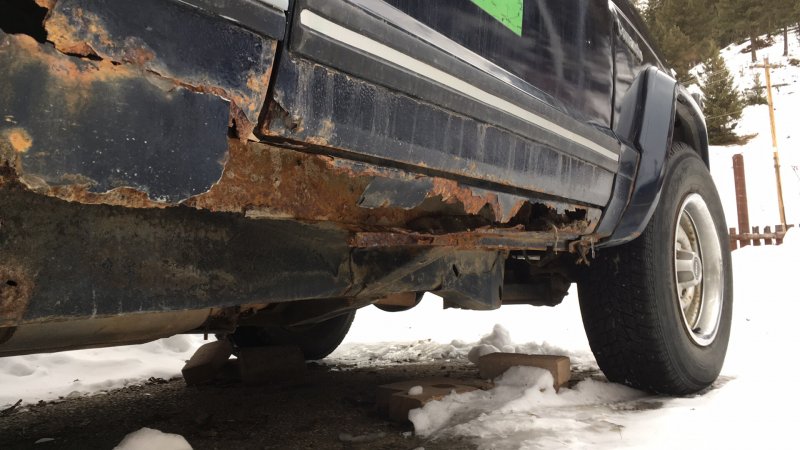
Well the snow brings up one more topic. Salt is a thing. We're not always excited about MJs seeing salt. Case in point, this is one of my rocker panels: Don't let yours get like that. I'm assuming by DT swap you mean Dana 30?
-
Engine driven air compressor questions
gogmorgo replied to ShortBox88's topic in MJ Tech: Modification and Repairs
Oh. Yes, much easier. Good to know. The earlier style is definitely better than the old v-belt technique of shoving a prybar in and pivoting the whole accessory while you crank down the mounting bolts, but it definitely isn't as accessible as a tensioner pulley. The recent ones where it's just an idler on a spring-loaded pivot are great, slip belt over most pulleys, pull the tensioner back, slip the belt on the last one, then let go, perfect tension. I usually end up leaving one of the rear bolts on my power steering pump loose because it's difficult to get tools onto. Hasn't caused me a problem yet. -
Engine driven air compressor questions
gogmorgo replied to ShortBox88's topic in MJ Tech: Modification and Repairs
What's better about the belt tensioning system? I've only ever used the earlier one. -
Looks decent to me. If you do pick it up, go to cruiser54.com and start working through the tips as you see fit. It's a great way to improve the way the truck runs and gives you confidence to do your own wrenching with small projects while helping you learn about the truck. One thing about the word "restore". We see a few people coming in saying they plan to do that, but then we see 4x4 conversions and lifts and tires and bumpers and all kinds of things that aren't restoring". "Restore" means to put it back to the way it left the factory. I was one of those people. Once you start messing with stuff, it becomes almost impossible to leave things alone... fixing what ain't broke. It's not always a bad rabbit hole, but it isn't always a hobby your neighbours and members of your household will always be on board with. Especially if you get to be like me, two unregistered 4x4s parked in the yard, the garage is full of parts jeep and other parts horde so you can't wrench in there, the sheds are full of parts, and there's a couple more Jeeps parked on the street. And I'm not even all that bad off compared to others here. It makes having to move a pain, and finding homes that work for me isn't always easy. Just something to keep in mind, figure out what your scope is and work within it.
-
2.5 gas consumption
gogmorgo replied to Victor Alejandro's topic in MJ Tech: Modification and Repairs
Man, took some work to dig this thread back up. Less than a week and it's already three pages deep. I'm currently working towards addressing my own poor fuel economy, so I figured I'd sorta document what all I'm doing. The first thing I'm working on is replacing the fuel in the tank. Just letting it burn down, I mean. It was at 3/4 tank when I bought it, and I haven't let the gauge drop past half yet. The truck was sitting not running when I bought it, and I don't really know for how long. I don't think bad gas would have a huge effect, and I've put enough into it that it should have mixed in reasonably well and be mostly new, but I'll be running some fuel system cleaner through it with the next fill, which will be below 1/4-tank on the gauge, possibly to the low fuel light... assuming it works. More importantly, I'm trying to make sure it's running at operating temp. By my temperature gauge it isn't, it's not getting much past 150°F/~80°C on the gauge. But I've got a temp sender from a YJ in it right now, and I don't know for certain it's compatible with the XJ/MJ gauge. Different part numbers and whatnot. I struck out at the local parts store on getting a new sender so I may just rob one off something else in the yard. As for everything else that could be contributing to running cool, my thermostat is newly replaced and it's definitely working (heater hoses get too hot to touch comfortably before the upper rad hose noticeably gets warmer) but I'm not sure what temperature it's opening at, just what it's supposed to be running, which is much higher than what the temp gauge ever has seen. My fan clutch also seems functional. I may swap out my temperature sensor too for the heck of it, even though I don't have any codes for it. (Or for anything else). The reason for making sure it's up to operating temperature is that if it isn't, it will stay in open loop, meaning it's running rich for warmup, and the O2 sensor is out of the loop. Other things to check for will be vacuum leaks (especially to the MAP sensor) and fuel leaks. -
It's not unusual in many contexts for vehicles left on a property to be sold with it. For example a farm sale often is not just the land and structures but the whole operation, including the junk back behind the barn.
-
I don't know what the seller sees, as I've never tried selling anything. What I do know is usually tracking info quits updating once the packages hit the shipping facility until a day or so after the packages arrive, when suddenly all the "missing" updates become visible. I've only attempted to contact the seller/eBay about it if the item hasn't arrived by the end of the window, but almost always just get an "I don't know what's going on" from the seller, eBay takes too long to respond and then says they can't do anything unless I open a dispute, and then either the package shows up within a few days or I start contacting the local couriers hunting for it. eBay themselves also aren't hands-on on the shipping, they contract it out to another company, so I don't know how much knowledge they initially have on what's going on. As for cost, I've never seen one with free shipping. Initially when they first rolled out the program, there was the shipping charge, and the there was a "brokerage" charge of $15-$50 that was a separate line item at checkout. Now there isn't a "brokerage" charge, but shipping is almost always about double or on smaller items at least $10 more than from sellers who don't use the program, which on its own is incentive to avoid them. What it costs to ship is what it costs, so I imagine most buyers just suck it up, at least the ones who are even paying attention. Especially after they rolled the shipping and "brokerage" costs together so it just looks like expensive shipping. I don't really see the advantage of including middle men for things that are both bought and sold in small quantities. It just adds complexity and there's almost no way it can reduce costs.
-
eBay global shipping sucks. 50% of the time you lose tracking once it hits their hub, and you've got no clue which service ends up with it. The seller frequently doesn't seem able or even willing to help either. See the thing I said earlier about needing to know which service sends me stuff because it's 50/50 whether it gets to me, unless it goes via mail. It also tends to double the shipping cost because it needs shipped twice, and it takes longer to get stuff. But of course the seller doesn't see the shipping costs or extra time... Classic example, back in September I ordered NOS ecodes for my ZJ. I couldn't get both from the same seller, but by coincidence the two I got shipped from the Milwaukee area. Both shipped the same day, one via global shipping, one just usps. They hit the mail at the same time, and were on the same shipment through a couple transfer facilities to Cincinnati. Then they split, regular mail to Toronto area, through customs, and I got it within a week to Fairview, AB. The global shipping program package, on the other hand, went from Cincinnati to Erlanger, KY (total distance of like, 10 miles) via Dallas and Memphis, which maybe is a fluke, but still took three days. Then it sat in Erlanger for a couple days, before going through the rest of the trip, five full business days behind the other package at double the cost, with the end result being an extra eight days before I got it... at double the cost. It also showed up with a little bit of damage because the seller just sent it loose bouncing around in the box, while the other seller took the time to open the box and add packing material, sorta irrelevant but shows they cared more about the item making it to the buyer, unlike the guy who just took the easy route out and used the shipping program. That's pretty much been my experience with the shipping program more often than not. Now I just try to avoid things that ship through it.
-
I'm not convinced any thread that RedWolf started should be considered authoritative. Maybe that's just me. This guy's built a pretty decent catalogue, however: http://colorado4wheel.com/images/jeepwheels/wheelsindex.html There are a few XJ wheels the MJ didn't get, but I'm pretty confident the only MJ-specific wheel is the Eliminator 10-hole with the "rivets". The XJ variant of that wheel was smooth, no rivets. The linked database interestingly has the Eliminator wheel pictured, but not the plain XJ variant.
-
AMC 20 rear from FSJ Wagoneer
gogmorgo replied to JolietJEEP'84's topic in MJ Tech: Modification and Repairs
2.5" could be made up with adapters to get you back to 5x4.5 lug pattern, but whether it's worth doing, I dunno. I don't think the XJ ever got the AMC 20. -
Sometimes there's an overlap in weight or size groups, where two smaller or lighter packages together will end up costing less than the big heavy one. At least I encountered that with getting Lada parts from Europe once. But yes, so far the most reliable way for me to get things shipped has been the mail. Admittedly I tend to live in pretty remote places, but I've had a few packages get started on the return trip because the courrier wouldn't bring it all the way here and didn't bother telling me or the sender that I had to go get it myself at their depot 100+ miles away. And do you think they'd ever offer to give the sender a refund if I didn't pick up on it and arrange an intercept? Ha! No.
-
2.5 gas consumption
gogmorgo replied to Victor Alejandro's topic in MJ Tech: Modification and Repairs
Seems high to me too. I've only been driving my 2.5L MJ about a month, and I've only put gas in it three times. The second time I came up with about 11.7L/100, the third time with 13.5. Probably 10-15% around town and the rest at ~100km/h on the highway ln both fills but more time sitting idle on the second tank. I don't think it's enough data points to find a trend. I don't know what your roads are like, but here I usually don't have to slow down again once I get up to speed because there's not much traffic. Having to slow down and speed up over and over really cuts into fuel economy. But we also have some pretty good hills here: