


Eagle
-
Posts
15698 -
Joined
-
Last visited
-
Days Won
27
Content Type
Profiles
Forums
Gallery
Everything posted by Eagle
-
I think you are still misunderstanding. The clutch system, like the brake system, is a hydraulic system. It works by pushing fluid from the master cylinder to the slave cylinder under pressure. Once the moving column of fluid gets to the slave cylinder, it then pushes the pistol inside the slave, and that's what pushes on the clutch to disengage it. Fluid does not compress under pressure -- so stepping on the peddle pushes a column of fluid through the clutch line. Air compresses, so if you have ANY air bubbles trapped in the line -- anywhere -- stepping on the clutch peddle only compresses the air bubble(s), it doesn't move the pistol in the slave cylinder. So ... we need to bleed the system to get the air out. If you just open the bleeder screw without moving the peddle, fluid will drip out. This is called gravity bleeding. Some people have decent results gravity bleeding brakes -- I've never had good luck with it. The hydraulic clutch seems to be more difficult to get bled well, so it's important to do it right. And to do it right, you need an assistant. Your assistant sits in the driver's seat to work the peddle. You get underneath to work the bleeder screw. It doesn't mean to depress the peddle with a stick and leave it down while you open the bleeder screw. When you are ready, have your helper SLOWLY pump the peddle up and down about three strokes while the bleeder is CLOSED. Did I say SLOWLY? Do it fast and any air in the system gets frothy -- if that happens, you'll never get it out. SLOWLY up and down for three strokes. Them, with the peddle up, you open the bleeder and tell your helper to depress the peddle. He pushes it down, SLOWLY but firmly. When it bottoms out, he holds it DOWN and tells you "DOWN." You close the bleeder. Your helper then releases the peddle, and repeats the process of depressing the peddle SLOWLY for three strokes. At the end of the third, he lets the peddle up , tells you he's ready, and you open the bleeder. Once the bleeder is open, the helper again pushes the peddle down, slowly and firmly, until it bottoms out. Then he holds it down, tells you it's down, and you close the bleeder. You keep repeating this process until you get no air from the bleeder, and only clean fluid. One of you has to check the master cylinder after every cycle or every other cycle to make certain there's fluid in the reservoir. If you let it get pumped out, you'll let air in and then you have to start over.
-
The cat doesn't mate to the tailpipe, it goes into the muffler. Don't remember for certain, but I think the bolts I used are 5/16x1.5 or 5/16x2.
-
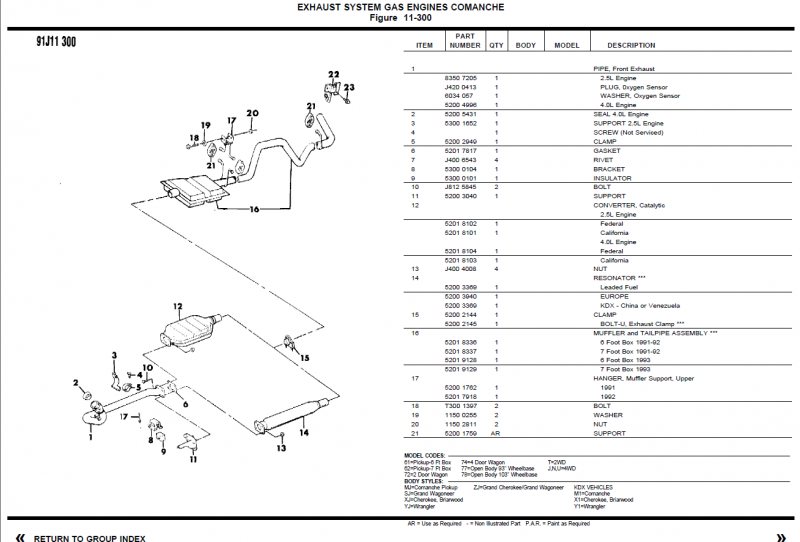
Looks like the '91 still uses the flange and gasket:
-
Does the '91 still have a flange at the front end of the catalytic converter, or is a male-female slip connection? If it's a flange, you'll need a new flange gasket, probably new bolts -- and I hope you ordered a direct-fit converter, not a universal fit.
-
Suspension Updates (Upgrades?)
Eagle replied to bigmistake's topic in MJ Tech: Modification and Repairs
Speaking from personal experience, you can do a LOT of mild -- and even moderate -- wheeling with no lift, and if most of your driving will be on pavement, the less lift the better. Especially with gas prices escalating daily. IMHO, 31s are too big to even consider under a 2.5L. The 2.5L is a good engine, but it's not a powerhouse, and 31-inch tires are really going to bog it down. You have a 5-speed? Forget about using 5th gear. Put 31s under your truck and you'll only be able to use 5th on the highway, downhill, with a tailwind. -
Not sure, but I'd guess that if someone deleted their account, the photos are gone. Mine might be visible again -- I didn't delete my account. I haven't used it since their attempted blackmail, but I left it up because I wanted to be using up space on their server.
-
Proportioning valve options
Eagle replied to Knucklehead97's topic in MJ Tech: Modification and Repairs
I suppose if the YJ valve doesn't work you could try an XJ valve, and then a ZJ valve. Where did you find the reduction rating for the YJ unit? Does that source also give the corresponding numbers for the XJ and ZJ units? My concern is that any reduction is ... a reduction. I think I've commented before that I have probably half a million miles under my tires in various XJs. I typically go through at least three sets of front pads for every set of rear shoes. That means under normal driving (which is what I mostly do these days), the rear brakes just aren't doing much work. On my '88 I had the hard line to the rear blow out, and I drove it for weeks like that. Other than the peddle being a bit lower, I didn't notice any difference in performance. It's difficult to lock up the rear brakes on an XJ -- on my '88, it's impossible, even on sand or gravel. -
I saw this announced on another site. It referred me to the Photobucket web site. On that site I found nothing to indicate a $1.99/month plan. On one page they say a plan with third party hosting is $399.99/year. On another page they say it's #39.99/month -- which comes out to 479.88/year. I agree in the skepticism regarding "For a limited time only." Thanks, but no thanks.
-
Proportioning valve options
Eagle replied to Knucklehead97's topic in MJ Tech: Modification and Repairs
Or an adjustable, and that brings us right back to the question of where to mount it. -
Proportioning valve options
Eagle replied to Knucklehead97's topic in MJ Tech: Modification and Repairs
What if (like the OP) you don't trust the factory valve or (like me) the factory valve exploded and is no longer functional? -
Yeah, but the gas mileage! To the Moon and back on one tank of gas! Beat THAT, TDI!
-
I love a story with a happy ending. Apparently the would-be perp died, either en route to the hospital or after he got there. So, no money wasted on a trial or on feeding and housing a low-life scumbag for years and years. Apparently on a number of "gun" forms the armchair experts are criticizing the woman's tactics. I saw nothing to criticize. She had the element of surprise, she took her shot (or shots) and quickly backed out of reach -- not that the perp was in any condition to want to go mano a mano with her at that point.
-
Works in Firefox.
-
Proportioning valve options
Eagle replied to Knucklehead97's topic in MJ Tech: Modification and Repairs
There is no possible setting for an adjustable that works well for both unloaded driving and heavily loaded driving. That's why the factory used the height sensing valve rather than the same proportioning valve they used in the XJ. If you run with no proportioning, you get full braking to the rear at all times. That's what I do in the red '88 MJ (the one that had the height sensing valve explode in a panic stop). Most of the time, I'm happy with the braking even when running light. But ... I learned early after eliminating the valve to be careful to avoid panic situations. A few miles from my house, there's a 4-way stop sign. Leaving home, the approach is down a fairly steep incline. I approached it one day in the rain, touched the brakes -- and found myself sitting sideways in the road. With no load in the bed, the incline took even more weight off the rear wheels and left basically no contact between the tires and the pavement. By contrast, I've found from over a half million miles in XJs that the rear brakes never wear out. I go through two or three sets of front pads before needing to replace the rear shoes. That's because the proportioning valve pretty much "proportions" the brakes so the front does all the work. I suspect the YJ proportioning valve is the same. That would work fine in an MJ when unloaded, but it won't give you good braking when heavily loaded. The best solution if you eliminate the factory height sensing valve is an adjustable proportioning valve, and locating it where you have easy access to adjust it when putting a load in the bed. -
I just use an open-end wrench. 28mm is 1.102". 1-1/8" = 1.125, so that will fit over a 28mm bar. A 1-1/16" wrench is 1.0625, so that won't fit over a 28mm but it will fit over a 26mm bar (1.024").
-
Do you understand what a differential is, and how it works? The inner axle shaft on the passenger side does NOT connect rigidly to the wheel on the driver's side. It goes through the differential -- which is not locked.
-
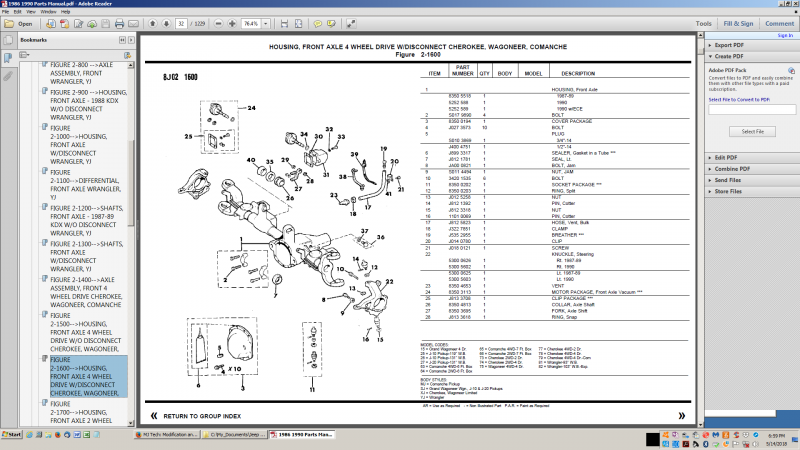
Yes ... and no. I assume you're referring to the inner axle shaft on the passenger side of the front axle. The central axle disconnect (CAD) basically works like a transmission synchronizer -- the slider is always engaged on one shaft, and the vacuum motor moves it over to engage or disengage the other shaft. But -- the front axle has an open differential, so even with the CAD engaged the front wheels won't be locked together. That said, your explanation could be a bit clearer -- there are no gears in the CAD, just two axle shafts, a sliding collar, and the vacuum motor. Let's see if this will come in:
-
That one should work, too. Dunno why, but I started with Auto Zone and I couldn't come up with anything but aftermarket senders for aftermarket temp gauges. So I jumped over to Advanced Auto.
-
No limitations. There are four diameters that were available, but they all have the same configuration and can be interchanged (subject to using the correct size bushings). Keep in mind that a larger front sway bar keeps the vehicle flatter, but it increases understeer in corners.
-
Group 58. Standard was 390 CCA, optional was 425 CCA.
-
Just the opposite. He has a temperature "sensor." He needs to replace it with a "switch" for use with the idiot light. #WT387 https://shop.advanceautoparts.com/web/PartSearchCmd?storeId=10151&catalogId=10051&langId=-1&pageId=partTypeList&actionSrc=Form&searchTerm=temperature switch%2Fsender&vehicleIdSearch=8505
-
For 1986, Selec-Trac referred to an NP 228 or NP229 transfer case that used both a lever and a separate vacuum switch to engage 4WD. The NP207 was what was called Command-Trac. It's the predecessor to the NP 231 transfer case that was used from 1987 through the end of production in the XJ and MJ. No full-time position, only 2WD-High, Neutral (which wasn't a true neutral), 4WD-High, and 4WD-Low. Shifting was done by the lever to the left of the console, Please post a photo showing the shift bezel and lever(s) on your console.
-
This. From your opening post, it sounds like you have a temperature idiot light, not a "gauge." The light should be either on or off -- it should never glow dimly.
-
I took a ride in it last night. BIG improvement -- HUGE! Like the difference between a candle lantern and a Cree LED flashlight difference.
-
Of course, as long as you leave it in 2WD you can run mismatched ratios. Most folks doing that remove the front drive shaft just to ensure that nobody accidentally engages 4WD and grenades a transfer case.