

Eagle
-
Posts
15698 -
Joined
-
Last visited
-
Days Won
27
Content Type
Profiles
Forums
Gallery
Everything posted by Eagle
-
You'll probably get better fuel economy, too. I recently did a 200 mile road trip in my 2000 XJ 5-speed. I had to keep the speed below 65 MPH due to a tire balance issue -- I got 20.4 MPG. When my '88 XJ 5-speed was a couple of years old, I once got 28 MPG on a trip from Connecticut to Vermont -- with a girlfriend, two kids, and everything that entourage required for a long weekend.
-
Yes, it does matter. At least on the Renix models. That's why the factory issued a TSB on "indexing" the distributor.
-
The distributor is driven by the camshaft. Retard the camshaft and you retard the spark. Or, at least, you retard where the distributor rotor is relative to the turrets in the cap. And don't forget that there's a distributor sensor involved as well as a CPS.
-
The problem is, without comparative dynomometer runs on the same engine and same camshaft with both chains ... how are you going to know? It's going to run. I think you'll have to have a very sensitive "seat of the pants dyno" to pick up on the difference, and if you're dropping a different engine into your truck, any perceived difference could be due to the cam timing, or to other factors. The factory did make some changes but, of course, the parts manual doesn't tell us what the differences are, only that there are different part numbers. 87-93 . . . . Chain . . . . 3300 2977 . . . . . . . . . .Sprocket . 3300 2978 94-99 . . . . Chain . . . . 5302 0444 . . . . . . . . . .Sprocket . 5302 0445 2000 . . . . Chain . . . . 5302 0444 . . . . . . . . . .Sprocket . 5301 0400 2001 . . . . Chain . . . . 5302 0444 . . . . . . . . . .Sprocket . 53010 557AA
-
I always hoped he'd still be there the next time I made a road trip to the western U.S. I guess I waited too long, and that's my loss. Jim was a great resource for the Comanche Club and he will be missed by all who knew him, whether in person or only through cyberspace.
-
That was pretty much my assessment. "Better than nothing."
-
Looking at your photo, it appears that both brake shoes have the same length lining. Usually there are two with long linings and two with shorter linings. They get paired, one long and one short per side. The short lining goes toward the front of the vehicle.
-
The solenoids are the key. Back in the days of the old XJ Forum (the predecessor of NAXJA) there was a member named (IIRC) Frank Swigert who had an XJ 4.9L engine and AW4 transmission in a Hornet station wagon. He had the tranny wired up to a 6-position rotary switch so he could control shifting manually just by turning the knob. Once he had it in overdrive (4th gear), the next step on the knob locked the torque converter. That's why the FSM for the AW4 starts out by having you pull the fuse for the TCU and test drive by shifting manually. If that works, the tranny works, and you look for electrical problems.
-
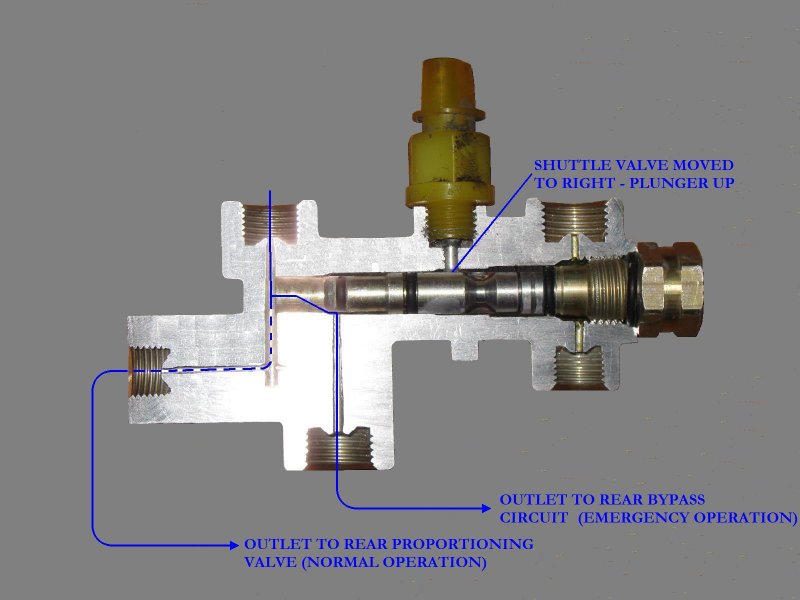
No, the peddle doesn't stay depressed ... but the front bleed screw remains open. Obviously, if you're bleeding the traditional way (by having one person open and close the bleeder while a second person alternately depresses and releases the brake peddle) the peddle can't stay depressed. The purpose of opening a front bleed screw is only to simulate a failure of the front brake circuit (loss of pressure) and to trip the shuttle valve. If the shuttle valve doesn't move, the bypass circuit doesn't open and you can't bleed the bypass circuit.
-
Not certain, but I don't think the vacuum pump can bleed the bypass circuit. The reason for the special procedure is that the MJ has two brake lines to the rear. The primary goes through the rear load/height sensing proportioning valve. The secondary line is a bypass, so that if you lose the front brakes you'll get full braking to the rear, not "proportioned" braking. The bypass circuit isn't open unless the shuttle valve in the front distribution block has been tripped. That's why the FSM calls for opening a front bleeder and stepping on the brakes. The idea is to simulate a front brake circuit failure. If you didn't step on the brakes hard enough with the bleeder open, perhaps you didn't trip the shuttle valve. Also, the fact that your brake warning light on the dash illuminates doesn't mean the switch at the distribution block is working. Here's what the distribution block looks like, with the bypass circuit opened by tripping the shuttle valve: That pastic thingie on top is the switch that activates the warning light. Normally the plunger rests in that notch, which is the OFF position. When it moves to either side (depending on whether the front or rear circuit fails), the plunger is pushed up and the light goes on. If you didn't trip the plunger, the bypass circuit would be closed and the suction bleeder wouldn't pull anything through the bypass circuit. Even with the plunger tripped, I don't know how effectively the vacuum bleeder would get the bypass circuit, since the primary circuit is also open. I use a vacuum bleeder on XJs, buty I still use the foot pedal when bleeding MJs.
-
Shifting is controlled by solenoids. If it shifts manually, the transmission isn't the problem. I don't know how to check out the solenoids, but that's where I would look next.
-
Shift points for XJ auto? Too low rpm
Eagle replied to rynoshark's topic in MJ Tech: Modification and Repairs
You can't run a 91 ECU in a Renix (87-90) MJ. They are totally incompatible. -
Don't. My '88 had one when I bought the truck. I don't know the brand, but the support slats/hoops look a lot like the ones in Limeyjeeper's photo. It was useless. The snaps didn't hold it because the Naugahyde cover had shrunk. Any time I drive more than 40 MPH the thing would start to peel off. I gave up on it. If I were going to get a cover for one of mine, I'd go for one of the hard covers.
-
And this is why I said there's no consensus on what actually causes death wobble. I've driven for periods of six months or more with a VERY loose, sloppy track bar when it was too cold and snowy to think about changing it. Sloppy steering, but not a hint of death wobble. No matter how much I think about it, I keep coming back to the fact that a rolling tire is a gyroscope. There's simple no way that loose steering components can cause death wobble. My belief is that it's usually tire balance that causes it. Ultimately, you have to check everything and just keep eliminating possible causes until you hit the one that works.
-
That's death wobble. There is no consensus as to what causes it, unfortunately, so you'll have to do some sleuthing. Is this a new phenomenon? How long have you had the truck and how many miles have you driven it? What has changed? New tires? Different alignment? Lift? ???
-
I have a suggestion that would be considerably less expensive than having a new set of springs shipped to Mexico from the U.S. If you have looked through any of the many discussions about springs and lifts, you must have encountered the term "bastard pack." That refers to keeping the original main leaf in the vehicle and installing other leaves from another vehicle (or other vehicles) to make up the rest of the spring pack. You can buy a decent, full-length add-a-leaf (AAL) from Rancho for around $75 U.S. dollars. Rancho says it provides 2-1/2" of lift for both the XJ and the MJ, but that's impossible. A long time ago I called Rancho and spoke with one of their engineers, who checked with another engineer, and then came back on the phone with me to say that in an MJ it should provide maybe 1-1/2 inches 37-38mm) of lift. So that's one solution. The solution I'm waiting to try out on the '88 2WD 4-cylinder I picked up awhile back involves doing an odd bastard pack. If you use additional leaves from the same vehicle type, you get lift. For example, a common "budget boost" for the XJ is to get another set of XJ springs, take them apart, cut the eyes off the main leaves, and use those as AALs. This generally gives you 1-1/2" of lift. The same thing will happen if you add in extra leaves from another MJ. But -- what if you want to add capacity without adding lift? Then you want to add a leaf that has some arch to it, but that in it's free state is arched basically the same as the springs in your vehicle when it's unloaded. So -- there must be a lot of junked Cherokees in Mexico -- I know when my wife and I used to visit her family in Chile we saw XJs everywhere. The XJ springs have less arch than MJ springs, because they are set up for spring over axle. So my idea is to take a pair of old XJ springs, pull out the main leaves, cut off the eyes, and use those as full-length AALs in the MJ pack. (I believe you also have to drill out the center hole to the next larger size.) If it works the way I think it will, you'll get a 25% to 33% increase in capacity with little or no lift.
-
The track bar is the FIRST thing I look at if the steering gets loosey-goosey.
-
Maybe at one time there was an aftermarket tachometer?
-
Yes, the side markers blink alternately from the turn signals. All bulbs light, including the side markers. The odd part is that the 2000 XJ doesn't have the old-style flasher units we're accustomed to with the MJs. It uses a combination electronic flasher that does turns and hazards all in one -- and costs $25 or more (the last time I bought one for my late wife's XJ, which was several years ago). I didn't think those were load sensitive. The other XJ has a trailer package, but there doesn't appear to be a separate part number for the flasher module with trailer tow.
-
I'm usually pretty good with electrical (not "electronic") issues, but I've encountered something that has me stumped. My beautiful, low-miles 2000 Cherokee 5-speed was in an accident awhile back. Collision damage was repaired properly, but the insurance didn't cover fixing the ruptured brake lines that actually caused the accident. I finally got around to doing that, using copper-nickel (cunifer) line and silicone brake fluid, so I hope not to have a repeat performance. Now that it's back on the road, there's an anomaly. Right turn signals blink at the normal rate. Left turn signals blink at the normal rate when the headlights are off, but when the headlights are on, they blink faster. No bulbs burned out. Any ideas?
-
What do you mean by "improve the front end performance"? Do you want tighter, stronger, more precise, more/less steering wheel effort? There are lots of ways to change the steering, but some of them may not accomplish whatever it is you're looking for.
-
Be advised that if you have the rear height-sensing proportioning valve, there are two brake lines to the rear. One is an emergency bypass line, it is NOT a "brake return line" (which you will see it called if you look long enough). There is a special, non-typical procedure for bleeding the rear brakes when you have that rear height-sensing valve. It has been posted here, several times.
-
Pricing help on black interior parts?
Eagle replied to junkdealz's topic in MJ Tech: Modification and Repairs
Pete, thanks for locking this. Just to add - The discussion forum areas, regardless of whether it's The Pub, Modifications and Repairs, Epic Journeys, or DIY Write-Ups, are not for use for selling parts (or anything). That's why we have a Classifieds area. And we have the rule about a minimum number of posts before people can use the classifieds for a reason. If you look through the classifieds, there are a lot of "PM Sent" posts. Use the Classified threads to advertise your stuff, and to ask questions if a description isn't clear. Negotiations (offers to buy, counter-offers, etc) should be done back-channel, via PM (Private Message). We don't want/need a bidding war in every For sale thread. Comanche Club isn't an auction site, so let's not go there. -
Info in 2.5 evolution and revisions
Eagle replied to omega_rugal's topic in MJ Tech: Modification and Repairs
Omega gave us data for the 4.0L. He asked for comparable data for the 2.5L. I gave him a head start. -
Info in 2.5 evolution and revisions
Eagle replied to omega_rugal's topic in MJ Tech: Modification and Repairs
1984-85 ... XJ: 105 hp at 5,000 RPM, 132 ft-lb at 2800 RPM 1986 ...... XJ/MJ: 117 hp at 5,000 RPM, 135 ft-lb at 3,500 RPM 1987-90 ... XJ/MJ: 121 HP at 5,250 RPM, 141 ft-lb at 3,250 RPM 1991-2000 XJ/MJ: 130 hp at 5,250 RPM, 150 ft-lb at 3,250 RPM.